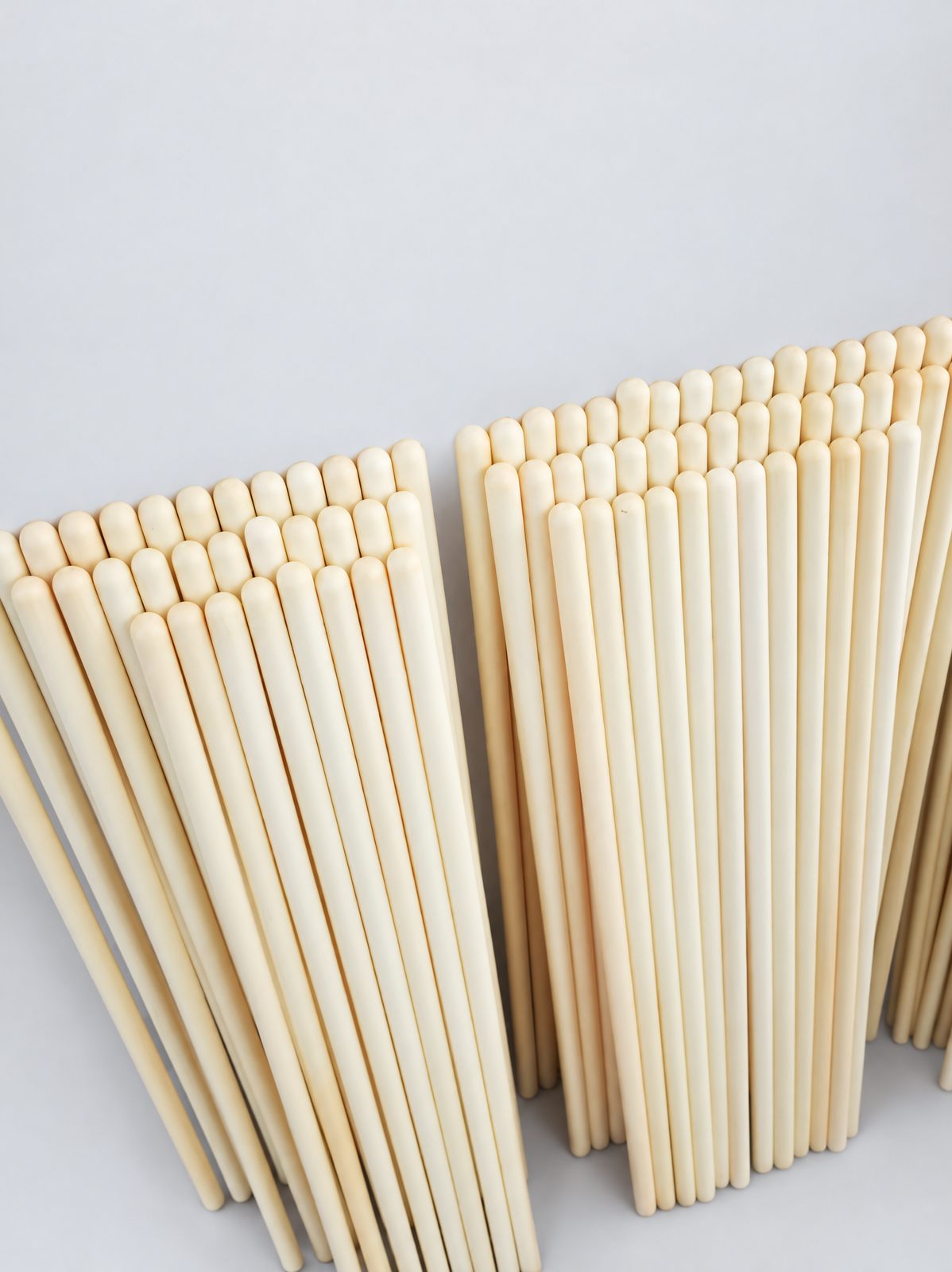
Alumina melts at 2,054 °C, but parts are rated far lower. A high-purity (C 799) thermocouple protection tube is rated 1,600 °C continuous; the same material as a furnace work tube is rated up to 1,800 °C in air, and only 1,400–1,500 °C under vacuum. Lower-purity alumina and mullite stop at 1,200–1,500 °C.
So when two suppliers quote 1,600 and 1,800 °C for what looks like the same tube, both can be right. The number depends on the purity, on whether the part carries load or vacuum, how fast it is heated, and what touches it. Below are the published limits with the source next to each, then what brings them down.
High-purity alumina: the limit depends on the job
| Use | Max. temperature (°C) | Source |
|---|---|---|
| Melting point of aluminium oxide | 2,054 | ILO/WHO ICSC 0351 |
| Material working temperature (>99.7% Al₂O₃) | up to 1,800 | Morgan Haldenwanger |
| Load-bearing elements, approximate | 1,800 | Morgan Haldenwanger |
| Furnace work tube in air | 1,800 | Nabertherm; MTI |
| Unsupported tube starts to sag | 1,600 | Sentro Tech (99.5% and 99.8%) |
| Thermocouple protection tube, continuous | 1,600 | DIN 43724 table (Morgan); WIKA |
| Protection tube with alkali vapour or melting glass | 1,500 | DIN 43724 guideline (Morgan) |
| Furnace work tube under vacuum | 1,400–1,500 | Nabertherm; MTI |
Read the table from the top down as the job gets harder. The material itself is good to about 1,800 °C. A thin protection tube that is pushed into a hot furnace, held at one end and expected to stay straight and gas-tight for months is rated 1,600 °C. Add vacuum, and the tube has to carry atmospheric pressure while it is soft, so the limit drops again.
Limits by grade: C 799, C 795, C 786 and mullite
Purity matters. In the DIN EN 60672 classes the limit falls as the Al₂O₃ content drops:
| Class | Material | Al₂O₃ (%) | Max. use temperature (°C) |
|---|---|---|---|
| C 610 | Mullite | 50–65 | 1200 |
| C 620 | Mullite | 65–80 | 1200 |
| C 780 | Alumina | 80–86 | 1200–1400 |
| C 786 | Alumina | 86–95 | 1400 |
| C 795 | Alumina | 95–99 | 1400–1500 |
| C 799 | Alumina | >99 | 1400–1700 |
Protection-tube tables are more specific. The DIN 43724 sheath-tube table reproduced by Morgan Haldenwanger gives the maximum permissible continuous temperature and a thermal-shock rating for each class:
| Class | Material | Max. continuous (°C) | Thermal shock resistance |
|---|---|---|---|
| C 799 | High-purity alumina, gas-tight | 1,600 | medium |
| C 610 | Mullite (aluminium silicate), gas-tight | 1,400 | medium to good |
| C 530 | Aluminium silicate, porous | 1,350 | very good |
WIKA rates the same classes slightly differently: C 799 up to 1,600 °C, C 610 up to 1,500 °C and porous C 530 up to 1,600 °C as an outer tube over a gas-tight inner one. The order is the same everywhere: gas-tight high-purity alumina has the highest limit and the lowest thermal shock resistance. C 610 sits at 1,200 °C in the class table and 1,400 °C in the sheath-tube table.
What lowers the limit
- Vacuum. Nabertherm allows C 799 work tubes 1,800 °C in air but 1,400 °C under vacuum; MTI says alumina softens above 1,500 °C and vacuum above that can collapse the tube.
- Load and span. An unsupported horizontal tube sags at around 1,600 °C in Sentro Tech's test. WIKA advises extra support for horizontal C 799 protection tubes. Long dwells above about 1,500 °C need support along the length.
- Fast heating. High-purity alumina has the poorest thermal shock resistance of the three classes. Carbolite Gero limits ceramic work tubes to 5 °C/min, and gives 400 ÷ inner diameter (mm) as the maximum rate in °C/min. WIKA says C 799 protection tubes must be pre-heated and inserted slowly.
- Alkali and glass. The DIN 43724 guideline in Morgan's brochure gives C 799 only 1,500 °C in contact with alkali vapours or melting glass, against 1,600 °C in clean conditions. WIKA lists C 799 and C 610 as not resistant to alkali vapours.
- Platinum thermocouples. Here the limit is set by the wire, not the tube. Above 1,200 °C WIKA recommends gas-tight, high-purity C 799 to keep the platinum from being poisoned. See thermocouple types and temperature ranges.
Alumina crucibles
A crucible is the same ceramic as a tube, so the grade limits above apply. Two things are different. A crucible doesn't carry vacuum or a long span, so sag is rarely the limit. But it holds the melt or powder, and what's inside can attack the alumina at temperatures well below its rating, as the 1,500 °C guideline for C 799 in melting glass shows.
Our crucibles, boats and lids come in 99%, 99.5% and 99.7% Al₂O₃, from 0.5 to 1500 ml. Our material table gives corundum (99% and up) 1600–1800 °C working temperature and high-alumina ceramic (>85% Al₂O₃) 1300–1450 °C. We confirm the limit for each part, so tell us what goes in the crucible, the peak temperature, the atmosphere and how fast you heat and cool. All sizes are on the crucibles and boats page.
Our grades and sizes
Our standard grade is 99.5% Al₂O₃, comparable to C 799; 99.7%, 99% and 95% are available, and high-alumina ceramic (>85%) for lower temperatures. We state the maximum temperature per part rather than one number for everything: not every corundum part is rated to 1800 °C.
| Material | Al₂O₃ (%) | Working temperature (°C) |
|---|---|---|
| Corundum (high-purity alumina) | 99, 99.5 (standard), 99.7; 95 available | 1600–1800 |
| High-alumina ceramic | >85 | 1300–1450 |
Protection tubes come in OD 6–40 mm, including the European sizes 10×6, 15×10 and 24×18 mm; furnace tubes in OD 30–100 mm. Standard sizes are usually in stock and ship in about 3 days for a small order, about 7 for a bulk one; lengths are cut to order. See the protection tubes and furnace tubes pages, and for furnace work tubes alumina vs quartz.
For a quotation, send the size, the peak and the continuous temperature, the atmosphere (air, vacuum, reducing, alkali or glass), how the part is mounted, your heating rate and the quantity. We'll tell you which grade we'd use and what we can promise for it.
Questions buyers ask
- What is the melting point of alumina?
- 2,054 °C, according to the ILO/WHO International Chemical Safety Card for aluminium oxide. Service ratings are much lower: the highest we found published for high-purity alumina tubes is 1,800 °C, in air.
- What is the maximum temperature of an alumina protection tube?
- 1,600 °C for a high-purity (C 799) thermocouple protection tube. That is the maximum permissible continuous temperature in the DIN 43724 sheath-tube table reproduced by Morgan Haldenwanger, and WIKA also rates C 799 tubes up to 1,600 °C. Mullite (C 610) tubes are rated 1,400 °C in the same table.
- Why do some suppliers quote 1,800 °C for alumina tubes?
- 1,800 °C is the figure for high-purity alumina work tubes in a furnace, in air, heated slowly and supported. Nabertherm and MTI both give 1,800 °C for alumina work tubes, and Morgan gives 1,800 °C as the working temperature of its 99.7% material. Under vacuum the same tubes are limited to 1,400–1,500 °C.
- What is the maximum temperature of an alumina crucible?
- It depends on the purity and on what's inside. Our material table gives 1,600–1,800 °C working temperature for corundum (99% Al₂O₃ and up) and 1,300–1,450 °C for high-alumina ceramic (>85%), and we confirm the limit per part. Melts and vapours can lower it: the DIN 43724 guideline puts C 799 at 1,500 °C in contact with melting glass or alkali vapours.
- Can alumina be used under vacuum at 1,600 °C?
- Not as a work tube carrying atmospheric pressure. Nabertherm limits C 799 work tubes to 1,400 °C under vacuum and MTI to 1,500 °C, because alumina starts to soften and the tube can collapse.
Sources
- ILO/WHO International Chemical Safety Card 0351: aluminium oxide (melting point)
- Morgan Advanced Materials Haldenwanger: Ceramic tubes brochure (working temperatures; DIN 43724 sheath tube table, pages 12–13)
- Brevier Technische Keramik (Verband der Keramischen Industrie), Table 41: properties by DIN EN 60672 class
- WIKA data sheet TE 65.80, thermocouples with ceramic protection tube
- Nabertherm: Laboratory Furnaces catalogue, working tubes table (pages 56–57)
- MTI Corporation: setup and use tips for tubes and vacuum flanges
- Sentro Tech: alumina tubes (sag temperature)
- Carbolite Gero: TF tube furnace range data sheet
- Carbolite Gero: TZF 12/38/850 operating instructions, section 4.6 (ceramic work tubes), from carbolite.com downloads
- DIN Media: DIN 43724, withdrawn (DIN EN 50446 recommended)
- Our own figures: the factory's standard-size list, 2026 orders and test report, as recorded in our product catalog.