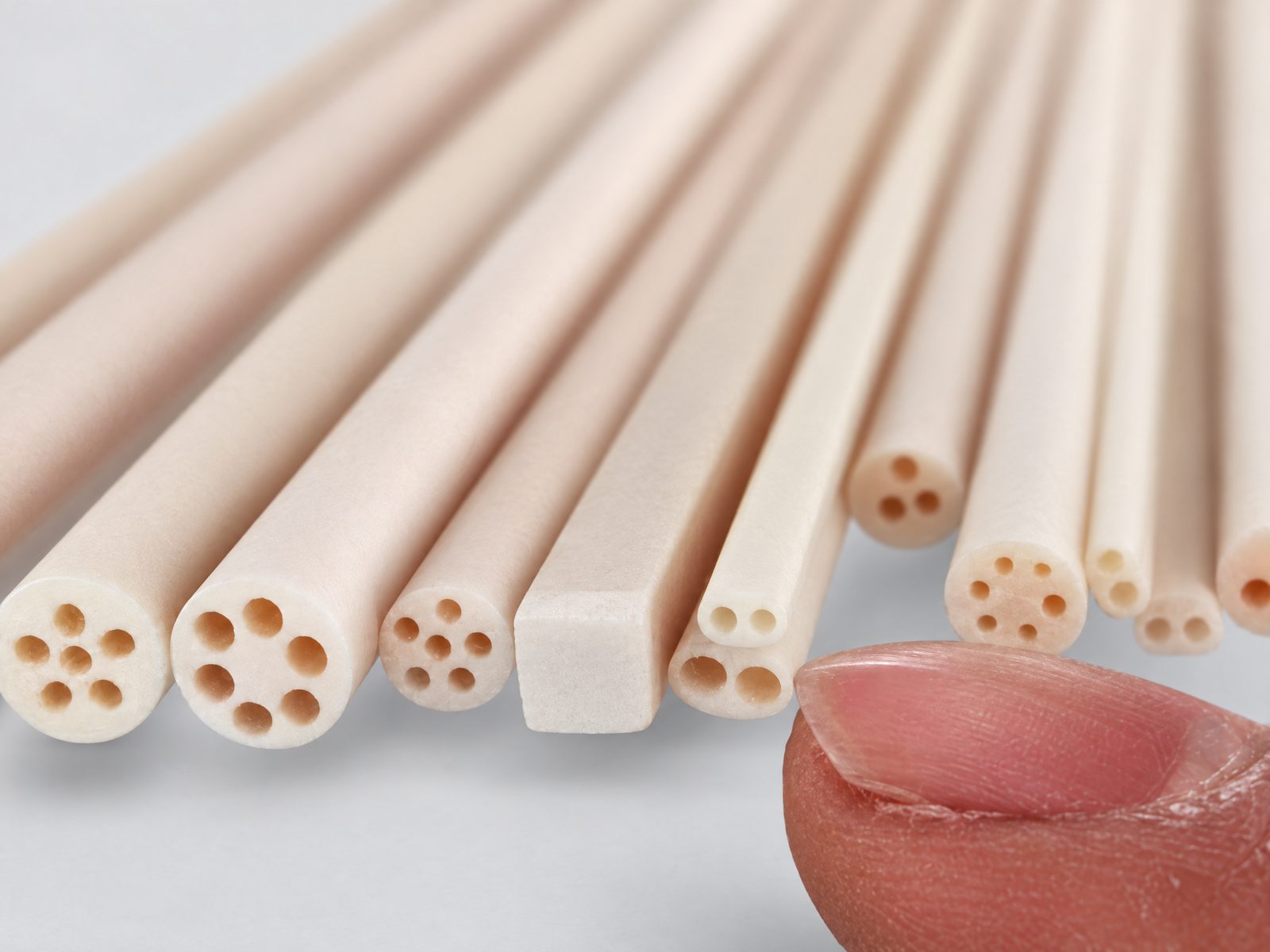
The bore has to be bigger than the wire, with room for the bore tolerance. Our standard twin-bore insulators have bores from 0.5 to 1.8 mm, four-bore from 0.4 to 1.6 mm, which takes noble-metal wire (0.35 and 0.5 mm) and, in twin-bore, base-metal wire up to 1.38 mm with at least 0.3 mm to spare. For 2 or 3 mm base-metal wire you need a single-bore tube per leg or a larger insulator made to drawing.
The table below takes the wire sizes WIKA, Rössel and ASTM list, plus three that buyers named on our own orders this year, and gives the smallest standard size of ours each one passes through.
Insulator size by wire diameter
| Wire Ø (mm) | Where this wire size comes from | Twin-bore, OD × bore | Four-bore, OD × bore | Single-bore, OD × bore |
|---|---|---|---|---|
| 0.25 | 30 AWG | 3×0.8 (0.55) | 3×0.6 (0.35) | 2×1 (0.75) |
| 0.33 | 28 AWG | 3×0.8 (0.47) | 4×1 (0.67) | 2×1 (0.67) |
| 0.35 | S, R, B (WIKA, Rössel) | 3×0.8 (0.45) | 4×1 (0.65) | 2×1 (0.65) |
| 0.5 | S, R, B (WIKA, Rössel) | 3×0.8 (0.3) | 4×1 (0.5) | 2×1 (0.5) |
| 0.51 | 24 AWG | 4×1 (0.49) | 4×1 (0.49) | 2×1 (0.49) |
| 0.6 | Named on our 2026 orders | 4×1 (0.4) | 4×1 (0.4) | 2×1 (0.4) |
| 0.8 | Named on our 2026 orders | 5×1.2 (0.4) | 5×1.2 (0.4) | 3×2 (1.2) |
| 0.81 | 20 AWG | 5×1.2 (0.39) | 5×1.2 (0.39) | 3×2 (1.19) |
| 0.9 | Named on our 2026 orders | 5×1.2 (0.3) | 5×1.2 (0.3) | 3×2 (1.1) |
| 1 | K, N, J (WIKA); base metal (Rössel) | 6×1.4 (0.4) | 6×1.3 (0.3) | 3×2 (1) |
| 1.38 | Base metal (Rössel) | 8×1.8 (0.42) | 8×1.6 (0.22, tight) | 3×2 (0.62) |
| 1.63 | 14 AWG | 8×1.8 (0.17, tight) | – | 3×2 (0.37) |
| 2 | Base metal (Rössel) | – | – | 4×2.5 (0.5) |
| 3 | K, N, J (WIKA); base metal (Rössel) | – | – | 6×4 (1) |
| 3.25 | 8 AWG | – | – | 6×4 (0.75) |
Where a cell says tight, a bore at the low end of its tolerance could grip the wire. Either go one size up, or write the wire on the order and let us check it. Some buyers already do: instead of a bore tolerance, their 2026 orders named the wire that has to pass through the bores (0.6, 0.8, 0.9 mm). If fit is what you care about, that is the clearer way to write it.
For wire thicker than 1.8 mm the standard list only has single-bore tubes, one per leg. Larger twin-bore insulators, other layouts up to 7 bores and flat twin-bore insulators are made to drawing.
AWG sizes in millimetres
ASTM E230, the US thermocouple standard, sizes wire by AWG gauge. It lists six gauges in its table of suggested upper temperature limits for protected thermocouples (in closed-end protection tubes). Thinner wire gets a lower limit: for types K and N, 1,260 °C at 8 AWG against 870 °C at 24 AWG.
| AWG | Wire Ø (mm) | K and N, suggested upper limit (°C) |
|---|---|---|
| 8 | 3.25 | 1260 |
| 14 | 1.63 | 1090 |
| 20 | 0.81 | 980 |
| 24 | 0.51 | 870 |
| 28 | 0.33 | 870 |
| 30 | 0.25 | 760 |
So the temperature you need decides the wire, and the wire decides the bore. A type K probe in 8 AWG wire (3.25 mm) is past our standard twin-bore list; the same probe in 20 AWG (0.81 mm) fits our twin-bore 5×1.2 with 0.39 mm to spare.
Which grade for the insulator
Rössel's handbook puts base-metal thermocouples in C 610 insulating rods and noble-metal ones in C 799. JUMO goes further for platinum thermocouples: both the insulating rod and the protection tube must be its KER 710 grade, because in a reducing atmosphere as little as 0.2% SiO₂ in the ceramic can form brittle platinum silicides. What the class numbers mean is in C 799, C 610 and C 530.
We quote insulators by Al₂O₃ content: 99.5% (C799-class) as standard, or 99.7%, 99% or 95%. Tell us the thermocouple type and the quotation confirms the grade.
Our standard insulator sizes and the tubes they fit
Every size below has its own page with a drawing. The last column is the smallest of our standard protection tubes the insulator goes into, with at least 1 mm between insulator OD and tube ID.
| Bores | OD × bore (mm) | Fits our protection tube |
|---|---|---|
| 1 | 2×1 | 6×4 |
| 1 | 3×2 | 6×4 |
| 1 | 4×2.5 | 8×5 |
| 1 | 5×3 | 10×6 |
| 1 | 6×4 | 10×7 |
| 1 | 8×5 | 15×10 |
| 1 | 10×4 | 15×11 |
| 1 | 12×7 | 20×15 |
| 2 | 2×0.5 | 6×4 |
| 2 | 3×0.8 | 6×4 |
| 2 | 4×1 | 8×5 |
| 2 | 5×1.2 | 10×6 |
| 2 | 6×1.4 | 10×7 |
| 2 | 8×1.8 | 15×10 |
| 4 | 2×0.4 | 6×4 |
| 4 | 3×0.6 | 6×4 |
| 4 | 4×1 | 8×5 |
| 4 | 5×1.2 | 10×6 |
| 4 | 6×1.3 | 10×7 |
| 4 | 8×1.6 | 15×10 |
What to send for a quotation
- Wire diameter and thermocouple type.
- Number of bores, OD and length. If you don't have a size yet, the wire and the protection tube ID are enough to start.
- The wire that must pass through the bores, or a bore tolerance.
- Quantity and how often you reorder.
Standard sizes usually ship in about 3 days for small orders and about 7 days for bulk. Other sizes are made to drawing, usually in 25–30 days, from 100 pieces. See the insulator page for photos and bore layouts, or request a quote.
Sources
- WIKA data sheet TE 65.80, thermocouples with ceramic protection tube
- Rössel-Messtechnik, Praxis der Thermoelemente (German), Table 9 and insulating rods
- JUMO data sheet 90.1000 (German), KER 710 and KER 610
- Tempco catalog page 14-103: ASTM E230 suggested upper temperature limits for protected thermocouples, by wire gauge
- Our own figures: the factory's standard-size list, 2026 orders and test report, as recorded in our product catalog.