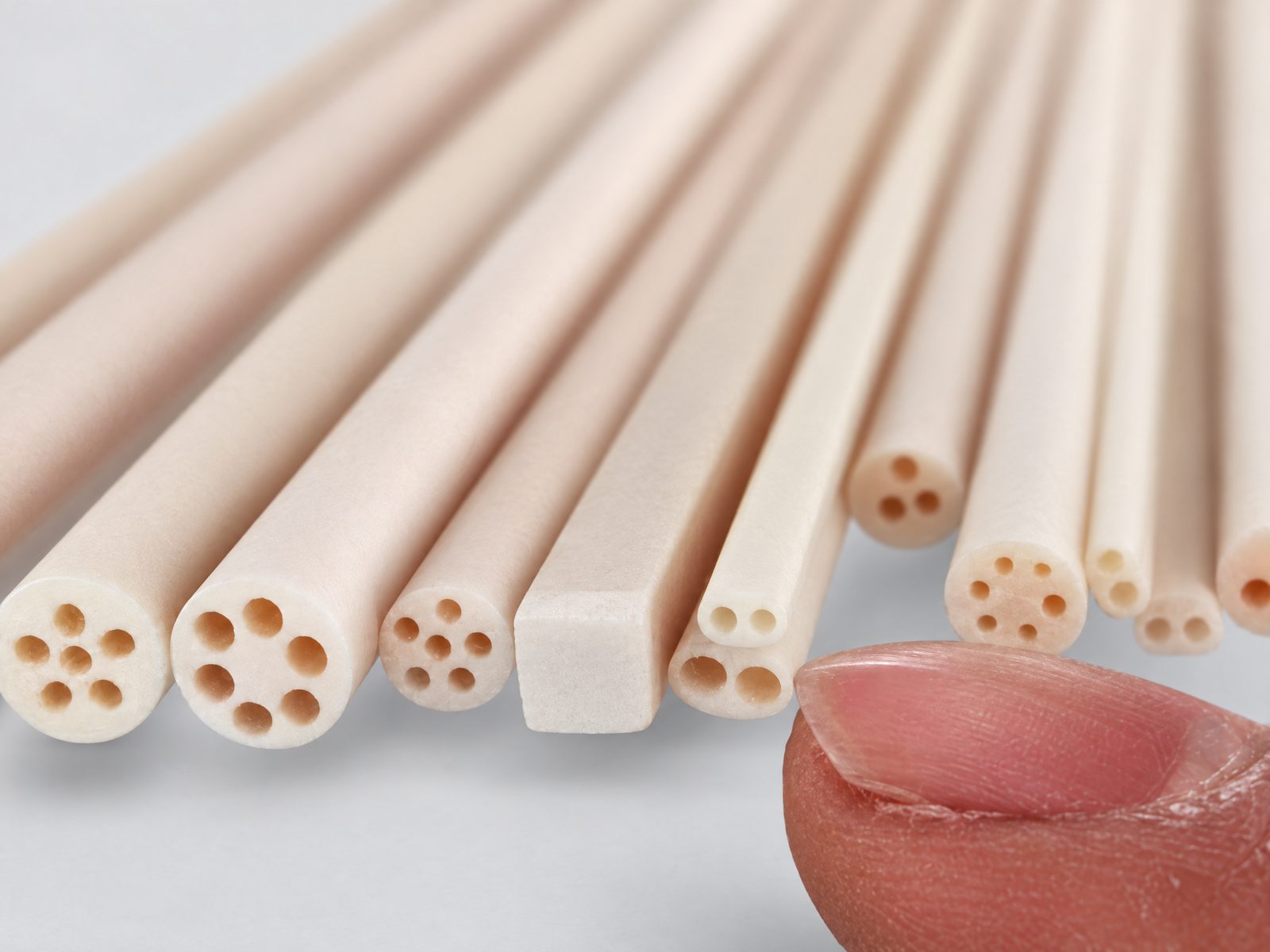
Alumina purity does not give you a unique density or strength. For example, CoorsTek lists 3.90 g/cm³ for its 99.5% AD-995, while Precision Ceramics lists 3.95 g/cm³ for its 99.7% grade. These are values for named materials. Our 99–99.5% brochure data are grouped by forming method, with bulk density from 3.65 to 3.9 g/cm³.
For a protection tube or insulator, specify the Al₂O₃ grade and the properties the assembly needs. A purity percentage on its own cannot confirm the fit, operating temperature or electrical performance.
Alumina density in g/cm³ and kg/m³
Multiply g/cm³ by 1,000 to get kg/m³: 3.90 g/cm³ is 3,900 kg/m³. Keep the density from the actual material data sheet when estimating a part’s weight. Do not substitute a value for fully dense material for a different ceramic body.
| Forming method | Bulk density (g/cm³) | Converted density (kg/m³) |
|---|---|---|
| Slip cast | 3.7–3.9 | 3,700–3,900 |
| Pressed or extruded | 3.65–3.8 | 3,650–3,800 |
| Hot pressed | 3.7–3.85 | 3,700–3,850 |
Our materials page carries the full GY table, including water absorption and room-temperature rupture strength. For a contractual data sheet, agree the grade, forming method and required test values for the part.
Published properties of named alumina grades
| Manufacturer / grade | Al₂O₃ | Density (g/cm³) | Thermal conductivity (W/m·K) | Flexural strength (MPa) |
|---|---|---|---|---|
| CoorsTek AD-96 | 96% nominal | 3.72 | 24.7 at 20 °C | 343; four-point, 20 °C |
| CoorsTek AD-995 | 99.5% nominal | 3.90 | 30.0 at 20 °C | 300; four-point, 20 °C |
| Precision Ceramics CeramAlox 99.7 | 99.7% | 3.95 | 33 at 25 °C | 250–350 at 25 °C; configuration not stated |
The CoorsTek rows show why purity alone is a poor strength selector: the 96% material has the higher listed four-point flexural strength, while the 99.5% material has the higher conductivity. Precision Ceramics also warns that its test-sample values vary with the finished component’s shape and size.
Room-temperature electrical data need the same care. CoorsTek’s AD-995 resistivity falls from over 10¹⁴ Ω·cm at 25 °C to 2×10⁶ Ω·cm at 1,000 °C. For a hot insulator, request data at the operating temperature.
What we can state for our 95%, 99%, 99.5% and 99.7% grades
| Grade | Availability | Property evidence |
|---|---|---|
| 95% Al₂O₃ | Available | Confirmed per part; the 99–99.5% brochure values do not apply automatically. |
| 99% Al₂O₃ | Available | Included in the 99–99.5% brochure group, with values by forming method. |
| 99.5% Al₂O₃ | Standard, C799-class | Included in the brochure group. Yearly sample chemistry reports are available on request. |
| 99.7% Al₂O₃ | On request | Properties confirmed per part; do not use another supplier’s 99.7% data as ours. |
C 799 is a material class, not another way to write 99.7%. The classification includes more than 99% Al₂O₃ and other requirements. We use “C799-class” for our standard 99.5% material; that does not claim certified conformity. The C 799, C 610 and C 530 comparison explains the classes and old KER names.
Our annual chemistry report represents one sample, not every shipped piece. If the drawing calls for a guaranteed composition or a particular property test, put that requirement on the enquiry before selecting a grade.
Specify the property that matters to the assembly
- For protection tubes, give the atmosphere, immersion depth, working temperature and heating cycle. See the temperature limits by use; a material rating is not automatically a complete tube assembly rating.
- For insulators, give the wire diameter, bore count and operating temperature. Compare nominal sizes, then check maximum insulator OD against minimum tube ID, including the tolerances on the drawing.
- For furnace tubes, specify the span, supports, atmosphere and whether vacuum or pressure is involved. A higher-purity label alone does not establish suitability.
- For crucibles, state the contents, temperature and cycle. Capacity and outer dimensions both matter when matching an existing holder or furnace.
Estimate the weight of a straight, open-ended tube
With all dimensions in mm and density ρ in g/cm³, the calculated mass in grams is π × (OD² − ID²) × length × ρ ÷ 4,000. This is the annular volume converted to cm³, multiplied by density.
For example, an open-ended 30×20 mm tube, 1,000 mm long, has a calculated volume of about 392.7 cm³. Using our pressed/extruded brochure range of 3.65–3.8 g/cm³ gives about 1.43–1.49 kg. This is an estimate from nominal dimensions, not a measured shipping weight. Closed ends, slots, holes, dimensional tolerances and packing change the result.
Open-ended tube weight calculator
Estimate ceramic mass from nominal dimensions and GY Alumina’s typical 99–99.5% brochure density ranges. This does not establish the part’s grade, forming method or shipping weight.
- Calculated ceramic volume per tube
- 392.7 cm³
- Estimated ceramic mass per tube
- 1.433–1.492 kg
- Estimated ceramic mass, all tubes
- 1.433–1.492 kg
For a straight open-ended tube. Excludes closed ends, holes, slots, dimensional tolerances and packing. Confirm actual weight and density for the quoted part.
Send the drawing, Al₂O₃ grade, quantity and service conditions with your quote request. Name any property that must be guaranteed, its test method and the temperature at which it matters.
Questions buyers ask
- What is the density of 99.5% alumina?
- CoorsTek lists 3.90 g/cm³ for its nominal 99.5% AD-995. That is a supplier-specific typical value. GY Alumina’s 99–99.5% brochure table gives 3.65–3.8 g/cm³ for pressed or extruded parts and 3.7–3.9 g/cm³ for slip-cast parts; it is not a separate test result for every purity.
- Is 99.7% alumina the same as C799?
- No. C 799 is a ceramic material class with more than 99% Al₂O₃ and other property requirements, rather than a single purity. GY Alumina calls its standard 99.5% grade C799-class; no formal C799 conformity test is recorded.
- Does higher purity always mean higher bending strength?
- No. CoorsTek lists four-point flexural strength at 20 °C of 343 MPa for nominal 96% AD-96 and 300 MPa for nominal 99.5% AD-995. Compare the named material, manufacturing method and test conditions, rather than purity alone.
Sources
- CoorsTek: alumina typical properties (AD-96 and AD-995; checked 6 October 2026)
- Precision Ceramics: CeramAlox alumina properties (99.7%; checked 6 October 2026)
- Brevier Technische Keramik (Verband der Keramischen Industrie), Table 41: properties by DIN EN 60672 class
- WIKA data sheet TE 65.80, thermocouples with ceramic protection tube
- Our own figures: the factory’s standard-size list, 2026 orders and test report, as recorded in our product catalog.