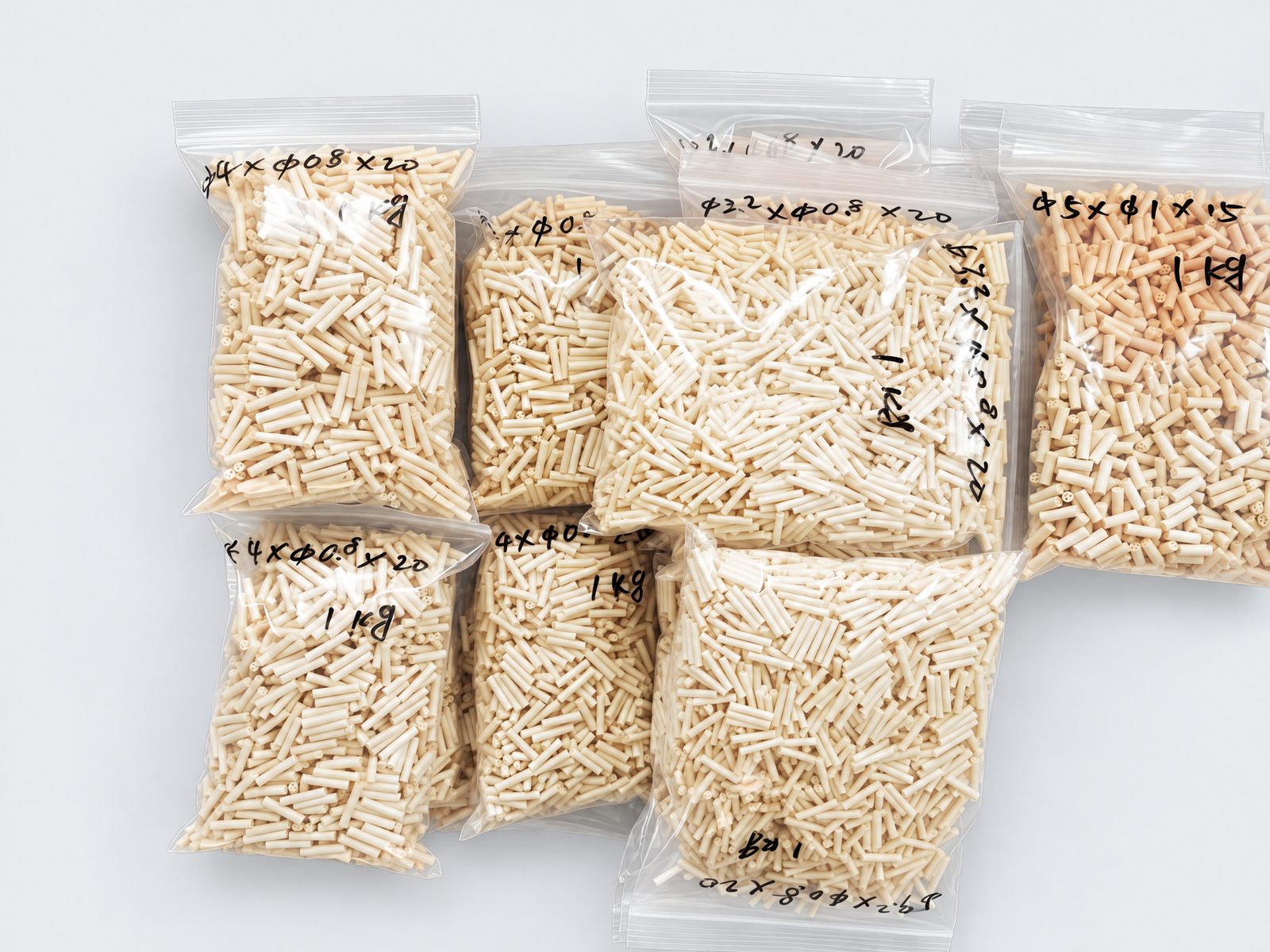
Choose wire insulation by temperature. Tempco rates glass braid to 482 °C continuous, high-temperature glass braid to 704 °C, silica fibre to 871 °C and ceramic fibre to 1,204 °C. Above that, and wherever wire lies against a hot heating element, use rigid ceramic: insulator tubes or beads threaded over the wire. For heating wire the ceramic needs little iron, alkali and silica, and dense alumina keeps far more of its insulation resistance at 1,000 °C than porous refractory. We make alumina insulator tubes with one, two or four bores, 99.5% (C799) as standard.
Temperature ratings by insulation
| Insulation | Continuous (°C) | Short term (°C) |
|---|---|---|
| Kapton (polyimide) | 260 | 427 |
| Glass braid | 482 | 538 |
| High-temperature glass braid | 704 | 871 |
| Vitreous silica fibre | 871 | 1,093 |
| Ceramic fibre | 1,204 | 1,427 |
| Cordierite (Kanthal) | 1,100 | – |
| Aluminosilicate (Kanthal) | 1,100–1,200 | – |
| Aluminous (Kanthal) | about 1,300 | – |
| Dense alumina (Tempco) | 1,700 | – |
Sleeving bends with the wire, so use it while the temperature allows. Its limit is the fibre: glass, then silica, then ceramic fibre. Tempco also marks silica and ceramic fibre “fair” for moisture. Past about 1,200 °C nothing flexible is left on that list, and rigid ceramic takes over. Our corundum ceramic is rated 1,600–1,800 °C in our material table, and we confirm each part's maximum in the quotation.
Which ceramic can touch heating wire
Kanthal makes both the heating alloys and the ceramic supports, and its catalogue sets the rules for the ceramic. For electric furnaces: at least 40% Al₂O₃, under 1% Fe₂O₃, and Na₂O and K₂O as low as possible, because the ceramic's insulation falls as it heats. For FeCrAl wire in hot furnaces, Kanthal asks for over 60% Al₂O₃ and the lowest possible SiO₂, so that silicon in the support can't react with the aluminium oxide layer that protects the wire.
| % | Kanthal’s rule | Our 99.5% (lab) |
|---|---|---|
| Al₂O₃ | 40+, over 60 with hot FeCrAl | 99.55–99.61 |
| SiO₂ | Lowest possible with FeCrAl | 0.15–0.19 |
| Fe₂O₃ | Under 1 | 0.014–0.026 |
| Na₂O | As low as possible | 0.043–0.054 |
Then match the temperature. Kanthal rates its Nikrothal 80 (NiCr 80/20, the usual “nichrome”) wire to 1,200 °C in air and its Kanthal A-1 FeCrAl wire to 1,400 °C, while its own porous supports stop at about 1,300 °C. Where the wire runs above that, use dense alumina, and for FeCrAl wire near its limit write 99.5% Al₂O₃ on the order.
Insulation resistance when hot
Insulation falls as a ceramic heats, as with every insulating material. Kanthal warns that near 1,000–1,100 °C leakage currents through its supports can trip differential protection, and advises low supply voltages. Compare its porous refractories with CoorsTek's dense 99.5% alumina:
| °C | Kanthal porous | CoorsTek 99.5% |
|---|---|---|
| 25 | – | over 10¹⁴ |
| 400 | 10⁷–10⁸ | – |
| 500 | – | 2×10¹⁰ |
| 600 | 10⁶–10⁷ | – |
| 800 | 10⁵–10⁶ | – |
| 1,000 | 10⁴–10⁵ | 2×10⁶ |
At 1,000 °C the dense alumina is 20 to 200 times more resistive in these figures. Porosity matters too: Kanthal's refractories take up 12–18% water by volume, and Kanthal says absorbed alkalis or combustion residues lower their insulation. Our corundum ceramic absorbs 0.2% or less. The heater designer sets the voltage and leakage limits; send them with your enquiry.
Bore sizes for resistance wire and leads
Pick a bore at least 0.3 mm over the wire. That is the largest bore tolerance on our 2026 insulator orders (±0.15 to ±0.3 mm), so a minimum bore still clears the wire. For a coil, size the bore to the coil's outside diameter, not the wire. Single-bore tubes, largest wire at a 0.3 mm gap:
| OD × bore (mm) | Largest wire (mm) | Supply |
|---|---|---|
| 2×1 | 0.7 | Made to order |
| 2.5×1.5 | 1.2 | Usually in stock |
| 3×2 | 1.7 | Usually in stock |
| 4×2.5 | 2.2 | Made to order |
| 5×3 | 2.7 | Made to order |
| 6×4 | 3.7 | Made to order |
| 10×4 | 3.7 | Usually in stock |
| 8×5 | 4.7 | Made to order |
| 12×7 | 6.7 | Made to order |
The largest single bore we list is 7 mm (12 mm OD). For thicker wire, coils or a lead-through, use an open-ended tube: our protection tubes are also made open at both ends, and furnace tubes start at 30 mm OD.
Twin-bore sizes for a lead pair or both legs of a hairpin element
| OD × bore (mm) | Largest wire per bore (mm) | Supply |
|---|---|---|
| 2×0.5 | 0.2 | Made to order |
| 2.5×0.7 | 0.4 | Usually in stock |
| 3×0.8 | 0.5 | Made to order |
| 3.5×0.9 | 0.6 | Usually in stock |
| 4×1 | 0.7 | Made to order |
| 4.2×1.1 | 0.8 | Usually in stock |
| 4.5×1.2 | 0.9 | Usually in stock |
| 5×1.2 | 0.9 | Made to order |
| 5.5×1.4 | 1.1 | Usually in stock |
| 6×1.4 | 1.1 | Made to order |
| 8×1.8 | 1.5 | Made to order |
| 8.5×1.8 | 1.5 | Usually in stock |
For thermocouple wire, the sizes by wire diameter and AWG are in thermocouple insulator sizes.
Tubes, beads, coil formers and lead-throughs
- Straight tubes are one rigid piece per straight run, cut to length. Use them on element legs, terminals and hot leads that don't move.
- Beads bend with the wire. Kanthal lists steatite beads from 3.3 × 1 mm (OD × bore) to 19 × 10.7 mm. We cut alumina beads in all our insulator sizes; see insulator beads for types and sizes.
- Twin- and four-bore tubes keep two or four wires apart in one piece, so both legs of a hairpin element or a lead pair can't touch.
- Threaded tubes carry a coil in a helical groove. Kanthal sells them as “threaded candles” with pitches of 1.5–30 mm. We make threaded and perforated tubes to drawing.
- Lead-throughs are open-ended tubes through the furnace wall, sized to the lead or terminal.
What to send for a quotation
- Wire alloy and diameter, or the coil’s outside diameter.
- The wire’s working temperature and the furnace atmosphere.
- Bores, OD and length, or the part you are replacing; a drawing for threaded, perforated or flanged parts.
- Quantity and how often you reorder.
Stocked insulator sizes usually ship in about 3 days for small orders and about 7 days for bulk. Other sizes are made to drawing in 25–30 days, from 100 pieces. See the insulator page for bore layouts and photos, or request a quote.
Questions buyers ask
- What is the best insulation for high-temperature wire?
- It depends on the temperature. Tempco rates glass braid to 482 °C continuous, high-temperature glass braid to 704 °C, vitreous silica fibre to 871 °C and ceramic fibre to 1,204 °C. Above that, or where the wire lies against a hot heating element, use rigid ceramic: alumina insulator tubes or beads threaded over the wire.
- How do you insulate nichrome wire?
- Thread it through ceramic insulator tubes or beads. Kanthal rates its Nikrothal 80 (NiCr 80/20) wire to 1,200 °C in air, so the ceramic needs a rating above the wire temperature and little iron or alkali: Kanthal asks for under 1% Fe₂O₃ in element supports. Choose a bore at least 0.3 mm larger than the wire.
- What ceramic is used for heating element supports?
- Kanthal sells cordierite, aluminosilicate and aluminous refractories rated 1,100 to about 1,300 °C, with 12–18% water absorption. For FeCrAl wire in hot furnaces it asks for over 60% Al₂O₃ and as little SiO₂ as possible. Dense 99.5% alumina goes further: our yearly lab samples measured 0.15, 0.18 and 0.19% SiO₂.
- Does alumina still insulate at 1,000 °C?
- Yes, with lower resistance than when cold. CoorsTek gives its 99.5% AD-995 a volume resistivity over 10¹⁴ Ω·cm at 25 °C and 2×10⁶ Ω·cm at 1,000 °C. Kanthal’s porous refractories measure 10⁴–10⁵ Ω·cm (10–100 kΩ·cm) at 1,000 °C, and Kanthal advises low supply voltages near 1,000–1,100 °C because leakage currents can trip differential protection.
Sources
- Tempco catalog page 14-104: insulated thermocouple and extension wire insulation types, continuous and single-reading temperature ratings (read 19 October 2026)
- Kanthal: Thermodielectric refractories product overview, pages 4–7, 19–25: support materials, maximum temperatures, resistivity by temperature, FeCrAl rule (read 19 October 2026)
- Kanthal A-1 resistance heating wire data sheet: maximum continuous operating temperature in air (read 19 October 2026)
- Kanthal Nikrothal 80 (NiCr 80/20) wire data sheet: maximum continuous operating temperature in air (read 19 October 2026)
- CoorsTek: alumina typical properties (AD-96 and AD-995; checked 6 October 2026, hardness, specific heat and dielectric strength 16 October 2026)
- Tempco: ceramic protection tubes, catalog page 14-85 (alumina and porcelain/mullite limits)
- Our own figures: the factory’s standard-size list, 2026 orders and test report, as recorded in our product catalog.