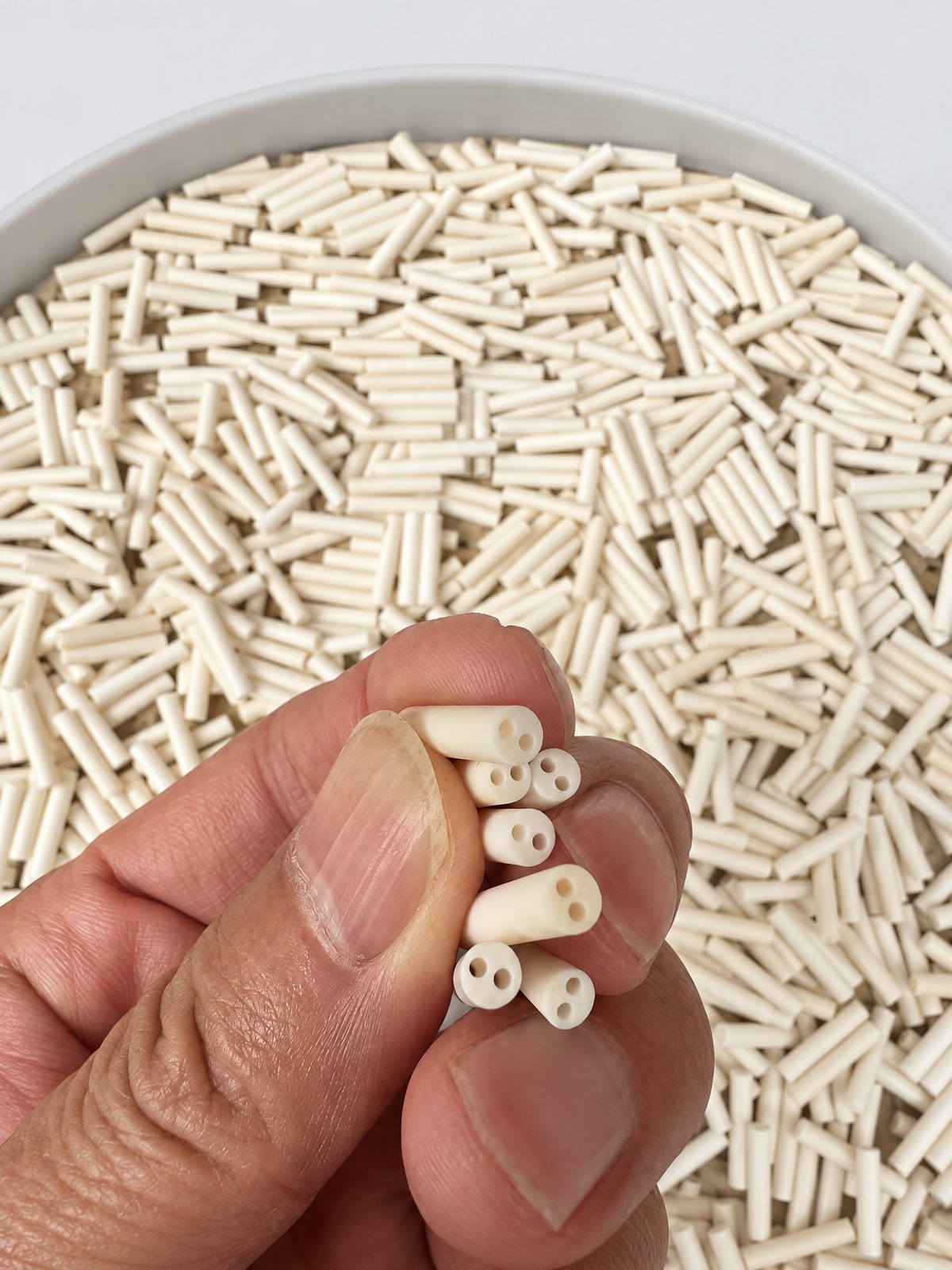
A Type S, R or B thermocouple needs a twin-bore insulator for the 0.35 or 0.5 mm platinum-rhodium wire and a gas-tight, high-purity alumina tube around it. WIKA and JUMO both put the rod and the tube in C 799-type alumina, because silica and iron from the ceramic contaminate the wire. From our stock, 2.5×0.7 twin-bore takes 0.35 mm wire and 3.5×0.9 takes 0.5 mm. Below: which tube each insulator goes in, the double-tube pairs we make, and what to put on the order.
What the tube and insulator are made of
The sources agree on the material and differ only in how strict they are. Temperature ranges by type are in thermocouple types and ranges; this page is about the parts.
| Source | What it says |
|---|---|
| WIKA | Above 1,200 °C use gas-tight ceramic, preferably high-purity C 799, against poisoning. Types S, R and B use Ø0.35 or Ø0.5 mm wire in C 799 insulating rods. |
| JUMO | For platinum thermocouples both the insulating rod and the protection tube must be KER 710 (C 799). Silicon, arsenic, phosphorus, sulphur and boron poison platinum; SiO₂ is particularly harmful, faster in neutral and reducing gas, where 0.2% SiO₂ in the ceramic already forms brittle platinum silicides. |
| JUMO | KER 610 tubes become noticeably conductive above 1,000 °C, and the shunt falsifies the reading. |
| NASA | TN D-7027 cites earlier work: the main cause of drift in noble-metal thermocouples in alumina insulators was iron carried over from the insulator, in step with the insulator grade's impurity content. In TN D-5287, iron rose most at the junction of a Pt-13Rh/Pt couple after 3,700 hours, most likely from the alumina insulators. |
| Tempco | Silica is a prime contaminant of platinum, so alumina tubes and insulators are recommended above 1,093 °C. |
So silica and iron are the numbers to watch. Our 99.5% alumina measured 0.15–0.19% SiO₂ and 0.014–0.026% Fe₂O₃ in the three yearly lab samples from 2024 to 2026. If the thermocouple runs in neutral or reducing gas, write a maximum SiO₂ and Fe₂O₃ on the order and we confirm the grade and analysis for that part. We make C799 alumina, 99.5% Al₂O₃, as our standard. The full analyses are in the low-sodium alumina guide, and what the C codes mean is in C 799 and C 610 grades.
Insulators for 0.35 and 0.5 mm wire
WIKA and Rössel both list 0.35 and 0.5 mm for noble-metal wire. Twin-bore carries one couple; four-bore carries two, for a duplex sensor. The table picks our stocked sizes with at least 0.3 mm between wire and bore, the largest bore tolerance on our 2026 multi-bore orders (±0.15 to ±0.3 mm).
| Wire | Twin-bore | Four-bore |
|---|---|---|
| 0.35 | 2.5×0.7, 3.5×0.9 | 3.5×0.8, 4.2×1.0 |
| 0.5 | 3.5×0.9, 4.2×1.1 | 3.5×0.8, 4.2×1.0 |
Name the wire diameter on the order next to the insulator size, as buyers did on our 2026 multi-bore orders. Those orders held the OD to ±0.2 to ±0.5 mm and the bores to ±0.15 to ±0.3 mm. Every stocked and made-to-order insulator against every wire size is in insulator sizes by wire diameter. Flat twin-bore sections for profile thermocouples are covered in profile thermocouple insulators.
The protection tube around the insulator
The insulator slides into a closed-end alumina protection tube. For each stocked twin-bore size, the two smallest stocked tubes with an ID at least 1 mm larger than the insulator OD:
| Twin-bore insulator | Smallest tubes, OD × ID |
|---|---|
| 2.5×0.7 | 6×4, 7×5 |
| 3.5×0.9 | 7×5, 8×5 |
| 4.2×1.1 | 9×6, 10×6 |
| 4.5×1.2 | 9×6, 10×6 |
| 5.5×1.4 | 10×7, 12×8 |
| 8.5×1.8 | 14×10, 15×10 |
We test-fit tubes before dispatch: an 8.5 mm core reaches the bottom of a 15×10 tube, a 9.5 mm rod doesn't. If your insert must reach the tip, name it on the order, or ask for a one-sided ID such as 10 +1/−0. European buyers mostly order the C 799 series sizes 10×6, 15×10 and 24×18; all three are in our standard list, and the rest are in protection tube sizes.
Outer tubes and double tubes
Above the gas-tight inner tube, the makers describe three ways to build the sensor:
- One gas-tight alumina tube, closed at the tip. WIKA says the tube needs a metal support tube to carry the process connection.
- A porous, shock-resistant outer tube over the gas-tight inner one. WIKA uses C 530 this way, and JUMO allows a gas-permeable outer tube once the inner tube is gas-tight.
- A metal outer tube with a ceramic inner tube. Rössel says platinum thermocouples in metal tubes generally get one, against contamination by metal ions.
Our standard double-tube pairs are a 10×7 tube inside a 17×13, and a 12×8 tube inside a 20×15. A 12×8 doesn't go inside a 17×13. With the insulators above, that gives complete sets:
| Wire (mm) | Insulator | Inner tube | Outer tube |
|---|---|---|---|
| 0.35 or 0.5 | 5.5×1.4 | 10×7 | 17×13 |
| 0.35 or 0.5 | 5.5×1.4 | 12×8 | 20×15 |
Lengths and tolerances
Protection tubes come in standard lengths of 300, 450, 600 and 1,000 mm and are cut to order from 300 to 2,500 mm; our 2026 orders included the European lengths 530 to 2,030 mm. Insulators are cut to length from 10 to 4,000 mm. On closed-end tubes we quote ±0.5 mm on OD and ID for OD 6–12 mm, ±0.6 for 15–17 mm, ±0.7 for 20 mm and ±1.0 for 24 mm, with ±1 mm on length. The 2026 order table is in alumina tube tolerances.
WIKA asks for C 799 tubes to be preheated before installation and pushed in slowly, with support if they sit horizontally. We supply closed-end tubes and 1- to 4-bore insulators to 10+ thermocouple and instrument makers, including makers of platinum-rhodium thermocouples that measure up to about 1,600 °C.
What to put on the order
- Thermocouple type and wire diameter, and whether it's single or duplex.
- Insulator: number of bores, OD × bore, length, quantity.
- Inner tube: OD × ID × length, closed one end, and the insert that must reach the tip.
- Outer tube, if any: OD × ID × length, or the pair from the table above.
- Grade (99.5% Al₂O₃, C799, is standard), and any maximum SiO₂ or Fe₂O₃.
- Working temperature and atmosphere: air, neutral or reducing.
Standard sizes usually ship from stock in about 3 days for a small order and about 7 for a bulk one. We send 5–10 samples to approve first. Send the list and we quote the set.
Questions buyers ask
- What insulator does a Type S thermocouple need?
- A twin-bore alumina insulator: WIKA puts Type S, R and B wire of 0.35 or 0.5 mm in C 799 insulating rods. From our stock, 2.5×0.7 mm twin-bore takes 0.35 mm wire and 3.5×0.9 mm takes 0.5 mm, with at least 0.3 mm between wire and bore.
- Can a Type S or R thermocouple go in a mullite or porcelain tube?
- JUMO says no: for platinum thermocouples both the insulating rod and the protection tube must be KER 710 (C 799 alumina), because in reducing gas 0.2% SiO₂ is enough to form brittle platinum silicides. Tempco recommends alumina tubes and insulators above 1,093 °C because silica contaminates platinum.
- Why do platinum thermocouples drift in alumina insulators?
- Contamination of the wire. NASA TN D-7027 cites earlier work that traced the main drift in noble-metal thermocouples to iron carried over from the alumina insulator, in step with its impurity content. JUMO lists silicon, arsenic, phosphorus, sulphur and boron as platinum poisons, silica in particular.
- Which protection tubes fit together as a double tube?
- Our standard pairs are a 10×7 mm tube inside a 17×13 mm tube and a 12×8 mm tube inside a 20×15 mm tube. A 12×8 doesn’t go inside a 17×13. A 5.5×1.4 mm twin-bore insulator passes both inner tubes at our 1 mm nominal filter.
Sources
- WIKA data sheet TE 65.80, thermocouples with ceramic protection tube
- JUMO data sheet 90.1000 (German), KER 710 and KER 610
- Rössel-Messtechnik, Praxis der Thermoelemente (German), Table 9 and insulating rods
- G. E. Glawe and A. J. Szaniszlo, NASA TN D-7027 (1970): thermal emf change of noble- and refractory-metal thermocouples at 1600 K
- A. J. Szaniszlo, NASA TN D-5287 (1969): thermal emf change for Pt-13Rh/Pt thermocouples at 1530 K for 3700 hours
- Tempco: ceramic protection tubes, catalog page 14-85 (alumina and porcelain/mullite limits)
- Our own figures: the factory’s standard-size list, 2026 orders and test report, as recorded in our product catalog.