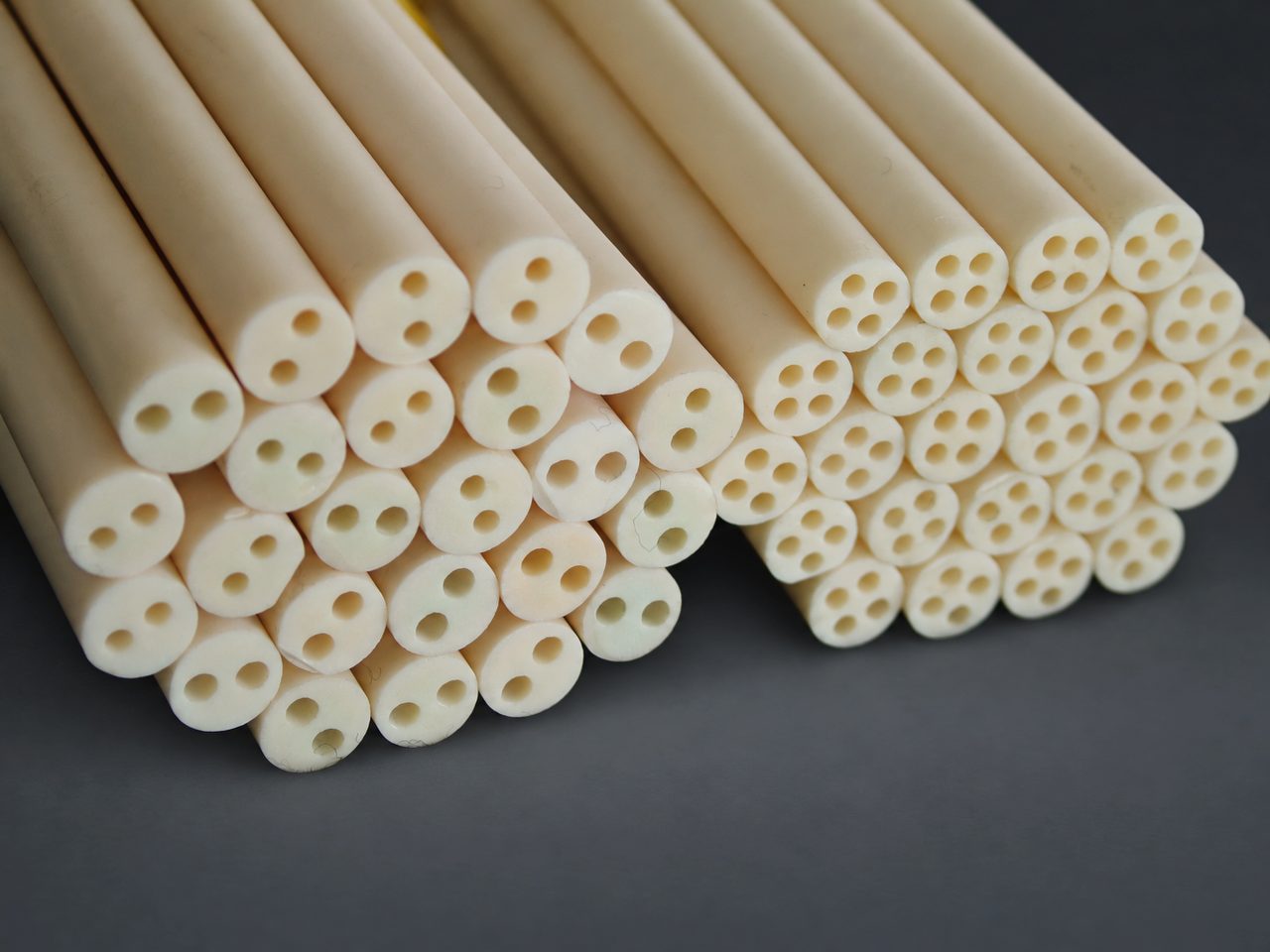
An industrial thermocouple has five main parts: two wires of different alloys welded together at the measuring point, a ceramic insulator that keeps them apart, a protection tube (sometimes with a gas-tight inner tube) that shuts out the furnace, a metal support tube with the process connection, and a connection head with the terminal block. DIN EN 50446 sets out straight thermocouples built this way, and WIKA's TC80 series follows it. We make the ceramic parts as spares in C799 alumina: 18 protection-tube sizes and 15 insulator sizes are usually in stock, cut to length, and small orders ship in about 3 days.
Thermocouple diagram
The parts, one by one
| Part | What it does | In WIKA TE 65.80 |
|---|---|---|
| Measuring point | The welded joint of the two wires, where the temperature is read. | Welded; insulated from the tube unless ordered otherwise. |
| Wires | Two alloys that make the voltage. | K, N, J: Ø1 or Ø3 mm. S, R, B: Ø0.35 or Ø0.5 mm. |
| Insulator* | Keeps the wires apart along their length. | K, N, J: C 610 insulation tubes. S, R, B: C 799 insulation rod. |
| Inner tube* | A second, gas-tight tube that keeps furnace gas off the wires. | Gas-tight C 610 or C 799; Ø15 in a metal Ø22 tube, Ø10 in Ø15. |
| Protection tube* | Takes the heat, the atmosphere and the knocks. | Metal Ø22 or Ø15; ceramic Ø10, Ø15/16 or Ø26. |
| Ceramic cement | Fixes the ceramic tube in the support tube. | Fireproof ceramic compound. |
| Support tube | Carries the brittle ceramic tube and the fitting. | Carbon or stainless steel, Ø15, Ø22 or Ø32. |
| Process connection | Mounts the thermocouple in the furnace wall. | Stop flange, threaded bushing or welded flange; gas-tight to 1 bar. |
| Connection head | Holds the terminal block, and a transmitter if fitted. | Form A or form B. |
The insulator grade follows the wire. WIKA and Rössel put base-metal wire (K, N, J) in C 610 and platinum wire (S, R, B) in C 799. JUMO goes further: for platinum thermocouples, both the insulating rod and the protection tube must be C 799-grade alumina, because in reducing gas 0.2% SiO₂ is enough to form brittle platinum silicides. Our insulators and tubes are C799 alumina, 99.5% Al₂O₃, as standard.
DIN EN 50446 model codes: AK, AKK, AM and the rest
Thermocouples to DIN EN 50446 carry a short code. The first letter is the connection head, form A or B. The second is the protection tube: M for metal, K for ceramic. A second K means a ceramic inner tube.
| Code | Head | Tube (mm) | Inner tube |
|---|---|---|---|
| AM | A | Metal Ø22 | – |
| AMK | A | Metal Ø22 | Ceramic Ø15 |
| BM | B | Metal Ø15 | – |
| BMK | B | Metal Ø15 | Ceramic Ø10 |
| AK | A | Ceramic Ø26, Ø15/16 | – |
| AKK | A | Ceramic Ø26, Ø15/16 | Ceramic Ø15/16, Ø10 |
| BK | B | Ceramic Ø10 | – |
WIKA pairs its porous C 530 outer tube with a gas-tight inner tube (the AKK layout), because porous ceramic doesn't keep gas out on its own. In an AMK, the ceramic inner tube protects the wires once the metal tube turns porous or scaled at high temperature.
Metal or ceramic protection tube
WIKA uses metal tubes up to 1,200 °C, generally with base-metal K, J or N thermocouples, and ceramic tubes up to 1,600 °C, generally with platinum R, S or B. Above 1,200 °C the series uses only platinum thermocouples, in gas-tight ceramic, preferably high-purity C 799. Ceramic is brittle, which is why it sits in a metal support tube. Temperature ranges by type are in thermocouple types and temperature ranges, and the material choice by atmosphere in the protection tube material selector.
Ceramic parts for a rebuild
To rebuild a thermocouple, order the ceramic parts by size: OD × ID (or bores) × length. Our usually stocked closed-end tubes at WIKA's ceramic diameters, as nominal candidates to check against your drawing:
- Ø10: 10×6 or 10×7.
- Ø15 and Ø16: 15×10, 15×11 or 16×12.
- Ø26: 26×20.
- Double tubes: our standard pairs are 10×7 inside 17×13 and 12×8 inside 20×15.
- Insulators: Morgan lists DIN EN 50113 four-bore insulators of Ø5.5 × 1.2 and Ø8.5 × 1.5 mm; our nearest stocked four-bore sizes are 5.5×1.3 and 8.5×1.6. For 0.35 and 0.5 mm platinum wire, 2.5×0.7 and 3.5×0.9 twin-bore; for 1 mm base-metal wire, 5.5×1.4.
We test-fit tubes before dispatch: on our 15×10 closed-end tube an 8.5 mm core reaches the bottom and a 9.5 mm rod doesn't. So name the insulator or inner tube that has to go inside. Lengths are cut to order; our standard protection-tube lengths are 300, 450, 600 and 1,000 mm. Full size lists are in protection tube sizes and insulator sizes by wire diameter, and the platinum-thermocouple parts in tubes and insulators for Type S, R and B.
What to send for a quotation
- Thermocouple type and wire diameter.
- Each ceramic part: OD × ID or bores × length, and which part goes inside which.
- Grade, or the working temperature and atmosphere so we can propose one.
- Quantity and how often you rebuild.
Stocked sizes usually ship in about 3 days for small orders and about 7 days for bulk. Other sizes are made to drawing in 25–30 days, from 100 pieces. Request a quote for tubes, or see the insulator page.
Questions buyers ask
- What are the parts of a thermocouple?
- Two wires of different alloys welded together at the measuring point, a ceramic insulator that keeps the wires apart, a protection tube (sometimes with a gas-tight inner tube), a metal support tube with the process connection, and a connection head with a terminal block. WIKA’s straight thermocouples to DIN EN 50446 are built this way.
- What is the ceramic in a thermocouple for?
- Two jobs. The insulator, a twin- or four-bore ceramic rod, keeps the wires apart along their length. The ceramic protection tube shuts out furnace gas and keeps the wires clean: WIKA puts precious-metal thermocouples above 1,200 °C in gas-tight ceramic, preferably high-purity C 799 alumina.
- What do AK, AKK and AM mean on a thermocouple?
- They are DIN EN 50446 model codes. The first letter is the connection head form, A or B. The second is the protection tube: M for metal, K for ceramic. A second K adds a ceramic inner tube. An AKK has a form A head, a ceramic outer tube and a ceramic inner tube.
- Do you sell thermocouple spare parts?
- We make the ceramic ones in C799 alumina: closed-end protection tubes and inner tubes, and single-, twin- and four-bore insulators and beads. 18 protection-tube sizes and 15 insulator sizes are usually in stock and cut to length, and small orders ship in about 3 days. The thermocouple maker supplies the wire, the head and the metal tubes.
- Can I replace just the ceramic tube in a thermocouple?
- Yes, if the assembly can be opened. WIKA cements its ceramic protection tube into a metal support tube with a fireproof ceramic compound, so the old tube has to come out of the support first. Order the tube by OD × ID × length and name the insulator that goes inside. We test-fit tubes before dispatch: on our 15×10 closed-end tube an 8.5 mm core reaches the bottom.
Sources
- WIKA data sheet TE 65.80, thermocouples with ceramic protection tube
- Morgan Haldenwanger price list, valid from 1 January 2026: standard sizes and DIN 40680 tolerance table
- DIN Media: DIN 43724, withdrawn (DIN EN 50446 recommended)
- JUMO data sheet 90.1000 (German), KER 710 and KER 610
- Rössel-Messtechnik, Praxis der Thermoelemente (German), Table 9 and insulating rods
- Our own figures: the factory’s standard-size list, 2026 orders and test report, as recorded in our product catalog.