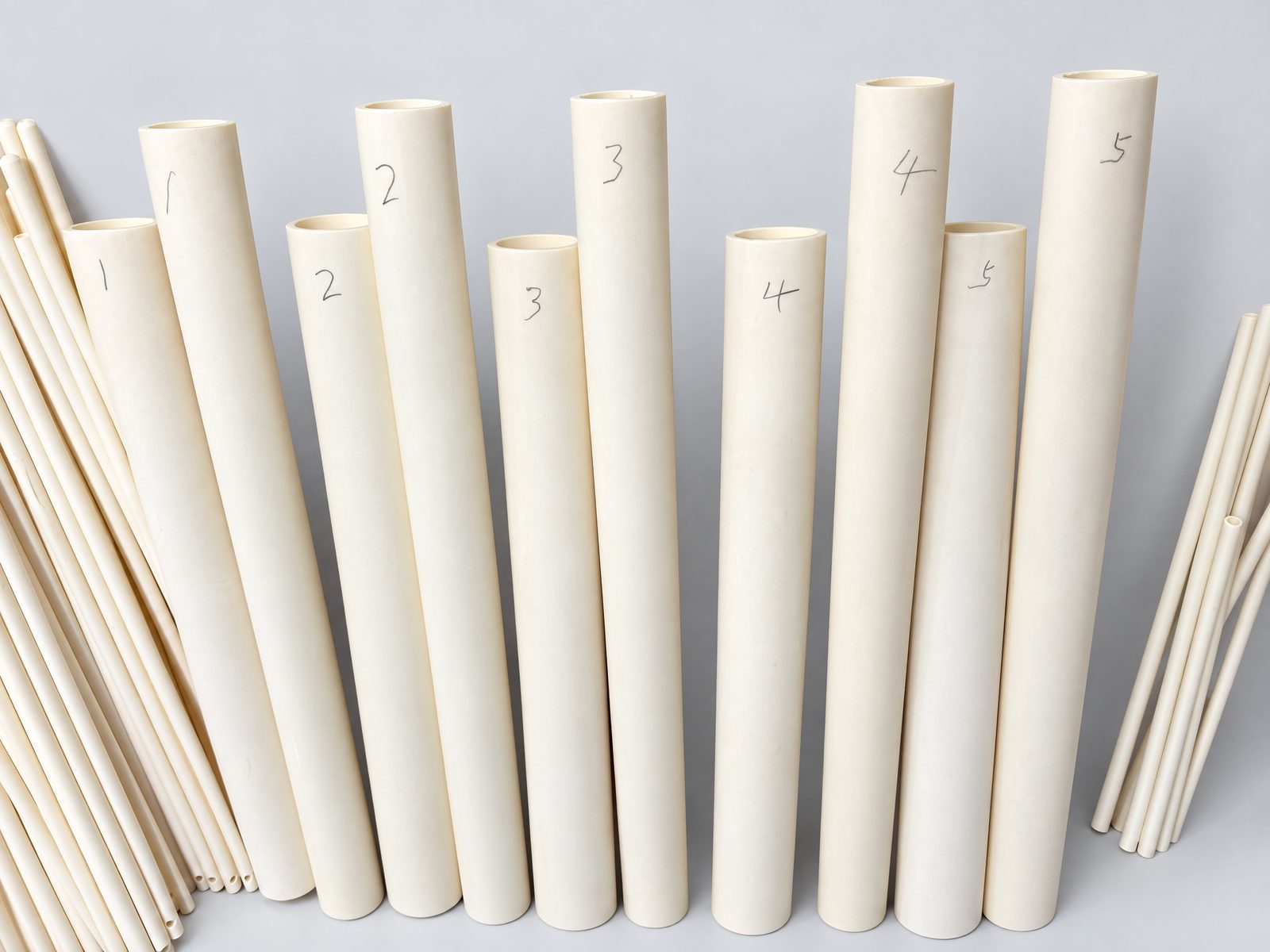
A quartz work tube is good for about 1,100 °C in air and 950–1,000 °C under vacuum. Above that you need alumina: furnace makers rate high-purity (C 799) alumina tubes to 1,800 °C in air and 1,400–1,500 °C under vacuum. The price of the higher limit is slow heating, about 5 °C per minute, where quartz takes almost any ramp.
So the choice is usually made by the process temperature. Below 1,000 °C, with fast cycles or a sample you want to watch, use quartz. From 1,100 °C up, or with long dwells near 1,100 °C, use alumina. Between the two, read on.
Quartz and alumina work tubes side by side
| Tube material | Heating rate | Max. in air (°C) | Max. under vacuum (°C) |
|---|---|---|---|
| Quartz glass | unlimited | 1,100 | 950 |
| C 799 (alumina) | 300 K/h below 120 mm OD, 200 K/h from 120 mm | 1,800 | 1,400 |
| C 610 (mullite) | 300 K/h below 120 mm OD, 200 K/h from 120 mm | 1,400 | 1,200 |
| C 530 (porous) | unlimited | 1,300 | not possible |
Other makers publish slightly different numbers, so here they are with the source next to each:
| Fused quartz | High-purity alumina | Source | |
|---|---|---|---|
| Continuous use in air | 1,110–1,160 °C (by grade) | 1,800 °C | Heraeus; Nabertherm |
| Maximum (makers' furnaces) | 1,200 °C | 1,800 °C | MTI |
| Under vacuum | 950–1,000 °C | 1,400–1,500 °C | Nabertherm; MTI |
| Heating rate | No limit | About 5 °C/min | Nabertherm; Carbolite Gero |
| Thermal expansion | 0.5 × 10⁻⁶/K | 8.2 × 10⁻⁶/K (25–1,000 °C) | Heraeus; CoorsTek |
| Thermal conductivity (W/m·K, 20 °C) | 1.38 | 30–31 | Heraeus; CoorsTek (99.5–99.8%) |
| See the sample | Yes, transparent | No |
Why quartz stops near 1,100 °C
The softening point is much higher: Momentive puts it at 1,683 °C for its Type 214 quartz. Two other things limit a work tube long before that.
- Devitrification. The glass slowly turns into cristobalite, goes white and cracks on cooling. Technical Glass Products says this hardly ever happens at 1,150 °C or below on a clean tube, usually starts at 1,200 °C or higher, and can start at 1,000 °C or less when the surface carries alkali. Fingerprints are enough; Heraeus advises wiping the tube with alcohol before heating.
- Creep. Technical Glass Products warns that long quartz tubes may deform at 1,100 °C or higher. A horizontal tube spanning the whole furnace is exactly that case.
Heraeus's ratings show how much the grade matters: electrically fused quartz 1,160 °C continuous and 1,300 °C short-term, flame fused quartz 1,110 °C continuous and 1,250 °C short-term, synthetic fused silica 950 °C continuous and 1,200 °C short-term. If a supplier quotes 1,200 °C or more for a quartz tube, ask for which grade and for how long.
Why alumina needs slow heating
Alumina expands about 15 times as much as quartz: CoorsTek gives 8.2 × 10⁻⁶/K for alumina, Heraeus about 0.5 × 10⁻⁶/K for quartz (the ratio is our arithmetic). A tube heated fast, or unevenly, cracks between the hot middle and the cooler ends. Furnace makers write the same rules into their manuals:
- Carbolite Gero limits ceramic work tubes to 5 °C/min. Nabertherm gives 300 K/h under 120 mm OD and 200 K/h from 120 mm.
- Carbolite's TZF manual gives a rule of thumb: maximum heating or cooling rate in °C/min = 400 ÷ inner diameter in mm. For an 80×70 mm tube that's about 5.7 °C/min.
- Ceramic tubes are more brittle below 900 °C, so load and unload slowly at low temperatures too (Carbolite).
- Tube sections outside the heated zone are more at risk. Fit insulation plugs or radiation shields at both ends (Carbolite); MTI says tube blocks should always be inserted.
Vacuum and sag
Under vacuum the tube carries atmospheric pressure from outside while it is soft. Nabertherm allows quartz to 950 °C and C 799 alumina to 1,400 °C under vacuum. MTI allows quartz to 1,000 °C and alumina to 1,500 °C, and says vacuum above that can collapse an alumina tube.
Alumina also sags if it isn't supported. Sentro Tech defines the sag temperature as the point where an empty 1¼-inch tube over an 18-inch span sags ¼ inch in an hour, and gives 1,600 °C for 99.5% and 99.8% alumina. For long dwells above about 1,500 °C, support the tube along its length and keep heavy fittings off the free span.
Chemical attack
Heraeus lists hydrofluoric and phosphoric acid as the only acids that attack quartz, but quartz is sensitive to all alkali and alkaline-earth compounds, which also speed up devitrification. Alumina isn't immune either: WIKA describes C 799 as not resistant to alkali vapours. If your process releases alkali vapour, tell us the temperature and atmosphere and we'll say what we can offer.
Our alumina furnace tube sizes, and the boats that fit
In the furnace makers' catalogues we read, 50, 60 and 80 mm OD tubes come up most often. Nabertherm's C 799 work tubes include 50×40 and 80×70 mm, and both sizes are among our standard ones (dimensions match; that says nothing about the grade). All 12 standard sizes are below, open at both ends, in lengths of 1000–2000 mm. The last two columns show the largest of our standard rectangular boats that passes through each tube, and how many of them do.
| Tube OD × ID (mm) | Wall (mm) | Largest boat cross-section that fits, L × W × H (mm) | Boats that fit |
|---|---|---|---|
| 30×20 mm | 5 | 100 × 10 × 10 | 4 |
| 30×23 mm | 3.5 | 100 × 10 × 10 | 4 |
| 32×25 mm | 3.5 | 75 × 18 × 14 | 6 |
| 35×25 mm | 5 | 75 × 18 × 14 | 6 |
| 40×30 mm | 5 | 150 × 20 × 20 | 11 |
| 45×35 mm | 5 | 52 × 25 × 23 | 14 |
| 50×40 mm | 5 | 100 × 30 × 20 | 16 |
| 55×45 mm | 5 | 50 × 25 × 35 | 17 |
| 60×50 mm | 5 | 50 × 25 × 35 | 19 |
| 65×55 mm | 5 | 50 × 25 × 35 | 19 |
| 70×60 mm | 5 | 100 × 50 × 30 | 21 |
| 80×70 mm | 5 | 100 × 50 × 30 | 23 |
Alumina and corundum. Grades: 99.5% Al₂O₃ (C799-class) as standard, plus 99.7%, 99% and 95%, all available. Purity and maximum temperature are confirmed per SKU at quotation. For reference, our material table gives 1600–1800 °C working temperature for corundum and 1300–1450 °C for high-alumina ceramic; not every corundum part is rated to 1800 °C.
Standard sizes are usually in stock and ship in about 3 days for a small order, about 7 for a bulk one; lengths are cut to order. Every size and the made-to-drawing options are on the furnace tubes page, and all our boats and crucibles, with lids, on the crucibles and boats page. For a quotation, send the OD, ID and length, the maximum temperature and atmosphere, whether you run vacuum, your heating and cooling rates, and the quantity.
Questions buyers ask
- What is the maximum temperature of a quartz tube in a tube furnace?
- About 1,100 °C for continuous use. Nabertherm rates quartz work tubes to 1,100 °C in air and 950 °C under vacuum; MTI gives 1,200 °C maximum and 1,000 °C under vacuum. Heraeus rates electrically fused quartz at 1,160 °C continuous and 1,300 °C short-term.
- What is the maximum temperature of an alumina furnace tube?
- Furnace makers rate high-purity (C 799) alumina work tubes to 1,800 °C in air: Nabertherm and MTI both give 1,800 °C. The figure depends on purity and on how the tube is supported; an unsupported tube starts to sag at around 1,600 °C in Sentro Tech's test.
- Can I run vacuum in an alumina tube at high temperature?
- Only up to about 1,400–1,500 °C. Nabertherm gives 1,400 °C under vacuum for C 799 tubes; MTI says alumina softens above 1,500 °C and vacuum above that can collapse the tube.
- How fast can I heat an alumina work tube?
- About 5 °C per minute. Carbolite Gero limits ceramic work tubes to 5 °C/min, and Nabertherm gives 300 K/h (5 K/min) for C 799 tubes under 120 mm OD and 200 K/h from 120 mm. Quartz has no such limit in Nabertherm's table.
- Why did my quartz tube turn white and crack?
- That's devitrification: the glass turns into cristobalite. Technical Glass Products says it usually starts at 1,200 °C or higher, but can begin at 1,000 °C or less when the surface carries alkali, for example from fingerprints. Heraeus advises wiping quartz with alcohol before heating.
Sources
- Nabertherm: Laboratory Furnaces catalogue, working tubes table (pages 56–57)
- Heraeus Covantics: properties of fused silica (working temperatures by grade, chemical resistance)
- Technical Glass Products: fused quartz proper usage guidelines (devitrification, deformation)
- Momentive Technologies: fused quartz thermal properties (Type 214)
- Carbolite Gero: TF tube furnace range data sheet
- Carbolite Gero: TZF 12/38/850 operating instructions, section 4.6 (ceramic work tubes), from carbolite.com downloads
- MTI Corporation: setup and use tips for tubes and vacuum flanges
- CoorsTek: Advanced Alumina property chart (2023)
- Sentro Tech: alumina tubes (sag temperature)
- WIKA data sheet TE 65.80, thermocouples with ceramic protection tube
- Our own figures: the factory's standard-size list, 2026 orders and test report, as recorded in our product catalog.