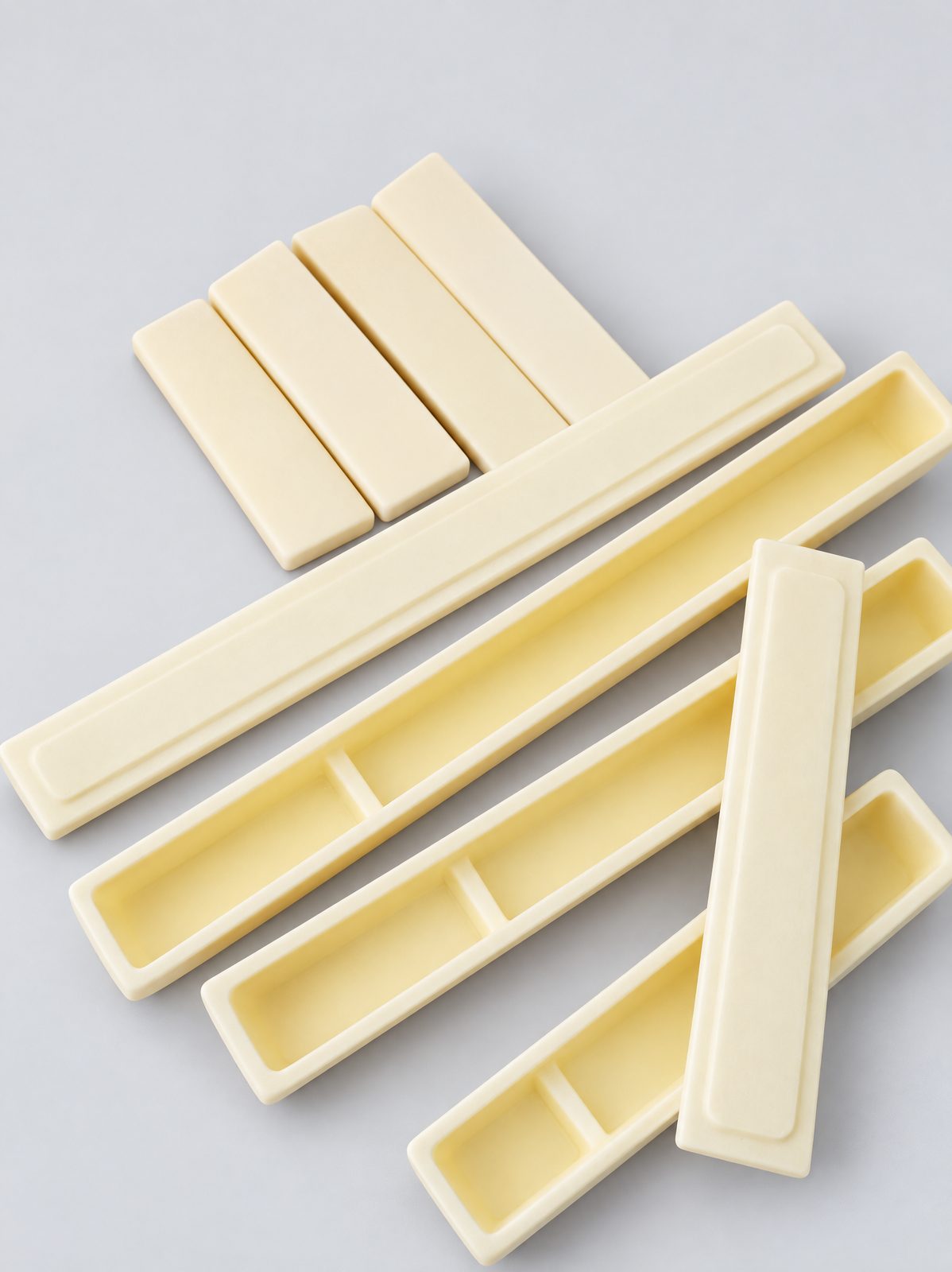
A boat fits a tube furnace when the diagonal of its cross-section is smaller than the work tube's inside diameter: √(width² + height²) has to stay under the ID, with about 1 mm to spare. In our 50×40 mm tube, 40 of our 67 boats pass, the roomiest being the 100×27×27 mm perforated boat. Our boats come in five shapes, 20 to 250 mm long, in 99% and 99.5% Al₂O₃.
Find the boats that fit your tube
Enter the inside diameter of your work tube. Add the length of the hot zone if the whole boat has to sit in it. Check whether your furnace names its tube by the outside diameter: a 50 mm tube with a 5 mm wall has a 40 mm bore.
Boat finder
Checks all 67 boats in our tables against your tube's inside diameter, largest cross-section first.
40 boats fit a 40 mm bore
| L×W×H (mm) | Shape | Min. bore |
|---|---|---|
| 100×27×27 | perforated | 39.2 mm |
| 73×30×22 | perforated | 38.3 mm |
| 38×34×18 | half-round | 39.5 mm |
| 115×30×20 | boat-shaped | 37.1 mm |
| 100×30×20 | rectangular | 37.1 mm |
| 100×30×20 | half-round | 37.1 mm |
| 60×30×20 | rectangular | 37.1 mm |
| 52×25×23 | rectangular | 35.0 mm |
| 60×35×15 | trapezoid | 39.1 mm |
| 120×30×15 | rectangular | 34.6 mm |
| 60×30×15 | trapezoid | 34.6 mm |
| 40×25×17 | half-round | 31.3 mm |
| 110×24×17 | rectangular | 30.5 mm |
| 100×24×17 | perforated | 30.5 mm |
| 150×20×20 | rectangular | 29.3 mm |
| 100×20×20 | rectangular | 29.3 mm |
| 100×20×20 | half-round | 29.3 mm |
| 75×20×20 | rectangular | 29.3 mm |
| 65×25×16 | half-round | 30.7 mm |
| 50×20×20 | rectangular | 29.3 mm |
| 60×25×15 | trapezoid | 30.2 mm |
| 100×23×15 | trapezoid | 28.5 mm |
| 20×20×17 | trapezoid | 27.3 mm |
| 48×24×14 | trapezoid | 28.8 mm |
| 100×20×15 | half-round | 26.0 mm |
| 75×18×14 | rectangular | 23.9 mm |
| 50×25×10 | rectangular | 28.0 mm |
| 97×17×12 | boat-shaped | 21.9 mm |
| 50×20×10 | rectangular | 23.4 mm |
| 88×15×9 | boat-shaped | 18.5 mm |
| 77×13×8 | boat-shaped | 16.3 mm |
| 100×10×10 | rectangular | 15.2 mm |
| 80×10×10 | rectangular | 15.2 mm |
| 60×11×8 | boat-shaped | 14.7 mm |
| 44×11×8 | boat-shaped | 14.7 mm |
| 70×12×7 | rectangular | 14.9 mm |
| 40×10×7 | boat-shaped | 13.3 mm |
| 39×10×6.5 | boat-shaped | 13.0 mm |
| 45×8×6 | rectangular | 11.0 mm |
| 27×7×6 | boat-shaped | 10.3 mm |
Each size opens the quote form with it filled in. Typical dimensions; the exact ones are confirmed in your quotation.
Why the diagonal decides the fit
A boat lying in a round tube rests on its two bottom corners, which touch the wall. Its top corners then meet the wall when width and height, taken together along the diagonal, equal the bore. So a 30 mm wide, 20 mm high boat needs more than 36.1 mm of bore, even though both sides are smaller than 30. The check is the same whether the boat sits on the floor of the tube or in the middle.
Half-round and boat-shaped bottoms follow the curve of the tube, so for them the rule leaves extra room. Leave more than 1 mm when the tube may be slightly bowed, when the boat must pass a thermocouple or a gas inlet inside the tube, or when it carries a lid.
Boats for our alumina furnace tubes
We make the work tube as well as the boat, so here is every standard furnace tube we make with the boats that pass it at 1 mm clearance, across all five shapes.
| Tube | Boats | Roomiest | Longest |
|---|---|---|---|
| 30×20 | 11 | 88×15×9 | 100×10×10 |
| 30×23 | 12 | 97×17×12 | 100×10×10 |
| 32×25 | 14 | 75×18×14 | 100×10×10 |
| 35×25 | 14 | 75×18×14 | 100×10×10 |
| 40×30 | 24 | 150×20×20 | 150×20×20 |
| 45×35 | 32 | 52×25×23 | 150×20×20 |
| 50×40 | 40 | 100×27×27 | 150×20×20 |
| 55×45 | 45 | 50×25×35 | 250×40×18 |
| 60×50 | 49 | 100×40×25 | 250×40×18 |
| 65×55 | 50 | 100×43×26 | 250×40×18 |
| 70×60 | 53 | 100×50×30 | 250×40×18 |
| 80×70 | 57 | 100×56×35 | 250×40×18 |
All 12 tubes and their lengths are on the furnace tubes page, and alumina furnace tube sizes compares them with the tubes furnace makers list.
Five boat shapes, and when to use each
- Rectangular (30 sizes, 45 to 150 mm long, 8 to 100 mm wide). Flat bottom and straight sides. The widest choice, and the one to use for an even powder layer or flat parts.
- Rectangular, perforated (6 sizes, 73 to 100 mm long, 24 to 84 mm wide). A rectangular boat with holes, so gas passes through the boat as well as over the top.
- Boat-shaped (9 sizes, 27 to 115 mm long, 7 to 30 mm wide). The narrow classic boat for small samples in small bores.
- Half-round bottom (14 sizes, 38 to 250 mm long, 20 to 65 mm wide). The round bottom follows the tube, so a half-round boat sits lower than a flat one of the same width. It includes our longest boat.
- Trapezoid (8 sizes, 20 to 100 mm long, 20 to 77 mm wide). Sloping sides, which make a powder easier to tip out.
All 67 boat sizes, with the bore each one needs
| L×W×H (mm) | Shape | Min. bore |
|---|---|---|
| 45×8×6 | rectangular | 11.0 mm |
| 50×20×10 | rectangular | 23.4 mm |
| 50×20×20 | rectangular | 29.3 mm |
| 50×25×10 | rectangular | 28.0 mm |
| 50×25×35 | rectangular | 44.1 mm |
| 50×40×20 | rectangular | 45.8 mm |
| 50×50×25 | rectangular | 57.0 mm |
| 52×25×23 | rectangular | 35.0 mm |
| 60×30×20 | rectangular | 37.1 mm |
| 70×12×7 | rectangular | 14.9 mm |
| 75×18×14 | rectangular | 23.9 mm |
| 75×20×20 | rectangular | 29.3 mm |
| 80×10×10 | rectangular | 15.2 mm |
| 90×60×20 | rectangular | 64.3 mm |
| 90×60×40 | rectangular | 73.2 mm |
| 90×65×30 | rectangular | 72.6 mm |
| 90×90×30 | rectangular | 95.9 mm |
| 100×10×10 | rectangular | 15.2 mm |
| 100×20×20 | rectangular | 29.3 mm |
| 100×30×20 | rectangular | 37.1 mm |
| 100×40×20 | rectangular | 45.8 mm |
| 100×50×30 | rectangular | 59.4 mm |
| 100×100×50 | rectangular | 112.9 mm |
| 110×24×17 | rectangular | 30.5 mm |
| 120×30×15 | rectangular | 34.6 mm |
| 120×60×20 | rectangular | 64.3 mm |
| 120×60×40 | rectangular | 73.2 mm |
| 120×80×30 | rectangular | 86.5 mm |
| 120×80×40 | rectangular | 90.5 mm |
| 150×20×20 | rectangular | 29.3 mm |
| 73×30×22 | perforated | 38.3 mm |
| 100×24×17 | perforated | 30.5 mm |
| 100×27×27 | perforated | 39.2 mm |
| 100×43×26 | perforated | 51.3 mm |
| 100×56×35 | perforated | 67.1 mm |
| 100×84×35 | perforated | 92.0 mm |
| 27×7×6 | boat-shaped | 10.3 mm |
| 39×10×6.5 | boat-shaped | 13.0 mm |
| 40×10×7 | boat-shaped | 13.3 mm |
| 44×11×8 | boat-shaped | 14.7 mm |
| 60×11×8 | boat-shaped | 14.7 mm |
| 77×13×8 | boat-shaped | 16.3 mm |
| 88×15×9 | boat-shaped | 18.5 mm |
| 97×17×12 | boat-shaped | 21.9 mm |
| 115×30×20 | boat-shaped | 37.1 mm |
| 38×34×18 | half-round | 39.5 mm |
| 40×25×17 | half-round | 31.3 mm |
| 40×35×25 | half-round | 44.1 mm |
| 55×35×22 | half-round | 42.4 mm |
| 60×54×24 | half-round | 60.1 mm |
| 65×25×16 | half-round | 30.7 mm |
| 100×20×15 | half-round | 26.0 mm |
| 100×20×20 | half-round | 29.3 mm |
| 100×30×20 | half-round | 37.1 mm |
| 100×40×20 | half-round | 45.8 mm |
| 100×40×25 | half-round | 48.2 mm |
| 100×50×30 | half-round | 59.4 mm |
| 100×65×30 | half-round | 72.6 mm |
| 250×40×18 | half-round | 44.9 mm |
| 20×20×17 | trapezoid | 27.3 mm |
| 48×24×14 | trapezoid | 28.8 mm |
| 60×25×15 | trapezoid | 30.2 mm |
| 60×30×15 | trapezoid | 34.6 mm |
| 60×35×15 | trapezoid | 39.1 mm |
| 80×40×17 | trapezoid | 44.5 mm |
| 100×23×15 | trapezoid | 28.5 mm |
| 100×77×27 | trapezoid | 82.6 mm |
Lids for boats
A lid keeps furnace debris out and spatter in. Leave it off when the gas flow has to reach the charge. 17 of our boat sizes are listed with lids: 10 rectangular, 1 trapezoid and 6 round-bottom. Separate rectangular lids run from 50×20 to 120×60 mm outside and 3 to 4 mm high. Add the lid's height to the boat's before you check the fit.
Temperature and heating rate
Our alumina crucibles are used up to 1,650 °C in air, and our alumina tubes up to 1,650 °C lying horizontally, which is how a tube furnace holds them. Heat and cool slowly. The makers' own figures differ:
| Maker | For | Rate |
|---|---|---|
| Nabertherm | C 799 and C 610 work tubes below 120 mm OD / from 120 mm | 300 K/h / 200 K/h (5 / 3.3 K/min) |
| Carbolite Gero | Ceramic work tubes, heating or cooling (TZF manual) | 400 ÷ ID in mm, °C/min (10 °C/min for a 40 mm bore) |
| CoorsTek | High-alumina labware, heating or cooling | 150 °C/h (2.5 °C/min) |
| Almath | Larger alumina crucibles, heating and cooling | 5 °C/min |
Follow the slowest figure that applies to your tube and your boat. Load the boat before you heat where the process allows it. A cold boat pushed into a hot zone takes the same shock as a cold tube. More in our alumina thermal shock guide and alumina maximum temperature guide.
Alumina, porcelain or quartz boat
At lower temperatures a porcelain or quartz boat can do the job. CoorsTek limits its glazed chemical porcelain to 1,150 °C, and Heraeus gives 1,160 °C for continuous use of electrically fused quartz. Above those, use alumina: CoorsTek rates its AD-998 alumina labware to 1,750 °C with no load. Quartz also suits work where you need to see the sample, and alumina where alkalis or fluxes would attack silica. Our crucible materials guide and porcelain or alumina crucible compare them in full.
What to put on the request
- Shape and size from our tables, or your drawing.
- Your tube's ID and the length of its hot zone, so we can check the fit with you.
- Grade: 99% or 99.5% Al₂O₃, and whether you need a lid.
- What goes in the boat, the peak temperature, the atmosphere and your heating rate.
- Quantity.
Every boat above opens the quote form with its size filled in, as do all the crucibles and lids on the crucibles and boats page. Choosing between a boat and a crucible is covered in how to choose an alumina crucible. Or send your boat and tube sizes directly.
Questions buyers ask
- What size alumina boat fits a 50 mm tube furnace?
- First check whether 50 mm is the tube’s outside or inside diameter. Our 50×40 mm tube has a 40 mm bore, and 40 of our 67 boats pass it with 1 mm to spare. The one with the largest cross-section is the 100×27×27 mm perforated boat. For any other tube, the boat’s width² + height² must stay under the square of the bore minus the clearance.
- What is an alumina boat crucible used for?
- Heating a sample spread thin inside a tube furnace: annealing, calcining or sintering powders and small parts under a gas flow or vacuum. Its long, low shape slides through the bore and spreads the charge, so the gas reaches all of it.
- How hot can an alumina boat go?
- Our alumina crucibles are used up to 1,650 °C in air, and our alumina tubes up to 1,650 °C lying horizontally, which is how a tube furnace holds them. Heat and cool slowly, at the slowest rate your tube and boat makers give.
- Do alumina boats come with lids?
- Yes. 17 of our boat sizes are listed with lids, and separate rectangular lids run from 50×20 to 120×60 mm outside. Add the lid’s height to the boat’s when you check that it fits the tube.
Sources
- Nabertherm: Laboratory Furnaces catalogue, working tubes table (pages 56–57)
- Carbolite Gero: TZF 12/38/850 operating instructions, section 4.6 (ceramic work tubes), from carbolite.com downloads
- CoorsTek: Labware catalog (high-alumina labware heating and cooling rate)
- Almath Crucibles: alumina crucible instructions, handling with care
- CoorsTek: Labware catalog, chemical-porcelain properties (page 3) and AD-998 high-alumina properties (page 10)
- Heraeus Covantics: properties of fused silica (working temperatures by grade, chemical resistance)
- Our own figures: the factory’s standard-size list, 2026 orders and test report, as recorded in our product catalog.