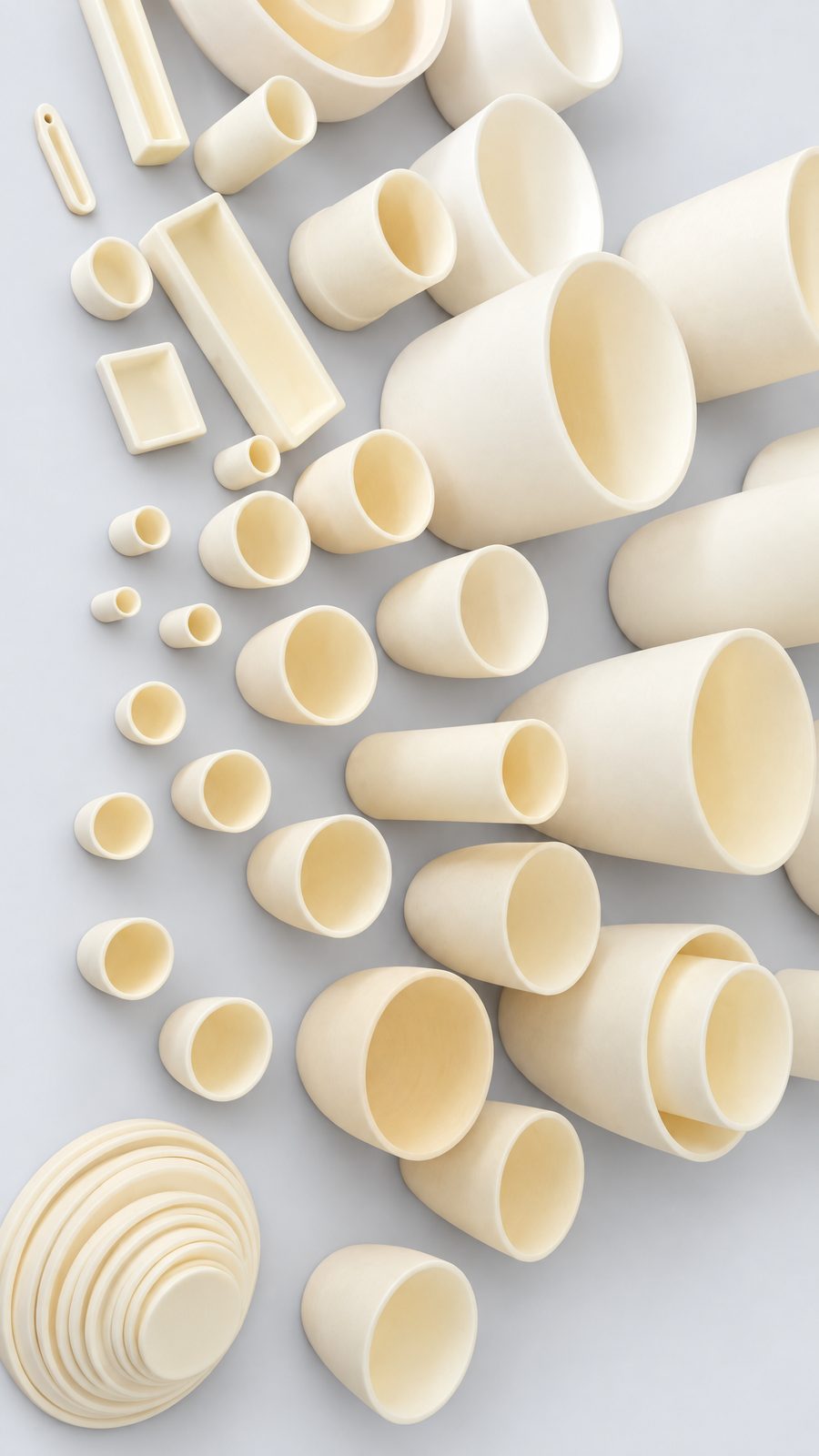
Start from the charge and the furnace, not the capacity figure. Work out the volume your charge takes up, leave room above it, then pick the shape whose footprint fits the furnace or the work tube. Use a boat when the sample slides into a tube furnace, and a crucible for a deeper charge. Our tables list 79 crucible sizes from 0.5 to 1500 ml, 67 boats and 32 lids, in 99% and 99.5% Al₂O₃.
Same capacity, different shapes
The capacity says little about the footprint. Many capacities come as an arc-shaped crucible, which tapers from a wide rim to a narrower base, as a taller arc-shaped version and as straight cylinders. At 10 ml our cylinders alone run from 19 mm wide and 58 mm tall to 30 mm wide and 28 mm tall.
| ml | Arc-shaped | Tall arc | Cylinder |
|---|---|---|---|
| 10 | 30/20/28 | 28/20/32 | 19×58, 20×50, 30×28 |
| 50 | 50/30/48 | 50/30/54 | 30×100 |
| 150 | 73/43/67 | 67/41/80 | 50×100 |
| 300 | 88/53/85 | – | 70×100, 80×80, 95×60 |
| 800 | 113/62/140 | – | 80×200, 115×110 |
| 1300 | 135/83/150 | – | 115×155 |
Pick by the space you have. A tall, narrow crucible suits a crowded furnace or a small opening. A wide, shallow one spreads the charge thin, which helps when you dry or calcine a powder. Every size is on the crucibles and boats page.
Capacity against your charge
The capacities are nominal figures from the industry size tables we work from, so leave headroom rather than filling to the listed figure. If an internal depth or diameter matters, put it on the request.
Size by volume, not mass: 20 g of a powder with a bulk density of 0.8 g/cm³ takes 25 ml before it's heated. Then leave room above it. Almath advises against overfilling or over-compacting a crucible, and says to allow for the charge expanding differently from the crucible. It also warns that a crucible with too little clearance to the top and sides of the furnace can crack as it expands, and keeps its crucibles at least 25 mm, preferably 50 mm, from the heating elements.
Lid or no lid, and which lid
A lid keeps furnace debris out of the charge and spatter in. Leave it off when gases have to escape or the furnace atmosphere has to reach the sample. We make four kinds:
- Flat round lids, 21–51 mm across, that rest on the rim.
- Outer lids, OD 20–100 mm, that fit over the rim.
- Stepped inner lids, large OD 12–100 mm, whose smaller step fits inside the rim.
- Rectangular lids for boats, 50×20 to 120×60 mm outside.
17 boat sizes are also listed with lids. Our tables don't pair lids with crucibles, so put the crucible and the lid on one request: an outer lid's ID has to clear the rim OD, an inner lid's step has to enter the rim ID, and both are confirmed together in the quotation.
Boat or crucible
A boat is long and shallow. It slides into the work tube of a tube furnace, or spreads a powder thin along its length. A crucible holds a deeper charge and stands in a box or muffle furnace. Our 67 boat sizes run from 20 to 250 mm long in five shapes: rectangular, rectangular with holes, boat-shaped, half-round bottom and trapezoid. The boat's width and height have to pass the work tube's ID with room to spare. Our alumina boat guide has a finder that lists every boat that passes your tube's ID.
| Shape | Sizes | Length × width × height (mm) | Examples |
|---|---|---|---|
| Rectangular | 30 | 45–150 × 8–100 × 6–50 | 45×8×6, 150×20×20 |
| Rectangular, perforated | 6 | 73–100 × 24–84 × 17–35 | 73×30×22, 100×84×35 |
| Boat-shaped | 9 | 27–115 × 7–30 × 6–20 | 27×7×6, 115×30×20 |
| Half-round bottom | 14 | 38–250 × 20–65 × 15–30 | 38×34×18, 250×40×18 |
| Trapezoid | 8 | 20–100 × 20–77 × 14–27 | 20×20×17, 100×77×27 |
| Rectangular, with lid | 10 | 50–120 × 20–65 × 20–40 | 50×20×20, 120×60×40 |
| Trapezoid, with lid | 1 | 60 × 30 × 15 | 60×30×15 |
| Round bottom, with lid | 6 | 60–100 × 20–54 × 15–25 | 60×54×24, 100×40×25 |
Boats also come in porcelain. CoorsTek limits its glazed chemical porcelain to 1,150 °C, so above that you need a more refractory boat, such as alumina. Our crucible materials guide compares the two with quartz, zirconia, graphite and platinum.
TGA pans and other instrument crucibles
An instrument decides its own crucible. METTLER TOLEDO's selection factors for thermal analysis include material, volume, mass, base flatness and sample-changer compatibility, so the same capacity does not make a replacement. Our smallest sizes, a 0.5 ml cylinder 20×4 mm and a 1 ml cylinder 11×20 mm, are general labware. For an instrument part, such as a thermal-analysis pan, send the model, the original part reference and the drawing it must match, and we quote a part to that drawing, as with our other custom alumina ceramic parts. Used pans are covered in our crucible cleaning guide.
Heating, cooling and grade
Heat and cool slowly, and more slowly for large crucibles. CoorsTek gives 150 °C per hour for its high-alumina labware. Almath gives at most 5 °C per minute for its larger crucibles, says to stand them on a plate of the same material and never to stack them inside each other. Those are their figures for their own ware, compared in our alumina thermal shock guide. Our crucibles are used up to 1,650 °C in air, and we confirm the grade for each part in the quotation. Our alumina maximum temperature guide explains why published limits differ.
What to put on the request
- Shape and size from our table, or your drawing, plus any internal depth or diameter that matters.
- Grade: 99% or 99.5% Al₂O₃, and the lid type if you need one.
- What goes in it, the peak temperature, the atmosphere and your heating and cooling rates.
- For an instrument part, the model and the original part reference.
- Quantity.
Each size in the table above, and all 195 rows on the crucibles and boats page, opens the quote form with that size filled in. Or send the crucible specification directly.
Questions buyers ask
- What is the difference between an alumina boat and a crucible?
- A boat is long and shallow and usually slides into the work tube of a tube furnace. A crucible holds a deeper charge and stands in a box or muffle furnace. In a tube furnace, the boat’s width and height must pass the tube’s inside diameter with room to spare.
- Do alumina crucibles come with lids?
- Lids are separate parts. We make flat round lids, outer lids that fit over the rim, stepped inner lids and rectangular lids for boats, and 17 boat sizes are listed with lids. Order the lid on the same request as the crucible so both sets of dimensions are confirmed together.
- Is a high alumina crucible the same as a 99% alumina crucible?
- Not necessarily. High alumina is not a grade: our own material table uses it for ceramic with more than 85% Al₂O₃. Ask for the Al₂O₃ percentage. Our crucibles, boats and lids come in 99% and 99.5%.
- How much does an alumina crucible cost?
- The price depends on the size, grade, lid and quantity, so send those and we quote the part.
Sources
- Almath Crucibles: alumina crucible instructions, handling with care
- CoorsTek: Labware catalog (high-alumina labware heating and cooling rate)
- CoorsTek: Labware catalog, chemical-porcelain properties (page 3) and AD-998 high-alumina properties (page 10)
- METTLER TOLEDO: alumina crucibles for thermal analysis and selection factors
- Our own figures: the factory’s standard-size list, 2026 orders and test report, as recorded in our product catalog.