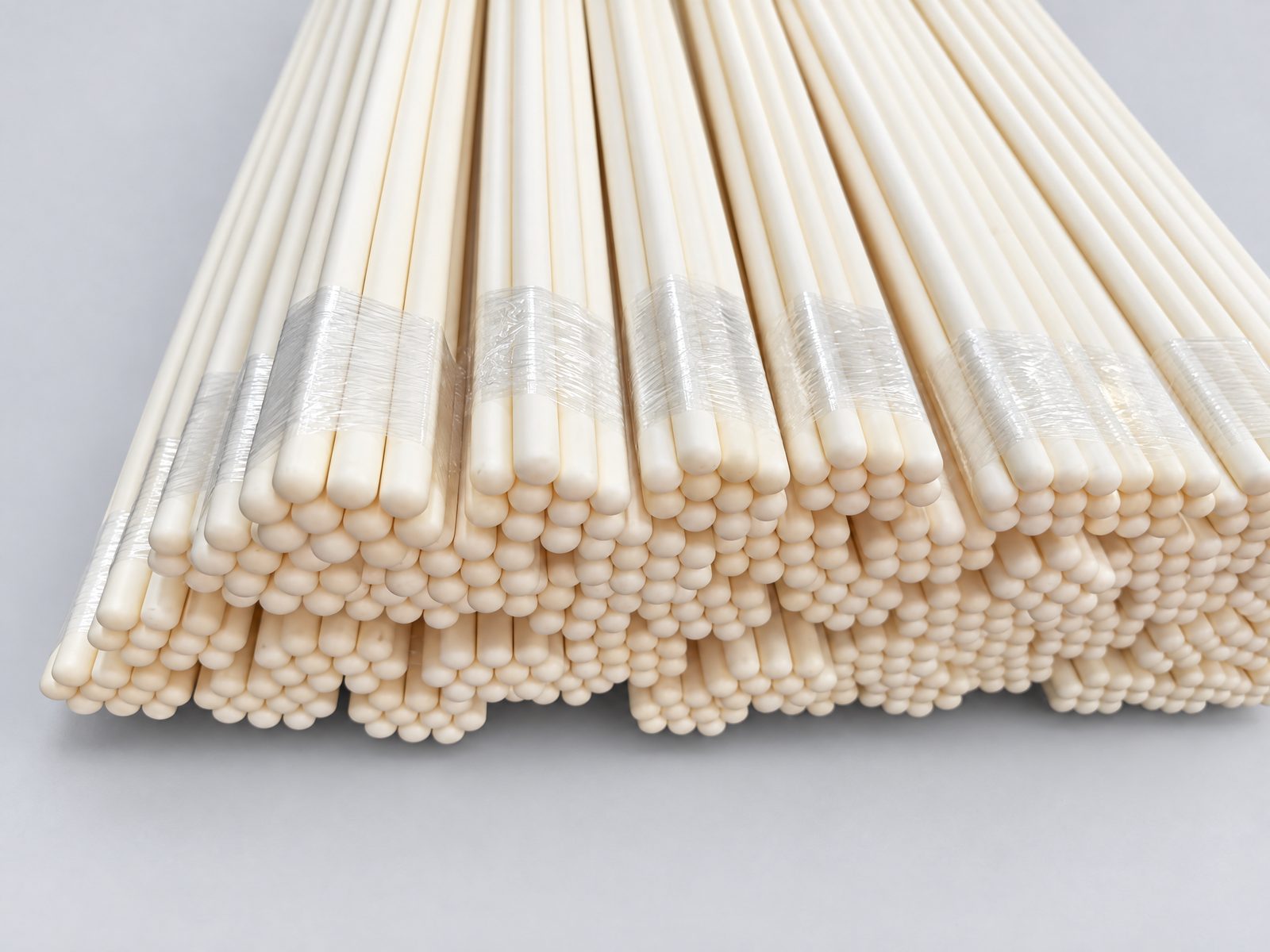
WIKA generally puts base-metal types K, N and J in metal tubes, which reach up to 1,200 °C depending on the steel, and platinum types R, S and B in ceramic. Above 1,200 °C it recommends gas-tight ceramic, preferably C 799 alumina. C 610 mullite is cheaper, but JUMO rules it out in reducing gas and for platinum. For molten metal, none of the sources lists dense alumina at all.
The selector below applies those published rules to your thermocouple type, temperature and atmosphere, and shows whose rule each line is. Where WIKA, JUMO, Rössel and the DIN 43724 table don't cover a case, it says so rather than guessing.
Selector: type, temperature, atmosphere and melt
Protection tube material selector
Shortlists tube materials from WIKA, JUMO, Rössel and the DIN 43724 table reproduced by Morgan. It shows each source's rule next to the material, and says so where none of them decides. It is not an approval of a complete assembly.
Type K: WIKA's table gives IEC 60584-1 up to 1,200 °C (class 2) and ASTM E230 up to 1,260 °C. Those are tolerance ranges, not service limits; thinner wire has a lower one.
C 799 alumina (over 99% Al₂O₃, gas-tight; old name KER 710)Fits the cited limits
WIKA 1,600 °C (usable up to); Morgan (DIN 43724 table) 1,600 °C (max. continuous, sheath tube); Rössel 1,600 °C (max. use temperature).
- Rössel lists C 799 for gases of all kinds.
- WIKA: C 799 is only partially resistant to changes in temperature; pre-heat it and insert it slowly, and support long horizontal tubes.
Our standard grade is C799 alumina, 99.5% Al₂O₃.
C 610 mullite (about 60% Al₂O₃, gas-tight; old name KER 610)Fits the cited limits
WIKA 1,500 °C (usable up to); Morgan (DIN 43724 table) 1,400 °C (max. continuous, sheath tube); Rössel 1,600 °C (max. use temperature).
- The DIN 43724 guideline reproduced by Morgan lists C 610 for alkali- and hydrofluoric-acid-free gases up to 1,500 °C.
- JUMO: KER 610 becomes noticeably conductive above 1,000 °C, which can falsify the thermocouple signal.
Where buyers would use C 610 mullite, we supply 95% white alumina or our standard C799 alumina instead.
C 530 aluminium silicate (porous, not gas-tight)Fits with a condition
WIKA 1,600 °C (as outer tube over a gas-tight inner tube); Morgan (DIN 43724 table) 1,350 °C (max. continuous, sheath tube); Rössel 1,500 °C (max. use temperature).
- WIKA: used as an outer tube with a gas-tight inner tube; its strength is thermal shock resistance.
Our tubes are alumina; this material comes from specialist makers.
Metal tubes (3 of 4 steels within a cited limit; metal tubes come from metal-tube makers)
Heat-resisting steel 1.4749 (446)Fits the cited limits
WIKA 1,150 °C (in air); Rössel 1,100 °C (max. use temperature).
- The temperature figures are for air.
Our tubes are alumina; this material comes from specialist makers.
Heat-resisting steel 1.4841 (310 / 314)Fits the cited limits
WIKA 1,150 °C (in air); Rössel 1,200 °C (max. use temperature).
- The temperature figures are for air.
Our tubes are alumina; this material comes from specialist makers.
Heat-resisting steel 1.4762Fits the cited limits
WIKA 1,200 °C (in air); Rössel 1,200 °C (max. use temperature).
- The temperature figures are for air.
Our tubes are alumina; this material comes from specialist makers.
Stainless steel 1.4571 (316Ti)Ruled out by a source
WIKA 800 °C (in air); Rössel 800 °C (max. use temperature). 1,100 °C is above every one of these.
- The temperature figures are for air.
Our tubes are alumina; this material comes from specialist makers.
Our closest tubes
C799 alumina (99.5% Al₂O₃) as standard. The European C 799 series sizes: 10×6 mm, 15×10 mm, 24×18 mm. In air our tubes are used up to 1,750 °C hanging vertically and 1,650 °C lying horizontally.
Send the type, temperature, atmosphere and size for a quoteMaximum temperature by tube material, and whose figure it is
Three sources give three different limits for the same ceramic class. They describe different things: WIKA a usable temperature in its assemblies, the DIN 43724 sheath-tube table a maximum continuous temperature, and Rössel a maximum use temperature for the material.
| Material | WIKA (°C) | DIN 43724 table, Morgan (°C) | Rössel (°C) | From us |
|---|---|---|---|---|
| C 799 alumina | 1,600 | 1,600 | 1,600 | 99.5% (C799) |
| C 610 mullite | 1,500 | 1,400 | 1,600 | 95% white or C799 alumina instead |
| C 530 aluminium silicate | 1,600 | 1,350 | 1,500 | – |
| Stainless steel 1.4571 | 800 | – | 800 | – |
| Heat-resisting steel 1.4749 | 1,150 | – | 1,100 | – |
| Heat-resisting steel 1.4841 | 1,150 | – | 1,200 | – |
| Heat-resisting steel 1.4762 | 1,200 | – | 1,200 | – |
Our standard tube is C799 alumina, 99.5% Al₂O₃. Our corundum tubes are used up to 1,750 °C hanging vertically and 1,650 °C lying horizontally, in air. Materials across the whole range, including quartz, zirconia and silicon carbide, are compared in the alumina maximum temperature guide.
Porcelain tubes: mullite with silica in it
When a seller lists a porcelain tube for thermocouples, it is usually a mullite ceramic of the C 610 class, not alumina. Tempco sells “Porcelain (Mullite)” protection tubes rated to 1,400 °C, against 1,700 °C for its alumina, and notes that the porcelain contains silica, is attacked by halogen gases and has poor thermal shock resistance (alumina: fair). JUMO gives its KER 610 as 60% Al₂O₃, 37% SiO₂ and 3% alkali, and Morgan its C 610 tube as 56–58% Al₂O₃, working up to 1,400 °C.
When a porcelain tube is enough, and when to use alumina
- Porcelain is enough for base-metal thermocouples (K, N, J) in clean, oxidising furnace gas. WIKA puts type K, N and J wire in C 610 insulating tubes, and the DIN 43724 guideline reproduced by Morgan lists C 610 for alkali- and HF-free gases up to 1,500 °C.
- Use alumina for platinum types R, S and B. Tempco recommends alumina tubes and insulators above 1,093 °C because silica contaminates platinum, and JUMO requires KER 710 (C 799) for both the tube and the insulating rod.
- Use alumina in reducing gas, which JUMO rules out for KER 610. JUMO also says KER 610 becomes noticeably conductive above 1,000 °C, which can falsify the signal.
Where a drawing or order asks for C 610 or a porcelain tube, we supply 95% white alumina or our standard C799 alumina instead, and the C799 alumina where the thermocouple is platinum or the gas is reducing. The class numbers and old KER names are in C 799, C 610 and C 530.
What the sources say about the atmosphere
- JUMO: KER 610 (C 610) must not be used in reducing atmospheres, because of its SiO₂ content.
- JUMO: a gas-permeable tube can't be used alone in reducing gas; with a gas-tight inner tube, the outer one may be porous.
- JUMO: in reducing gas, 0.2% SiO₂ in the tube or insulator is enough to form brittle platinum silicides. For platinum types, both the insulating rod and the tube must be KER 710 (C 799).
- WIKA: above 1,200 °C with platinum types, use gas-tight ceramic, preferably high-purity C 799.
- WIKA: C 799 and C 610 are not resistant to alkali vapours. The DIN 43724 guideline (Morgan) allows C 799 with alkali vapours or melting glass up to 1,500 °C and C 610 only in alkali-free gases; Rössel lists C 799 for alkali vapours and glass tanks.
- WIKA: process gas can diffuse through a ceramic tube at high temperature, so the wire must suit the atmosphere too.
- JUMO: KER 610 becomes noticeably conductive above 1,000 °C and can falsify the signal.
The alkali rules disagree, so we show all three. None of these sources gives a vacuum rating for a protection tube; Nabertherm's vacuum figures (C 799 1,400 °C, C 610 1,200 °C, C 530 not possible) are for furnace work tubes.
For metal tubes, WIKA also rates each steel against sulphurous, low-oxygen and carburising gases (page 10 of TE 65.80). 1.4762 and 1.4749 rate high or very high against sulphurous gases, 1.4841 is the one WIKA rates high for nitrogenous, low-oxygen gases. The steels themselves are compared in thermocouple types and temperature ranges.
Endress+Hauser's material table (TI00251T) adds the nickel and FeCrAl alloys, as recommended maximums for continuous use in air. Inconel 600 (1,100 °C) is not to be used in sulphur-bearing atmospheres and Inconel 601 (1,200 °C) is particularly sensitive to sulphidation, while Incoloy 800HT (1,100 °C) suits sulphur-bearing environments. Kanthal AF (1,300 °C) resists sulphur and carburizing gas but must not be used with chlorides or nitrogenous gases such as cracked ammonia.
Molten metal: alumina isn't on the list
Neither WIKA's melt table nor Rössel's lists dense alumina for a metal melt. They list steels, cast iron, cermets, silicon nitride, graphite and aluminium titanate, and Rössel rules out its silicon carbide grades for aluminium and copper. Kyocera sells silicon nitride (StarCeram N) protection tubes for foundries, rated to 1,000 °C, citing very low wettability by non-ferrous melts. For a tube that goes into the melt, specify one of these; alumina belongs above the melt or inside another tube, as the next section shows.
Tube materials listed for metal melts (22 rows)
| Material | Melts | °C | Source |
|---|---|---|---|
| Steel 1.4841 | aluminium | 700 | WIKA |
| Pure iron 1.1003 | aluminium, magnesium (magnesium-containing aluminium) | – | WIKA |
| Steel 1.0305 | bearing (babbitt) metal | 600 | WIKA |
| Steel 1.0305, 1.4841, alloy 2.4867 | lead | 700 | WIKA |
| Steel 1.0305, 1.4749, 1.4762 | zinc | 480 | WIKA |
| Pure iron 1.1003 | zinc | 600 | WIKA |
| Steel 1.0305 | tin | 650 | WIKA |
| Steel 1.4762 | copper | 1,250 | WIKA |
| Steel 1.4841 | brass (copper-zinc) | 900 | WIKA |
| Enamelled steel | zinc | 600 | Rössel |
| Steel 1.0305 | bearing (babbitt) metal, lead, tin (melts up to 650 °C) | 900 | Rössel |
| Steel 1.4749 | lead, tin | 1,100 | Rössel |
| Steel 1.4772 | copper, brass (copper-zinc) | 1,250 | Rössel |
| Steel 1.4841 | lead (lead melts up to 700 °C) | 1,200 | Rössel |
| Grey cast iron (GG 22) | bearing (babbitt) metal, lead, aluminium, zinc | 700 | Rössel |
| Grey cast iron, ceramic-coated | aluminium, zinc | 800 | Rössel |
| Cr-Al₂O₃ 77/23 (cermet) | copper, tin, zinc, magnesium, lead (not for aluminium or glass melts, or salt baths) | 1,200 | Rössel |
| Mo-ZrO₂ 60/40 (cermet) | cast iron, copper, zinc (oxidises in air from 500 °C) | 1,700 | Rössel |
| Silicon nitride | aluminium, brass (copper-zinc) (not wetted by aluminium and brass melts; impact-sensitive) | 1,000 | Rössel |
| Silicon nitride + alumina | copper, aluminium | 1,300 | Rössel |
| Graphite | copper, brass (copper-zinc), aluminium (oxygen-free melts; oxidises heavily in air) | 1,250 | Rössel |
| Aluminium titanate | aluminium (impact-sensitive) | 1,000 | Rössel |
Steel plants and glass furnaces: where alumina is used
In metal and glass plants, the sources put alumina thermocouple tubes above the melt or inside another tube. In the glass itself they use platinum.
- Inside a metal tube. Rössel says platinum thermocouples in metal protection tubes generally get a ceramic inner tube, against contamination by metal ions, especially at higher temperatures.
- Heat-treatment and annealing furnaces. WIKA names 1.4762 steel for heat-treatment and annealing furnaces. JUMO says a porous tube alone can't go into a reducing atmosphere such as an annealing furnace, so the inner tube there must be gas-tight.
- Glass furnace crown. Pyrosales says the crown thermocouples, which see the highest temperature, use Type B in recrystallised alumina sheaths, depending on the glass and the temperature, and that glass furnaces work at up to 1,575 °C.
- In the glass. Pyrosales says glass temperature needs a platinum sheath because glass is abrasive and corrosive, and its forehearth thermocouples sit in ODS platinum or platinum-rhodium. Rössel lists C 799 for glass tanks, with a platinum coating for glass melts, and Endress+Hauser names sintered silicon carbide for glass feeders and float glass.
Optical-glass and specialty-alloy producers use our alumina tubes and insulators in their melting, annealing and heat-treatment furnaces. For molten steel and glass, our alumina tubes go above the melt or inside a metal or platinum outer sheath, as described above. For kilns, see kiln thermocouples.
What to send for a quotation
- Thermocouple type and wire diameter.
- Maximum and normal working temperature at the tube, and how fast it heats up.
- The atmosphere: air, reducing, sulphur-bearing, alkali or glass, vacuum.
- OD × ID × length with tolerances (DIN 40680 or your own), closed or open end, and how the tube is mounted and supported.
- Grade if you have one in mind (99.5% is standard) and the quantity.
Our stock sizes are on the ceramic thermocouple protection tubes page; the European series and lengths are in thermocouple protection tube sizes, and the grade names in C 799, C 610 and C 530. Or send the conditions for a quote.
Questions buyers ask
- What is the best protection tube material for a type S thermocouple?
- WIKA recommends gas-tight ceramic, preferably high-purity C 799 alumina, above 1,200 °C, and JUMO says both the insulating rod and the tube must be KER 710 (C 799) for platinum thermocouples. JUMO also warns that 0.2% SiO₂ in the tube or insulator is enough to form brittle platinum silicides in a reducing atmosphere.
- Can a C 610 mullite tube be used in a reducing atmosphere?
- JUMO says no: because of its high SiO₂ content, KER 610 (C 610) must not be used in reducing atmospheres. A porous tube such as C 530 can be used only over a gas-tight inner tube.
- Is an alumina tube suitable for molten aluminium?
- None of the sources we cite lists dense alumina for metal melts. Rössel lists materials such as aluminium titanate, silicon nitride, graphite and ceramic-coated cast iron for aluminium melts, and WIKA lists steel 1.4841 up to 700 °C.
- What is a porcelain thermocouple tube?
- Usually a mullite tube with silica in it, the C 610 class. Tempco sells Porcelain (Mullite) tubes rated to 1,400 °C, against 1,700 °C for its alumina, and JUMO’s KER 610 is 60% Al₂O₃ and 37% SiO₂. It suits base-metal thermocouples in oxidising gas. For platinum types or reducing gas, use alumina. Where buyers ask for C 610 or porcelain, we supply 95% white alumina or our standard C799 alumina instead.
- How hot can a C 799 protection tube go?
- WIKA lists C 799 as usable up to 1,600 °C, the DIN 43724 table reproduced by Morgan gives 1,600 °C continuous, and Rössel 1,600 °C. In contact with alkali vapours or melting glass, the DIN guideline gives 1,500 °C. Those are other makers' figures. Our own corundum tubes are used up to 1,750 °C hanging vertically and 1,650 °C lying horizontally, in air.
Sources
- WIKA data sheet TE 65.80, thermocouples with ceramic protection tube
- JUMO data sheet 90.1000 (German), KER 710 and KER 610
- Rössel-Messtechnik, Praxis der Thermoelemente (German), Table 9 and insulating rods
- Morgan Advanced Materials Haldenwanger: Ceramic tubes brochure (working temperatures; DIN 43724 sheath tube table, pages 12–13)
- DIN Media: DIN 43724, withdrawn (DIN EN 50446 recommended)
- Nabertherm: Laboratory Furnaces catalogue, working tubes table (pages 56–57)
- Endress+Hauser TI00251T (16.25), iTHERM FlameLine: protection tube materials, pages 14–16
- KYOCERA Fineceramics Europe: thermocouple protection tubes made of StarCeram N (silicon nitride, foundry), 2024
- Pyrosales: Focus on the glass industry (crown and glass thermocouples)
- Pyrosales: Thermocouples for the glass industry (forehearth tri-levels)
- Tempco: ceramic protection tubes, catalog page 14-85 (alumina and porcelain/mullite limits)
- Our own figures: the factory’s standard-size list, 2026 orders and test report, as recorded in our product catalog.