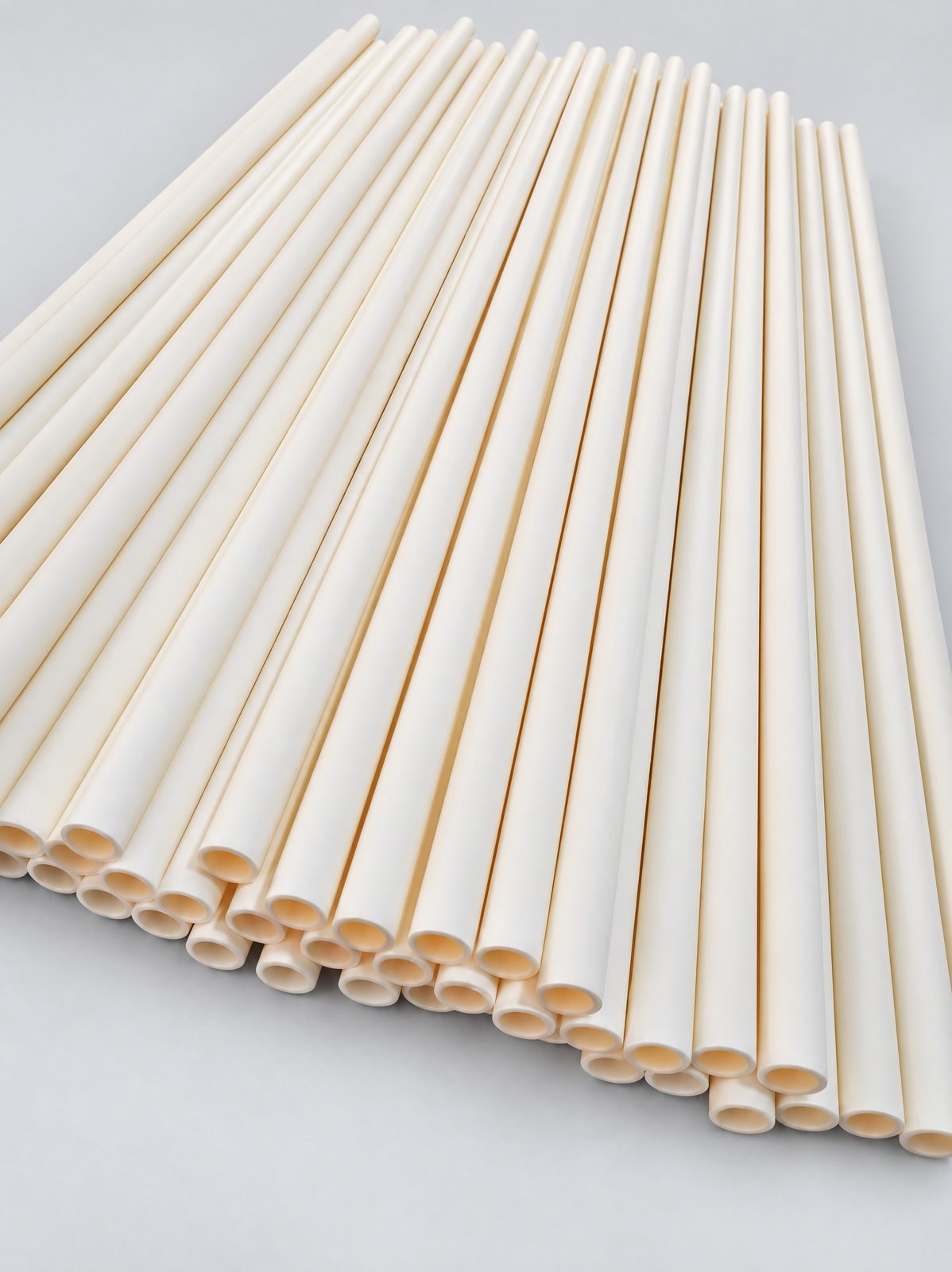
Alumina is aluminium oxide, Al₂O₃, and is made into a white ceramic. Aluminium (aluminum in the US) is the metal. Alumina melts at 2,054 °C and doesn't conduct electricity. Aluminium melts at 660 °C and conducts 62% as well as copper. Alumina is also the raw material for aluminium: about two tonnes of it make one tonne of metal. So an alumina tube and an aluminium tube are different parts, and only the alumina one survives a furnace above 660 °C.
Alumina and aluminium side by side
| Alumina | Aluminium | |
|---|---|---|
| What it is | Aluminium oxide, Al₂O₃ | The metal, Al |
| As a powder | White | Silvery-white to grey |
| Melting point | 2,054 °C | 660 °C |
| Density, g/cm³ | 3.97 (the oxide); 3.72 to 3.90 for dense ceramic | 2.7 |
| Electricity | Insulator: over 10¹⁴ Ω·cm at 25 °C (AD-995) | Conductor, 62% of copper |
| Made from | Bauxite, by the Bayer process | Alumina, about two t per t of metal |
| As a furnace tube | Rated to 1,700 °C (Tempco) | Melts at 660 °C |
Fired alumina is the heavier of the two: 3.90 g/cm³ for CoorsTek's 99.5% grade against 2.7 g/cm³ for the metal. The bigger difference is heat. A furnace at 1,000 °C is far above aluminium's melting point and well inside the range alumina tubes are sold for. Density by grade is in alumina density and properties by purity.
How one becomes the other
Alumina refineries dissolve bauxite in hot caustic soda, let the impurities settle out as mud, grow alumina hydrate crystals from the clear liquor and dry them above 1,000 °C. The Australian Aluminium Council describes the result as a white granular material, "a little finer than table salt". Smelters turn about two tonnes of it into one tonne of aluminium.
It also works the other way round, on the surface. Aluminium forms a natural film of aluminium oxide when it meets air, and the film reforms if it is scratched. An aluminium part in air carries that thin skin of alumina, but it is still a metal part.
Ceramic parts start from calcined alumina powder. Ours arrives in 25 kg sacks. We mill it, form the parts by extrusion or slip casting, and fire them in kilns, as the photos on our factory page show. Nothing in the process turns it back into metal.
Other names for alumina on quotes and data sheets
- Aluminium oxide, aluminum oxide, Al₂O₃. The same compound. The ILO safety card lists alumina and alpha-aluminum oxide as synonyms.
- Corundum. The mineral made only of aluminium and oxygen. Sapphire and ruby are corundum, GIA says. Chinese makers use 刚玉 (corundum) for their high-purity alumina ceramic: our 刚玉瓷 is C799 alumina, 99.5% Al₂O₃. A "corundum tube" or "corundum crucible" from China is an alumina part.
- High alumina (高铝). Not a grade. In our own material table it means more than 85% Al₂O₃ with under 12% SiO₂. Ask for the percentage.
- Porcelain. Tempco sells "porcelain (mullite)" protection tubes that contain silica and rates them to 1,400 °C, against 1,700 °C for its alumina. In Chinese factory names, 陶瓷 (ceramics) is often translated as porcelain. Ours, 唐山市高铝刚玉工业陶瓷厂, was printed in English as "High-Aluminium & Corundum Industrial Porcelain Factory of Tangshan". 高铝 means high-alumina, translated word by word as high-aluminium. The factory makes alumina ceramics, not aluminium and not tableware.
- C 799, C 610, C 530. Class codes from IEC 60672 for alumina, mullite and porous aluminosilicate ceramics. Our grades guide explains them.
When you search or order
Keyword tools lump the two words together. In our own keyword research, "alumina plate" and "alumina rod" came back with aluminium-sized search counts. Write the material so it can't be misread:
- "Alumina ceramic" or "Al₂O₃ ceramic", never "alumina" alone in a subject line or part description.
- The purity as a number: "99.5% Al₂O₃". A grade class alone ("high alumina", "corundum") is not enough.
- The temperature and atmosphere the part will see, so the supplier can say whether the grade suits it.
If a part has to carry current, you want the metal. If it has to insulate a thermocouple wire, hold a melt or line a furnace at 1,000 °C and above, you want the ceramic. For platinum thermocouples, Tempco notes that silica contaminates platinum and recommends alumina tubes and insulators above 1,093 °C.
What we make
We make alumina ceramic parts, not aluminium: thermocouple protection tubes, multi-bore insulators, furnace tubes, crucibles and boats, and custom aluminum oxide parts made to your drawing. Our standard grade is 99.5% Al₂O₃ (C799), and we supply 95% white alumina where a drawing names C 610. The grade is confirmed for each part in the quotation. Chinalco Testing measured 99.55, 99.57 and 99.61% Al₂O₃ on our yearly tube samples, 2024–2026 (test reports).
What to send for a quotation
- The part and its size: OD × ID × length for a tube, or a drawing.
- The Al₂O₃ grade, or the temperature and atmosphere if you want us to suggest one.
- Quantity and delivery country.
Send it from the quote page or to the address on it. Every standard size we make is listed on the products page.
Questions buyers ask
- Is alumina the same as aluminum?
- No. Alumina is aluminium oxide, Al₂O₃, made into a ceramic. Aluminum (aluminium) is the metal. Alumina is the raw material for the metal: the Australian Aluminium Council says about two tonnes of alumina make one tonne of aluminium.
- Is alumina a metal?
- No. It is an oxide, and once fired it is a ceramic that insulates: CoorsTek gives its 99.5% AD-995 a volume resistivity over 10¹⁴ Ω·cm at 25 °C. Aluminium conducts 62% as well as copper, per the Australian Aluminium Council.
- Which melts first, alumina or aluminium?
- Aluminium, at 660 °C. Alumina melts at 2,054 °C. Both figures are from the ILO International Chemical Safety Cards. Tube makers rate alumina well below its melting point: Tempco gives 1,700 °C for its alumina protection tubes.
- Is a corundum crucible the same as an alumina crucible?
- From a Chinese maker, yes: 刚玉 (corundum) is the trade word for high-purity alumina ceramic, and our standard grade is C799 alumina. Ask for the Al₂O₃ percentage, because high alumina (高铝) covers ceramic with more than 85% Al₂O₃ in our own material table.
Sources
- ILO/WHO International Chemical Safety Card 0351: aluminium oxide (melting point)
- ILO/WHO International Chemical Safety Card 0988: aluminium powder (melting point, density)
- Australian Aluminium Council: alumina refining (Bayer process, alumina per tonne of aluminium)
- Australian Aluminium Council: aluminium properties (conductivity, oxide film)
- CoorsTek: alumina typical properties (AD-96 and AD-995; checked 6 October 2026, hardness, specific heat and dielectric strength 16 October 2026)
- Precision Ceramics: CeramAlox alumina properties (checked 6 October 2026)
- GIA: sapphire description (corundum, sapphire and ruby)
- Tempco: ceramic protection tubes, catalog page 14-85 (alumina and porcelain/mullite limits)
- Our own figures: the factory’s standard-size list, 2026 orders and test report, as recorded in our product catalog.