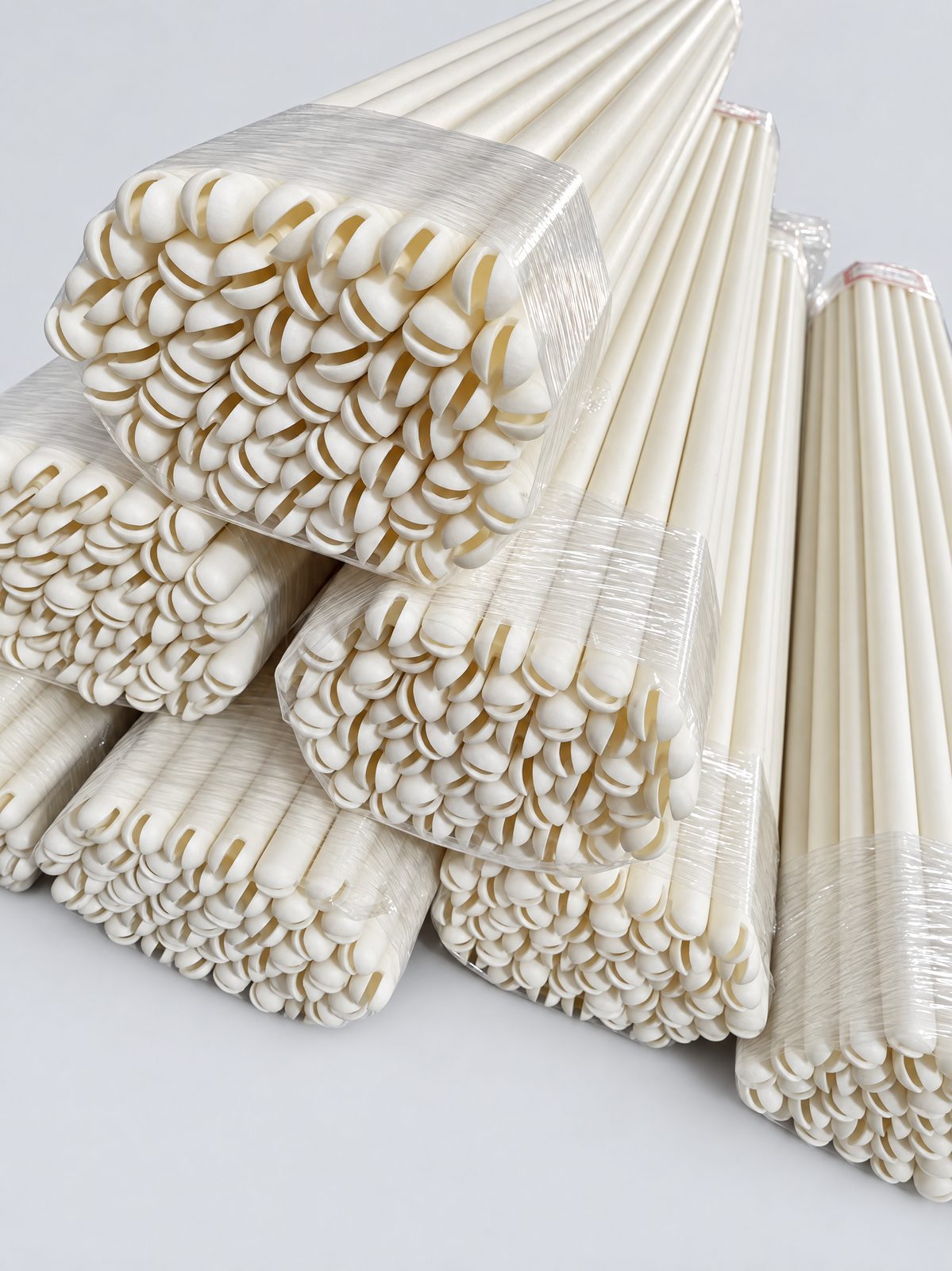
Fired alumina only cuts with diamond. Use a continuous-rim diamond blade made for ceramics, run it wet, feed with light pressure and hold the tube on both sides of the cut. That works for a few cuts in a lab or a workshop. For a batch, order the length you need: we cut lengths to order, and the protection tube orders we supplied in 2026 carried a length tolerance of ±1 mm.
Below is what the saw and blade makers publish, with the source next to each number, then what to put on an order if you'd sooner not cut at all.
Why it takes diamond
Precision Ceramics, which supplies alumina tubes and rods, says it in one sentence: once fired and sintered, alumina can only be machined using diamond grinding methods. A diamond saw blade is a thin grinding wheel. It doesn't slice the tube, it grinds a slot through it.
Buehler, which makes laboratory cut-off saws, adds two things. Cubic boron nitride blades, the usual choice for hard steel, aren't recommended for ceramics. And diamond works better on ceramics than on metals: in its own test, the same saws got through alumina and zirconia faster than through cast iron and stainless steel.
You'll also find forum advice to score a thin tube with a file and snap it. We couldn't find a tube maker or a tool maker who publishes that method, so it isn't covered here.
Which blade
| Choice | Recommendation | Source |
|---|---|---|
| Abrasive | Diamond. Cubic boron nitride isn't recommended for ceramics | Buehler |
| Diamond concentration | Low concentration, metal bond, for ceramics | Buehler; Kemet |
| Rim | Continuous. Segmented only where the edge doesn't matter | UKAM; MK Diamond |
| Bond | Sintered metal bond for production cutting and deeper cuts; resin bond for precision sectioning and thin substrates | UKAM |
| Grit | 120–220 mesh for general production cutting, 220–325 mesh where edge quality matters | UKAM |
| Thickness | As thin as the saw allows: a thinner blade does less damage, and the kerf is about the blade width | Buehler |
Low concentration sounds wrong. More diamonds should cut faster, and in metal they do. Buehler explains why ceramics are different: metal is ploughed away, but a brittle ceramic is cut by fracture. With fewer diamonds in the rim, each one presses harder on the alumina, hard enough to chip off small flakes. Kemet sorts its wheels the same way, with a low-concentration metal bond for ceramics and glass.
| Blade series | Diamond size | Buehler's application |
|---|---|---|
| 20 LC | Coarse | Very hard materials: ceramics, carbides and nitrides |
| 15 LC | Medium coarse | Very hard materials (less aggressive than 20 LC), plus glass, electronic devices and concrete |
| 10 LC | Fine | Lower hardness ceramics |
Speed, load and feed
Published cutting data for alumina is scarce. The clearest set we found is a Buehler test on 12.7 mm alumina and zirconia specimens with 178 mm low-concentration blades, on two of its laboratory saws:
| Saw | Blade speed (rpm) | Load or feed | Result |
|---|---|---|---|
| Gravity-fed precision saw | 700 | 400 g load | Slower; the finest blade (10 LC) struggled on alumina |
| Linear-feed high-speed saw | 3,200 | 0.75 inch/min (19 mm/min) | Just under 40 seconds per cut, whichever blade |
Buehler found alumina harder to cut than zirconia. The coarse 20 LC blade was fastest and the fine 10 LC slowest, and the difference in surface finish between them was minor. So for cutting tubes to length, a medium or coarse ceramic blade is the sensible pick.
Don't push to save time. Buehler warns that the heaviest load and highest speed don't always give the fastest cut, and that too much of either drives up the damage. MK Diamond's rule for continuous-rim blades is light to medium pressure: feed slowly until the blade cuts at its own speed, and never let it slow down. A forced blade glazes over and stops cutting, or bends.
Wet or dry
Wet. UKAM strongly recommends wet cutting for 99.5% alumina. Buehler lists what the coolant does: it lubricates the cut, carries the heat away and flushes out the swarf. MK Diamond adds that water keeps the dust down, and gives the rule that matters if you're borrowing a blade: water can be used with a dry-cutting blade, but a wet-cutting blade can never be used dry.
Chipped ends, and a blade that stops cutting
Chips come at the start of the cut and where the blade breaks out. The tool makers' fixes:
- Start gently. UKAM says to reduce the feed at entry and raise it gradually.
- Back the tube up where the blade exits. UKAM's fix for exit breakout is backing support, so the last bit of wall isn't left hanging.
- Stiffen the blade. Flanges on both sides, and the larger the flange the steadier the blade (UKAM). Buehler warns that a flange that's too small lets the blade flex, which damages the blade, the part or both. UKAM's runout target for precision cutting is 0.002 inch (0.05 mm) or less.
- Dress the blade. A new metal-bond blade needs 4 to 6 cuts into a dressing stick at under 200 rpm before use, Buehler says, and again when cuts take more than 25% longer than they did. Dressing wears the blade, so do it only when needed.
Closed ends, big tubes, wet tubes
- A closed-end protection tube can only be shortened from the open end. Cut the closed end off and it's an open tube.
- Cutting several pieces from one long tube costs a kerf each time, about the blade width (Buehler). Allow for it before you order stock lengths to cut down.
- Laboratory precision saws are small. Buehler's largest takes pieces up to 50 mm in diameter, and says a thin-walled cylinder of that size is fine. 5 of our 12 standard furnace tube sizes are bigger than that and need a larger wet saw.
- Thermo-Kinetics notes that ceramics hold moisture, which can destroy a tube when it's thermally shocked, and says to preheat ceramic tubes to about 400 °C to drive it off. So dry a tube that has just come off a wet saw before you use it. More in alumina thermal shock.
Dust
Cutting alumina makes fine aluminium oxide dust. The ILO safety card for aluminium oxide lists a cough from inhaling it and redness in the eyes, and calls for local exhaust or breathing protection and safety goggles. For cleaning up, it says to moisten the dust first so it doesn't fly. Another reason to cut wet.
Ordering tubes cut to length
We cut lengths to order, on a wet cutting bench with a ruler rail and a sliding length stop. Standard sizes are usually in stock, and the length is cut to your order. What buyers wrote on the 2026 orders we supplied:
| Part | Lengths ordered (mm) | Length tolerance (mm) |
|---|---|---|
| Closed-end protection tubes | 300 to 2030 | ±1 |
| Multi-bore insulators, OD 3 to 8.5 mm | 480 to 1680 | ±1 |
| Open tubes, OD 34 mm | – | ±1 |
| Open tubes, OD 50 mm | – | ±2 |
| Open tubes, OD 65 mm | – | ±2 |
Compare that with a length left as fired. DIN 40680's medium grade, as Morgan Haldenwanger tables it, allows ±10.00 mm on a length of 900 to 1,000 mm. The ±1 mm on a cut protection tube is ten times closer. The other dimensions are in alumina tube tolerances.
We also make the other cuts buyers ask for: a slot across the closed tip of a protection tube, slits in an open end, slots across the end of a four-bore insulator, and side holes. Those go by drawing.
Standard sizes such as 10×6 mm, 15×10 mm and 24×18 mm usually ship in about 3 days for a small order and about 7 for a bulk one. All sizes are on the protection tubes, insulators and furnace tubes pages. To get a price, send OD × ID × length, the length tolerance you need, the grade and the quantity, plus a drawing for any slots or holes, and request a quote.
Questions buyers ask
- What do you cut alumina tube with?
- A diamond blade. Precision Ceramics states that once alumina is fired and sintered it can only be machined by diamond grinding. Tool makers recommend a continuous-rim blade with a low diamond concentration for ceramics, run wet. Buehler says cubic boron nitride blades are not recommended for ceramics.
- Can you cut alumina ceramic dry?
- Only with a blade made for dry cutting. UKAM strongly recommends wet cutting for 99.5% alumina, and MK Diamond warns that a wet-cutting blade can never be used dry. Water cools the blade, flushes the cuttings out of the cut and keeps the dust down.
- How fast can you cut an alumina tube?
- Slowly, and let the blade set the pace. In Buehler's test a laboratory saw at 3,200 rpm cut 12.7 mm alumina specimens in just under 40 seconds at a feed of 0.75 inch (19 mm) per minute; a gravity-fed saw ran at 700 rpm with a 400 g load. MK Diamond's rule for continuous-rim blades is light to medium pressure, never enough to slow the blade.
- Can a closed-end protection tube be shortened?
- Yes, from the open end only; cut the closed end off and it's an open tube. If you need a different length, it's easier to order it: we cut lengths to order, and the protection tube orders we supplied in 2026 carried a length tolerance of ±1 mm.
- Do you cut alumina tubes to length?
- Yes. Lengths are cut to order on a wet cutting bench with a length stop. Protection tube lengths run from 300 to 2,500 mm. We also cut end slots and drill side holes to a drawing.
Sources
- Precision Ceramics: alumina tubes and rods (machining after firing)
- Buehler TechNotes volume 3, issue 6: Precision Cutting, The Science of the Cut (blade selection, alumina cutting test, dressing, coolant)
- UKAM Industrial Superhard Tools: how to select a diamond blade for 99.5% alumina ceramic without edge chipping
- Kemet International: diamond cut-off wheels (bond and concentration by material)
- MK Diamond Products: diamond blade training manual (wet and dry blades, feed pressure, dressing)
- Thermo-Kinetics: Protection Tubes catalogue (ceramic tubes, moisture and preheating)
- ILO/WHO International Chemical Safety Card 0351: aluminium oxide (melting point)
- Morgan Haldenwanger price list, valid from 1 January 2026: standard sizes and DIN 40680 tolerance table
- Our own figures: the factory’s standard-size list, 2026 orders and test report, as recorded in our product catalog.