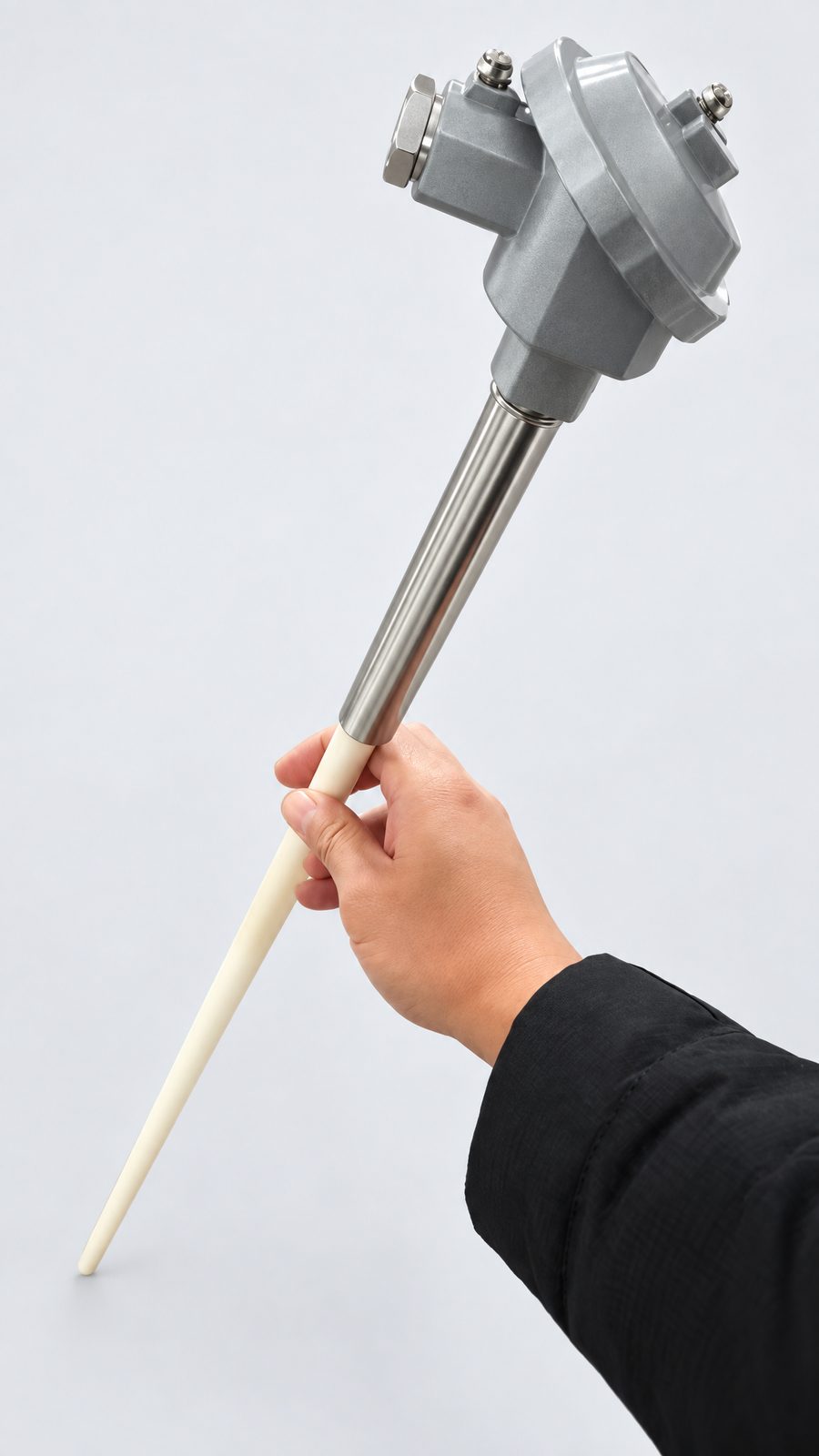
Most electric pottery kilns use a Type K thermocouple. Skutt fits an 8-gauge Type K as standard and recommends it for low fire, with occasional high fire. For regular cone 10 firing it sells a Type S: platinum-rhodium wire in a thin-walled alumina sheath. The ceramic tube keeps the kiln atmosphere off the wire, but a heavy one makes the reading lag. We make the alumina tubes and insulators these thermocouples are built from, and thermocouple makers assemble the finished sensor.
Type K or Type S in a kiln
Kiln makers and the brick industry draw the same line: Type K is cheap and drifts, while platinum Types S and R cost far more and hold their reading longer.
| Type | Where it's used, and what the maker says |
|---|---|
| K, 8-gauge | Standard on Skutt KilnMaster kilns. Low fire ceramics, occasional high fire OK; degrades with age and drifts toward overfiring (Skutt). |
| K, MI cable | Standard on Skutt GlassMaster kilns, for low fire ceramics and glass (Skutt). |
| S | Special-order upgrade from Skutt for cone 10, high fire firing after firing. Does not degrade; about 20 times the price of Type K (Skutt). |
| K | Brick kilns, in non-critical spots. Cumulative drift after time above 1,650 °F, about 900 °C (JMS Southeast). |
| R or S | Brick kilns, in control spots; Type R in the top centre of the tunnel kiln tested. Much more stable than Type K, up to ten times the price, and drifts after time at high temperature from platinum migration (JMS Southeast). |
The two sources disagree on Type S. Skutt says it doesn't degrade and won't drift, and JMS Southeast says platinum thermocouples do drift after long use at high temperature. Either way, Type S drifts far less than Type K.
Switching types means switching the whole circuit. Skutt warns that a Type S needs a Type S controller setting and Type S lead wire all the way through; mixing them can badly over-fire the kiln. After the change, Skutt has you test fire each program with only kiln furniture and witness cones inside.
How long a kiln thermocouple lasts
Skutt says life depends mainly on the wire type and the temperature. Its example: a thermocouple used at glass temperatures may last over 1,000 firings, and the same one at cone 10 only 20. The wire gauge and gases from clay and glazes count as well.
- Type K wears out gradually. Skutt says it drifts toward overfiring as it ages, and self-supporting cones show when it's time to replace it.
- Type K wire oxidises and drops black flakes, so Skutt says to vacuum the kiln now and then. Type S doesn't flake.
- Type S doesn't degrade like Type K, Skutt says, but its alumina sheath is extremely fragile, so take care loading ware or shelves around it.
What the ceramic protection tube does
On a Type S, the tube is part of the thermocouple. Skutt says it protects the probe from the kiln atmosphere and gives the thin platinum wire dimensional stability. Its Type S sheath is 1/4″ (6.4 mm) in diameter against 1/2″ (12.7 mm) for its Type K, so the hole in the brick has to be packed with fibre or the brick replaced, or the reading goes wrong.
Mass is the trade-off. Skutt keeps its Type K without a heavy tube and uses a low-mass tube on the Type S, because a high-mass tube can read low even during a long soak, and the kiln then fires hotter than the controller shows. To compare two tube sizes by weight, use the calculator with the density of alumina. If you change the tube wall or diameter on an existing kiln, check the result with witness cones.
For platinum wire, the tube material matters as much as its size. JUMO wants both the insulating rod and the tube in C 799-type alumina for platinum thermocouples, because silica poisons platinum; mullite (C 610) is ruled out. The rules and the sources are in thermocouple types and temperature ranges.
Industrial kilns: brick, ceramic and cement
Large kilns use the same choice of metal or ceramic tube as other industrial furnaces. Sensor makers name a few materials for kilns directly: WIKA the heat-resisting steel 1.4762 for cement and ceramic furnaces, up to 1,200 °C in air, Endress+Hauser sintered silicon carbide for the ceramic industry, to 1,600 °C. Above 1,200 °C WIKA moves to gas-tight ceramic, preferably C 799 alumina.
Protection tube materials named for kilns (5 rows)
| Tube material | Named for | °C (whose figure) |
|---|---|---|
| Steel 1.4762 | Cement and ceramic furnaces | 1,200 in air (WIKA) |
| CrAl₂O₃ 77/23 | Cement kilns | 1,200 (Rössel) |
| Sintered SiC | Ceramic industry, industrial ovens | 1,600 (Endress+Hauser) |
| MoSi₂ | Glass and ceramic industries (WIKA; Kanthal Super) | 1,700 (Endress+Hauser) |
| C 799 alumina | Gas-tight; above 1,200 °C in general (WIKA) | 1,600 (WIKA), 1,800 (Endress+Hauser) |
Ceramic tubes going into a kiln that is already hot need care. WIKA says C 799 must be preheated and inserted slowly; insertion rates are in the alumina thermal shock guide, and the full material selector is in thermocouple protection tube material.
Our tubes and insulators for kiln thermocouples
We make closed-end alumina protection tubes and multi-bore insulators for thermocouple and instrument makers, including platinum-rhodium thermocouples that measure up to about 1,600 °C. 10+ of these makers buy from us, and most reorder every few weeks.
- 18 protection tube sizes, OD 6 to 26 mm, are usually in stock, for example 6×4, 8×5 and 10×6. Standard lengths are 300, 450, 600 and 1,000 mm; other lengths are cut to order.
- Twin- and four-bore insulators. WIKA uses 0.35 or 0.5 mm wire for Types S, R and B; which of our bores takes which wire diameter is tabled in insulator sizes by wire diameter.
- C799 alumina (99.5% Al₂O₃) as standard, used up to 1,750 °C hanging vertically and 1,650 °C horizontally, in air.
Match the old part, not just its diameter: Skutt's Type S sheath is 6.4 mm and we stock a 6 mm OD tube. Send the old part's dimensions or a drawing and we quote the size that matches it. Standard sizes usually ship in about 3 days for a small order.
What to send for a quotation
- Thermocouple type and wire diameter.
- Top firing temperature or cone, and whether you fire in reduction.
- Tube OD × ID × length with OD and length tolerances, closed end, and how far it reaches into the chamber.
- Insulator OD, bore and number of bores, if you need those too.
- Grade, if you have one in mind, and the quantity.
Every size is on the alumina protection tubes for thermocouples page and the insulators page. Or send the sizes for a quote.
Questions buyers ask
- What type of thermocouple does a kiln use?
- Most electric pottery kilns use Type K. Skutt fits an 8-gauge Type K as standard and recommends it for low fire, with occasional high fire. For regular cone 10 firing it offers Type S, a platinum-rhodium thermocouple in a thin alumina sheath. Brick plants have used Type K in non-critical spots and Type R or S for control, according to JMS Southeast.
- Does a kiln thermocouple need a ceramic protection tube?
- A Type S does. Skutt says it needs the tube for dimensional stability, and the tube also keeps the kiln atmosphere off the wire. Skutt's Type K runs with ceramic insulators but no heavy tube, because a high-mass tube can read low during a long soak and the kiln then fires hotter.
- How long does a kiln thermocouple last?
- It depends mainly on the wire type and the temperature. Skutt's example: a thermocouple used at glass temperatures may last over 1,000 firings, and the same one at cone 10 only 20. Type K drifts toward overfiring as it ages, so Skutt suggests watching self-supporting cones to know when to replace it.
- Do you sell replacement kiln thermocouples?
- We make the alumina protection tubes and multi-bore insulators that kiln and thermocouple makers build thermocouples from, and a ready-made replacement comes from your kiln's maker. Kiln makers and sensor shops can send us tube or insulator sizes for a quote.
Sources
- Skutt: Precision Thermocouples (Type K, Type S, life and drift in kilns)
- Skutt: Service Training Manual 14.17, Type S Thermocouple Upgrade (REV 10/8/18)
- JMS Southeast: Type N versus Type K thermocouple in a brick manufacturing facility
- WIKA data sheet TE 65.80, thermocouples with ceramic protection tube
- JUMO data sheet 90.1000 (German), KER 710 and KER 610
- Endress+Hauser TI00251T (16.25), iTHERM FlameLine: protection tube materials, pages 14–16
- Rössel-Messtechnik, Praxis der Thermoelemente (German), Table 9 and insulating rods
- Our own figures: the factory’s standard-size list, 2026 orders and test report, as recorded in our product catalog.