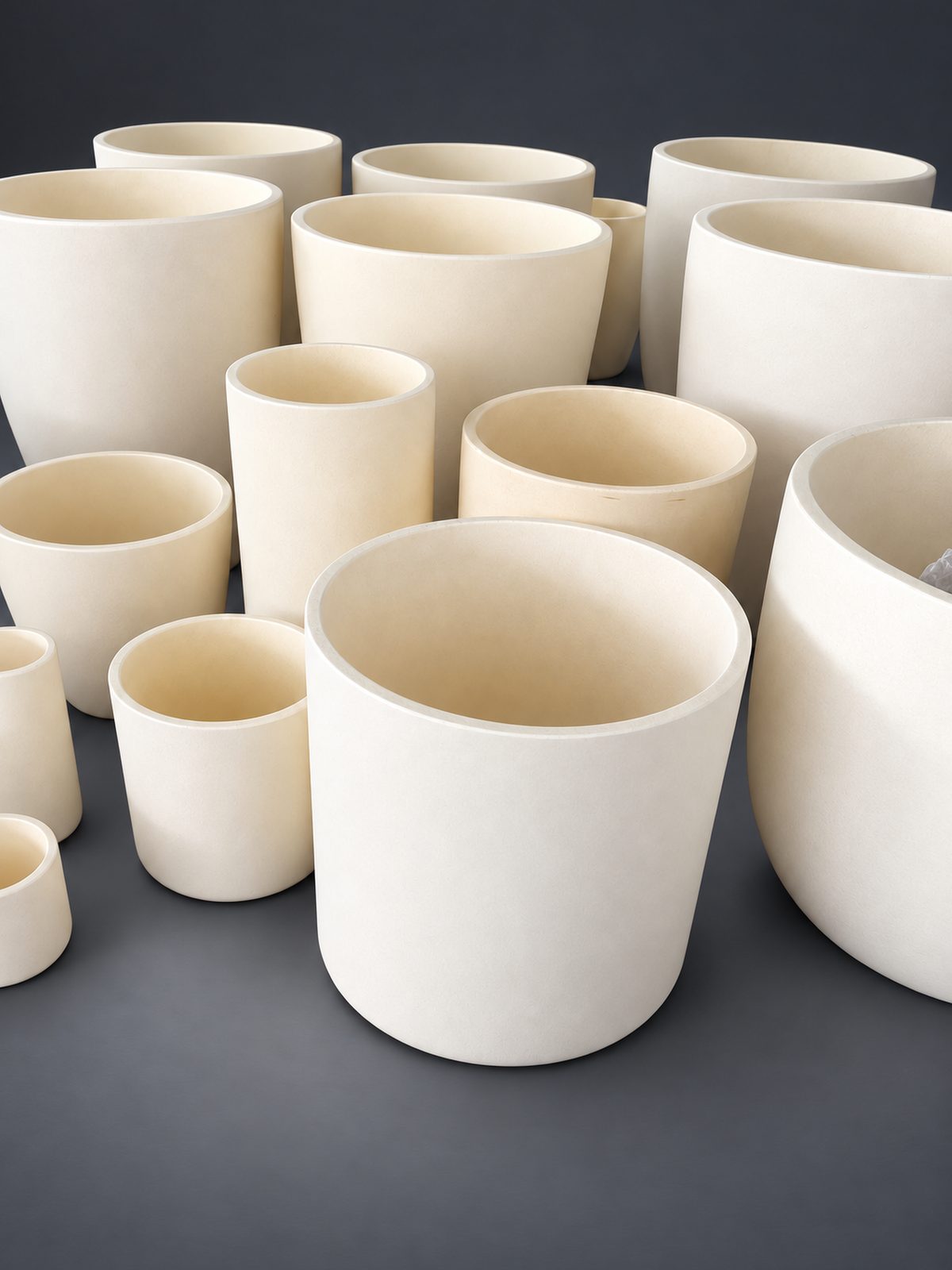
Use alumina up to its makers' limits, 1,700 °C for Almath's and 1,750 °C for CoorsTek's. It is cheaper, lighter and an electrical insulator, and it handles most oxide powders, fluxes and glass. Choose zirconia above that, or for acidic slags, superalloys and platinum-group metals: Almath rates its dense stabilised zirconia at 2,000 °C and above. Which zirconia matters, because the stabiliser sets the limit. We make alumina crucibles, used up to 1,650 °C in air; every zirconia figure here is the named maker's.
Alumina and zirconia from the same maker
| Almath | Alumina | Zirconia, 3.25% MgO | Zirconia, 5.5% CaO |
|---|---|---|---|
| Max service (°C) | 1,700 | 2,000 | >2,000 |
| Density (g/cm³) | >3.90 | 5.78 | 5.37 |
| Porosity (%) | <0.02 | <0.1 | <0.1 |
| Hardness (HV5) | 2,000 | 1,200 | – |
| SiO₂ (%) | 0.02 | <0.2 | <0.2 |
| Fe₂O₃ (%) | 0.02 | <0.1 | <0.1 |
| Conducts when hot | – | Yes | Yes |
Almath makes crucibles in both, so this is like for like. Its zirconia takes 300 °C more, and Almath puts the melting point some 500 °C above alumina's. Alumina is the harder material, zirconia the tougher: fracture toughness 4.5 against 11–13 MPa·m½. Our corundum ceramic is rated 1,600–1,800 °C in our material table, and our alumina crucibles are used up to 1,650 °C in air.
Weight and heat flow
| CoorsTek | Density (g/cm³) | Conductivity (W/m·K) | Expansion (10⁻⁶/K) |
|---|---|---|---|
| Alumina AD-995 | 3.90 | 30.0 | 8.2 |
| Zirconia, MgO-PSZ | 5.72 | 2.2 | 10.2 |
| Zirconia, Y-TZP | 6.02–6.07 | 2.2 | 10.3 |
- Weight: at 5.37–6.0 g/cm³ against 3.90 for alumina, a zirconia crucible of the same shape and wall weighs about 40 to 55% more. That adds up on a balance, in a sample changer or in a crucible rack. Alumina's density by purity is in the alumina density table.
- Heat flow: alumina conducts heat about 14 times better (30.0 against 2.2 W/m·K in CoorsTek's data). A zirconia wall warms through slowly, which is one reason zirconia makers ask for slow ramps.
- Expansion: zirconia grows more on heating, 10.2–10.3 against 8.2 × 10⁻⁶/K. Leave room for it in a tight furnace or holder.
Temperature: which zirconia?
“Zirconia” covers materials with very different limits. Ask the maker for the stabiliser and its rating before you compare:
| Material (maker) | Limit (°C) |
|---|---|
| Zirconia, 5.2% Y₂O₃ crucible (MTI) | 2,300 |
| Zirconia, 5.5% CaO, dense (Almath) | >2,000 |
| Zirconia, 3.25% MgO, dense (Almath) | 2,000 |
| Alumina labware (CoorsTek) | 1,750 |
| Alumina (Almath) | 1,700 |
| Toughened Y-TZP machine-part grades (Precision Ceramics) | 800 in air, 1,000–1,500 inert |
The last row is the trap. CoorsTek sells its MgO-PSZ and Y-TZP for machinery parts, valves and cutting tools and keeps fully stabilised zirconia for high-temperature work, and Precision Ceramics rates its toughened grades to 800 °C in air. For a crucible, ask for fully stabilised zirconia and the maker's rating. Why alumina limits differ is in alumina maximum temperature.
Stabilisers: lime, magnesia and yttria
Zirconium dioxide is metastable, Almath says, and must be stabilised before use with small amounts of CaO, MgO or, best of all, Y₂O₃, which hold the high-temperature cubic phase. Fully stabilised zirconia sinters to a dense ceramic; partially stabilised zirconia is also used to toughen alumina. Crucible makers name the stabiliser in the grade.
Stabilised zirconia grades in these sources
| Grade (maker) | Stabiliser | Density (g/cm³) |
|---|---|---|
| Dense, fully stabilised (Almath) | 3.25% MgO | 5.78 |
| Dense, fully stabilised (Almath) | 5.5% CaO | 5.37 |
| Porous 195Z, 19.5% porosity (Almath) | Lime | – |
| Partially stabilised, MgO-PSZ (CoorsTek) | MgO | 5.72 |
| Y-TZP (CoorsTek) | Y₂O₃ | 6.02–6.07 |
| YSZ crucible (MTI) | 5.2% Y₂O₃ | 6.02 |
Almath's dense zirconias also become electrically conductive when hot. Alumina stays an insulator: CoorsTek gives its AD-995 2 × 10⁶ Ω·cm at 1,000 °C. If the crucible touches electrodes, a heating element or thermocouple wires, use alumina.
Chemistry: slags, metals and purity
- Metal melts: Almath says zirconia can be used over 2,000 °C and suits acidic slags, platinum-group metals and superalloys. It calls alumina a general-purpose material for a wide range of alloys up to around 1,700 °C, resistant to acidic and basic slags. Those are porous refractory grades; dense lab crucibles are a different product.
- Fluxes and glass: CoorsTek rates its alumina highly resistant to alkalies and other fluxes, suitable for glass melting, and inert in hydrogen and carbon-bearing atmospheres. For hydrofluoric acid, see platinum in the crucible materials guide.
- Purity: Almath lists 0.02% SiO₂ in its alumina and under 0.2% in its zirconias. Our yearly samples of 99.5% alumina measured 0.15–0.19% SiO₂ and 0.043–0.054% Na₂O; the low-sodium alumina guide has the full analyses.
Thermal shock and ramp rates
In quench tests zirconia does better. Morgan gives alumina a quench ΔT of 170–300 °C and zirconia 400–500 °C. Kyocera, dropping test pieces into water from 550 °C, gives 150 °C for 99% alumina and 300 °C for zirconia, and Almath 350 °C for its zirconias.
In use, plan the same slow ramp for either. MTI says never to heat or cool its yttria zirconia crucible faster than 5 °C per minute, Almath gives 5 °C per minute for its larger alumina crucibles, and CoorsTek 150 °C per hour for alumina labware. More rates are in alumina thermal shock.
Cost
Almath, which sells both, says zirconia is considerably more expensive than alumina. If alumina's limit covers your work, it is the economical choice, and we quote it per size, grade and quantity.
When to choose which
- Alumina: most lab heating up to 1,700–1,750 °C, alkaline fluxes, glass melts, hydrogen.
- Alumina: where the crucible must insulate electrically, or where weight matters on a balance.
- Zirconia: work above alumina's limit, acidic slags, superalloys and platinum-group metals (Almath).
- Zirconia: fully stabilised grades for crucibles; a toughened Y-TZP part is not a crucible material.
The same capacity in alumina
If alumina covers your temperature, start from capacity. Each MTI zirconia crucible is set against our cylindrical alumina crucible of similar capacity and diameter; each link opens the quote form with that size filled in.
| Zirconia (MTI) | Our alumina |
|---|---|
| 50 ml, 40×40 | 60 ml, 40×70 |
| 145 ml, 63×60 | 180 ml, 59×87 |
| 350 ml, 82×80 | 400 ml, 70×120 |
Our alumina crucibles
We make 195 standard sizes of alumina crucibles, boats and lids in 99% and 99.5% Al₂O₃, with crucibles from 0.5 to 1,500 ml, and other sizes to drawing. To size one against your charge, see how to choose an alumina crucible. Porcelain is compared in porcelain or alumina crucible, and all seven materials in crucible materials compared.
Our alumina crucibles are used up to 1,650 °C in air. Zirconia earns its price above alumina's limit and with acidic slags, superalloys and platinum-group metals; for the rest, alumina does the job for less. Send the size, peak temperature and what goes in it, and we quote the alumina crucible for that job.
Questions buyers ask
- Which is better, an alumina or a zirconia crucible?
- Alumina for most lab work within its makers’ limits, 1,700 °C for Almath’s and 1,750 °C for CoorsTek’s: it is cheaper, lighter and an electrical insulator. Zirconia above that, and for acidic slags, superalloys and platinum-group metals: Almath rates its dense stabilised zirconia at 2,000 °C and above.
- What temperature can a zirconia crucible withstand?
- It depends on the stabiliser and grade. Almath rates its dense MgO-stabilised zirconia at 2,000 °C and its CaO-stabilised grade above 2,000 °C, and MTI gives 2,300 °C for its yttria-stabilised crucible. Toughened Y-TZP engineering grades are different: Precision Ceramics rates them to 800 °C in air. Ask for the stabiliser and the maker’s rating.
- Why does a zirconia crucible need a stabiliser?
- Zirconium dioxide is metastable. Almath says it must be stabilised before use with small amounts of CaO, MgO or, best of all, Y₂O₃, which hold the high-temperature cubic phase. Crucible grades are usually named by the stabiliser, such as 3.25% MgO or 5.5% CaO in Almath’s data sheets.
- Is a zirconia crucible more expensive than an alumina one?
- Yes. Almath, which makes both, says zirconia is considerably more expensive than alumina. Zirconia is also 40 to 55% heavier for the same shape, at 5.37–6.0 g/cm³ against 3.90 for alumina. We quote alumina crucibles per size, grade and quantity.
Sources
- Almath Crucibles: zirconia material page and data sheets for alumina, MgO-stabilised and CaO-stabilised zirconia (read 19 October 2026)
- CoorsTek: zirconia materials, Dura-Z (MgO-PSZ) and YTZP property table (read 19 October 2026)
- CoorsTek: alumina typical properties (AD-96 and AD-995; checked 6 October 2026, hardness, specific heat and dielectric strength 16 October 2026)
- CoorsTek: Labware catalog, chemical-porcelain properties (page 3) and AD-998 high-alumina properties (page 10)
- MTI Corporation: yttria-stabilised zirconia cylindrical crucible, composition, density, working temperature and sizes (read 19 October 2026)
- Precision Ceramics: zirconia grades, maximum temperature in air and inert gas (checked 16 October 2026)
- Almath: Refractory crucibles for induction melting (alumina, magnesia, zirconia)
- Almath Crucibles: alumina crucible instructions, handling with care
- Morgan Technical Ceramics: thermal shock resistance (mechanism, downshock ΔT by ceramic)
- Kyocera: heat shock resistance (water-quench test, 99% alumina)
- Our own figures: the factory’s standard-size list, 2026 orders and test report, as recorded in our product catalog.