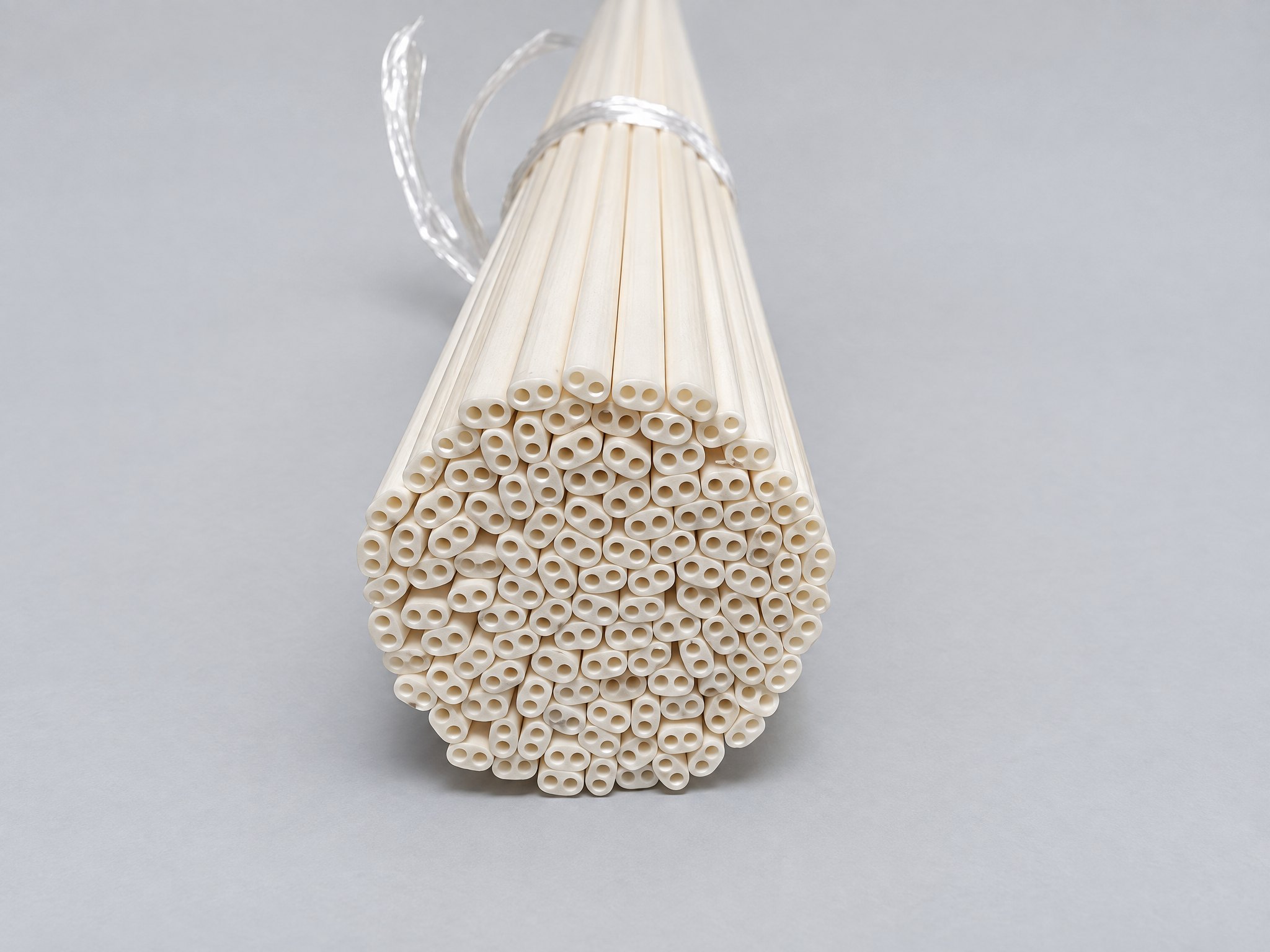
Profile and spike thermocouples carry each pair of wires in a long, thin twin-bore alumina insulator, flat or round. We keep flat twin-bore 2.3 × 1.4 mm in stock in lengths up to 2,000 mm, and have shipped flat 3 × 2 mm in one piece up to 4,000 mm. Round twin-bore from 2.5 mm OD is usually in stock, cut to your length. The standard grade is C799 alumina. If your specification limits sodium, put the number on the request: our yearly sample analysis measured 0.043 to 0.054% Na₂O.
How profile and spike thermocouples are built
Both are used in diffusion furnaces and CVD systems. A spike thermocouple goes in across the furnace, next to the heater, and the furnace controls the heater from it. A profile thermocouple runs along the inside of the quartz process tube and reads several points at once, at the front, middle and rear of the furnace. That is how a 1999 Samsung patent on diffusion furnaces describes them. Metivo calls the profile type multi-point and the spike type single-point.
The same patent describes the usual profile thermocouple as several wire pairs, an insulator around each, and a quartz sheath over the part that goes into the furnace. Conax lists profile and spike thermocouples in Type B, R and S, as well as K and N, with quartz or SiC sheaths, for semiconductor, photovoltaic and LED furnaces. Every junction needs its own pair of wires from the head to its point, so a profile probe can hold several twin-bore insulators of different lengths side by side in one sheath. One of our orders was a set of six lengths, 1,000 to 3,795 mm, of the same 3 × 2 mm section. We make the ceramic parts; the thermocouple maker fits the wire, junctions and sheath.
Flat twin-bore sizes
Flat (oval) twin-bore insulators carry the two wires side by side in a thin section. We describe them by width × thickness, the way they are written on our orders. 2.3 × 1.4 mm is in stock. The other sections below are ones we have shipped to more than one buyer and make to order. For any other section, send the cross-section drawing.
| W × T (mm) | Bores (mm) | Supply and length (mm) |
|---|---|---|
| 2.3×1.4 | Ask | In stock, up to 2,000 |
| 3×2 | 0.5, 0.8 | Made to order; 930 to 4,000 shipped |
| 3×1.8 | 0.5, 0.8 | Made to order; 1,219 to 2,000 shipped |
| 4×3 | 0.8 | Made to order; 1,220 to 3,000 shipped |
| 4.1×2.8 | 1 | Made to order; 1,219 shipped |
For comparison, KYOCERA Fineceramics Europe's web shop lists oval twin-bore capillaries in four sections, from 1.55 × 0.9 to 4.2 × 2.2 mm, each cut to at most 400 mm, and its round twin-bore capillaries from 3 to 8 mm OD to at most 2,100 mm. Its 2.3 × 1.4 mm section has a 0.7 mm bore. Those are shop listings, not that maker's production limits. If you are replacing a part, send its width, thickness and bore, and we quote the same section in the length you need.
Round twin-bore for thin probes
Round twin-bore is the other option. The table lists our standard twin-bore sizes up to 4.5 mm OD. Round twin-bore insulators of 3, 3.5, 4, 5, 6 and 8 mm OD have shipped in 1,000 to 2,000 mm lengths, and 3.5 mm OD up to 3,000 mm.
| OD × bore (mm) | Supply | Quote |
|---|---|---|
| 2×0.5 | Made to order | Request this size |
| 2.5×0.7 | Usually in stock | Request this size |
| 3×0.8 | Made to order | Request this size |
| 3.5×0.9 | Usually in stock | Request this size |
| 4×1 | Made to order | Request this size |
| 4.2×1.1 | Usually in stock | Request this size |
| 4.5×1.2 | Usually in stock | Request this size |
To pick the bore for your wire, use the insulator size by wire diameter guide. For 0.5 mm Type S, R or B wire it points to 3.5 mm twin-bore with 0.9 mm bores.
Purity and sodium
Metivo says its profile thermocouples are made from ultra-pure materials, and Furuya Metal processes its semiconductor thermocouples in cleanrooms to keep impurities out. Sodium is the usual worry: a 2006 Chalmers University thesis found mobile sodium in oxides grown in an alumina furnace, and notes that this mobile charge shifts the threshold voltage of the devices. None of these sources gives a sodium limit for a thermocouple insulator, so the limit has to come from your own specification. The low-sodium alumina guide covers why sodium matters and how to specify it.
| % by mass | 2024 | 2025 | 2026 |
|---|---|---|---|
| Al₂O₃ | 99.55 | 99.57 | 99.61 |
| SiO₂ | 0.19 | 0.18 | 0.15 |
| Fe₂O₃ | 0.018 | 0.026 | 0.014 |
| Na₂O | 0.052 | 0.043 | 0.054 |
| CaO | 0.14 | 0.14 | 0.13 |
Our standard grade is 99.5% Al₂O₃ (C799), and it is our low-sodium grade: the raw alumina carries 0.03% sodium, and the 2026 report measured 0.054% Na₂O. If your specification sets limits for Na₂O, SiO₂ or Fe₂O₃, put them on the request. The quotation says whether we can meet them, and we can send 5 to 10 samples for your own analysis first. The quality page shows the lab reports and our ISO 9001 scope.
Length, straightness and tolerances
Our insulator range runs from 10 to 4,000 mm, and lengths are cut to order. The longest flat twin-bore we have shipped is 4,000 mm. On 2026 orders for round multi-bore insulators, buyers wrote OD tolerances of ±0.2 to ±0.5 mm and bore tolerances of ±0.15 to ±0.3 mm. Flat sections are toleranced per drawing. Our straightness standard is 0.1% of length, 1 mm per metre, set for protection tubes; thin insulators flex a little, so if bow matters over a 2 m piece, write the straightness limit on the drawing and we confirm it in the quotation. The DIN 40680 straightness limits are a useful reference.
Order the set the way the probe is built: one line per junction length, with the section and bore the same for each. That keeps the whole probe on one quotation.
What to put on the request
- Flat (width × thickness) or round (OD), and the bore diameter, or the wire diameter that must pass.
- Each length, or the set of lengths for one probe, and the quantity per length.
- Grade (99.5% Al₂O₃ is standard), plus any limits for Na₂O, SiO₂ or Fe₂O₃.
- Straightness or other drawing notes, and whether you want samples first.
Stock sizes usually ship in about 3 days for small orders and about 7 days for bulk. Made-to-order sections take 25–30 days, from 100 pieces. Each size in the tables above opens a prefilled quote, or send the insulator specification directly. Crystal-growth furnaces use the same flat insulators: see compound-semiconductor crystal growth.
Questions buyers ask
- What is the difference between a profile and a spike thermocouple?
- A spike thermocouple goes in across the diffusion furnace, next to the heater, and is used to control it. A profile thermocouple runs along the inside of the quartz process tube and reads several points along it, so one sheath holds several wire pairs, each in its own insulator. That is how a 1999 Samsung patent and Furuya Metal describe them.
- Which flat twin-bore insulator sizes do you have?
- Flat twin-bore 2.3×1.4 mm (width × thickness) is usually in stock in lengths up to 2,000 mm. We make 3×2, 3×1.8, 4×3 and 4.1×2.8 mm to order, and other sections to your drawing. Tell us the bore diameter with the section.
- How long can a twin-bore alumina insulator be?
- Our insulator range runs to 4,000 mm, and we have shipped 3 × 2 mm flat twin-bore insulators 4,000 mm long in one piece. Round twin-bore insulators of 3 to 8 mm OD have shipped in 1,000 to 2,000 mm lengths, and 3.5 mm OD up to 3,000 mm. Lengths are cut to order.
- How much sodium is in your alumina?
- Our standard alumina is our low-sodium grade: the raw alumina carries 0.03% sodium, and our yearly sample analysis of an alumina tube measured Na₂O at 0.052%, 0.043% and 0.054% (2024 to 2026). If your specification sets a sodium limit, put it on the request and the quotation says whether we can meet it.
- Do you make the thermocouple too?
- We specialise in the alumina parts: twin-bore and multi-bore insulators and protection tubes. The thermocouple maker fits the wire, the junctions and the quartz or SiC sheath.
Sources
- US Patent 5,863,123 (Samsung Electronics, 1999): profile thermocouple of a transverse-type diffusion furnace, background
- Conax Technologies: Profile & Spike Thermocouples (GlobalSpec product listing)
- Furuya Metal: Thermocouples for Semiconductor Manufacturing
- Metivo (formerly BASF Catalysts & Metals): Semiconductor Profile Thermocouples
- KYOCERA Fineceramics Europe shop: oval multi-bore capillaries, DEGUSSIT AL23 (German)
- KYOCERA Fineceramics Europe shop: round multi-bore capillaries, DEGUSSIT AL23 (German)
- Allerstam, Electrical properties of thermal oxides on SiC manufactured in an alumina furnace, Chalmers University thesis, 2006
- Our own figures: the factory’s standard-size list, 2026 orders and test report, as recorded in our product catalog.