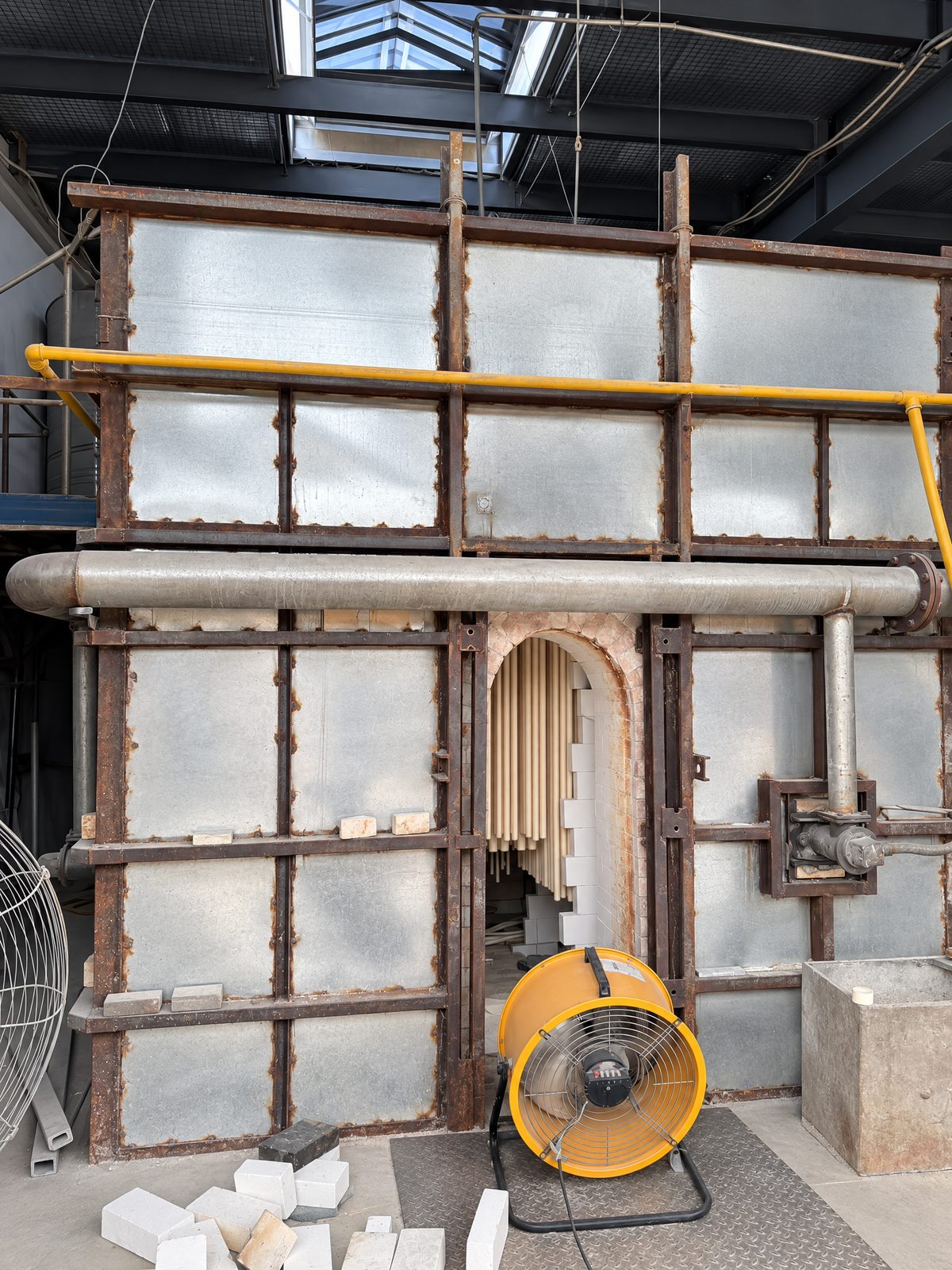
We make alumina tubes from calcined alumina powder: milled, formed by extrusion or slip casting, dried, then sintered. Our C799 alumina tubes are sintered at about 1,760 °C in a gas-fired corundum kiln, hanging vertically. Extrusion goes up to 17×10 mm (OD × ID) and slip casting up to 100×90×1000 mm. Our straightness standard for protection tubes is 0.1% of length. Below is each step and what it decides on your order.
The steps, from powder to crate
- Raw material. Calcined alumina powder, delivered in 25 kg sacks.
- Milling in large drum ball mills.
- Forming on horizontal vacuum extruders and a vertical hydraulic ram extruder, or by slip casting in plaster moulds. We also press and hot-press parts to drawing.
- Drying on multi-tier rack carts and grooved boards.
- Sintering in gas-fired kilns, tubes hung by size.
- Finishing: cut to the ordered length on a wet cutting bench, then slotted or drilled where the drawing asks for it.
- Inspection: OD and ID measured with 0.02 mm vernier calipers.
- Packing in bubble wrap or film bundles, in foam-lined plywood crates.
All of it happens in one factory in Tangshan. The factory page has a photo of each step; the rest of this page adds the numbers.
Forming: extrusion or slip casting, and the largest sizes
The forming method sets the largest diameter and how long a tube can be. Extrusion pushes a stiff, de-aired paste through a die in one continuous length, so it suits thin tubes and multi-bore insulators. Slip casting fills plaster moulds with liquid slip, so it suits larger diameters, with the length set by the mould.
| Method | Largest (mm) | Used for |
|---|---|---|
| Extrusion | 17×10 | Insulators, thin tubes |
| Slip casting | 100×90×1000 | Large tubes |
| Pressing, hot pressing | Per drawing | Parts to drawing |
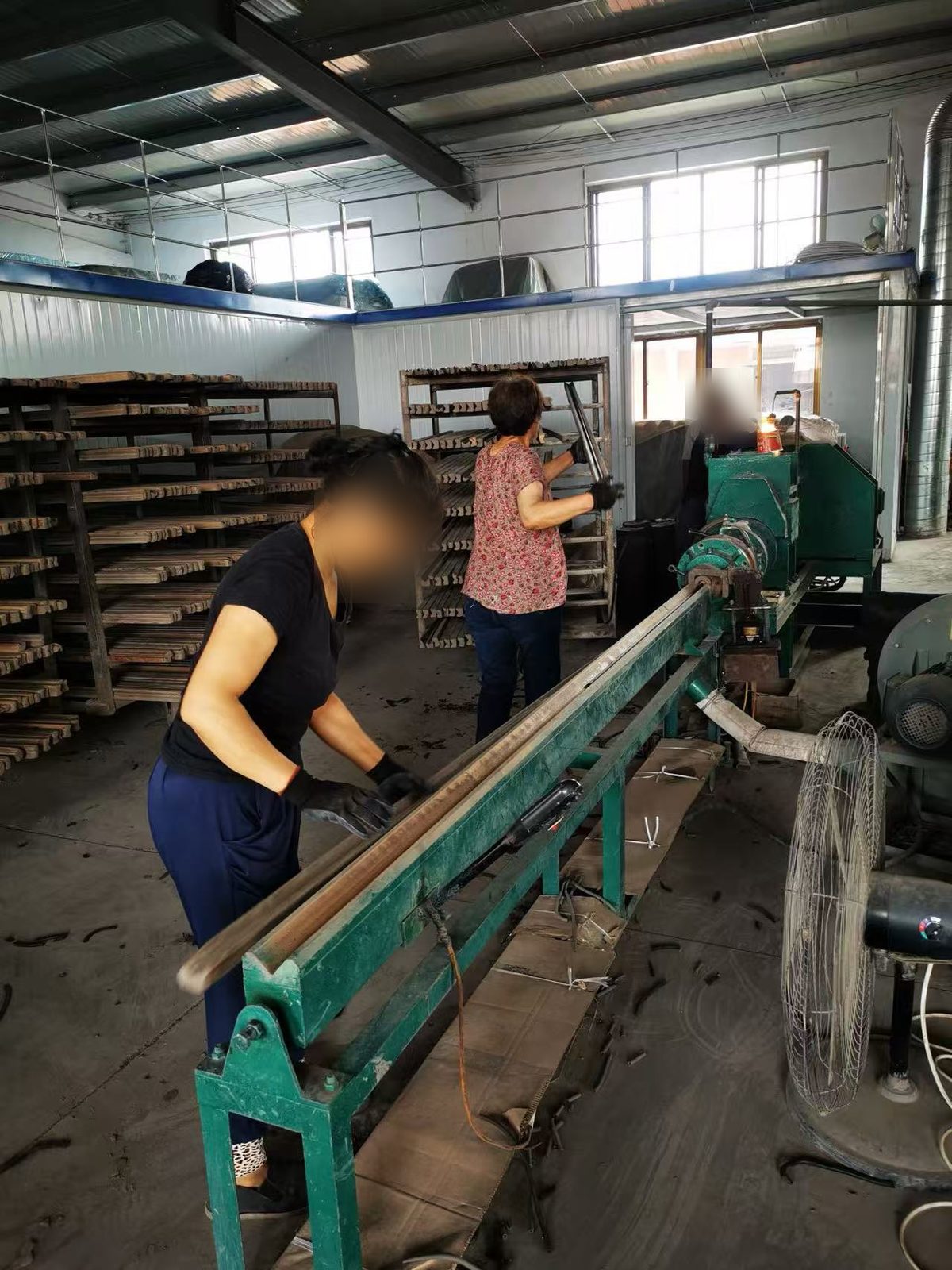
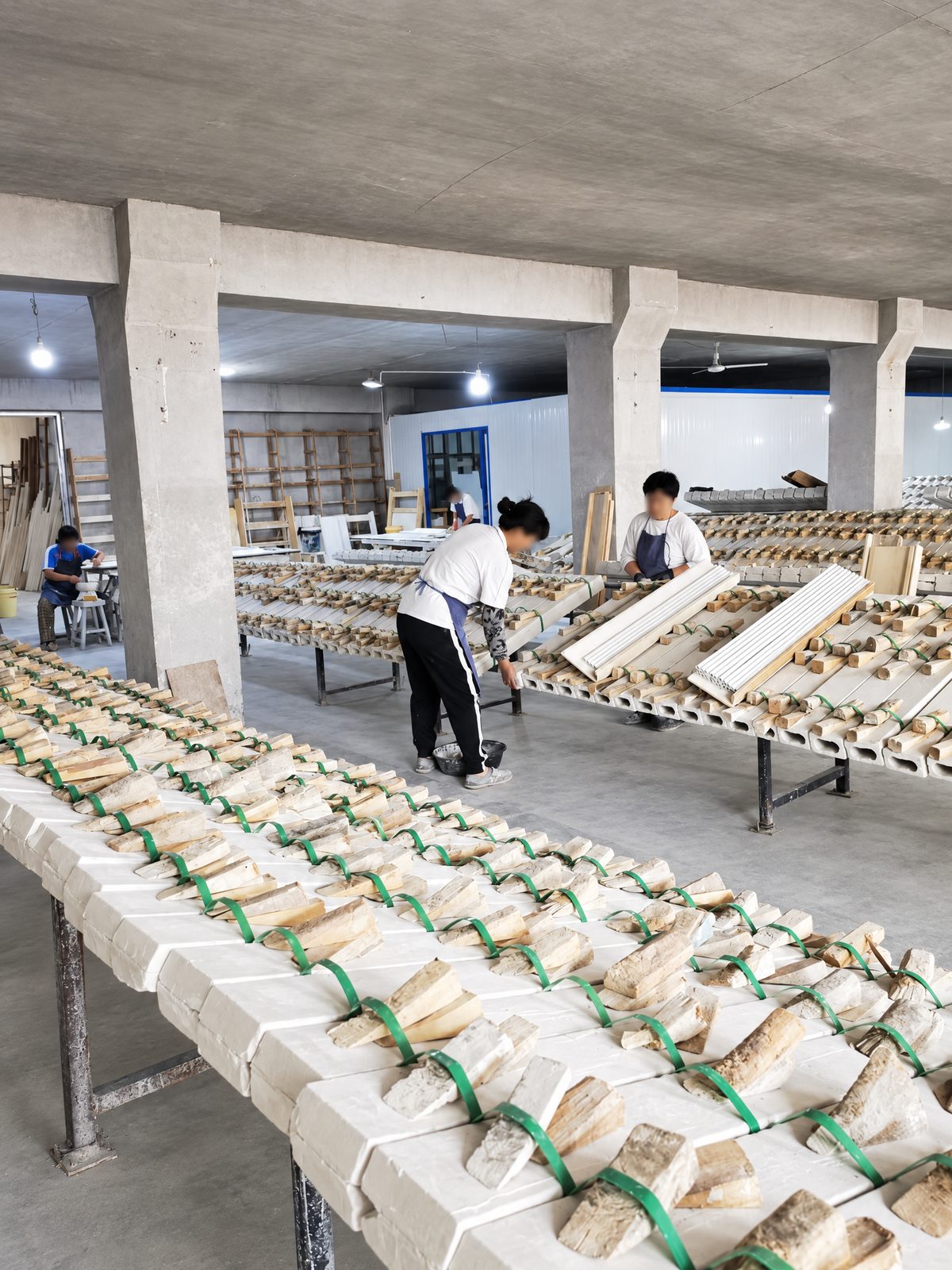
Our insulator list runs from 2 to 12 mm OD in lengths up to 4,000 mm. Our stocked furnace tubes run 30 to 100 mm OD in 1,000 to 2,000 mm lengths; on cast tubes, the larger the diameter, the shorter the tube, down to 1,000 mm at 100 mm OD. Sizes are in alumina furnace tube sizes and protection tube sizes.
Sintering temperature
Sintering is the firing that turns the dried, chalky tube into dense ceramic. NIST gives about 1,700 °C as the usual sintering temperature for high-purity alumina. Our two kilns:
| Kiln and what it fires | Sintering temperature |
|---|---|
| Corundum kiln: C799 alumina tubes, 99.5% Al₂O₃ | About 1,760 °C |
| Porcelain kiln: porcelain tubes | 1,270 °C |
Our written kiln procedure has the tubes hung by size with even gaps. The kiln temperature is read three ways, by thermocouples with digital displays, by pyrometric cones and by an optical pyrometer, and the three must agree. Readings go on a log sheet at the control cabinet.
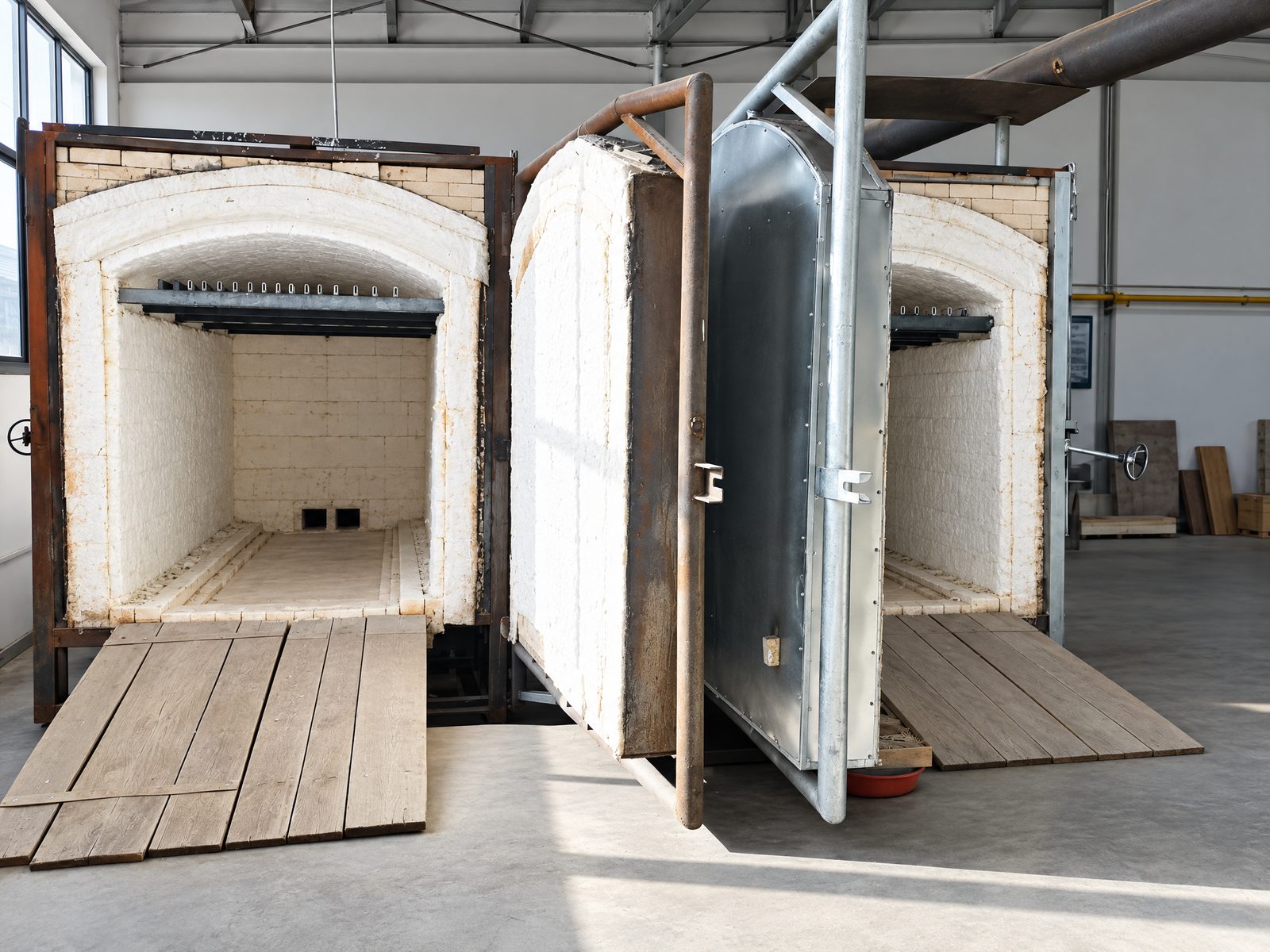
Use temperature is a separate figure from the sintering temperature. In air, we rate our corundum tubes to 1,750 °C hanging vertically and 1,650 °C lying horizontally, and our crucibles to 1,650 °C. A horizontal tube carries its own weight across the span, which is why its figure is lower. Other makers' figures are in alumina maximum temperature. Porcelain is a different material from alumina; for porcelain against alumina in a thermocouple, see protection tube materials.
Finishing and straightness
After sintering, tubes are cut to your length on a wet cutting bench with a length stop, so any length within the range is a normal order. Slots across closed ends, slits in open ends and side holes are cut where the drawing shows them.
Our straightness standard for protection tubes is 0.1% of length: 0.6 mm of bow on a 600 mm tube and 1 mm on 1,000 mm. DIN 40680 medium, as Morgan Haldenwanger tables it, allows 3.00 mm over 500 to 600 mm, 5.00 mm over 900 to 1000 mm and 0.5% of length above that. Long thin insulators of 1.5 to 4 m are slightly flexible, so a bow figure means little on them; tell us what the insulator has to slide into instead. Tolerances are in alumina tube tolerances.
What it means for your order
- Small diameters come long: our insulators run to 4,000 mm and our protection tubes to 2,500 mm.
- For a large tube, give the OD and the length together. At 100 mm OD the longest cast tube is 1,000 mm.
- Put a straightness figure on the drawing if the tube goes into a close-fitting sheath and you need tighter than 0.1% of length.
- Name the material: alumina (corundum) or porcelain.
- Give the use temperature and whether the tube hangs vertically or lies horizontally; the rating differs by 100 °C.
Stocked sizes usually ship in about 3 days for small orders and about 7 days for bulk. Parts made to drawing take 25–30 days, from 100 pieces. Send the drawing or the size with your quote request.
Questions buyers ask
- What temperature is alumina sintered at?
- NIST gives about 1,700 °C as the usual sintering temperature for high-purity alumina. We sinter our C799 alumina tubes at about 1,760 °C in a gas-fired corundum kiln, with the tubes hanging vertically. Porcelain tubes go through a separate kiln at 1,270 °C.
- How are alumina ceramic tubes made?
- Calcined alumina powder is milled, formed into a tube by extrusion or slip casting, dried, and sintered in a kiln. Then the tubes are cut to length, slotted or drilled where the drawing asks for it, measured with calipers and packed. All of these steps happen in our factory in Tangshan.
- What is the difference between extruded and slip cast alumina tubes?
- Extrusion pushes a stiff paste through a die, so it suits small tubes and multi-bore insulators in long lengths: we extrude up to 17×10 mm. Slip casting pours a liquid slip into plaster moulds and suits larger diameters: we cast up to 100×90×1000 mm.
- How straight are alumina tubes?
- Our standard for protection tubes is 0.1% of length, which is 1 mm of bow on a 1,000 mm tube. DIN 40680 medium, as Morgan Haldenwanger tables it, allows 5.00 mm on a part over 900 to 1,000 mm. Put a tighter figure on the drawing if your sheath needs it.
Sources
- NIST Ceramics Data Portal: Property Data Summary for sintered alumina, processing note (read 19 October 2026)
- Morgan Haldenwanger price list, valid from 1 January 2026: standard sizes and DIN 40680 tolerance table
- Our own figures: the factory’s standard-size list, 2026 orders and test report, as recorded in our product catalog.