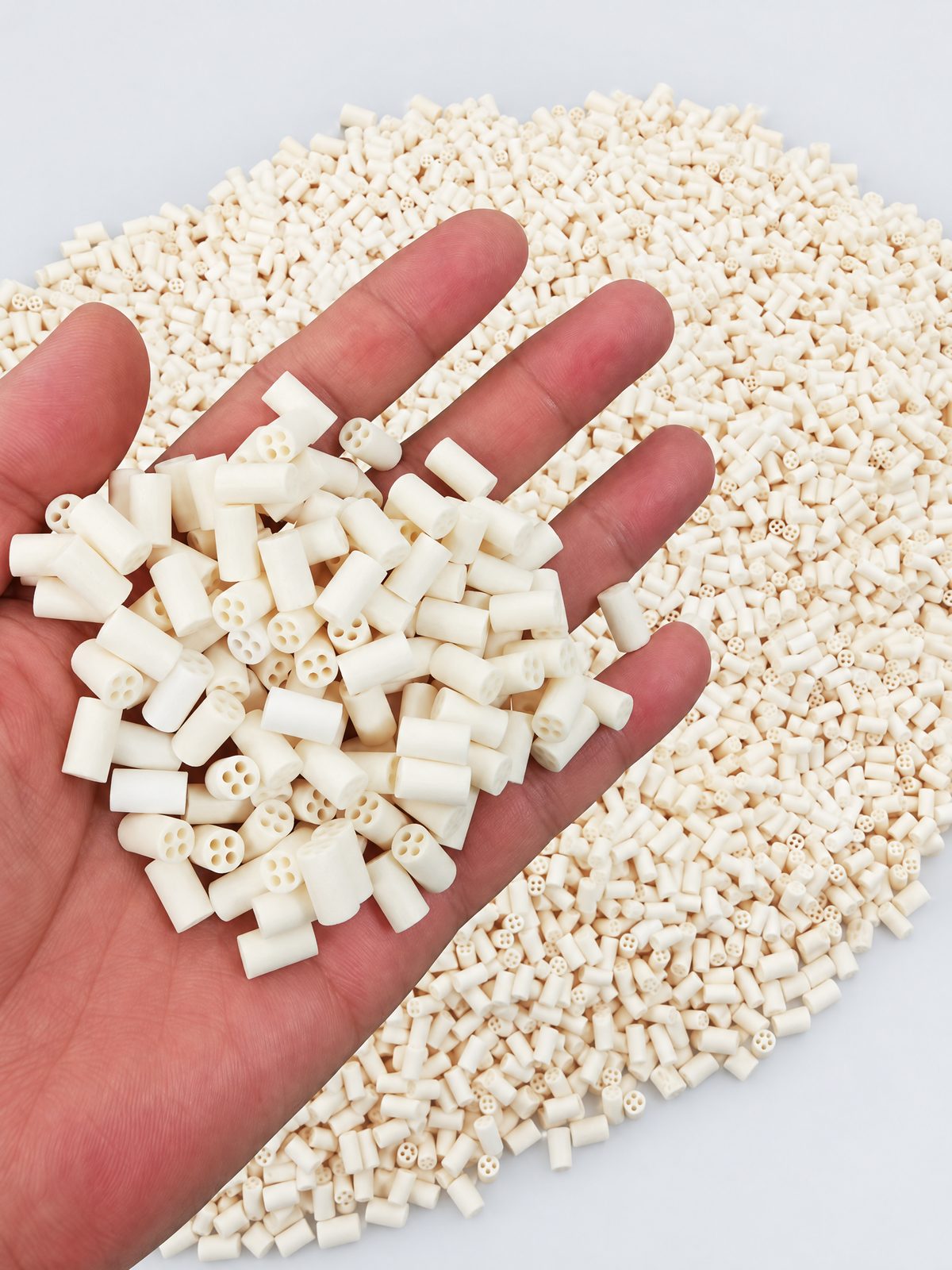
Use beads where the wire has to bend: a string of short ceramic beads follows the wire round a curve, and a one-piece insulator can't. On straight runs, such as a thermocouple inside a protection tube, one-piece ceramic thermocouple insulators cover the wire with no joints and go in as one part. Our beads come in the same sizes as our insulators, with one, two or four bores from 2 to 12 mm OD, cut to the length you need from long C799 alumina insulator tubes.
Beads or a one-piece insulator
| Situation | Beads | One-piece insulator |
|---|---|---|
| Wire bends or moves | Yes | No |
| Straight probe in a protection tube | Works | Better: no joints |
| Long run, many metres | Yes, any length | Up to 4,000 mm per piece |
| Repair a short damaged section | Replace a few beads | Replace the piece |
| Assembly | Thread bead by bead | Slide on once |
Where a bead string bends, the gaps between flat-ended beads open on the outside of the curve. Keep bends gentle, use shorter beads on tighter bends, or use fish-spine beads where the wire must stay covered through a sharp bend. Fish-spine beads are single-bore; for a thermocouple pair in one bead, use twin- or four-bore beads.
Bead types and what their makers rate them
| Type | Material and rating | Whose figure |
|---|---|---|
| Round, single or twin bore | Mullite, 1,600 °C, 25 mm long | Omega |
| Oval, twin bore | Mullite, 1,600 °C | Omega |
| Fish-spine, single bore | Steatite, 1,200 °C; 2.79–10.2 mm for 20 to 8 AWG | Omega |
| Fish-spine, single bore | Steatite or 96% alumina; 2.8–22.2 mm OD | Du-Co |
| Steatite beads | OD × bore 3.3 × 1 to 19 × 10.7 mm | Kanthal |
| Cut beads, 1, 2 or 4 bores | C799 alumina | Ours |
Pick the material by temperature first. Omega rates steatite to 1,200 °C, so above that, and for platinum thermocouples, use alumina; the limits by thermocouple type are in thermocouple types and temperature ranges. For heating wire, Kanthal's rules for the ceramic (Al₂O₃, iron and alkali) are in high-temperature wire insulation. We confirm the rating of each part in the quotation.
Our bead sizes
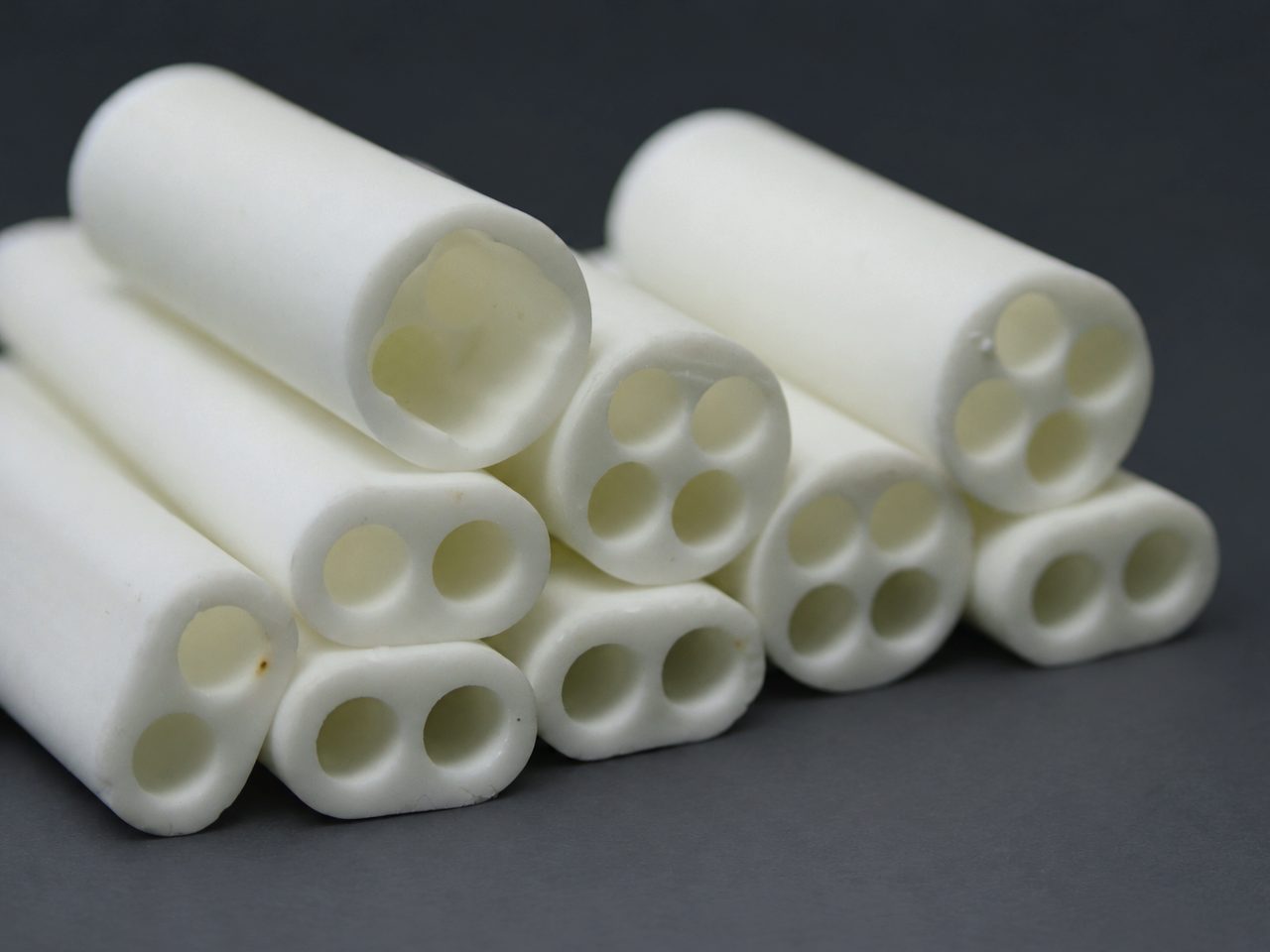
Every insulator size we make can be cut into beads. Choose the bore at least 0.3 mm over the wire, then the bore count: one per wire, two for a thermocouple pair, four for a duplex pair. These 15 sizes are cut from insulator tubes we usually keep in stock:
| OD × bore (mm) | Bores | Largest wire (mm) |
|---|---|---|
| 2.5×1.5 | 1 | 1.2 |
| 3×2 | 1 | 1.7 |
| 10×4 | 1 | 3.7 |
| 2.5×0.7 | 2 | 0.4 |
| 3.5×0.9 | 2 | 0.6 |
| 4.2×1.1 | 2 | 0.8 |
| 4.5×1.2 | 2 | 0.9 |
| 5.5×1.4 | 2 | 1.1 |
| 8.5×1.8 | 2 | 1.5 |
| 2.5×0.6 | 4 | 0.3 |
| 3.5×0.8 | 4 | 0.5 |
| 4.2×1.0 | 4 | 0.7 |
| 4.5×1.1 | 4 | 0.8 |
| 5.5×1.3 | 4 | 1 |
| 8.5×1.6 | 4 | 1.3 |
18 more sizes, cut from made-to-order tubes
| OD × bore (mm) | Bores | Largest wire (mm) |
|---|---|---|
| 2×1 | 1 | 0.7 |
| 4×2.5 | 1 | 2.2 |
| 5×3 | 1 | 2.7 |
| 6×4 | 1 | 3.7 |
| 8×5 | 1 | 4.7 |
| 12×7 | 1 | 6.7 |
| 2×0.5 | 2 | 0.2 |
| 3×0.8 | 2 | 0.5 |
| 4×1 | 2 | 0.7 |
| 5×1.2 | 2 | 0.9 |
| 6×1.4 | 2 | 1.1 |
| 8×1.8 | 2 | 1.5 |
| 2×0.4 | 4 | 0.1 |
| 3×0.6 | 4 | 0.3 |
| 4×1 | 4 | 0.7 |
| 5×1.2 | 4 | 0.9 |
| 6×1.3 | 4 | 1 |
| 8×1.6 | 4 | 1.3 |
To go from a wire diameter or AWG to a size, use thermocouple insulator sizes by wire diameter; the same sizes apply to beads.
Bead length
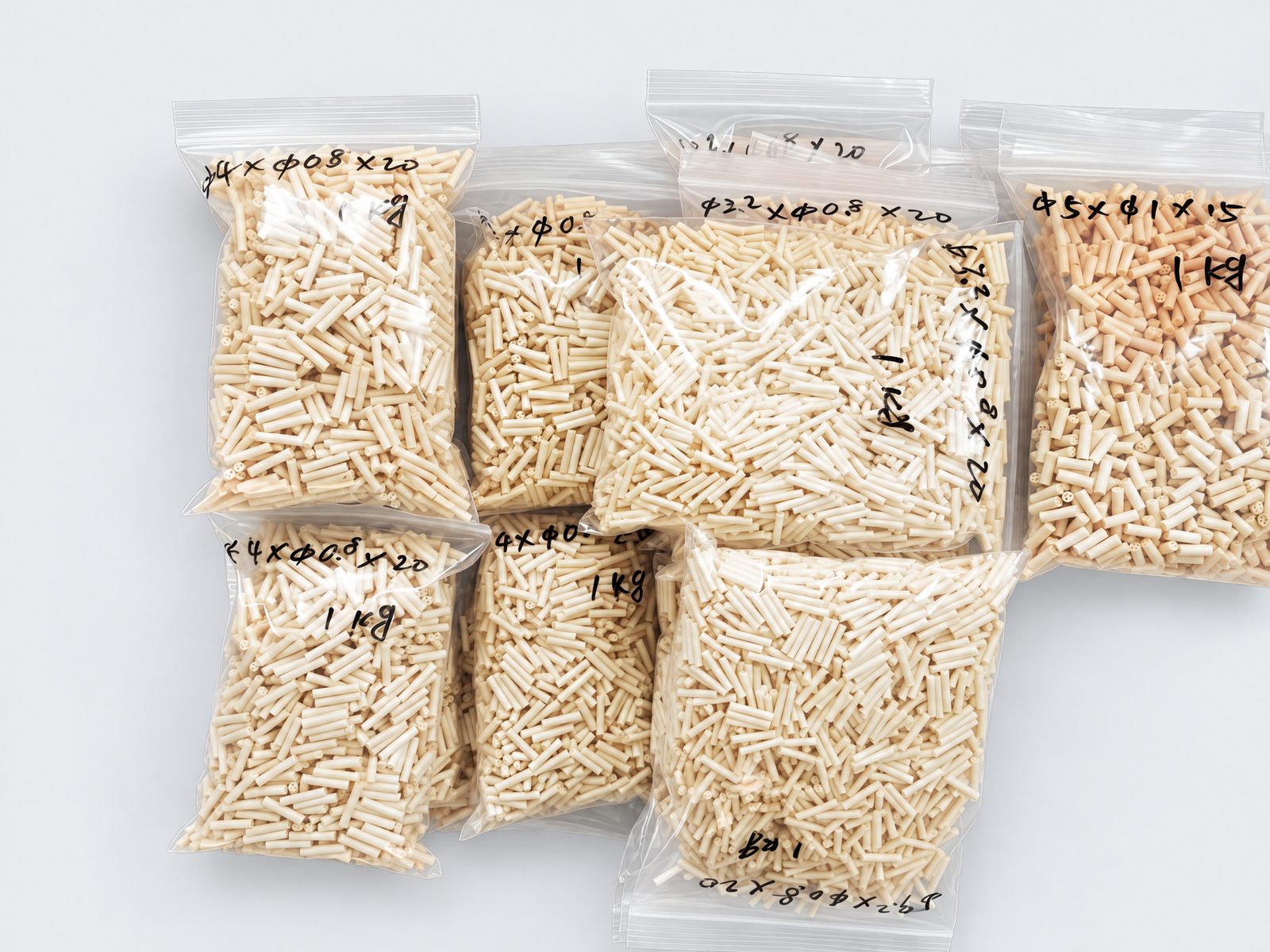
We cut beads to the length you order. Beads we have made for customers run 15 to 25 mm long, for example 5 mm four-bore beads at 15 mm and 3 mm four-bore beads at 20 mm. Shorter beads follow a tighter bend; longer beads mean fewer joints and faster threading. If the run is straight, a single insulator cut to the full length is simpler still. Beads and small insulators are packed in 1 kg zip-lock bags inside foam-lined wooden boxes.
What to send for a quotation
- Wire diameter (or AWG) and how many wires go through each bead.
- OD limit, if the beads go inside a sheath or tube.
- Bead length, and the total length of wire to cover or the number of beads.
- Use temperature, and the wire alloy if it is heating wire.
Standard insulator sizes usually ship in about 3 days for small orders and about 7 days for bulk; other sizes take 25–30 days, from 100 pieces. See the insulator page for bore layouts, or request a quote.
Questions buyers ask
- What are thermocouple beads?
- Short ceramic insulators threaded onto bare thermocouple or heater wire, one after another, to keep the wire from touching metal or the other wire. A string of beads bends with the wire, which a one-piece insulator can’t do. We cut ours from our alumina insulator tubes, with one, two or four bores.
- What size ceramic beads do I need?
- Choose a bore at least 0.3 mm larger than the wire, then the bore count: one per wire, two for a thermocouple pair, four for a duplex pair. Our beads come in the same sizes as our insulators and are cut to the length you need; the twin-bore sizes we usually stock are 2.5×0.7, 3.5×0.9, 4.2×1.1, 4.5×1.2, 5.5×1.4 and 8.5×1.8 mm (OD × bore).
- What is the difference between fish-spine and round beads?
- Fish-spine beads have a concave end and a convex end, so each sits in the next and the string bends without opening a gap. Du-Co makes them in steatite and 96% alumina, and Omega rates its steatite fish-spine beads to 1,200 °C. Omega’s round and oval beads are mullite, rated to 1,600 °C, and its fish-spine beads are single-bore only.
- Can ceramic beads be used on heating elements?
- Yes, they are a common way to insulate heating wire where it has to bend, such as element leads. For heating wire, Kanthal asks for at least 40% Al₂O₃ and under 1% Fe₂O₃ in the ceramic, and over 60% Al₂O₃ with hot FeCrAl wire. Dense alumina beads meet both.
Sources
- DwyerOmega data sheet SH-DH-FS-OV: single-hole, double-hole, oval and fish spine ceramic beads, materials, maximum temperatures and sizes by AWG (read 19 October 2026)
- Du-Co Ceramics: ball & socket fish spine beads, materials and standard sizes (read 19 October 2026)
- Kanthal: Thermodielectric refractories product overview, pages 4–7, 19–25: support materials, maximum temperatures, resistivity by temperature, FeCrAl rule (read 19 October 2026)
- Our own figures: the factory’s standard-size list, 2026 orders and test report, as recorded in our product catalog.