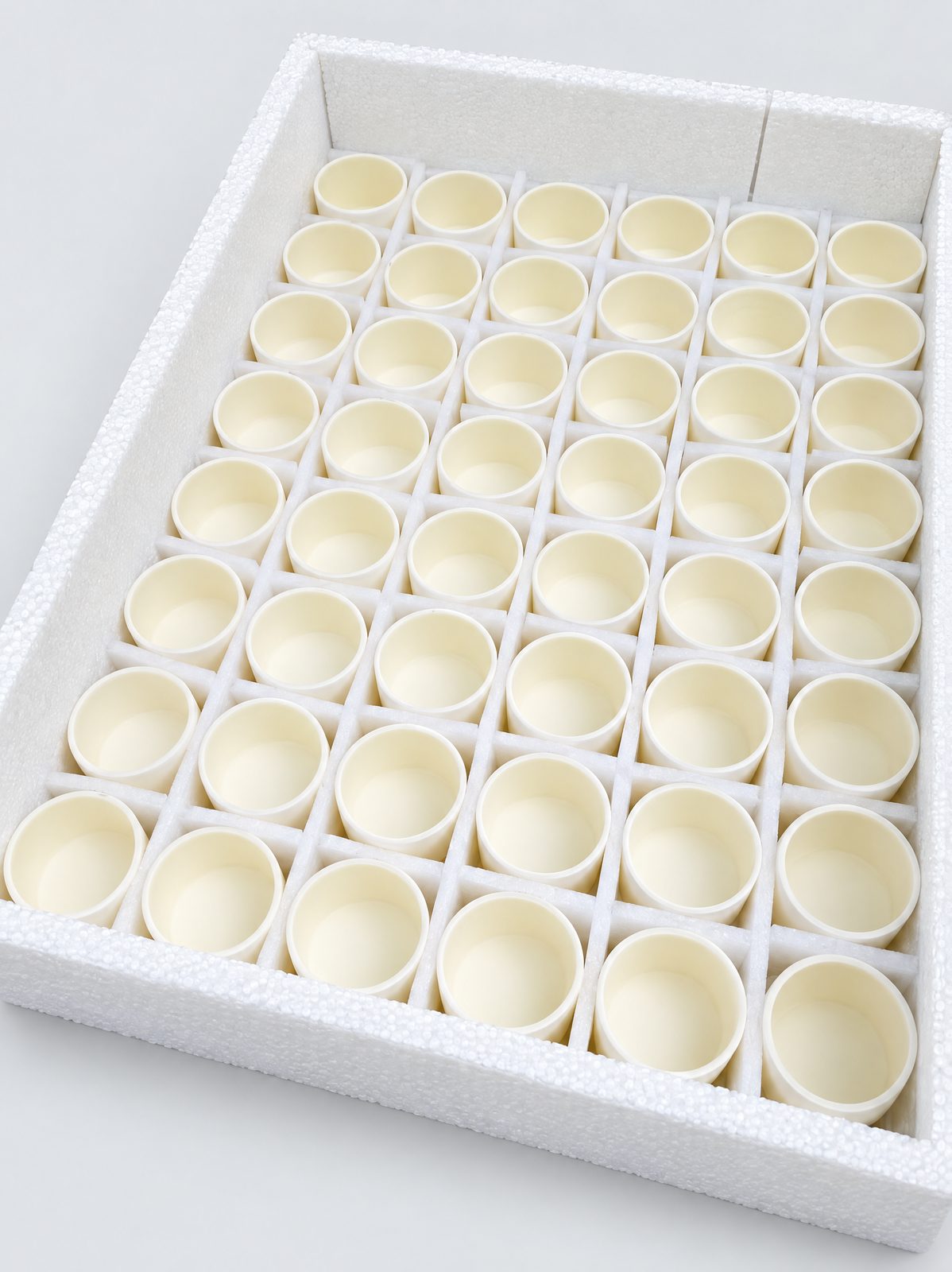
A glazed porcelain crucible is rated to 1,150 °C in CoorsTek's catalog and 1,050 °C in Almath's data, unglazed porcelain to 1,400 °C and 1,380 °C. The same makers rate alumina to 1,750 °C and 1,700 °C. Use porcelain for routine ashing and ignitions below its glaze limit. Switch to alumina above that, for alkaline fluxes and glass, or when silica or sodium from the crucible would show in your result. We make alumina crucibles, and the porcelain figures are the makers'.
Porcelain and alumina side by side
| CoorsTek | Porcelain | Alumina (AD-998) |
|---|---|---|
| Limit (°C) | 1,150 glazed, 1,400 unglazed | 1,750, no load |
| Softening (°C) | 1,400 | – |
| Expansion | 3.56 to 200 °C, 4.69 at 1,000 °C | 8.0, 25–1,000 °C |
| Ramp, max | 200 °C/h | 150 °C/h |
| Hardness | 57.5 | 79 |
| Alkalis, fluxes | – | High resistance |
| Gas-tight | – | Yes, no water absorption |
Two things in that table decide most cases. In CoorsTek's figures, alumina takes 600 °C more than glazed porcelain. Porcelain expands about 40% less and CoorsTek lets it heat faster. For our own alumina, the material table gives 1,600–1,800 °C, and our alumina crucibles are used up to 1,650 °C in air. All seven crucible materials are compared in crucible materials compared, and alumina against zirconia in alumina or zirconia crucible.
Temperature: the glaze sets the limit
Porcelain crucibles are glazed, and the glaze softens first. CoorsTek rates its porcelain 1,400 °C unglazed but 1,150 °C glazed, 1,300 °C evacuated, and gives 1,400 °C as the softening point. Almath gives 1,050 °C glazed and 1,380 °C unglazed. CoorsTek glazes its crucibles inside and out except the outside bottom and the rim, and sells its boats unglazed.
Alumina has no glaze. CoorsTek rates its alumina ware to 1,750 °C and Almath its alumina to 1,700 °C. Tempco draws the same line for protection tubes: 1,400 °C for porcelain (mullite), 1,700 °C for alumina. So if your muffle furnace runs above about 1,050 °C, a glazed porcelain crucible is past at least one maker's rating, and alumina is the safer choice. Why alumina ratings differ between makers is in alumina maximum temperature.
Chemistry and contamination
Porcelain is a silicate body. Almath publishes its porcelain at about half silica, with 3.5% K₂O, 1.68% MgO and 0.79% Na₂O. Next to it, the three yearly lab analyses of our 99.5% alumina:
| Oxide (%) | Porcelain (Almath) | Our 99.5% alumina |
|---|---|---|
| Al₂O₃ | 34.48 | 99.55–99.61 |
| SiO₂ | 54.48 | 0.15–0.19 |
| K₂O | 3.5 | – |
| MgO | 1.68 | – |
| Na₂O | 0.79 | 0.043–0.054 |
| CaO | 0.47 | 0.13–0.14 |
| Fe₂O₃ | 0.15 | 0.014–0.026 |
- Alkalis are porcelain's weak side. Almath gives its porcelain over 99.98% acid resistance but only over 97% alkali resistance. CoorsTek rates its alumina highly resistant to alkalies and other fluxes and suitable for glass melting, borosilicate included.
- Atmosphere: CoorsTek says its alumina is inert in hydrogen and carbon-bearing atmospheres and works in reducing and oxidising ones. Tempco notes that porcelain tubes contain silica and are attacked by halogen gases.
- Acids: in CoorsTek's four-hour tests an alumina crucible lost about 0.0006% of its weight in hot concentrated sulfuric acid and 0.16% in hot 50% phosphoric acid. Hydrofluoric acid attacks alumina; for HF, see platinum in the materials guide.
Where sodium and iron in the crucible matter, the low-sodium alumina guide has the full analyses and what to write on the order.
Thermal shock: porcelain takes faster ramps
CoorsTek allows 200 °C per hour for porcelain and 150 °C per hour for alumina, and alumina expands more: 8.0 against 4.69 × 10⁻⁶/K up to 1,000 °C (more in alumina properties by purity). Tempco rates the opposite way for tubes, porcelain (mullite) “poor” and alumina “fair”, so treat both as fragile. CoorsTek's advice covers both: heat and cool gradually, use an oven or hot plate as a step in between when you need to go faster, and never set hot ware on a cold surface. Rates from other alumina makers are in alumina thermal shock.
Cost
No crucible maker we read publishes a price ratio between porcelain and alumina, and we quote prices per size and quantity. The closest figure is for tubes: JUMO puts its KER 610, a 60% alumina, 37% silica ceramic, at about five times cheaper than its KER 710 alumina. So choose on temperature and chemistry first, then compare quotes for the size and quantity you need.
When to switch from porcelain to alumina
- Your peak temperature is above the glaze limit of your porcelain, 1,050–1,150 °C in these makers' data.
- You fuse samples with alkaline fluxes or melt glass.
- You heat in hydrogen or a carbon-bearing atmosphere.
- Silica or sodium from the crucible would show in your blank or result.
- You need a size porcelain isn't made in: the largest porcelain crucible in CoorsTek's catalog is 250 ml, its alumina goes to 4,750 ml.
Stay with porcelain for routine ignitions and ashing below the glaze limit, where faster ramps matter, and for Gooch filtration crucibles, which CoorsTek makes in porcelain and which aren't in our standard alumina range.
The same capacity in alumina
If you're replacing porcelain crucibles you already use, start from capacity. Each CoorsTek porcelain size below is set against our arc-shaped alumina crucible of the same or the next larger capacity, and each link opens the quote form with that size filled in.
| Porcelain, high form | Our alumina |
|---|---|
| 10 ml, 31×26 | 10 ml, 28×32 tall |
| 12 ml, 35×28 | 15 ml, 31×35 tall |
| 20 ml, 45×36 | 20 ml, 34×39 tall |
| 30 ml, 50×40 | 30 ml, 37×45 tall |
| 80 ml, 60×49 | 100 ml, 61×60 |
| 120 ml, 70×56 | 120 ml, 63×73 tall |
| 200 ml, 80×62 | 200 ml, 82×70 |
Wide-form crucibles, boats and lids
| Porcelain, wide form | Our alumina |
|---|---|
| 5 ml, 32×20 | 5 ml, 26×21 |
| 17 ml, 41×26 | 20 ml, 38×35 |
| 30 ml, 50×31 | 30 ml, 45×39 |
| 62 ml, 60×38 | 70 ml, 56×56 |
| 91 ml, 70×44 | 100 ml, 61×60 |
| 150 ml, 84×52 | 150 ml, 73×67 |
| 250 ml, 102×60 | 250 ml, 90×76 |
| Porcelain boat | Our nearest boat |
|---|---|
| 75×13×8 | 77×13×8 boat-shaped |
| 105×14×9 | 100×10×10 rectangular |
| 130×20×13 | 120×30×15 rectangular |
CoorsTek sells glazed covers per crucible number. Our lids are separate parts too: flat round lids, outer lids that fit over the rim and stepped inner lids. Order the lid on the same request as the crucible so both sets of dimensions are confirmed together.
Our alumina crucibles
We make 195 standard sizes of alumina crucibles, boats and lids in 99% and 99.5% Al₂O₃, with crucibles from 0.5 to 1,500 ml, and other sizes to drawing. To size one against your charge and pick a lid, see how to choose an alumina crucible; every size is on the crucibles and boats page. Our alumina crucibles are used up to 1,650 °C in air. Send the size, grade, peak temperature and what goes in it, and we quote the alumina part for that job.
Questions buyers ask
- What temperature can a porcelain crucible withstand?
- Glazed, 1,150 °C in CoorsTek’s catalog and 1,050 °C in Almath’s data. Unglazed porcelain goes higher, 1,400 °C (CoorsTek) or 1,380 °C (Almath), and CoorsTek gives 1,400 °C as the softening point. Most porcelain crucibles are glazed, so work to the glazed figure.
- What is a porcelain crucible used for?
- Routine ashing and ignitions below the glaze limit, 1,050–1,150 °C in the makers’ data, where its faster ramps help. CoorsTek also makes porcelain Gooch crucibles with a perforated bottom for total suspended solids. For higher temperatures, alkaline fluxes or glass, use alumina.
- Is an alumina crucible better than a porcelain one?
- For heat and alkalis, yes: CoorsTek rates its alumina to 1,750 °C with high resistance to alkalies and fluxes. Porcelain takes faster ramps, 200 °C per hour against 150 °C for alumina in CoorsTek’s advice, and is fine for routine ashing below its glaze limit.
- Can I use a porcelain crucible in a muffle furnace?
- Yes, below the glaze limit of your crucible: 1,050 to 1,150 °C in the makers’ data. Above that, or for fusions with alkaline fluxes, use alumina.
- Can a porcelain crucible contaminate a sample?
- It can add what it is made of. Almath gives its porcelain as 54.48% SiO₂, 3.5% K₂O and 0.79% Na₂O. Our 99.5% alumina measured 0.15–0.19% SiO₂ and 0.043–0.054% Na₂O in our yearly lab samples since 2024.
Sources
- CoorsTek: Labware catalog Rev O, chemical-porcelain properties, boats and crucibles (pages 3–5), AD-998 properties and crucibles (pages 10–11)
- Almath Crucibles: porcelain material page (temperature resistance, composition, acid and alkali resistance)
- Almath Crucibles: technical data sheets, alumina and MgO- and CaO-stabilised zirconia
- JUMO data sheet 90.1000 (German), KER 710 and KER 610
- Tempco: ceramic protection tubes, catalog page 14-85 (alumina and porcelain/mullite limits)
- NETZSCH: Recommendations for Cleaning Al₂O₃ and Pt Crucibles
- Our own figures: the factory’s standard-size list, 2026 orders and test report, as recorded in our product catalog.