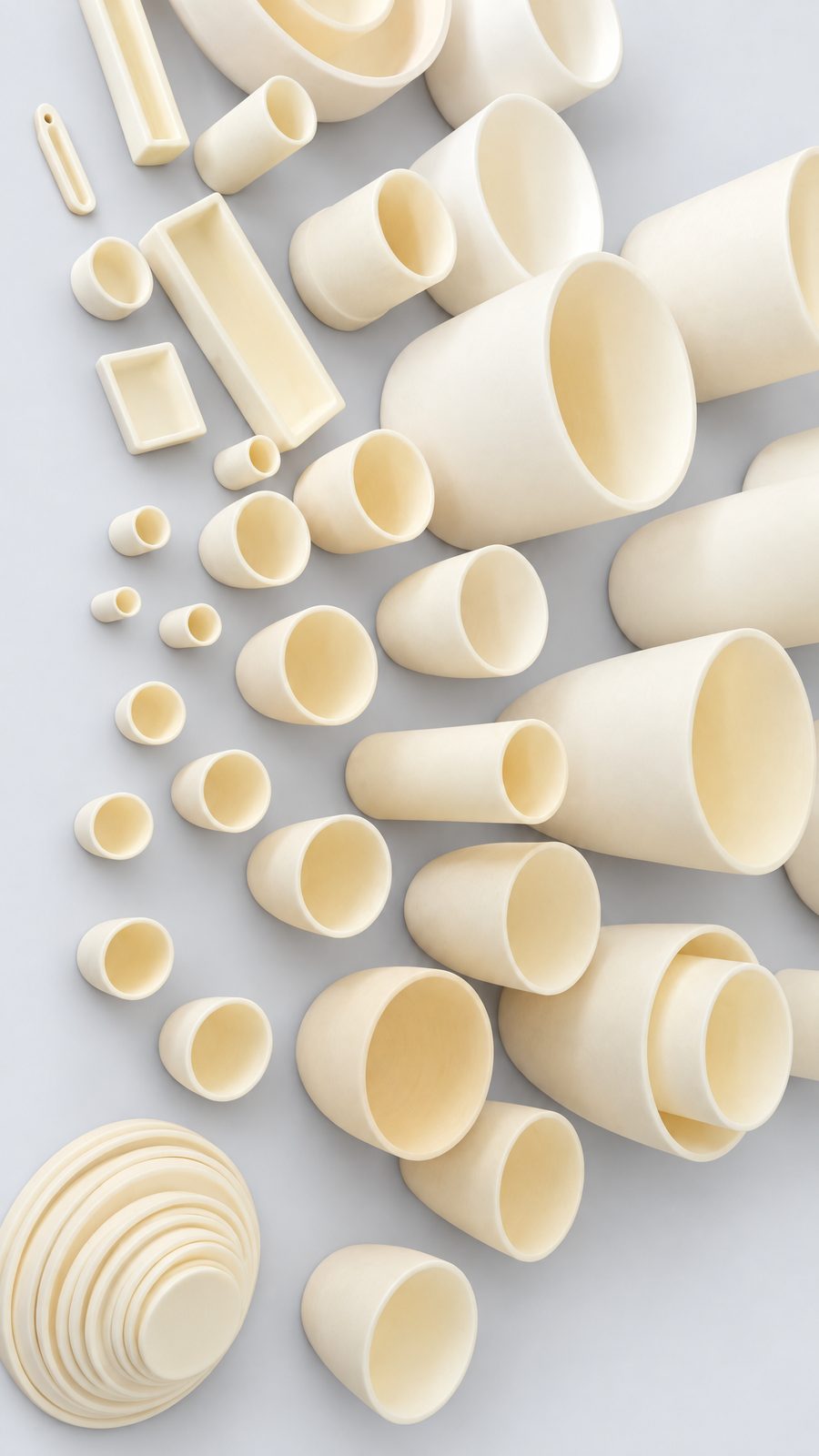
Choose by peak temperature, then by what goes in the crucible. Makers rate glazed porcelain to 1,050–1,150 °C, fused silica to 950–1,160 °C, alumina to 1,700–1,750 °C and stabilised zirconia past 2,000 °C. Graphite needs inert gas or vacuum. Platinum, to 1,400 °C, handles hydrofluoric acid but not metals or reducing conditions. We make alumina; every figure below is the named maker's for its own ware.
Temperature limits, as each maker publishes them
| Material (maker) | Limit (°C) | Basis |
|---|---|---|
| Porcelain, glazed (CoorsTek chemical porcelain) | 1,150 | limit of use |
| Porcelain, glazed (Almath) | 1,050 | temperature resistance |
| Porcelain, unglazed (CoorsTek chemical porcelain) | 1,400 | limit of use; 1,300 evacuated |
| Fused silica, electrically fused (Heraeus) | 1,160 | continuous; 1,300 short-term |
| Fused silica, synthetic (Heraeus) | 950 | continuous; 1,200 short-term |
| Alumina (CoorsTek AD-998) | 1,750 | maximum use, no load |
| Alumina (Almath) | 1,700 | maximum service |
| Zirconia, MgO-stabilised (Almath) | 2,000 | maximum service |
| Zirconia, CaO-stabilised (Almath) | above 2,000 | maximum service |
| Graphite (Almath grade 2020) | 427 in air | 2,760 in inert gas |
| Platinum (Johnson Matthey) | 1,400 | maximum recommended |
| Platinum, 5% gold (Johnson Matthey) | 1,300 | maximum recommended |
| Platinum, 10% rhodium (Johnson Matthey) | 1,550 | maximum recommended |
Makers disagree: 1,150 or 1,050 °C for glazed porcelain, 1,750 or 1,700 °C for high-purity alumina. Work to the figure of the maker whose crucible you use. Our material table gives 1,600–1,800 °C for corundum ceramic, and our alumina crucibles are used up to 1,650 °C in air. The alumina maximum temperature guide explains why published limits differ.
What attacks each material
- Porcelain is a silicate body, about 54% SiO₂ and 34% Al₂O₃ in Almath's, and glazed ware is held to the glaze's limit. Porcelain against alumina in detail, with same-capacity sizes, is in porcelain or alumina crucible.
- Fused silica is attacked by only two acids, hydrofluoric and phosphoric, says Heraeus, but by all alkali and alkaline-earth compounds, down to fingerprints. Technical Glass Products says it usually starts to devitrify at 1,200 °C or above.
- Alumina: CoorsTek rates its alumina ware highly resistant to alkalies and fluxes, fit for glass melts and for hydrogen and carbon-bearing atmospheres. In its four-hour tests a crucible lost about 0.0006% of its weight in hot concentrated sulfuric acid, 0.0009% in hot 10% sodium hydroxide and 0.16% in hot 50% phosphoric acid. Hydrofluoric acid attacks it (NETZSCH).
- Zirconia must be stabilised with CaO, MgO or Y₂O₃. Almath sells a porous lime-stabilised grade for acidic materials and slags, superalloys and precious metals. Alumina against zirconia, stabiliser by stabiliser, is in alumina or zirconia crucible.
- Graphite oxidises in hot air, so Almath limits it to 427 °C in air and 2,760 °C in inert gas.
- Platinum goes brittle in reducing conditions or a smoky flame, says Johnson Matthey. Hot, it is attacked by phosphorus, arsenic, antimony, selenium, tellurium, fused alkali oxides and hydroxides, iron oxide above 1,200 °C, lead and bismuth oxides above 1,250 °C, silica and borax. Aqua regia and hydrochloric acid attack it at any temperature.
Thermal shock
| Material | Expansion (10⁻⁶/K) | Quench ΔT (°C) |
|---|---|---|
| Fused silica | about 0.5 (Heraeus) | – |
| Porcelain | 3.56–4.69 (CoorsTek) | – |
| Alumina | 8.0 (CoorsTek) | 170–300 |
| Zirconia | 10.1–10.3 (Almath) | 400–500 |
| Silicon carbide | – | 400 |
Low expansion is why fused silica survives a jump that cracks alumina. Zirconia expands more than alumina yet scores higher in Morgan's quench test; Morgan notes that toughness, porosity and shape count too. CoorsTek limits heating and cooling to 200 °C per hour for porcelain and 150 °C per hour for alumina, and the alumina thermal shock guide compares other makers' rates.
Crucibles for melting metal and glass
Foundry crucibles are clay-bonded graphite or carbon-bonded silicon carbide. Foseco gives these typical casting temperatures for its range, used for precious metals, copper and aluminium alloys and, in the clay-graphite grades, cast iron:
| Foseco crucible | Type | Casting (°C) |
|---|---|---|
| Salamander Super | clay-graphite | 850–1,600 |
| Grafit | clay-graphite | 400–1,400 |
| Excel | carbon-bonded silicon carbide | 850–1,250 |
| Himelt | carbon-bonded silicon carbide | 1,000–1,400 |
Plain graphite works for a melt under inert gas or vacuum. Never melt metal in platinum: Johnson Matthey warns that molten metals dissolve it.
For induction melting of alloys, Almath makes oxide crucibles. It calls alumina a good general-purpose material, usable to around 1,700 °C for a wide range of alloys. It uses magnesia for vacuum melting of nickel, cobalt and iron, and zirconia above 2,000 °C for platinum-group metals and superalloys. These are porous refractory grades, made porous to slow crack growth in thermal shock: Almath's 97.5% alumina has 21% apparent porosity, unlike dense lab alumina. Our crucibles are dense 99 to 99.5% alumina lab ware. For a metal melt, tell us the alloy, the temperature and the heating method, and we confirm the grade in the quotation.
Glass is a better fit for dense alumina. CoorsTek lists its alumina as suitable for glass melting, borosilicate included, and the DIN 43724 guideline reproduced by Morgan allows C799 alumina tubes in contact with melting glass up to 1,500 °C. In glass furnaces, Pyrosales says the glass itself is measured through a platinum sheath, since the glass is abrasive and corrosive; where alumina is used there is covered in protection tube material.
Which material for which job
- Routine ignitions and ashing below about 1,000 °C: glazed porcelain.
- Acids, or fast heating and cooling, within the grade's limit: fused silica, if no alkali touches it.
- Oxide powders, alkaline fluxes and glass melts up to 1,700 °C: alumina.
- Above alumina's limit, or acidic slags, superalloys and precious-metal melts: stabilised zirconia.
- Melting non-ferrous metals and cast iron: clay-graphite or silicon carbide.
- Vacuum induction melting of nickel, cobalt and iron: magnesia, in Almath's range.
- Hydrofluoric acid evaporations, carbonate fusions and ignitions of precipitates: platinum, kept oxidising.
On cost, Almath says zirconia is considerably more expensive than alumina, and Johnson Matthey calls platinum ware an investment. Cleaning differs too; see the crucible cleaning guide.
Our alumina crucibles and boats
We make 195 standard sizes of alumina crucibles, boats and lids in 99% and 99.5% Al₂O₃, and other sizes to drawing. Each example below opens the quote form with that size filled in.
| Shape (sizes) | Range | Examples |
|---|---|---|
| Arc-shaped crucibles (31) | 3–1,300 ml | 10 ml, 50 ml, 300 ml |
| Cylindrical crucibles (48) | 0.5–1,500 ml | 50 ml (30×100), 1500 ml (125×150) |
| Boats (67) | 20–250 mm long | 100×20×20, 100×40×20 |
| Boats with lids (17) | 50–120 mm long | 100×30×20 |
| Lids (32) | round and rectangular | all lid sizes |
All sizes are on the crucibles and boats page. To size one against your charge and pick a lid, see how to choose an alumina crucible. If alumina is right for your job, send the size, grade, peak temperature and what goes in it, and we quote the part. Our crucibles are used up to 1,650 °C in air.
Questions buyers ask
- Which crucible material takes the highest temperature?
- In air, stabilised zirconia: Almath rates its dense MgO- and CaO-stabilised zirconia at 2,000 °C and above, against 1,700 to 1,750 °C for alumina from Almath and CoorsTek. Graphite goes to 2,760 °C in Almath’s data, but only in inert gas or vacuum; in air Almath limits it to 427 °C.
- Should I use a porcelain or an alumina crucible?
- Porcelain for routine heating below its glaze limit, which is 1,150 °C for CoorsTek’s glazed chemical porcelain and 1,050 °C for Almath’s. Alumina above that, up to 1,700 to 1,750 °C in the makers’ data, and for alkaline fluxes and glass melts, which CoorsTek lists for its alumina.
- Can a quartz crucible be used with alkalis?
- No. Heraeus says fused silica is sensitive to all alkali and alkaline-earth compounds; among acids, only hydrofluoric and phosphoric acid attack it. CoorsTek rates its alumina highly resistant to alkalies and other fluxes.
- Which crucible should I use for hydrofluoric acid?
- Platinum. Johnson Matthey lists hydrofluoric acid evaporations among the uses of its platinum ware. NETZSCH notes that HF attacks alumina, and Heraeus that it attacks fused silica.
- What crucible is used for melting steel?
- It depends on the furnace. For induction melting, Almath uses magnesia crucibles for vacuum melting of nickel, cobalt and iron, and calls its porous alumina a general-purpose material for a wide range of alloys up to around 1,700 °C. In fuel-fired and induction foundry furnaces, Foseco’s clay-graphite Salamander Super is used for some ferrous alloys such as grey iron.
- What crucible should I use to melt glass?
- Alumina is one choice: CoorsTek lists its alumina as suitable for glass melting, borosilicate included. The DIN 43724 guideline reproduced by Morgan gives C 799 alumina tubes 1,500 °C in contact with melting glass, against 1,600 °C in clean conditions. In glass plants the melt itself is measured through platinum: Pyrosales says a platinum sheath is needed because glass is abrasive and corrosive.
Sources
- CoorsTek: Labware catalog, chemical-porcelain properties (page 3) and AD-998 high-alumina properties (page 10)
- Almath Crucibles: technical data sheets, alumina and MgO- and CaO-stabilised zirconia
- Almath Crucibles: material pages for zirconia, porcelain and graphite
- Heraeus Covantics: properties of fused silica (working temperatures by grade, chemical resistance)
- Technical Glass Products: fused quartz proper usage guidelines (devitrification, deformation)
- NETZSCH: Recommendations for Cleaning Al₂O₃ and Pt Crucibles
- Morgan Technical Ceramics: thermal shock resistance (mechanism, downshock ΔT by ceramic)
- Foseco: Salamander Super, Grafit and Excel/Himelt metal-melting crucibles (typical casting temperatures)
- Johnson Matthey: care and use of platinum laboratory apparatus
- Almath: Refractory crucibles for induction melting (alumina, magnesia, zirconia)
- Morgan Advanced Materials Haldenwanger: Ceramic tubes brochure (working temperatures; DIN 43724 sheath tube table, pages 12–13)
- Pyrosales: Focus on the glass industry (crown and glass thermocouples)
- Our own figures: the factory’s standard-size list, 2026 orders and test report, as recorded in our product catalog.