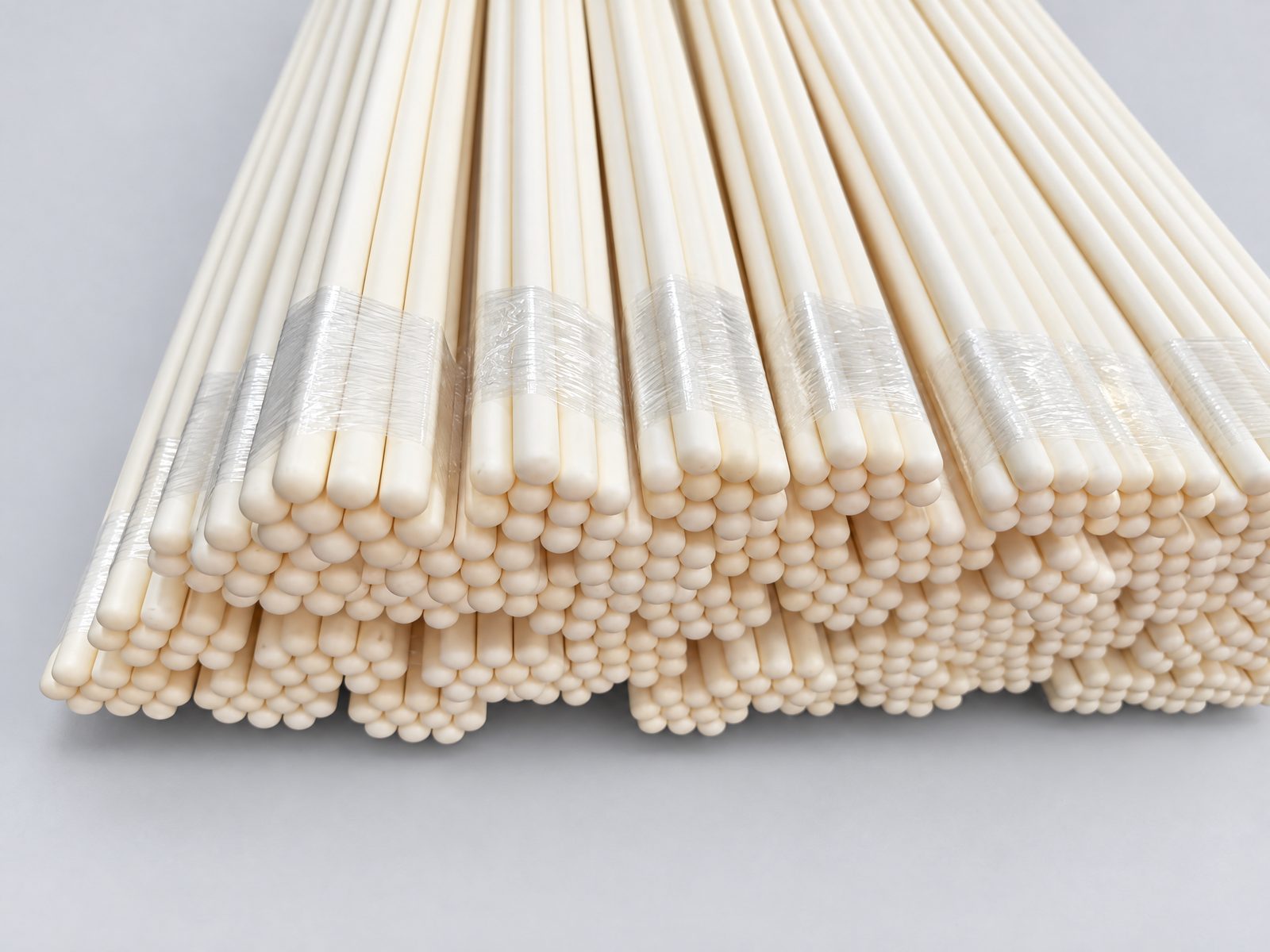
The structure of alumina in technical ceramics is alpha-alumina (Al2O3), which crystallizes in the corundum crystal system with space group R3(bar)c. According to NIST Standard Reference Database 150, its primitive cell contains 2 formula units, while the standard hexagonal unit cell contains 6 formula units with lattice parameters a = 4.761 Å and c = 12.991 Å at 20 °C. On a microscopic scale, commercial alumina is a polycrystalline ceramic sintered at about 1,700 °C to 1,760 °C to bond individual crystals into a dense body with controlled grain size.
Alpha Alumina Crystal Structure and Unit Cell Geometry
According to The American Ceramic Society, ceramics are broadly defined as nonmetallic, inorganic, crystalline compounds including oxides, nitrides, carbides, and borides, whereas commercial glasses are noncrystalline materials typically based on silicate or borosilicate compositions. In industrial oxide ceramics, the structure of alumina is governed by its thermodynamically stable crystalline phase, alpha-alumina, also known as corundum.
In the alpha-alumina crystal structure, the fundamental lattice belongs to the corundum crystal system with space group R3(bar)c. NIST Standard Reference Database 150 notes that while the primitive unit cell contains 2 formula units of Al2O3, crystallographers and materials engineers most commonly refer to a larger hexagonal unit cell that contains 6 formula units.
For high-precision room-temperature calibration, the NIST Standard Reference Material 1976c Certificate of Analysis (issued 05 April 2021) establishes certified hexagonal lattice parameters at 22.5 °C of a = 0.4759092 ± 0.0000080 nm and c = 1.299337 ± 0.000015 nm. By our calculation from the NIST SRM 1976c certified parameters, the axial ratio c/a at 22.5 °C is 2.73022.
| Temperature (°C) | Lattice Parameter a (Å) | Lattice Parameter c (Å) | Density (g/cm3) | Thermal Expansion from 0 °C (10^-6 K^-1) |
|---|---|---|---|---|
| 20 °C | 4.761(3) Å | 12.991(7) Å | 3.984(2) g/cm3 | 4.6(2) x 10^-6 K^-1 |
| 500 °C | 4.777 Å | 13.040 Å | 3.943 g/cm3 | 7.1 x 10^-6 K^-1 |
| 1,000 °C | 4.797 Å | 13.102 Å | 3.891 g/cm3 | 8.1 x 10^-6 K^-1 |
| 1,200 °C | 4.806 Å | 13.129 Å | 3.868 g/cm3 | 8.3 x 10^-6 K^-1 |
| 1,400 °C | 4.815 Å | 13.156 Å | 3.845 g/cm3 | 8.5 x 10^-6 K^-1 |
| 1,500 °C | 4.820 Å | 13.169 Å | 3.834 g/cm3 | 8.6 x 10^-6 K^-1 |
X-Ray Diffraction (XRD) Fingerprint of the Corundum Structure
Read more
Materials laboratories verify the phase purity and crystal structure of alumina using X-ray powder diffraction (XRD). NIST SRM 1976c is a sintered corundum-structure alumina disc (about 25.6 mm in diameter by 2.2 mm in thickness) used globally to calibrate XRD equipment for line position and relative intensity as a function of the 2-theta diffraction angle.
Using copper K-alpha radiation (wavelength 0.15405929 nm), the corundum crystal structure produces a distinct series of reflection peaks defined by their Miller indices (hkl). The most intense reflection is the (104) plane at 35.148 degrees 2-theta (assigned a relative intensity of 100.00), followed by the (116) reflection at 57.495 degrees 2-theta (relative intensity 87.83).
When inspecting incoming ceramic raw materials or sintered components, engineers match their diffraction scans against these reference angles. In NIST SRM 1976c, no crystalline impurities are detected, providing a baseline fingerprint for pure alpha-alumina.
| Reflection (hkl) | Peak Position (2-theta, degrees) | Certified Relative Intensity | Expanded Uncertainty (k = 2) |
|---|---|---|---|
| (012) | 25.575 degrees | 23.62 | ± 0.21 |
| (104) | 35.148 degrees | 100.00 | ± 0.34 |
| (113) | 43.352 degrees | 37.16 | ± 0.23 |
| (024) | 52.549 degrees | 20.68 | ± 0.15 |
| (116) | 57.495 degrees | 87.83 | ± 0.22 |
| (300) | 68.207 degrees | 12.43 | ± 0.15 |
| (0.2.10) | 88.989 degrees | 13.42 | ± 0.06 |
| (226) | 95.243 degrees | 8.22 | ± 0.05 |
| (2.1.10) | 101.066 degrees | 16.65 | ± 0.06 |
| (1.3.10) | 127.670 degrees | 15.29 | ± 0.05 |
| (146) | 136.066 degrees | 13.05 | ± 0.07 |
| (4.0.10) | 145.154 degrees | 11.04 | ± 0.06 |
Alumina Microstructure: Sintering, Grain Size, and Porosity
While the unit cell defines atomic arrangement at the nanometer scale, the engineering performance of a ceramic tube, rod, or insulator depends on its alumina microstructure at the micrometer scale. According to NIST Standard Reference Database 150, alumina ceramics are polycrystalline materials formed by sintering or hot pressing, with sintering typically performed at about 1,700 °C. At GY Alumina, our corundum ware is sintered at about 1,760 °C.
During high-temperature firing, individual powder particles fuse into a dense network of crystal grains separated by grain boundaries. NIST Standard Reference Database 150 notes that manufacturers often add a small amount of magnesium oxide (MgO) to control grain size during sintering. In commercial datasheets, nominal or average grain size is a primary microstructural metric: the NIST evaluated alpha-alumina baseline has a nominal grain size of 5 µm (at 98% or higher of theoretical density), while Kyocera Fineceramics Europe GmbH specifies an average grain size of 10 µm and 0 vol% open porosity for its DEGUSSIT AL23 (above 99.5% alpha-Al2O3) material.
Forming and sintering methods also shape grain orientation and intergranular phases. For example, the NIST SRM 1976c certificate describes electronic substrate discs made from corundum-structure platelets (typically 5 µm to 10 µm in diameter by 2 µm to 3 µm in thickness) that are liquid-phase sintered using a small percentage of anorthite glass phase. That glass phase prevents direct inter-particle contact and relaxes during cooling, while compaction creates an axisymmetric texture with basal planes tending parallel to the disc surface.
By contrast, KYOCERA Fineceramics Europe GmbH states that by largely dispensing with usual sintering aids in its high-purity alumina, the corrosion resistance of the grain boundary chamfer is developed to its best level, and a fine microstructure allows brilliant surface qualities to be achieved by fine machining.
How Alumina Structure Controls Mechanical and Thermal Properties
Read more
The strong ionic and covalent bonding inside the corundum lattice gives dense polycrystalline alumina its high stiffness, hardness, and melting point of 2,050 ± 4 °C (NIST Standard Reference Database 150). However, as temperature rises and the hexagonal lattice expands, both mechanical strength and thermal conductivity drop.
At 20 °C, NIST Standard Reference Database 150 reports an elastic modulus of 416 ± 30 GPa, a Vickers hardness (1 kg load) of 15 ± 2 GPa, a compressive strength of 3.0 ± 0.5 GPa, and a flexural strength of 380 ± 50 MPa. When the structure is heated to 1,000 °C, flexural strength remains at 345 MPa, but above 1,200 °C grain boundary sliding and diffusion accelerate. Under a flexural load of 150 MPa, the creep rate rises from 0 x 10^-9 s^-1 at 500 °C to 4 x 10^-9 s^-1 at 1,000 °C, 280 x 10^-9 s^-1 at 1,200 °C, and 24,600 x 10^-9 s^-1 at 1,500 °C (with a creep activation energy of 325 ± 25 kJ/mol and a stress exponent of 1.08 ± 0.05 between 1,200 °C and 1,800 °C).
| Property | 20 °C | 500 °C | 1,000 °C | 1,200 °C | 1,500 °C |
|---|---|---|---|---|---|
| Elastic Modulus (GPa) | 416(30) GPa | 390 GPa | 364 GPa | 354 GPa | 338 GPa |
| Shear Modulus (GPa) | 169(1) GPa | 158 GPa | 146 GPa | 142 GPa | 135 GPa |
| Bulk Modulus (GPa) | 257(50) GPa | 247 GPa | 237 GPa | 233 GPa | 227 GPa |
| Poisson's Ratio | 0.231(1) | 0.237 | 0.244 | 0.247 | 0.252 |
| Flexural Strength (MPa) | 380(50) MPa | 375 MPa | 345 MPa | 300 MPa | 130 MPa |
| Compressive Strength (GPa) | 3.0(5) GPa | 1.6 GPa | 0.7 GPa | 0.4 GPa | 0.28 GPa |
| Tensile Strength (MPa) | 267(30) MPa | 267 MPa | 243 MPa | 140 MPa | 13 MPa |
| Vickers Hardness, 1 kg (GPa) | 15(2) GPa | 8.5 GPa | 4.6 GPa | 3.7 GPa | 2.5 GPa |
| Fracture Toughness, 300 µm crack (MPa·m^1/2) | 3.5(5) MPa·m^1/2 | 3.0 MPa·m^1/2 | 2.7 MPa·m^1/2 | 2.6 MPa·m^1/2 | 2.5 MPa·m^1/2 |
| Thermal Conductivity (W/m·K) | 33(2) W/m·K | 11.4 W/m·K | 7.22 W/m·K | 6.67 W/m·K | 6.23 W/m·K |
| Specific Heat (J/kg·K) | 755(15) J/kg·K | 1,165 J/kg·K | 1,255 J/kg·K | 1,285 J/kg·K | 1,330 J/kg·K |
Commercial Alumina Grades, Standards, and Forming Routes
When you specify an alumina part on an engineering drawing, international standards and supplier datasheets group materials by composition and physical properties. IEC 60672-1:1995 (Edition 2.0, published 1995-06-27, stability date 2029) provides definitions and classification for ceramic, glass, and glass-ceramic materials used for electrical insulation. In North America, ASTM D2442-75(2025) covers requirements, limits, and test methods for electrical, mechanical, thermal, and general properties of fabricated alumina parts for electrical and electronic applications and ceramic-to-metal seals.
At GY Alumina, our standard grade is C799 alumina (99.5% Al2O3). Where a buyer's drawing names C 610, we supply 95% white alumina or our standard C799 instead. Neither is mullite. An independent lab analyses one of our alumina tubes every year, recording 99.55% Al2O3 in 2024, 99.57% Al2O3 in 2025, and 99.61% Al2O3 in 2026.
Both chemical purity and the forming method control the final bulk density and mechanical strength of the sintered ceramic. GY Alumina uses four forming methods: slip casting, pressing, extrusion, and hot pressing. Our largest extruded tube today is OD 17 x ID 10 mm, and our largest slip-cast tube is OD 100 x ID 90 x 1,000 mm. The table below compares published reference and manufacturer values for high-purity alpha-alumina.
| Property | NIST SRD 150 Sintered Alpha-Alumina | Kyocera DEGUSSIT AL23 (Feb 2025 Datasheet) |
|---|---|---|
| Al2O3 Purity (%) | 99.5% or higher | Above 99.5% |
| Nominal / Average Grain Size (µm) | 5 µm | 10 µm (ISO 13383-1 A1) |
| Open Porosity (vol%) | Not stated (98% or higher of theoretical density) | 0 vol% (DIN EN ISO 18754) |
| Bulk Density at 20 °C (g/cm3) | 3.984(2) g/cm3 | 3.70 to 3.95 g/cm3 (process dependent) |
| Bending / Flexural Strength at 20 °C (MPa) | 380(50) MPa (flexural) | 300 to 350 MPa (4-point bending, DIN EN 843-1) |
| Compressive Strength at 20 °C | 3.0(5) GPa | 2,500 MPa (DIN ISO 17162) |
| Elastic Modulus at 20 °C (GPa) | 416(30) GPa | 380 GPa (dynamic, EN 843-2) |
| Vickers Hardness at 20 °C (GPa) | 15(2) GPa (1 kg load) | 17.1 GPa (HV 1.0, DIN EN ISO 14705) |
| Thermal Conductivity at 20 °C (W/m·K) | 33(2) W/m·K | 34.9 W/m·K (DIN EN ISO 18755) |
| Max Service / Melting Temperature (°C) | Melting point 2,050(4) °C | 1,950 °C max in air |
Worked Example: Calculating Tube Expansion and Density Change at 1,200 °C
When designing furnace hardware or thermocouple assemblies, you need to account for how the crystal structure of alumina expands between room temperature and operating temperature. Below is a worked calculation written by our team using a tube of OD 100 x ID 90 x 1,000 mm (the largest cast tube dimensions made by GY Alumina) and the evaluated property data from NIST Standard Reference Database 150.
Step 1: Unit cell expansion along the a-axis and c-axis. At the atomic level, heating the hexagonal corundum lattice stretches interatomic bond distances slightly faster along the c-axis than along the basal a-axis. By our calculation from the NIST lattice parameter table above, heating from 20 °C to 1,200 °C increases a by 0.045 Å (from 4.761 Å to 4.806 Å, a 0.95% expansion) and increases c by 0.138 Å (from 12.991 Å to 13.129 Å, a 1.06% expansion). If the furnace reaches 1,500 °C, a increases by 0.059 Å (1.24%) to 4.820 Å and c increases by 0.178 Å (1.37%) to 13.169 Å.
Step 2: Axial length growth on a 1,000 mm furnace tube at 1,200 °C. In a randomly oriented polycrystalline alumina tube, directional crystal expansion averages to the bulk mean linear thermal expansion coefficient, which is 8.3 x 10^-6 K^-1 from 0 °C to 1,200 °C and 4.6 x 10^-6 K^-1 from 0 °C to 20 °C. Over the 1,200 K span from the 0 °C datum, a 1,000 mm tube elongates by 1,000 mm x 8.3 x 10^-6 K^-1 x 1,200 K = 9.96 mm. Subtracting the 0.092 mm expansion already present between 0 °C and 20 °C (1,000 mm x 4.6 x 10^-6 K^-1 x 20 K) gives a net elongation of 9.868 mm from 20 °C to 1,200 °C, bringing the hot tube length to 1,009.868 mm. Rigid metal endplates or bellows mounts must allow at least 10 mm of free axial travel so the expanding ceramic is not placed under compressive buckling or flange bending loads.
Step 3: Diametral clearance on the 100 mm OD and 90 mm ID. Applying the same expansion step to the cross-section, the 100 mm outside diameter grows by 0.996 mm from 0 °C, or 0.9868 mm net from 20 °C (0.996 mm minus 0.0092 mm), reaching 100.9868 mm at 1,200 °C. The 90 mm bore grows by 0.8964 mm from 0 °C, or 0.88812 mm net from 20 °C (0.8964 mm minus 0.00828 mm), reaching 90.88812 mm at 1,200 °C. Any refractory collar, radiation shield, or O-ring gland positioned near a hot zone must provide radial clearance for nearly 1 mm of OD growth.
Step 4: Lattice-driven density drop and wall heat transfer. Because the mass of the sintered Al2O3 tube stays constant while every hexagonal unit cell expands in volume, density drops from 3.984 g/cm3 at 20 °C to 3.868 g/cm3 at 1,200 °C, a reduction of 0.116 g/cm3 (2.91%), and reaches 3.834 g/cm3 at 1,500 °C, a reduction of 0.150 g/cm3 (3.77%). Over the same temperature climb, lattice phonon scattering cuts thermal conductivity from 33 W/m·K at 20 °C to 6.67 W/m·K at 1,200 °C (a 79.8% drop) and 6.23 W/m·K at 1,500 °C (an 81.1% drop), while specific heat rises from 755 J/kg·K at 20 °C to 1,285 J/kg·K at 1,200 °C. Because heat conducts nearly five times more slowly through the 5 mm tube wall at 1,200 °C than at room temperature, controlled heating and cooling ramps help prevent steep radial temperature gradients across large-diameter tubes.
Buyer's Specification Checklist for Alumina Components
At GY Alumina, we manufacture round, elliptical, and square tubes (open or one end closed), single-, twin-, and multi-bore tubes and capillaries, threaded, ribbed, perforated, and slotted tubes, solid rods, square bars, balls, rings, washers, bushings, discs, crucibles, boats, and custom shapes to your drawing or sample. Secondary operations we perform include cutting to length, end slots, side holes and perforated tubes, and closed ends with drilled holes.
Before sending your drawing for a quotation, use this specification checklist written by our team to make sure your material and microstructural requirements are clear:
- Material grade and purity: State the required Al2O3 grade on the drawing, such as C799 alumina for high-temperature corundum tubes, insulators, and crucibles, or 95% white alumina.
- Forming route and size envelope: Match the geometry to the forming method. Extruded tubes cover small profiles up to OD 17 x ID 10 mm, while cast tubes cover large profiles up to OD 100 x ID 90 x 1,000 mm.
- Critical dimensions and bore clearance: Specify OD, ID, and overall length with tolerances, and confirm the bore against your wire or insert before ordering.
- Secondary features: Mark the exact position and diameter of any end slots, side holes, perforations, or drilled closed ends on the drawing.
- Operating environment: Note the peak operating temperature, heating rate, mechanical load, and atmosphere (such as vacuum, air, or argon, the three atmospheres in which NASA Technical Note D-7027 studied thermal electromotive force change for noble and refractory-metal thermocouples at 1,326.85 °C (1,600 K)).
How to Order Custom and Stock Alumina Parts
For order terms at GY Alumina, parts made to your drawing or sample usually start at 100 pieces per item and take 25 to 30 days to produce, and 5 to 10 free samples are sent for your approval first (you pay the courier). Standard sizes ship from stock in about 3 days for small orders to about 7 days for bulk orders. Our ISO 9001:2015 certificate covers the manufacturing of ceramic protective tubes for thermocouples, and we have 100+ customers served.
Send your drawing, the grade and the quantity. We usually reply with a quote within two working days.
Questions buyers ask
- What is the crystal structure of alpha alumina?
- According to NIST Standard Reference Database 150, alpha-alumina crystallizes in the corundum system with space group R3(bar)c. It has 2 formula units in its primitive unit cell and 6 formula units in its standard hexagonal unit cell, with room-temperature (20 °C) lattice parameters of a = 4.761 Å and c = 12.991 Å.
- What is the grain size and sintering temperature of polycrystalline alumina?
- NIST Standard Reference Database 150 states that polycrystalline alumina is typically sintered at about 1,700 °C (often with a small MgO addition to control grain growth) to a nominal grain size of 5 µm, while Kyocera DEGUSSIT AL23 specifies an average grain size of 10 µm. At GY Alumina, our C799 corundum ware is sintered at about 1,760 °C.
- How does the forming method affect the bulk density of corundum ceramics?
- Bulk density and bending strength vary directly with the forming and sintering route. For example, Kyocera Fineceramics Europe GmbH lists a process-dependent bulk density of 3.70 to 3.95 g/cm3 and a 4-point bending strength of 300 to 350 MPa (with 0 vol% open porosity) for its DEGUSSIT AL23 alpha-alumina, while NIST Standard Reference Database 150 reports 3.984 g/cm3 at 20 °C for nearly fully densified sintered or hot-pressed alpha-alumina.
- What happens if my drawing specifies C 610 instead of C799 alumina?
- Where a drawing names C 610, GY Alumina supplies 95% white alumina or our standard C799 alumina instead. Neither material is mullite.
- What are the minimum order quantity, sample policy, and lead time for custom alumina parts?
- At GY Alumina, custom parts made to your drawing or sample usually start at 100 pieces per item and take 25 to 30 days to produce, with 5 to 10 free samples sent for approval first (the buyer pays the courier). Standard sizes in stock ship in about 3 days for small orders and about 7 days for bulk orders.
Sources
- NIST Standard Reference Database 150: Sintered Alumina Property Data Summary
- NIST Certificate of Analysis: Standard Reference Material 1976c
- The American Ceramic Society: Structure and Properties of Ceramics
- KYOCERA Fineceramics Europe GmbH: DEGUSSIT AL23 Datasheet
- KYOCERA Fineceramics Europe GmbH: Alumina Materials
- IEC 60672-1:1995 Ceramic and Glass Insulating Materials
- ASTM D2442 Standard Specification for Alumina Ceramics for Electrical and Electronic Applications
- NASA Technical Note D-7027: Thermal Electromotive Force Change for Thermocouples at 1600 K
- GY Alumina: Alumina and Corundum Grades Material Data
- GY Alumina: Buyer FAQ
- GY Alumina: Our Factory
- GY Alumina: Custom Alumina and Industrial Ceramic Components
Last checked .