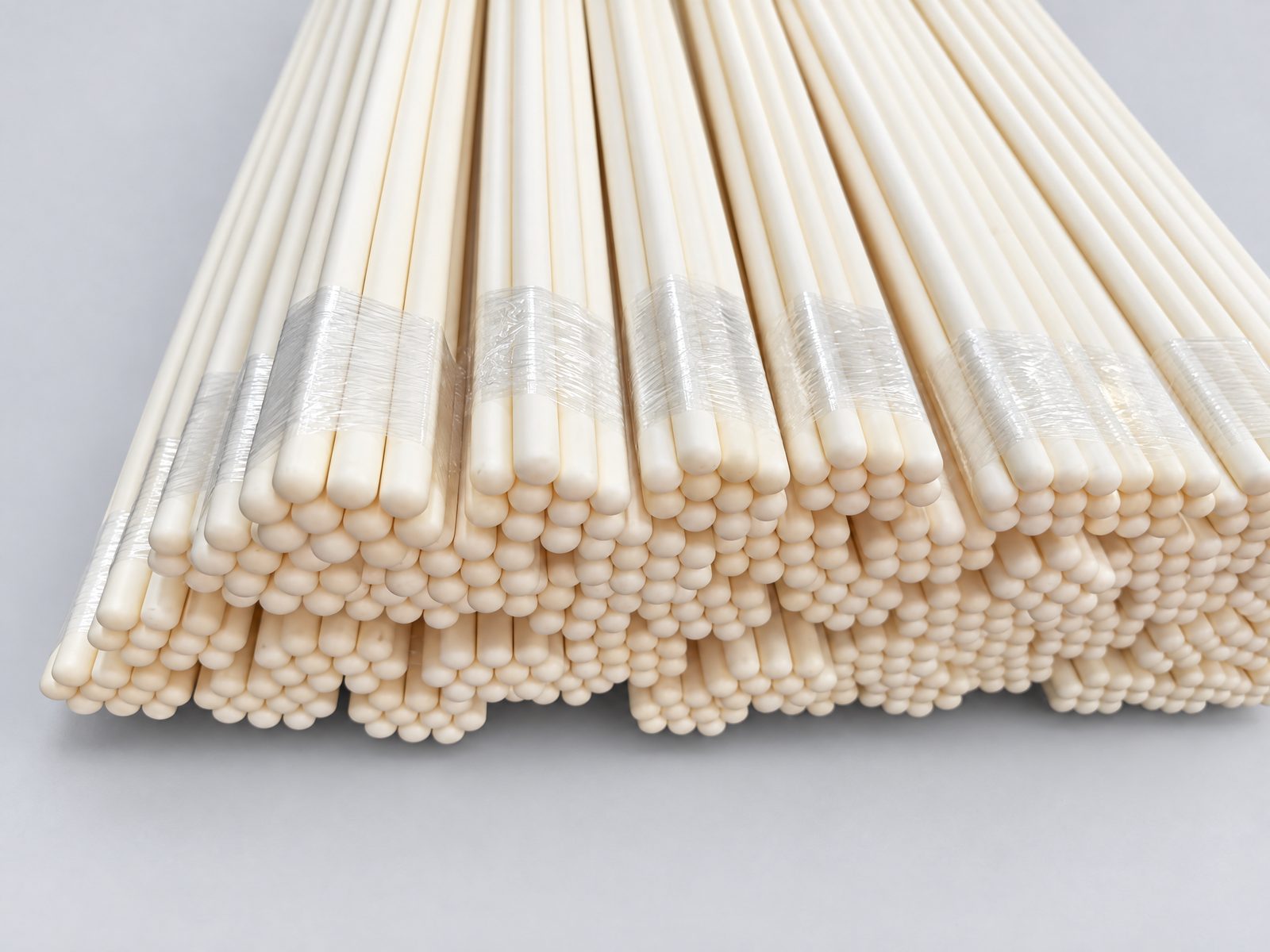
The room-temperature elastic modulus (Young's modulus) of commercial aluminum oxide ceramics ranges from 300 GPa for 94% and 96% alumina grades up to 375 GPa for 99.5% alumina according to Accuratus material data and 380 GPa for Kyocera DEGUSSIT AL23 (above 99.5% Al2O3). Using Young's modulus to measure rigidity, Kyocera notes that alumina displays nearly double the stiffness of stainless steel.
What the elastic modulus of alumina measures
When you model a ceramic shaft, furnace tube, substrate, or structural insulator in finite element analysis (FEA), one of the primary mechanical inputs is the elastic modulus of alumina. Engineers and datasheets refer to this property interchangeably as the alumina elastic modulus, alumina Young's modulus, the Young's modulus of alumina, or simply the alumina modulus.
In its Fine Ceramics engineering reference, Kyocera explains that rigidity is measured by inspecting the elasticity of a specimen after applying a load. The coefficient of extension with respect to that load is Young's modulus, which Kyocera also defines practically as the force necessary to bend a material to a given degree. Materials that show less reversible elastic deformation under load have higher stiffness.
Accuratus notes that aluminum oxide (Al2O3) has strong ionic interatomic bonding, and all of its crystalline phases revert at elevated temperatures to the hexagonal alpha phase, which is the strongest and stiffest of the oxide ceramics. Using Young's modulus to compare rigidity, Kyocera reports that alumina and silicon carbide reach nearly double the stiffness of stainless steel.
Across commercial technical datasheets at room temperature, aluminum oxide elastic modulus values start at 300 GPa (43.5 x 10^6 lb/in^2) for 94% and 96% Al2O3 grades from Accuratus and Precision Ceramics. Moving to high-purity grades raises alumina stiffness in GPa substantially, reaching 375 GPa (54.4 x 10^6 lb/in^2) for Accuratus 99.5% aluminum oxide and 380 GPa in dynamic testing at 20 °C for Kyocera DEGUSSIT AL23 (above 99.5% alpha-Al2O3).
Alumina elastic modulus and elastic constants by maker and grade
No single modulus figure applies to every aluminum oxide part because manufacturers adjust purity and oxide additives to target specific fabrication or service traits. Morgan Technical Ceramics groups commercial compositions into 90% to 98% alumina and above 98% alumina families, noting that additives enhance targeted properties and support metallizing and brazing. Accuratus points out that chrome oxide or manganese oxide additions improve hardness and alter color, while other additions improve the consistency of fired metal films on 94% metallizable alumina. At the high-purity end, Kyocera Fineceramics Europe states that its alumina formulations largely dispense with usual sintering aids to maximize grain-boundary corrosion resistance.
To build an isotropic linear-elastic material card in simulation software, you need the correlated elastic constants alongside Young's modulus, specifically shear modulus, bulk modulus, Poisson's ratio, and bulk density. The table below compiles published room-temperature data from Accuratus, Precision Ceramics, and the February 2025 Kyocera Fineceramics Europe datasheet for DEGUSSIT AL23.
| Manufacturer and Grade | Al2O3 Purity | Density (g/cm3) | Elastic / Young's Modulus (GPa) | Shear Modulus (GPa) | Bulk Modulus (GPa) | Poisson's Ratio |
|---|---|---|---|---|---|---|
| Accuratus 94% Aluminum Oxide | 94% | 3.69 (230.4 lb/ft3) | 300 (43.5 x 10^6 lb/in^2) | 124 (18 x 10^6 lb/in^2) | 165 (24 x 10^6 lb/in^2) | 0.21 |
| Accuratus 96% Aluminum Oxide | 96% | 3.72 (232.2 lb/ft3) | 300 (43.5 x 10^6 lb/in^2) | 124 (18 x 10^6 lb/in^2) | 172 (25 x 10^6 lb/in^2) | 0.21 |
| Precision Ceramics CeramAlox 96 | 96% | 3.75 | 300 | - | - | 0.23 |
| Accuratus 99.5% Aluminum Oxide | 99.5% | 3.89 (242.8 lb/ft3) | 375 (54.4 x 10^6 lb/in^2) | 152 (22 x 10^6 lb/in^2) | 228 (33 x 10^6 lb/in^2) | 0.22 |
| Kyocera DEGUSSIT AL23 | Above 99.5% | 3.70 to 3.95 | 380 (dynamic, EN 843-2) | - | - | 0.22 (resonance, EN 843-2) |
Specific stiffness, elastic ratios, and beam deflection example
Comparing single-supplier tables shows how rapidly stiffness rises once secondary oxide phases are removed. By our calculation from the Accuratus aluminum oxide datasheet, stepping up from 96% alumina (300 GPa) to 99.5% alumina (375 GPa) increases the room-temperature elastic modulus by 75 GPa, or 25.0%.
Here is a worked example written by our team to illustrate part deflection. Suppose a simply supported rectangular alumina support beam carries a fixed central point load at room temperature within its linear-elastic limit. Because elastic beam bending deflection is inversely proportional to Young's modulus, changing the grade from 96% alumina at 300 GPa to 99.5% alumina at 375 GPa (using Accuratus figures) reduces deflection to 300 divided by 375, which equals 0.80, cutting bending deflection by 20.0% with no change in beam dimensions.
Elastic modulus vs flexural strength, compressive strength, and hardness
Stiffness in GPa and fracture strength in MPa govern different failure modes and should never be treated as interchangeable on a drawing. Elastic modulus determines reversible elastic strain per unit of applied stress, whereas flexural, tensile, and compressive strengths define the stress at which brittle fracture occurs without plastic yield.
Both Precision Ceramics and Kyocera Fineceramics Europe note on their datasheets that published figures represent typical values measured on standardized test specimens at room temperature (20 °C or 25 °C), meaning component performance varies with part geometry, size, and forming method. Reviewing strength, fracture toughness, hardness, and thermal expansion beside Young's modulus ensures your design checks both deflection limits and peak tensile stress.
| Manufacturer and Grade | Elastic Modulus (GPa) | Flexural Strength (MPa) | Compressive Strength (MPa) | Tensile Strength (MPa) | Fracture Toughness KIC (MPa m1/2) | Hardness | Thermal Expansion CTE |
|---|---|---|---|---|---|---|---|
| Accuratus 94% Al2O3 | 300 | 330 (47 x 10^3 lb/in^2) | 2100 (304.5 x 10^3 lb/in^2) | - | 3.5 | 1175 kg/mm2 | 8.1 x 10^-6 /°C (4.5 x 10^-6 /°F) |
| Accuratus 96% Al2O3 | 300 | 345 (50 x 10^3 lb/in^2) | 2100 (304.5 x 10^3 lb/in^2) | - | 3.5 | 1100 kg/mm2 | 8.2 x 10^-6 /°C (4.6 x 10^-6 /°F) |
| Precision Ceramics CeramAlox 96 | 300 | 200 to 300 (at 25 °C) | 2000 | 140 | 4.5 | 12 GPa | 6.3 x 10^-6 /K (25 to 300 °C), 7.0 x 10^-6 /K (25 to 700 °C) |
| Accuratus 99.5% Al2O3 | 375 | 379 (55 x 10^3 lb/in^2) | 2600 (377 x 10^3 lb/in^2) | - | 4 | 1440 kg/mm2 | 8.4 x 10^-6 /°C (4.7 x 10^-6 /°F) |
| Kyocera DEGUSSIT AL23 | 380 | 300 to 350 (DIN EN 843-1) | 2500 (DIN ISO 17162) | - | - | 17.1 GPa (HV 1.0, DIN EN ISO 14705) | 8.2 x 10^-6 /K (20 to 1000 °C, DIN EN ISO 17562) |
How stiffness affects grinding accuracy and thermal stress
Read more
High Young's modulus also governs dimensional accuracy during ceramic finishing. Precision Ceramics notes that while unfired green or biscuit alumina can be shaped into intricate profiles, sintering shrinks the ceramic body by about 20%, so tight final tolerances require diamond grinding in the fully dense sintered state. Kyocera explains that grinding wheels impose heavy mechanical forces on the workpiece, and because high-modulus ceramics deform very little elastically under those forces, components can be ground to higher dimensional and geometric accuracy for seal rings, laser tubes, metering valves, and shafts.
In heated assemblies and brazed metal-to-ceramic joints (as described by Morgan Technical Ceramics and Precision Ceramics), constrained thermal expansion creates elastic stress proportional to both Young's modulus and the coefficient of thermal expansion (CTE). For Kyocera DEGUSSIT AL23, mean linear CTE is 8.2 x 10^-6 /K from 20 °C to 1000 °C, while thermal conductivity falls from 34.9 W/mK at 20 °C to 6.8 W/mK at 1000 °C and 5.3 W/mK at 1500 °C (per DIN EN ISO 18755). Accuratus also notes that high-purity alumina operates in oxidizing and reducing atmospheres up to 1925 °C, though alkali metal vapors attack lower-purity grades more readily at elevated temperatures.
Standard ASTM, EN, and ISO test methods for ceramic modulus
Read more
Because technical ceramics exhibit tiny elastic strains prior to fracture, laboratories measure Young's modulus, shear modulus, and Poisson's ratio primarily through non-destructive dynamic resonance or impulse excitation rather than static tensile pull bars. On European datasheets such as Kyocera DEGUSSIT AL23, dynamic elastic modulus and resonance Poisson's ratio are tested under EN 843-2.
In North America, ASTM Committee C28 (Subcommittee C28.01 on Mechanical Properties and Performance) maintains the active test standards for monolithic advanced ceramics, alongside ISO/TC 206 international standards. You can cite these current editions in material qualification plans.
- ASTM C1198-20(2026), Standard Test Method for Dynamic Young's Modulus, Shear Modulus, and Poisson's Ratio for Advanced Ceramics by Sonic Resonance.
- ASTM C1259-21(2026), Standard Test Method for Dynamic Young's Modulus, Shear Modulus, and Poisson's Ratio for Advanced Ceramics by Impulse Excitation of Vibration.
- EN 843-2, European dynamic test method used on Kyocera DEGUSSIT AL23 datasheets for elastic modulus and resonance Poisson's ratio at 20 °C.
- ASTM C1161-18(2023), ASTM C1211-18(2023), and ASTM C1684-18(2023), Standard Test Methods for Flexural Strength of Advanced Ceramics at Ambient Temperature, at Elevated Temperatures, and for Cylindrical Rods (alongside 4-point bending under DIN EN 843-1).
- ASTM C1424-26 and DIN ISO 17162, Standard test methods for monotonic compressive strength of advanced ceramics at ambient temperature.
- ASTM C1273-18(2024), ASTM C1366-19(2025), and ASTM C1291-25, Active ASTM methods for ambient and elevated-temperature tensile strength and elevated-temperature tensile creep strain, creep strain rate, and creep time to failure.
- ASTM C1421-18(2025), ISO 14705:2026, ASTM C1327-15(2024), and ASTM C1326-13(2023), Current active standards for ambient fracture toughness and room-temperature Vickers and Knoop indentation hardness.
GY Alumina grades, forming methods, and custom capabilities
GY Alumina is the export brand of our Chinese factory in Tangshan, manufacturing alumina and corundum ceramic parts for 100+ customers across furnace building, thermocouple manufacturing, laboratories, and industrial equipment. Our standard grade is C799 alumina, 99.5% Al2O3. Where a buyer's drawing names C 610, we supply 95% white alumina or our standard C799 alumina instead, and neither material is mullite.
An independent lab analyses one of our alumina tubes every year, recording 99.55% Al2O3 in 2024, 99.57% in 2025, and 99.61% in 2026, and our ISO 9001:2015 certificate covers the manufacturing of ceramic protective tubes for thermocouples. Our factory forms parts using four industrial routes, specifically slip casting, pressing, extrusion, and hot pressing. Our largest extruded tube today is OD 17 x ID 10 mm, and our largest slip-cast tube is OD 100 x ID 90 x 1,000 mm.
Alongside standard thermocouple protection tubes, thermocouple insulators, furnace tubes, crucibles and boats, and solid alumina rods, we manufacture custom parts to your drawing or physical sample. Custom shapes include round, elliptical, and square tubes (open or one end closed), single-, twin-, and multi-bore tubes and capillaries, threaded, ribbed, perforated, and slotted tubes, solid rods, square bars, and balls, plus rings, washers, bushings, discs, crucibles, and boats. Secondary factory operations include cutting to length, end slots, side holes and perforated tubes, and closed ends with drilled holes. You can send a drawing for any custom geometry so our team can review the forming route.
Buyer's checklist for specifying alumina parts
Translating an FEA stiffness calculation into a purchasable ceramic component requires matching purity, wall thickness, and hole features to the right forming process at GY Alumina. Run through the five specification checks below before releasing your drawing for quotation.
- Confirm the Al2O3 grade on the drawing, specifying C799 alumina (99.5% Al2O3) as the high-purity standard, or choosing between 95% white alumina and C799 alumina if an older print calls out C 610.
- Check tube cross-sections against forming envelopes, keeping extruded tubes within OD 17 x ID 10 mm and large slip-cast tubes within OD 100 x ID 90 x 1,000 mm, or send larger profiles for engineering review.
- Dimension all secondary features clearly, marking cut-to-length tolerances, end slots, side holes, perforation patterns, or drilled holes in closed ends directly on the print.
- Verify bore clearance for internal assemblies, confirming the inside diameter against your wire, core, or sensor rod before ordering so straightness and fit work across the full length.
- Schedule approval samples into your project timeline, requesting 5 to 10 free samples (buyer pays courier freight) ahead of custom production runs, which usually start at 100 pieces per item and take 25 to 30 days.
What to send with a quote request
At GY Alumina, standard sizes in stock ship in about 3 days for small orders and about 7 days for bulk orders, while parts made to your drawing or sample usually start at 100 pieces per item with a 25 to 30 day production cycle after sample approval. Including your 2D or 3D drawing (or photos of a sample), outside and inside diameters, length, critical tolerances, operating temperature and atmosphere, preferred grade, destination country, and order quantity lets our team confirm the forming method and schedule cleanly.
Send your drawing, the grade and the quantity. We usually reply with a quote within two working days.
Questions buyers ask
- What is the typical elastic modulus of 96% vs 99.5% alumina?
- According to Accuratus and Precision Ceramics datasheets, 96% alumina has a room-temperature elastic modulus (Young's modulus) of 300 GPa (43.5 x 10^6 lb/in^2). For 99.5% alumina, Accuratus reports 375 GPa (54.4 x 10^6 lb/in^2), while Kyocera Fineceramics Europe lists a dynamic elastic modulus of 380 GPa at 20 °C for DEGUSSIT AL23 (above 99.5% Al2O3).
- How does the Young's modulus of alumina compare to stainless steel?
- Kyocera states in its Fine Ceramics engineering reference that when Young's modulus is used to measure rigidity, alumina and silicon carbide display nearly double the values of stainless steel. That high stiffness limits elastic deflection under structural loads and reduces workpiece deformation during diamond grinding.
- What are the Poisson's ratio and shear modulus of commercial alumina?
- Accuratus lists a Poisson's ratio of 0.21 and a shear modulus of 124 GPa for 94% and 96% aluminum oxide, rising to a Poisson's ratio of 0.22 and a shear modulus of 152 GPa for 99.5% aluminum oxide. Kyocera reports a resonance Poisson's ratio of 0.22 for DEGUSSIT AL23, and Precision Ceramics lists 0.23 for CeramAlox 96.
- Which ASTM and European standards measure the elastic modulus of alumina?
- ASTM Subcommittee C28.01 maintains ASTM C1198-20(2026) for measuring dynamic Young's modulus, shear modulus, and Poisson's ratio by sonic resonance, and ASTM C1259-21(2026) by impulse excitation of vibration. European datasheets such as Kyocera DEGUSSIT AL23 cite EN 843-2 for dynamic elastic modulus and resonance Poisson's ratio.
- What alumina grades and forming methods does GY Alumina use?
- GY Alumina's standard grade is C799 alumina (99.5% Al2O3), and where a drawing names C 610 we supply 95% white alumina or C799 alumina instead. Our factory in Tangshan forms tubes, rods, crucibles, insulators, and custom shapes by slip casting, pressing, extrusion, and hot pressing.
- What are the minimum order quantity and lead time for custom parts at GY Alumina?
- Custom parts made to your drawing or sample usually start at 100 pieces per item and take 25 to 30 days to produce, with 5 to 10 free samples sent for your approval first (the buyer pays the courier). Standard stock sizes ship in about 3 days for small orders and about 7 days for bulk orders.
Sources
- Accuratus: Aluminum Oxide (Al2O3) Material Properties
- Precision Ceramics: Alumina (Al2O3) Properties and Industrial Applications
- KYOCERA Fineceramics Europe: DEGUSSIT AL23 Material Datasheet
- KYOCERA Fineceramics Europe: Alumina Materials Overview
- Kyocera Fine Ceramics World: Strength and Rigidity (Young's Modulus)
- Morgan Technical Ceramics: High-Performance Alumina Ceramics
- ASTM International: Subcommittee C28.01 on Mechanical Properties and Performance
- ISO: Fine Ceramics Hardness Test Method (ISO 14705)
- GY Alumina: Alumina and Corundum Grades Material Data
- GY Alumina: Buyer FAQ on MOQ, Lead Time, Samples, and ISO 9001
- GY Alumina: Alumina Custom Parts Made to Drawing or Sample
- GY Alumina: Alumina Ceramics Factory in Tangshan, China
Last checked .