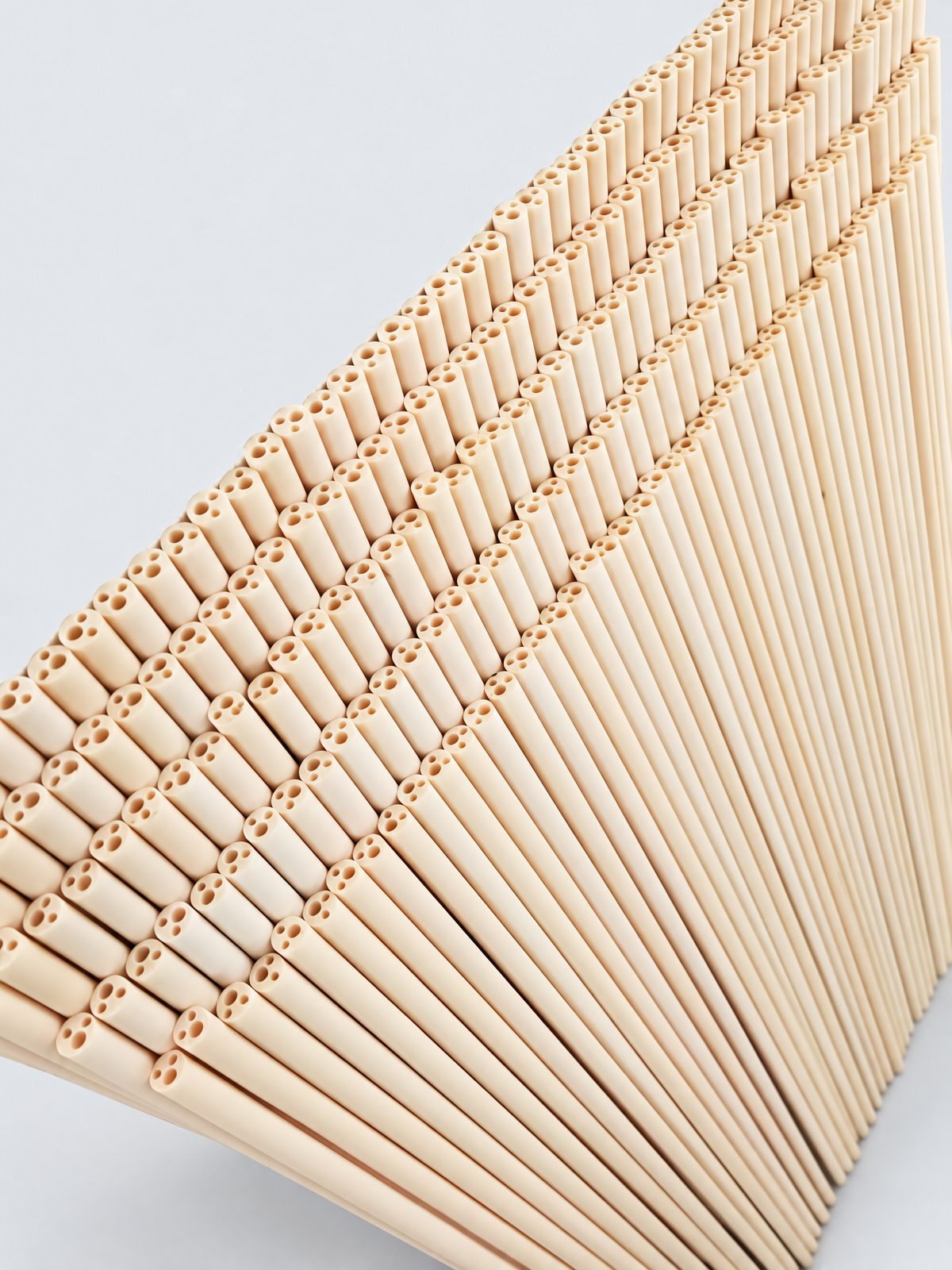
A ceramic thermocouple insulator for vacuum requires impervious, high-purity alumina (99% Al2O3 and above) with 0.00% water absorption so the tube does not outgas or react with thermocouple wires at high temperature. Omega Engineering lists its OMEGATITE 450 recrystallized alumina and OMEGATITE 350 (99% Al2O3) insulators as gas-tight with a volume resistivity of 10^13 ohm cm and maximum service temperatures of 1,900 to 1,950 °C (3,450 to 3,540 °F). At GY Alumina, we manufacture single-, twin- and multi-bore thermocouple insulators and capillaries in C799 alumina (99.5% Al2O3), cut to length in standard sizes or made to your drawing or sample.
Why Vacuum Systems Require High-Purity Alumina Insulators
In a vacuum environment, materials can outgas, meaning molecules come off the surface, drift away and land on sensitive instruments, as The American Ceramic Society Bulletin explains in its December 2022 aerospace materials feature. For high-temperature vacuum measurement, thermocouple wires are sheathed in ceramic tubes that are 99% or more alumina to protect the signal and resist vacuum-induced mass loss.
Purity and grain-boundary chemistry drive how well an insulator holds up under vacuum and heat. Kyocera Fineceramics Europe notes for its DEGUSSIT oxide ceramics that high-temperature strength and chemical resistance depend on the grain-boundary phases, so reducing silicon dioxide (SiO2) and other by-products prevents corrosion and wire contamination. In contrast, mullite-glass ceramics contain large amounts of silica. Omega Engineering's Typical Chemical Analyses table lists its OMEGATITE 200 (80% mullite, 20% glass) at 42.0% SiO2, compared with 0.7% SiO2 in its 99.0% Al2O3 OMEGATITE 350 and 0.070% SiO2 in its recrystallized alumina OMEGATITE 450.
By our calculation from Omega Engineering's Typical Chemical Analyses table, switching from the mullite-glass OMEGATITE 200 (42.0% SiO2) to 99.0% Al2O3 OMEGATITE 350 (0.7% SiO2) reduces the silica percentage by a factor of 60, and moving to recrystallized alumina OMEGATITE 450 (0.070% SiO2) reduces it by a factor of 600.
Buyers also need to separate two different components that share the name vacuum insulator: in-chamber wire insulators and chamber-wall feedthroughs. In-chamber insulators are open multi-bore tubes or beads that route bare thermocouple wires inside the hot zone. Chamber-wall insulating tubes and standoffs cross the vacuum boundary or support high-voltage electrodes. For example, Kyocera Fineceramics Europe tests its high-voltage insulating tubes for vacuum tightness to a helium leak rate below 10^-9 mbar l/s and fits them with stainless steel connecting pipes or CF, KF and COF flanges for direct welding into vacuum chambers across a temperature range of -271 to 450 °C.
Alumina Grade Comparison: C799 (99.5%), 99% and Mullite
International standards group ceramic electrical insulators by composition and properties. IEC 60672-3:1997 covers ceramic, glass-ceramic, glass-mica and glass materials for electrical insulating purposes. ASTM D2442-75(2025) specifies fabricated alumina parts for electronic and electrical applications and ceramic-to-metal seals used in electron devices.
At GY Alumina, our standard grade for thermocouple insulators is C799 alumina (99.5% Al2O3). Where a buyer's drawing names C 610, we supply 95% white alumina or our standard C799 alumina instead. Neither is mullite. An independent lab analyses one of our alumina tubes every year, recording 99.55% Al2O3 in 2024, 99.57% in 2025, and 99.61% in 2026. Corundum (99.5% Al2O3) ware at our factory is sintered at about 1,760 °C, which is the kiln firing temperature rather than a service rating.
The table below compares published physical, thermal, electrical and chemical values across Omega Engineering's three insulator grades alongside Kyocera Fineceramics Europe's DEGUSSIT AL23 alumina.
| Property | Omega OMEGATITE 450 | Omega OMEGATITE 350 | Kyocera DEGUSSIT AL23 | Omega OMEGATITE 200 |
|---|---|---|---|---|
| Constitution / Al2O3 content | Recrystallized pure alumina | Over 99% Al2O3 (99.0% typical) | High-purity alumina, low SiO2 | 80% Mullite, 20% Glass (55.4% Al2O3) |
| SiO2 content (%) | 0.070% | 0.7% | Reduced SiO2 (exact % not stated) | 42.0% |
| Na2O content (%) | 0.005% | 0.05% | Not stated | 0.5% |
| Fe2O3 content (%) | 0.025% | 0.07% | Not stated | 0.8% |
| Water absorption (%) | 0.00% | 0.00% | Not stated | 0.00% |
| Gas permeability | Gas Tight | Gas Tight | Not stated | Gas Tight |
| Specific gravity | 3.85 | 3.7 | Not stated | 2.4 |
| Max service temperature | 1,900 to 1,950 °C (3,450 to 3,540 °F) | 1,900 °C (3,450 °F) | Up to 1,950 °C | 1,650 °C (3,000 °F) |
| Volume resistivity (ohm cm) | 10^13 | 10^13 | Not stated | Not stated |
| Te value (resistivity = 1 MOhm cm) | 800 °C | 1,100 °C | Not stated | Not stated |
| Dielectric strength | 9.06 kV/mm (230 volts/mil) | 9.84 kV/mm (250 volts/mil) | Not stated | 9.84 kV/mm (250 volts/mil) |
| Hardness (Mohs scale) | 9 | 9 | Not stated | 7 |
Matching Thermocouple Calibrations to Vacuum and High-Temperature Service
When routing wires at extreme temperatures, check the ceramic's Te value, which is the temperature where electrical volume resistivity drops to 1 megohm-cm. In Omega Engineering's datasheet, OMEGATITE 450 lists a Te value of 800 °C and OMEGATITE 350 lists 1,100 °C, with a room-temperature dielectric constant (at 1 MC) of 9.29 and 8.61 respectively. Keeping sufficient wall thickness between bores prevents electrical leakage across the ceramic web when the furnace runs above the Te threshold.
Your thermocouple wire alloy dictates which alumina grade and bore geometry you need in a vacuum furnace or semiconductor chamber:
- Tungsten-rhenium (Type C) and molybdenum alloys: Furuya Metal states that Type C (WRe) thermocouples measure temperatures up to about 2,300 °C in vacuum and inert atmospheres. Omega Engineering recommends both OMEGATITE 450 (recrystallized pure alumina) and OMEGATITE 350 (over 99% Al2O3) as non-reactive and compatible with tungsten and molybdenum thermocouple alloys up to 1,900 °C (3,450 °F).
- Platinum-rhodium (Type R, Type S, Type B) alloys: Omega Engineering recommends OMEGATITE 450 (recrystallized pure alumina) for platinum thermocouple alloys. Furuya Metal notes that Type R platinum-rhodium thermocouples are used in semiconductor diffusion furnaces and CVD systems, where cleanroom assembly and high-purity components prevent contamination.
- Multi-point semiconductor profile thermocouples: Metivo (BASF Environmental Catalyst and Metal Solutions) designs multi-point profile and single-point spike thermocouples using ultra-pure materials to minimize contamination in vertical and horizontal semiconductor diffusion furnaces.
Bore Configurations and Standard Dimensions (Round, Oval and Multi-Bore)
Vacuum thermocouple insulators are extruded in round single-bore, twin-bore, four-bore and multi-bore capillary cross-sections, as well as flat oval twin-bore profiles for tight spaces where a round tube cannot fit.
At GY Alumina, we form tubes and rods by extrusion, slip casting, pressing and hot pressing. Our largest extruded tube today is OD 17 x ID 10 mm, and our largest slip-cast tube is OD 100 x ID 90 x 1,000 mm. In C799 alumina (99.5% Al2O3), we supply standard insulator sizes from stock, cut to length, and manufacture custom round, elliptical and square tubes alongside single-, twin- and multi-bore tubes and capillaries to your drawing or sample.
In published European catalog ranges, Kyocera Fineceramics Europe supplies round multi-bore tubes in its DEGUSSIT AL23 alumina with 2, 4, 6 or 8 bores, outer diameters from 0.9 to 8.5 mm, bore diameters from 0.2 to 1.6 mm, and maximum lengths of 400 to 1,200 mm. Kyocera also lists four standard oval twin-bore DEGUSSIT AL23 capillaries up to 400 mm long, including a 2.3 x 1.4 mm profile with 0.7 mm bores.
Wire-to-Bore Clearance, Tolerances and Thermal Expansion
Threading long thermocouple wires through a ceramic tube requires enough radial clearance to account for bore tolerance, camber (straightness) and differential thermal expansion during heating. Omega Engineering states that the diameter and out-of-roundness tolerance on its 152.4 mm (6 in) insulators is +/-5% or +/-0.381 mm (+/-0.015 in), whichever is greater, and straightness is at least 0.794 mm (1/32 in) for each 152.4 mm (6 in) length. Its linear thermal expansion coefficient for OMEGATITE 450 rises from 6.2 x 10^-6 /°C (24 to 250 °C) to 8.5 x 10^-6 /°C (24 to 1,000 °C) and 9.8 x 10^-6 /°C (24 to 1,500 °C).
Always confirm the bore against your wire diameter before ordering. If you need a guaranteed minimum hole size so wires never bind, ask for a one-sided bore tolerance on your drawing.
The table below gives Omega Engineering's recommended maximum wire diameter for nine standard bore diameters on 152.4 mm (6 in) insulator sections, together with our computed radial clearance.
| Bore Diameter, mm (in) | Max Recommended Wire Diameter, mm (in) | Total Diametral Clearance, mm (in) [Our Calculation] |
|---|---|---|
| 3.175 mm (1/8 in / 0.125 in) | 2.591 mm (0.102 in) | 0.584 mm (0.023 in) |
| 2.381 mm (3/32 in / 0.09375 in) | 1.626 mm (0.064 in) | 0.756 mm (0.02975 in) |
| 1.984 mm (5/64 in / 0.078125 in) | 1.626 mm (0.064 in) | 0.359 mm (0.014125 in) |
| 1.588 mm (1/16 in / 0.0625 in) | 1.016 mm (0.040 in) | 0.572 mm (0.0225 in) |
| 1.191 mm (3/64 in / 0.046875 in) | 0.813 mm (0.032 in) | 0.378 mm (0.014875 in) |
| 0.794 mm (1/32 in / 0.03125 in) | 0.508 mm (0.020 in) | 0.286 mm (0.01125 in) |
| 0.508 mm (0.020 in) | 0.305 mm (0.012 in) | 0.203 mm (0.008 in) |
| 0.397 mm (1/64 in / 0.015625 in) | 0.203 mm (0.008 in) | 0.194 mm (0.007625 in) |
| 0.127 mm (0.005 in) | 0.025 mm (0.001 in) | 0.102 mm (0.004 in) |
Alumina Plates, Threaded High-Voltage Standoffs and Custom Vacuum Shapes
Read more
Buyers searching for vacuum thermocouple ceramics frequently also need structural vacuum insulators on the same bill of materials, such as an alumina plate in insulation and vacuum systems, or M3 threaded ceramic insulators for ion repellers and high-voltage vacuum systems.
In analytical instruments, mass spectrometers and accelerator vacuum chambers, cylindrical standoffs and ribbed insulators isolate high-voltage electrodes and ion repellers from grounded chamber walls. For example, Kyocera Fineceramics Europe manufactures high-voltage alumina standoffs in three standard styles: Type A standoffs rated for 15 kV (24 mm OD, 30 mm length, 40 mm leakage path), Type B ribbed standoffs rated for 40 kV (24 mm OD, 80 mm length, 130 mm leakage path, with M6 internal threads at both ends), and compact Type C standoffs rated for 10 or 15 kV (7.5 mm or 9.5 mm OD with copper threaded inserts).
At GY Alumina, we manufacture custom alumina parts to your drawing or sample by slip casting, pressing, extrusion and hot pressing. Alongside thermocouple protection tubes and multi-bore insulators, we make custom round, elliptical and square tubes (open or one end closed), threaded, ribbed, perforated and slotted tubes, solid rods, square bars and balls, and rings, washers, bushings and discs. We also carry solid alumina rods in eight stock diameters from 2 to 12 mm, about 2,400 mm long, with a +0.2 mm grinding allowance on the diameter. Secondary operations we perform in our factory include cutting to length, end slots, side holes and perforated tubes, and closed ends with drilled holes.
Worked Example: Selecting a Twin-Bore Vacuum Insulator for 0.508 mm (0.020 in) Wire
Suppose you are building a platinum-rhodium Type R or tungsten-rhenium Type C thermocouple assembly with two 0.508 mm (0.020 in) bare wires that must run 600 mm inside a high-temperature vacuum furnace.
Follow these five steps to prepare a complete specification for quotation:
- Step 1, Choose the alumina purity: Because the sensor operates in vacuum at high temperature with platinum-rhodium or tungsten-rhenium wire, avoid mullite (42.0% SiO2 in Omega OMEGATITE 200) and specify high-purity corundum. At GY Alumina, select C799 alumina (99.5% Al2O3).
- Step 2, Check the minimum bore diameter: In Omega Engineering's clearance table, a 0.508 mm (0.020 in) wire is the maximum recommended size for a 0.794 mm (1/32 in) bore on a 152.4 mm (6 in) length, leaving 0.286 mm (0.01125 in) of diametral clearance. Because your insulator is 600 mm long, step up to at least a 1.016 mm (0.040 in) bore and specify a one-sided bore tolerance on your drawing so the wire threads smoothly without binding.
- Step 3, Set the outer diameter and wall web: In Omega Engineering's two-hole round catalog, two 1.016 mm (0.040 in) bores are paired with a 3.175 mm (1/8 in) outer diameter (model TRX-04018), keeping substantial ceramic wall thickness between the two wires and the outer sheath.
- Step 4, Decide on venting or secondary features: If your vacuum chamber pumps down rapidly and you want to prevent trapped air pockets along the 600 mm bore, specify side holes or end slots from GY Alumina's secondary operations on your drawing.
- Step 5, Confirm lead time and samples: Send your dimensions or drawing to GY Alumina to confirm whether a standard stocked size fits your wire (shipping in about 3 days for a small order or about 7 days for a bulk order) or to produce the part to your drawing (usually starting at 100 pieces in 25 to 30 days, with 5 to 10 free samples sent first for fit approval while you pay the courier).
Buyer Specification Checklist for Vacuum Insulators
Use the checklist below when preparing your drawing or quote request so our engineering team at GY Alumina can confirm tolerances and lead time on the first reply:
- Outside dimensions and section profile: state the outside diameter (for round tubes), width x thickness (for elliptical or flat oval twin-bore tubes), or custom profile dimensions.
- Bore count, bore diameter and layout: specify single-, twin- or multi-bore holes, the minimum bore diameter required, and whether you need a one-sided bore tolerance so your wire never binds.
- Overall length and secondary operations: give the overall cut length and note any end slots, side holes, perforations, or closed-end drilled holes.
- Thermocouple wire diameter and calibration: list your wire gauge or diameter in mm and the thermocouple type (such as Type R, S, B, C or K) so we can verify bore clearance.
- Material grade and operating environment: specify C799 alumina (99.5% Al2O3) or 95% white alumina, along with your peak temperature and vacuum or gas atmosphere.
- Order quantity and sample requirements: state the batch quantity and let us know if you want 5 to 10 free approval samples shipped by courier first.
Lead Times, Samples and How to Request a Quote
At GY Alumina, standard sizes in stock ship in about 3 days for a small order and about 7 days for a bulk order. Custom parts made to your drawing or sample usually start at 100 pieces per item and take 25 to 30 days to produce, with 5 to 10 free samples sent for your approval before production runs (the buyer pays the courier). Our ISO 9001:2015 certificate covers the manufacturing of ceramic protective tubes for thermocouples, and we have served 100+ customers.
Send your drawing, the grade and the quantity. We usually reply with a quote within two working days.
Questions buyers ask
- Why is high-purity alumina used instead of mullite for vacuum thermocouple insulators?
- High-purity alumina (99% to 99.5% Al2O3) is gas-tight, resists vacuum outgassing, and minimizes silicon dioxide (SiO2) that can corrode or contaminate thermocouple wires at high temperature. In Omega Engineering's datasheet, recrystallized alumina OMEGATITE 450 contains 0.070% SiO2 and is rated to 1,950 °C (3,540 °F), whereas mullite-glass OMEGATITE 200 contains 42.0% SiO2 and is limited to 1,650 °C (3,000 °F).
- Which thermocouple types are compatible with alumina insulators in a vacuum furnace?
- Omega Engineering recommends its OMEGATITE 450 grade for platinum, tungsten and molybdenum thermocouple alloys and its 99% Al2O3 OMEGATITE 350 grade for tungsten and molybdenum alloys. Furuya Metal notes that Type C (tungsten-rhenium) thermocouples measure up to about 2,300 °C in vacuum and inert atmospheres, while Type R (platinum-rhodium) thermocouples are used for high-precision control in semiconductor diffusion furnaces and CVD systems.
- What is the difference between a thermocouple wire insulator and a vacuum chamber insulating tube?
- An in-chamber thermocouple insulator is an open single-bore, twin-bore or multi-bore ceramic tube that routes and electrically isolates bare wires inside the hot zone. A chamber-wall insulating tube is a hermetic high-voltage or feedthrough component, such as Kyocera's high-voltage alumina insulating tubes, which are tested to a helium leak rate below 10^-9 mbar l/s and welded into vacuum systems or fitted with CF, KF or COF flanges for service from -271 to 450 °C.
- What shapes and configurations of C799 alumina insulators does GY Alumina make?
- GY Alumina manufactures single-, twin- and multi-bore thermocouple insulators and capillaries in C799 alumina (99.5% Al2O3), cut to length in standard stocked sizes or made to your drawing or sample. Custom options include round, elliptical and square tubes (open or one end closed), threaded, ribbed, perforated and slotted tubes, and solid alumina rods in eight stock diameters from 2 to 12 mm (about 2,400 mm long, with a +0.2 mm grinding allowance).
- What is the minimum order quantity and lead time for custom ceramic insulators at GY Alumina?
- Standard stocked insulator sizes ship in about 3 days for small orders and about 7 days for bulk orders. Custom parts made to your drawing or sample usually have a minimum order of 100 pieces per item and a production lead time of 25 to 30 days, with 5 to 10 free samples sent first for your approval (you pay the courier).
Sources
- Omega Engineering: Thermocouple Insulators Datasheet (OMEGATITE 450, 350, 200)
- Kyocera Fineceramics Europe: Insulators and Insulating Tubes
- Kyocera Fineceramics Europe: Tubes Made of Technical Ceramics
- Kyocera Fineceramics Europe: Thermocouple Protection Tubes
- Furuya Metal: Thermocouples for High-Temperature Furnaces
- Furuya Metal: Thermocouple Products
- Metivo (BASF): Semiconductor Profile Thermocouples
- The American Ceramic Society Bulletin: How Glass and Ceramics Push Us Deeper Into Space
- IEC 60672-3:1997 Ceramic and Glass-Insulating Materials
- ASTM D2442 Standard Specification for Alumina Ceramics for Electrical and Electronic Applications
- GY Alumina: Ceramic Thermocouple Insulators and Multi-Bore Tubes
- GY Alumina: Buyer FAQ (MOQ, Lead Time, Samples, ISO 9001)
- GY Alumina: Alumina Ceramics Factory in Tangshan
Last checked .