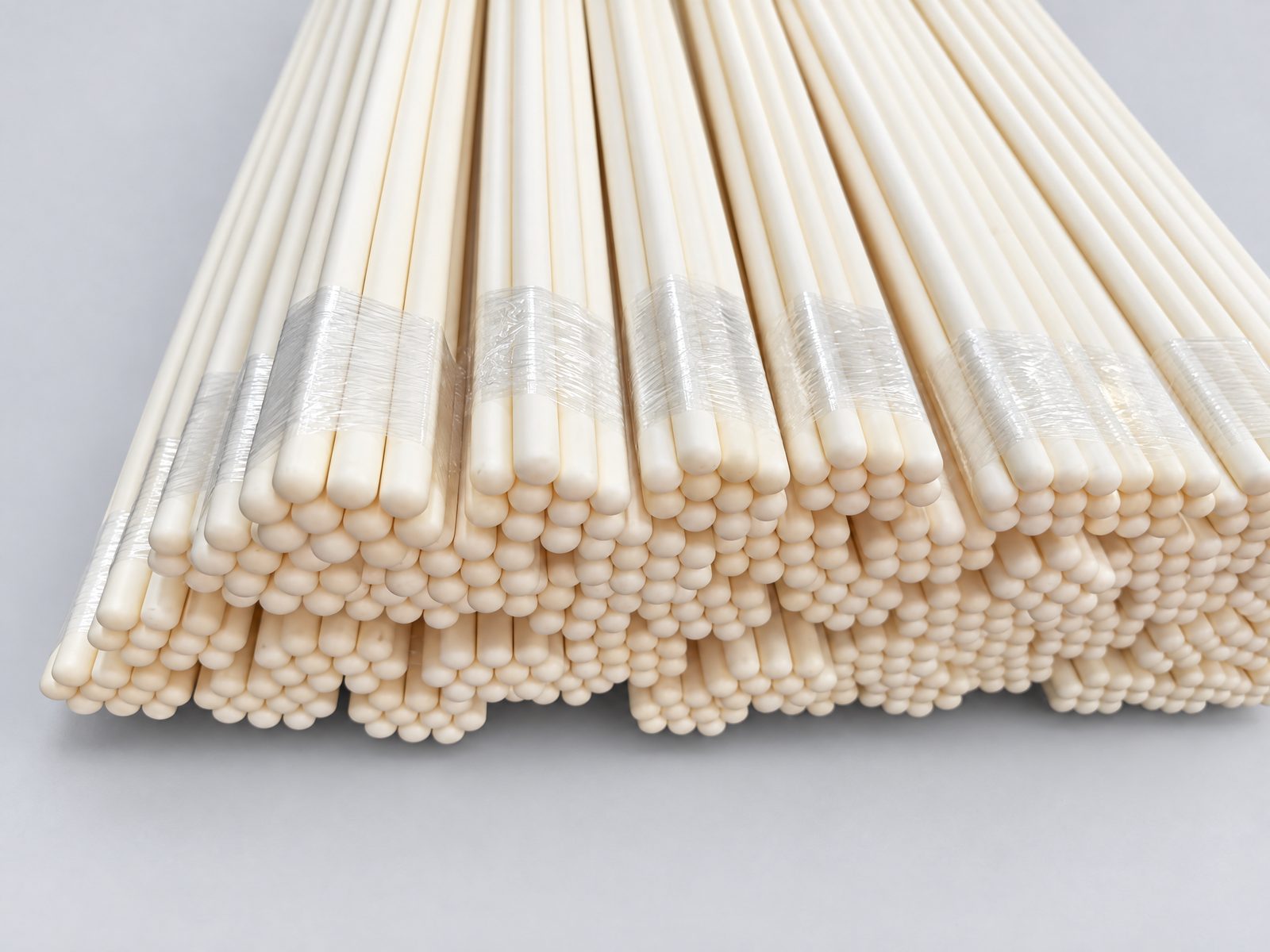
White alumina is the natural color of sintered alpha-phase aluminum oxide (Al2O3), while black alumina is produced by adding color-modifying metal oxides such as manganese oxide or chrome oxide to block stray light. In Kyocera's microelectronic packaging datasheets, black alumina grade A443 reaches 460 MPa flexural strength and 18 W/mK thermal conductivity, matching white grade A473 at 18 W/mK and 400 MPa. Choose white alumina for general electrical insulation, furnace tubes, and wear parts, and choose black alumina when an optical housing, image sensor package, or machine-vision fixture must stop internal light reflection.
Terminology check: sintered ceramic parts vs abrasive grit
Buyers searching for black vs white alumina ceramic often run into pages about sandblasting media, grinding wheels, or refractory aggregates. Those bulk minerals are fused alumina grains, not dense sintered engineering components. This guide covers sintered technical alumina ceramics: structural tubes, solid rods, wear guides, optical housings, and electronic substrates.
Pure aluminum oxide is documented on International Chemical Safety Card (ICSC) 0351 (February 2000) as a white powder with the formula Al2O3, a molecular mass of 101.9, a density of 3.97 g/cm3, a melting point of 2,054 °C (2,015 °C for natural corundum), and a boiling point of 3,000 °C. When calcined alumina powders such as Huber Advanced Materials Martoxid (which holds soda content, Na2O, below 0.1%) are pressed, extruded, or cast and fired at high temperature, they convert to the hexagonal alpha phase.
According to Accuratus, alpha-phase alumina is the strongest and stiffest of the oxide ceramics, showing 0% open porosity in sintered 94% and 96% white grades and an ivory tint in sintered 99.5% grades. To turn that naturally white or ivory ceramic into through-body black alumina, manufacturers change the body composition with inorganic additives. Accuratus notes that additions of chrome oxide or manganese oxide are used to change the color and improve hardness, while other additions improve the consistency of fired metal films for brazed and soldered assemblies.
Also watch out for heating-element catalogs that label alumina heaters as white ceramic and silicon carbide heaters as black ceramic. Black alumina ceramic is still aluminum oxide (Al2O3), retaining high electrical insulation rather than acting as a silicon carbide heating element.
Side-by-side properties: black vs white alumina by maker
Most commercial property sheets for black alumina come from microelectronic substrate and package manufacturers, where opaque walls are needed around light-sensitive dies. Kyocera's Alumina Packages and Substrates catalog publishes direct comparative figures for black purple (A440), black (A443), and white (A473 and A476) alumina formulations alongside light pink (AO610W) and gray (AO700, AO800) variants.
Comparing Kyocera's black A443 directly against its white A473 shows how close the two colors sit mechanically and thermally. Black A443 actually posts higher mechanical stiffness and strength than white A473: 310 GPa Young's modulus versus 270 GPa, and 460 MPa flexural strength versus 400 MPa.
Notice the electrical trade-off between the two dark grades in Kyocera's lineup. General-purpose black-purple A440 has a dielectric loss tangent (x1.0E-4) of 24 at 1 MHz and 14 W/mK thermal conductivity, whereas black A443 drops that dielectric loss tangent (x1.0E-4) to 5 at 1 MHz and raises thermal conductivity to 18 W/mK. When high optical reflectivity and flatness are required instead of light absorption, Kyocera's white A476 raises thermal conductivity to 24 W/mK.
| Property | Kyocera A440 (Black purple) | Kyocera A443 (Black) | Kyocera A473 (White) | Kyocera A476 (White) |
|---|---|---|---|---|
| Primary characteristic | General-purpose | Higher flexural strength | Lower transmission loss | Higher reflectivity and flatness |
| Laminating and dissimilar bonding | Applicable | Applicable | Applicable | Not applicable |
| Dielectric constant (1 MHz) | 9.8 | 9.6 | 9.1 (8.5 at 2 GHz) | 9.4 |
| Dielectric loss tangent (x1.0E-4 at 1 MHz) | 24 | 5 | 5 (10 at 2 GHz) | 4 |
| CTE, RT to 400 °C (ppm/K) | 7.1 | 6.9 | 6.9 | 7.2 |
| Thermal conductivity (W/mK) | 14 | 18 | 18 | 24 |
| Flexural strength (MPa) | 400 | 460 | 400 | 350 |
| Young's modulus (GPa) | 310 | 310 | 270 | 320 |
| Co-fired conductor material | W, Mo | W, Mo | W, Mo | Not stated |
White structural alumina properties across purity grades
When your part does not need optical light blocking, standard white and ivory alpha-alumina grades give you higher thermal conductivity, higher purity ceilings, and broader stock availability in tubes, rods, and plates. Accuratus supplies structural alumina including 94% (an easily metallizable grade) and 99.5%, while Precision Ceramics supplies CeramAlox in 96% and Ultra Pure variations.
| Property | Accuratus 94% Al2O3 (White) | Accuratus 96% Al2O3 (White) | Precision Ceramics CeramAlox 96 | Accuratus 99.5% Al2O3 (Ivory) |
|---|---|---|---|---|
| Density (g/cm3) | 3.69 (230.4 lb/ft3) | 3.72 (232.2 lb/ft3) | 3.75 | 3.89 (242.8 lb/ft3) |
| Flexural strength (MPa) | 330 (47 x 10^3 lb/in2) | 345 (50 x 10^3 lb/in2) | 200-300 | 379 (55 x 10^3 lb/in2) |
| Compressive strength (MPa) | 2100 (304.5 x 10^3 lb/in2) | 2100 (304.5 x 10^3 lb/in2) | 2000 | 2600 (377 x 10^3 lb/in2) |
| Young's or elastic modulus (GPa) | 300 (43.5 x 10^6 lb/in2) | 300 (43.5 x 10^6 lb/in2) | 300 | 375 (54.4 x 10^6 lb/in2) |
| Fracture toughness KIC (MPa m^1/2) | 3.5 | 3.5 | 4.5 | 4 |
| Hardness | 1175 kg/mm2 | 1100 kg/mm2 | 12 GPa | 1440 kg/mm2 |
| Thermal conductivity (W/mK) | 18 (125 BTU in/ft2 hr °F) | 25 (174 BTU in/ft2 hr °F) | 25 | 35 (243 BTU in/ft2 hr °F) |
| CTE (10^-6 /°C or /K) | 8.1 (4.5 x 10^-6 /°F) | 8.2 (4.6 x 10^-6 /°F) | 6.3 (25-300 °C), 7.0 (25-700 °C) | 8.4 (4.7 x 10^-6 /°F) |
| Max use temperature, no load (°C) | 1700 (3090 °F) | 1700 (3090 °F) | 1600 | 1750 (3180 °F) |
| Dielectric constant (1 MHz) | 9.1 | 9.0 | 9.8 (9.6 at 10 MHz) | 9.8 |
| Dielectric strength (kV/mm) | 16.7 AC (418 V/mil) | 14.6 AC (365 V/mil) | 9 DC | 16.9 AC (420 V/mil) |
| Volume resistivity (ohm-cm) | Above 10^14 | Above 10^14 | Above 10^14 | Above 10^14 |
Optical, mechanical, and chemical processing applications
Choosing between black alumina and white alumina comes down to how light, heat, wear, and process chemicals interact with your assembly. Below is how each environment dictates the specification.
Black alumina ceramic for industrial optical systems: Unmodified white alumina reflects ambient light, and Kyocera specifically engineers white grade A476 for high reflectivity in light-emitting packages. Inside image sensor packages, optical communication submounts, and camera or laser enclosures, internal reflection creates optical noise. Engineers specify black alumina (such as Kyocera A440 and A443) for image sensor packages, lids, and optical communication housings to block stray light while keeping a silicon-friendly CTE of 6.9 to 7.1 ppm/K and low dust generation.
Black alumina ceramic in precision mechanical systems: Both white and black sintered aluminas share high stiffness (270 to 400 GPa across Kyocera, Accuratus, and Precision Ceramics grades), low particle shedding, and strong wear resistance. Precision Ceramics and Accuratus list precision shafts, axles, unlubricated or vacuum sliding bearings, wire guides, seal rings, and wear pads as core alumina duties. In automated pick-and-place or optical inspection stations, dark ceramic guides and fixtures reduce glare for machine-vision cameras without sacrificing ceramic hardness.
Black alumina ceramic for chemical processing equipment: According to Accuratus, alpha-phase alumina resists attack by all gases except wet fluorine and resists all common chemical reagents except hydrofluoric acid and phosphoric acid. Precision Ceramics likewise highlights resistance to strong acid and alkali attack at elevated temperatures for valve seats, pistons, sleeves, and mechanical seals. However, Accuratus warns that elevated-temperature attack occurs in the presence of alkali metal vapors, particularly at lower purity levels. Because black alumina relies on metal-oxide color additions rather than 99.5% pure Al2O3, buyers running hot alkali vapors or ultra-clean semiconductor etches should verify chemical compatibility against high-purity white alumina.
Substrates, rods, forming shrinkage, and metallization
Read more
Forming and finishing rules apply equally to black and white alumina shapes, whether you are ordering a flat circuit carrier or a cylindrical rod.
Black alumina ceramic substrate: In microelectronics, Kyocera's black A440 and A443 substrates support multi-layer laminating structures, thin-film processing on polished surfaces, hermetic sealing, and dissimilar material bonding (brazing). Both co-fire with tungsten (W) and molybdenum (Mo) conductors and carry a sheet resistance of 10 milliohm/square on Kyocera's AO610W comparison sheet. For higher-power LEDs and lasers where light blocking is not needed, Kyocera's light-pink AO610W pairs alumina with copper-tungsten (CuW) conductors (5 milliohm/square sheet resistance) and built-in CuW heat spreaders rated at 200 W/mK.
Black alumina ceramic rod and custom shapes: Accuratus and Precision Ceramics note that alumina rods, tubes, and custom blanks are formed by extrusion, die pressing, isostatic pressing, injection molding, or slip casting. Precision Ceramics explains that while green or biscuit alumina can be machined into complex shapes before firing, high-temperature sintering causes the alumina body to shrink about 20%. Holding tight tolerances on a sintered rod, shaft, or substrate requires post-sintering diamond grinding, lapping, or polishing, and alumina can be joined to metals via metallizing and brazing.
Decision checklist: choosing black vs white alumina
Use this engineering checklist written by our team to decide whether your drawing actually needs a doped black formulation or whether a standard white or ivory high-purity alumina will perform better and ship faster.
- Optical stray-light sensitivity: Specify black alumina if the part houses a CMOS or CCD image sensor, optical communication transceiver, or machine-vision datum where reflected light degrades signal quality.
- High-reflectivity lighting: Specify white alumina (such as high-reflectivity packaging grades) when mounting LEDs or light-emitting emitters that benefit from light bounce.
- Maximum thermal conductivity: Specify 99.5% ivory alumina (35 W/mK per Accuratus) rather than black co-fired alumina (14 to 18 W/mK per Kyocera) when passive heat spreading is the primary bottleneck.
- Furnace and thermocouple protection above 1,600 °C: Specify high-purity white or ivory corundum ceramic. Accuratus rates 99.5% alumina to 1,750 °C under no load, and Precision Ceramics rates 96% alumina to 1,600 °C in air under no load (up to 1,650 °C or 2,900 °F in oxidizing and reducing atmospheres and 2,000 °C or 3,600 °F in vacuum in its general overview, while Accuratus cites 1,925 °C for high-purity alumina and vacuum weight loss of 10^-7 to 10^-6 g/cm2 sec from 1,700 °C to 2,000 °C).
- Hot alkali vapor or trace-contamination control: Specify 99.5% or higher white alumina to minimize grain-boundary additives that react with hot alkali vapors or leach into analytical samples.
- Lead time and tooling cost: Choose standard white or ivory 95% to 99.5% alumina for rods, tubes, washers, and insulators unless black optical absorption is mandatory.
What GY Alumina makes and what to send for a quote
GY Alumina is the export brand of our factory in Tangshan, China, with 100+ customers served. We manufacture industrial alumina and corundum ceramic parts: thermocouple protection tubes, insulators, furnace tubes, crucibles, and custom components made to your drawing or sample. Our standard grade is C799 alumina (99.5% Al2O3), and where a drawing names C 610, we supply 95% white alumina or our standard C799 instead. Neither is mullite. An independent lab analyzes one of our alumina tubes every year, recording 99.55% Al2O3 in 2024, 99.57% in 2025, and 99.61% in 2026. Our ISO 9001:2015 certificate covers the manufacturing of ceramic protective tubes for thermocouples.
In our factory, we form parts by slip casting, pressing, extrusion, and hot pressing. Secondary operations we perform include cutting to length, end slots, side holes and perforated tubes, and closed ends with drilled holes.
If white high-purity alumina fits your mechanical, thermal, or chemical design, our largest extruded tube today is OD 17 x ID 10 mm, and our largest slip-cast tube is OD 100 x ID 90 x 1,000 mm. Custom parts we make to your drawing or sample include round, elliptical, and square tubes (open or one end closed), single-, twin-, and multi-bore tubes and capillaries, threaded, ribbed, perforated, and slotted tubes, solid rods, square bars, balls, rings, washers, bushings, discs, crucibles, and boats.
Include the details below when sending a request for standard stock or custom parts to drawing:
- Drawing or sample: Attach a 2D or 3D engineering drawing or arrange to send a physical sample.
- Dimensions and critical tolerances: State outside diameter, inside diameter, wall thickness, or overall length, and confirm any bore clearance against your wire or insert before ordering.
- Material grade: Name C799 (99.5% Al2O3) or 95% white alumina.
- Operating conditions: List your working temperature, heating rate, mechanical support, and chemical or gas atmosphere.
- Order quantity and delivery schedule: Standard sizes ship from stock in about 3 days for small orders to about 7 days for bulk orders, while parts made to drawing usually start at 100 pieces per item and take 25-30 days to produce, with 5-10 free samples sent for approval first (the buyer pays the courier).
How to submit your drawing for review
Read more
At GY Alumina, our team reviews your drawing for custom pressed bushings, solid rods, crucibles, and multi-bore tubes in C799 alumina or 95% white alumina and confirms the forming route and tolerances before quoting. Send your drawing, the grade and the quantity. We usually reply with a quote within two working days.
Questions buyers ask
- What makes black alumina ceramic black instead of white?
- Pure alpha-phase aluminum oxide (Al2O3) is naturally a white powder (ICSC 0351) that sinters into a white or ivory ceramic. According to Accuratus, manufacturers add inorganic oxides such as manganese oxide or chrome oxide to the alumina body to change its color and improve hardness.
- Is black alumina as strong and thermally conductive as white alumina?
- In co-fired electronic packaging grades from Kyocera, black alumina A443 matches white alumina A473 in thermal conductivity (18 W/mK) and thermal expansion (6.9 ppm/K) while exceeding it in flexural strength (460 MPa vs 400 MPa). However, high-purity structural ivory alumina (99.5% Al2O3) from Accuratus reaches a higher thermal conductivity of 35 W/mK.
- Why is black alumina used in optical systems and sensor substrates?
- Kyocera specifies black alumina formulations such as A440 and A443 for image sensor packages, optical communication submounts, and lids because the dark body absorbs stray light rather than reflecting it onto photosensitive detectors. They also provide low dust generation, hermetic sealing capability, and a 6.9 to 7.1 ppm/K CTE close to silicon.
- Does black alumina resist acids and alkalis in chemical processing equipment?
- According to Accuratus, alpha-phase alumina resists all gases except wet fluorine and resists all common reagents except hydrofluoric acid and phosphoric acid. At high temperatures, alkali metal vapors can attack lower-purity grain boundaries, so buyers handling hot alkali vapors often select 99.5% or higher purity white alumina.
- What alumina rods and custom shapes does GY Alumina supply?
- GY Alumina supplies C799 alumina (99.5% Al2O3) and 95% white alumina parts, including custom solid rods, tubes, rings, bushings, discs, and crucibles made to your drawing or sample. Custom parts usually start at 100 pieces per item with a 25-30 day production time and 5-10 free approval samples (the buyer pays the courier).
Sources
- ILO/WHO International Chemical Safety Card: ICSC 0351 Aluminium Oxide
- Huber Advanced Materials: Calcined Aluminum Oxides (Martoxid)
- Accuratus: Aluminum Oxide (Al2O3) Ceramic Properties
- Accuratus: Alumina and Mullite Ceramic Rods and Tubes
- Kyocera: Alumina (Al2O3) Packages and Substrates
- Kyocera: AO610W Packages and Submounts
- Precision Ceramics: Alumina Properties and Industrial Applications
- GY Alumina: Alumina and Corundum Grades Material Data
- GY Alumina: Alumina Ceramics Factory in Tangshan, China
- GY Alumina: Custom Alumina Parts Made to Drawing or Sample
- GY Alumina: Buyer FAQ (MOQ, Lead Time, Samples, ISO 9001)
Last checked .