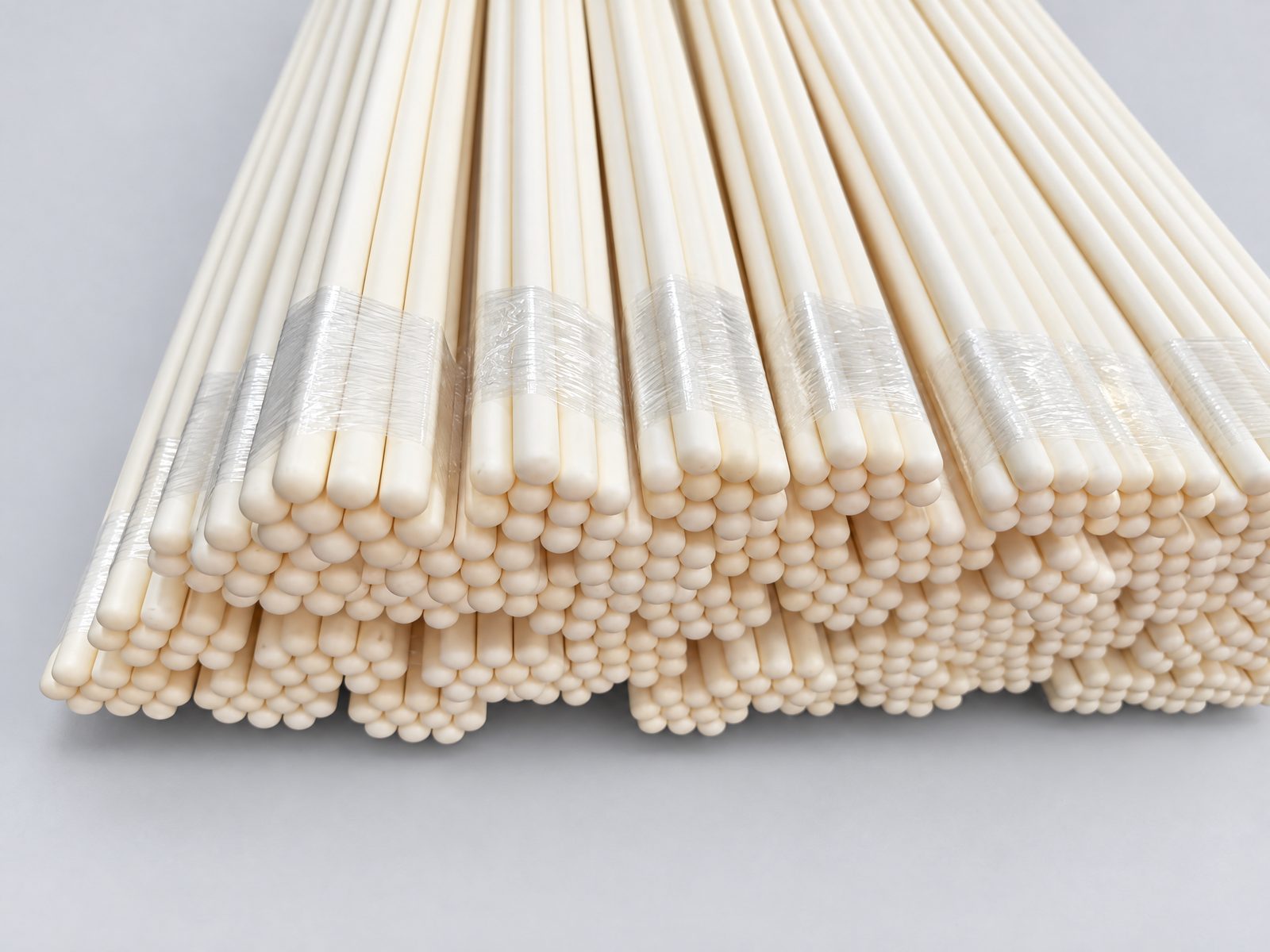
An alumina zirconia phase diagram maps the temperature-dependent phase equilibria between aluminum oxide (Al2O3), zirconium dioxide (ZrO2), and stabilizing oxides. Although zirconia melts some 500 °C above alumina on Almath Crucibles' datasheet, its tetragonal-to-monoclinic phase shift limits Precision Ceramics' CeramaZirc grades to 800 °C in air. High-purity alumina avoids this crystal inversion, reaching 1,750 °C in air for Precision Ceramics' CeramAlox Ultra Pure versus 1,500 °C for CeramAlloy ZTA.
How the Alumina Zirconia Phase Diagram Guides Ceramic Selection
When you specify high-temperature furnace hardware or wear components, the binary Al2O3-ZrO2 phase system and its stabilized ternary extensions explain why alumina, zirconia, and Zirconia Toughened Alumina (ZTA) behave differently under heat and mechanical stress. Accuratus notes that engineering ceramics rely on strong ionic and covalent atomic bonds, producing high melting points, high compressive strength, oxidation resistance, and resistance to high-temperature creep when manufactured from nearly chemically and phase-pure starting powders. Within oxide ceramics, alumina and zirconia sit at opposite ends of the toughness and thermal-stability spectrum.
Almath Crucibles reports that zirconium dioxide is more refractory than aluminum oxide, with a melting point some 500 °C above alumina, yet pure zirconium dioxide is metastable and must be stabilized with metal oxides before structural use. Because alumina and stabilized zirconia remain distinct crystalline phases during solid-state consolidation rather than dissolving into a single uniform crystal lattice, manufacturers combine them into two-phase composites. Kyocera groups alumina (Al2O3), zirconia (ZrO2), and Zirconia Toughened Alumina (ZTA) among polycrystalline oxide ceramics manufactured by firing, distinct from single-crystal sapphire (Al2O3) or single-crystal YAG (Y3Al5O12) grown by crystal control technology.
To inspect verified liquidus curves, isothermal sections, and dopant boundaries for Al2O3-ZrO2 systems, ceramic engineers use the ACerS-NIST Phase Equilibria Diagrams database maintained by The American Ceramic Society and NIST. First published in October 1933 in the Journal of the American Ceramic Society, the collection began with 178 diagrams. In PHASE Version 6.0, it has grown to more than 33,000 critically evaluated diagrams from 1898 to today, including 20,708 system writeups in Version 5.2. In the PED Viewer software, you can read exact temperatures along binary curves, compare experimental diagrams against calculated thermodynamic models, and convert compositions between weight percent and mole percent in one step, such as checking liquidus maxima at 1,730 °C or isothermal equilibria at 1,622 +/- 2 °C in alumina-titania-zirconia ternary sections.
Alumina Phase Transition Temperature vs Zirconia Phase Transformations
Buyers searching for the alumina phase transition temperature alongside the alumina zirconia phase diagram are usually checking whether a ceramic tube, crucible, or wear sleeve will crack from crystal volume changes during thermal cycling. Sintered polycrystalline alpha-alumina (corundum) does not suffer a destructive reversible crystal phase transition between room temperature and its upper service limit. On Precision Ceramics' datasheets, no-load maximum service temperatures in both air and inert atmospheres reach 1,600 °C for CeramAlox 96 (96% Al2O3) and 1,750 °C for CeramAlox Ultra Pure, with general alumina service reaching up to 1,650 °C (2,900 °F) in oxidizing and reducing atmospheres and up to 2,000 °C (3,600 °F) in vacuum. Load, atmosphere, and heating rate all govern the practical alumina maximum temperature in a working furnace.
Pure zirconia behaves very differently on heating and cooling because its crystal lattice shifts between monoclinic, tetragonal, and cubic polymorphs. Even after partial stabilization, phase stability sets a strict ceiling on service conditions. Precision Ceramics explains that Yttria Partially Stabilized Zirconia (Y-PSZ) is vulnerable to grain boundary sliding when prolonged exposure to heat causes the material to transform from the strong tetragonal crystal phase to the weaker monoclinic phase. Exposure to warm water vapor also triggers hydrothermal aging in Y-PSZ, degrading its mechanical strength in moist environments.
Adding ternary stabilizing oxides modifies the zirconia phase diagram so manufacturers can lock in desirable crystal structures at room temperature. Almath Crucibles notes that small additions of CaO, MgO, or Y2O3 allow the high-temperature cubic phase to stabilize itself, with standard datasheet grades including 3.25% MgO stabilized zirconia and 5.5% CaO stabilized zirconia. Fully Stabilized Zirconia (FSZ) sinters into a dense, often translucent ceramic with a relatively coarse grain size of 10 µm to 50 µm. Where impact resistance matters more than cubic translucency, manufacturers use Partially Stabilized Zirconia (PSZ), such as Precision Ceramics' 3 mol % Y2O3 grades (CeramaZirc 3YZ and Nano HIP), Magnesia Partially Stabilized Zirconia (M-PSZ, which avoids phase migration in moist high-temperature conditions), or ceria-stabilized composites (CeramaZirc Ultra Tough and Ultra Tough HIP, rated up to 1,500 °C in inert gas and 800 °C in air).
- Polycrystalline alpha-alumina (Al2O3): Remains phase-stable without tetragonal-to-monoclinic inversion, rated by Precision Ceramics to 1,600 °C (96% Al2O3) and 1,750 °C (CeramAlox Ultra Pure) in air under no load.
- Yttria Partially Stabilized Zirconia (3 mol % Y2O3, Y-PSZ): Delivers fine grain uniformity and 1,200 MPa to 1,400 MPa flexural strength on Precision Ceramics' datasheets, suited for dry and moderate temperatures up to 800 °C in air.
- Magnesia Partially Stabilized Zirconia (Mg-PSZ / M-PSZ): Resists phase migration and retains mechanical strength in moist, elevated-temperature environments where Y-PSZ degrades (Precision Ceramics).
- Ceria Partially Stabilized Zirconia (CeramaZirc Ultra Tough): Uses ceria partial stabilization and alumina platelets for crack deflection, raising fracture toughness to 17 MPa m1/2 and inert-atmosphere temperature capability to 1,500 °C (Precision Ceramics).
- Fully Stabilized Zirconia (FSZ with CaO, MgO, or Y2O3): Stabilizes the high-temperature cubic phase with a 10 µm to 50 µm grain size and 2,500 MPa compressive strength on Almath Crucibles' datasheet.
Comparing Alumina, ZTA, PSZ, and FSZ Properties by Maker and Grade
Zirconia Toughened Alumina (ZTA) bridges the binary Al2O3-ZrO2 system by dispersing zirconia particles inside an alumina matrix, while Alumina Toughened Zirconia (ATZ) reverses the matrix ratio. Precision Ceramics consolidates its CeramAlloy ZTA and CeramAlloy Ultra Hard composites through conventional sintering and hot isostatic pressing (HIP), retaining alumina's hardness and corrosion resistance alongside zirconia's fracture toughness and improved resistance to hydrothermal aging.
Reviewing alumina properties by purity next to ZTA and stabilized zirconia clarifies the engineering trade-offs in weight, thermal management, and temperature capability. By our calculation from Precision Ceramics' property tables, CeramAlox 96 alumina provides an exact 2.0 times higher no-load air temperature rating than CeramaZirc zirconia grades (1,600 °C versus 800 °C) and 1.5 times higher stiffness (300 GPa versus 200 GPa Young's modulus). Comparing thermal transport at 25 °C on the same Precision Ceramics datasheets, CeramAlloy ZTA conducts heat 10 times faster than CeramaZirc 3YZ zirconia (20 W/mK versus 2 W/mK), while CeramAlox 96 alumina conducts 1.25 times faster than CeramAlloy ZTA (25 W/mK versus 20 W/mK).
| Maker and Grade | Material System | Density (g/cm3) | Flexural Strength (MPa) | Fracture Toughness | Hardness | Max Temp in Air (°C) | Thermal Conductivity (W/mK) |
|---|---|---|---|---|---|---|---|
| Precision Ceramics CeramAlox 96 | 96% Al2O3 | 3.75 g/cm3 | 200 to 300 MPa | 4.5 MPa m1/2 | 12 GPa | 1,600 °C | 25 W/mK |
| Precision Ceramics CeramAlox Ultra Pure | High-purity Al2O3 | 3.98 g/cm3 | 500 to 600 MPa | 4.5 MPa m1/2 | 18 GPa | 1,750 °C | 45 W/mK |
| Precision Ceramics CeramAlloy ZTA | Al2O3-ZrO2 composite | 4.1 g/cm3 | 600 MPa | 7 MPa m1/2 | 16 GPa (Vickers 500 g) | 1,500 °C | 20 W/mK |
| Precision Ceramics CeramAlloy Ultra Hard | Al2O3-ZrO2 composite | 4.18 g/cm3 | 850 MPa | 5 MPa m1/2 | 21.5 GPa (Vickers 500 g) | 1,500 °C | 20 W/mK |
| Precision Ceramics CeramaZirc 3YZ | 3 mol % Y2O3 PSZ | 6.05 g/cm3 | 1,200 MPa | 8 MPa m1/2 | 13.5 GPa | 800 °C | 2 W/mK |
| Precision Ceramics CeramaZirc Nano HIP | 3 mol % Y2O3 ultrafine HIP | 6.07 g/cm3 | 1,400 MPa | 8 MPa m1/2 | 14.5 GPa | 800 °C | 2 W/mK |
| Precision Ceramics CeramaZirc Ultra Tough | Ceria PSZ + alumina platelets | 5.7 g/cm3 | 1,000 MPa | 17 MPa m1/2 | 13 GPa | 800 °C | 3 W/mK |
| Almath Crucibles PSZ | Partially stabilized ZrO2 | 5.7 g/cm3 (ASTM C20) | 620 MPa (ASTM F417) | 11 MPa (notched beam) | 77 Rockwell 45N | Not stated | 2.2 W/mK (ASTM C20) |
| Almath Crucibles FSZ | Fully stabilized ZrO2 | 6.0 g/cm3 (ASTM C20) | 900 MPa (ASTM F417) | 13 MPa (notched beam) | 83 Rockwell 45N | Not stated | 2.2 W/mK (ASTM C20) |
Sintering Shrinkage, Microstructure, and Worked Sizing Check
Read more
Phase equilibria govern not only maximum use temperature but also how ceramic powders densify in the kiln and how closely as-fired dimensions can be held. Precision Ceramics reports that firing a green or biscuit-machined ceramic body to full density causes alumina, CeramAlloy ZTA, and zirconia bodies to shrink about 20%. Because of that volumetric and linear contraction during sintering, green machining prior to firing produces complex shapes economically, whereas very tight final tolerances on sintered wear parts require diamond grinding after firing.
You can see the practical impact of firing contraction with a straightforward sizing check before setting drawing tolerances. By our calculation from Precision Ceramics' 20% sintering shrinkage figure, a green ceramic blank formed at a 25.0 mm outer diameter contracts by 5.0 mm during firing to finish at 20.0 mm (25.0 mm multiplied by 0.80), and a 125.0 mm green sleeve contracts by 25.0 mm to reach 100.0 mm. Over a long tube or multi-bore profile, small local variations in powder packing density translate into measurable as-fired ovality or camber, which is why engineers only apply tight bilateral tolerances to surfaces that actually mate with a metal housing, seal, or sensor insert.
Thermal expansion mismatch is equally important if your assembly joins ceramic to metal. Precision Ceramics lists a coefficient of thermal expansion (CTE) of 10 x 10^-6 /K from 25 °C to 400 °C across its CeramaZirc zirconia grades (similar to iron and steel), compared with 6.3 x 10^-6 /K to 7.5 x 10^-6 /K from 25 °C to 300 °C (and 7.0 x 10^-6 /K to 8.0 x 10^-6 /K from 25 °C to 700 °C) for its CeramAlox aluminas, and 7 x 10^-6 /°C to 7.5 x 10^-6 /°C for CeramAlloy ZTA. Almath Crucibles similarly records ASTM C372 CTE values from 25 °C to 1,000 °C of 10.1 x 10^-6 /°C for PSZ and 10.3 x 10^-6 /°C for FSZ, alongside a water-quench thermal shock delta Tc of 350 °C (versus 250 °C delta T on Precision Ceramics' zirconia table and 200 °C delta T on its ZTA table).
Choosing Between Pure Alumina, ZTA, and Stabilized Zirconia for Your Part
Before requesting a quote or locking a material callout onto an engineering print, match your operating temperature, atmosphere, electrical requirement, and mechanical load against each oxide family's strengths. Electrical behavior alone can rule a grade in or out: Almath Crucibles points out that stabilized zirconia becomes an oxygen anion conductor at high temperature (useful in oxygen sensors and fuel cells, with ASTM D116 dielectric strength of 9.4 ac-kV/mm at 6.25 mm thickness and ASTM D2520 dielectric loss of 0.001 at 25 °C and 1 MHz), whereas high-purity alumina and ZTA remain strong electrical insulators (above 10^16 ohm-cm volume resistivity at 25 °C and 16 kV/mm DC dielectric strength for Precision Ceramics' CeramAlox Ultra Pure and CeramAlloy ZTA).
Use the selection plan below, written by our team from the published grade limits above, to narrow down the right ceramic class for your application.
- Choose high-purity corundum alumina (such as C799 alumina, 99.5% Al2O3) when your part runs in air above 1,500 °C, insulates thermocouple wires at high voltage or high temperature, or holds melts and powders cleanly in furnace tubes, boats, and crucibles.
- Choose 95% white alumina when your furnace, kiln, or thermocouple assembly operates at moderate high temperatures and your legacy print calls out C 610.
- Choose Zirconia Toughened Alumina (ZTA) for abrasive slurry valves, sandblasting focusing nozzles, wire-drawing guides, and high-pressure pump seats operating up to 1,500 °C where you need both high hardness (16 GPa to 21.5 GPa Vickers on Precision Ceramics' datasheets) and elevated crack resistance (5 MPa m1/2 to 7 MPa m1/2).
- Choose Partially Stabilized Zirconia (PSZ) for heavy mechanical shock, metal-forming rollers, extrusion dies, and steel-mated sleeves below 800 °C in air, selecting M-PSZ or ceria-stabilized grades rather than Y-PSZ if warm steam or moisture is present.
- Choose Fully Stabilized Zirconia (FSZ) or specialized refractory zirconia when your design specifically needs oxygen-ion conduction for sensors and solid-oxide cells or specialized ultra-high-temperature crucible chemistry.
GY Alumina Grades, Forming Limits, and Drawing Specification Checklist
GY Alumina manufactures alumina and corundum ceramic parts at our factory in Tangshan, China, supplying thermocouple protection tubes, thermocouple insulators and multi-bore tubes, furnace tubes, crucibles and boats, solid alumina rods, and custom parts made to your drawing or sample. When your thermal and phase-stability review points to pure alumina or corundum rather than zirconia or ZTA, you can select directly from our standard alumina materials and grades.
Our standard high-purity grade is plain C799 alumina at 99.5% Al2O3. An independent laboratory analyses one of our alumina tubes every year, recording 99.55% Al2O3 in 2024, 99.57% Al2O3 in 2025, and 99.61% Al2O3 in 2026, and our ISO 9001:2015 certificate covers the manufacturing of ceramic protective tubes for thermocouples. Engineers frequently review C799 vs C610 ceramic grades when updating older European drawings: where a drawing names C 610, we supply 95% white alumina or our standard C799 alumina instead, and neither material is mullite.
If you have a drawing for a tube, insulator, crucible, or custom wear component, check the manufacturing envelope in the table below and include the checklist items on your inquiry.
| Capability Area | GY Alumina Specification | Application Notes for Buyers |
|---|---|---|
| Standard ceramic grades | C799 alumina (99.5% Al2O3) and 95% white alumina | State C799 or 95% white alumina on the print (supplied where drawings name C 610) |
| Forming methods | Slip casting, pressing, extrusion, and hot pressing | Route is matched to part wall thickness, bore count, and geometry |
| Largest extruded tube | 17 mm OD by 10 mm ID | Suited for single-bore, twin-bore, and multi-bore insulators and small protection tubes |
| Largest slip-cast tube | 100 mm OD by 90 mm ID by 1,000 mm length | Suited for large-diameter furnace tubes and heavy protection sheaths |
| Secondary operations | Cut to length, end slots, side holes, perforated tubes, closed ends with drilled holes | Mark slot widths, hole diameters, and hole positions clearly on your drawing |
| Custom configurations | Round, elliptical, and square tubes (open or one end closed), multi-bore capillaries, threaded or ribbed tubes, solid rods, square bars, balls, rings, washers, bushings, discs, crucibles, and boats | Built to your engineering drawing or physical sample |
Ordering Custom Alumina Parts, Samples, and Lead Times
Read more
GY Alumina has served 100+ customers across thermocouple, furnace, laboratory, and industrial equipment manufacturing. When you prepare a request for quotation, include the outside diameter, inside diameter, and overall length in mm with tolerances, the Al2O3 grade, whether tube ends are open or closed, the order quantity, and the diameter of any wire, rod, or sensor insert that must pass through the bore. Confirm the bore against your wire or insert before ordering.
For custom alumina parts made to your drawing or sample, orders usually start at 100 pieces per item and take 25 days to 30 days to produce. Before full production begins, we send 5 to 10 free samples for your approval, with courier freight paid by the buyer. Standard tube and insulator sizes held in stock ship in about 3 days for small orders and about 7 days for bulk orders. Send your drawing, the grade and the quantity. We usually reply with a quote within two working days.
Questions buyers ask
- Where can I find a verified alumina zirconia phase diagram?
- The ACerS-NIST Phase Equilibria Diagrams database (PHASE Version 6.0) contains more than 33,000 critically evaluated ceramic and inorganic diagrams from 1898 to today. In the PED Viewer software, you can read exact binary liquidus temperatures and convert compositions directly between weight percent and mole percent.
- Why does zirconia undergo a destructive phase transition while alumina stays stable?
- Pure zirconium dioxide is metastable, and Precision Ceramics notes that even Yttria Partially Stabilized Zirconia (Y-PSZ) transforms from its strong tetragonal crystal phase to a weaker monoclinic phase during prolonged heat exposure or warm water-vapor contact. Sintered polycrystalline alpha-alumina avoids this crystal inversion, allowing Precision Ceramics' CeramAlox Ultra Pure to work up to 1,750 °C in air compared with 800 °C in air for its CeramaZirc zirconia grades.
- How do stabilizing oxides change the zirconia and alumina zirconia phase systems?
- Almath Crucibles explains that small additions of CaO, MgO, or Y2O3 stabilize zirconia's high-temperature cubic phase in Fully Stabilized Zirconia (producing a 10 µm to 50 µm grain size) or retain tough metastable phases in Partially Stabilized Zirconia. Precision Ceramics also uses Magnesia Partially Stabilized Zirconia (M-PSZ) and ceria partial stabilization to stop phase migration and resist hydrothermal aging in hot, moist environments.
- When should I choose Zirconia Toughened Alumina (ZTA) over pure alumina?
- Zirconia Toughened Alumina fits high-wear ball valves, focusing nozzles, rollers, and extrusion dies up to 1,500 °C where pure alumina needs higher impact resistance. On Precision Ceramics' datasheets, CeramAlloy ZTA raises fracture toughness to 7 MPa m1/2 and flexural strength to 600 MPa, whereas pure corundum such as GY Alumina's C799 alumina (99.5% Al2O3) is selected for high-temperature furnace tubes, thermocouple protection tubes, insulators, and crucibles.
- What are GY Alumina's minimum order quantity, sample policy, and lead times?
- Custom alumina parts made to your drawing or sample at GY Alumina usually start at 100 pieces per item and take 25 days to 30 days to produce. We send 5 to 10 free samples for your approval before full production runs (you pay the courier), while standard sizes ship from stock in about 3 days for small orders and about 7 days for bulk orders.
Sources
- Phase Equilibria Diagrams, The American Ceramic Society
- Zirconia Ceramic Material and Properties, Almath Crucibles
- Zirconia and Its Unique Properties Explained, Precision Ceramics
- Zirconia Toughened Alumina: Properties and Uses, Precision Ceramics
- Alumina: Properties and Industrial Applications, Precision Ceramics
- Ceramic Materials Overview, Kyocera Fine Ceramics
- Ceramics and Glasses Material Properties, Accuratus
- Alumina and Corundum Grades: Material Data, GY Alumina
- Alumina Ceramics Factory in Tangshan, China, GY Alumina
- Buyer FAQ: MOQ, Lead Time, Samples, ISO 9001, GY Alumina
- Alumina Custom Parts Made to Drawing or Sample, GY Alumina
Last checked .