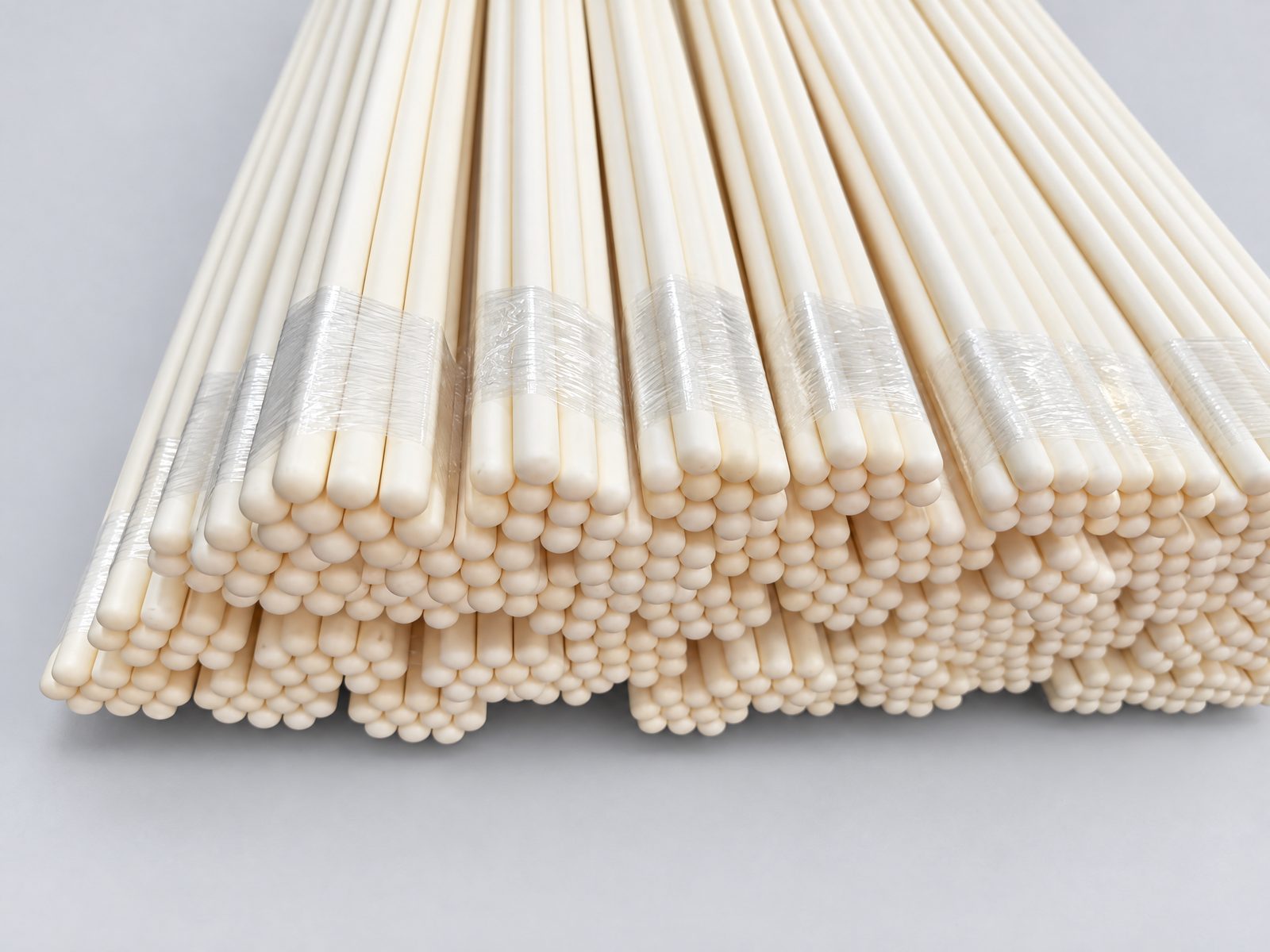
Choose alumina (Al2O3) when your part needs surface hardness, fast heat transfer, high-temperature electrical insulation, lower weight, and lower cost, or choose zirconia (ZrO2) when bending loads, impact, or crack growth would fracture a standard ceramic. In Precision Ceramics' published tables, CeramAlox 96% alumina works up to 1,600 °C in air with 25 W/mK thermal conductivity, whereas yttria-stabilized CeramaZirc 3YZ zirconia raises fracture toughness from 4.5 to 8 MPa m1/2 and flexural strength to 1,200 MPa while dropping its air limit to 800 °C. Always name the exact purity or stabilizer grade on your drawing, because toughened mechanical zirconia and fully stabilized crucible zirconia behave like two different materials.
Core differences and a four-gate material selection rule
Alumina (aluminum oxide, Al2O3) and zirconia (zirconium dioxide, ZrO2) solve opposite engineering problems. Precision Ceramics notes that alumina is one of the most cost-effective technical ceramics while still delivering high hardness, thermal stability, and electrical insulation, whereas zirconia delivers the highest fracture toughness among monolithic oxide ceramics and is often called ceramic steel.
Pure zirconium dioxide cannot be sintered directly into structural parts. As Almath Crucibles explains, pure zirconium dioxide is metastable and undergoes destructive phase changes unless stabilizing oxides such as calcia (CaO), magnesia (MgO), or yttria (Y2O3) hold its high-temperature crystal phase, alongside ceria-stabilized grades. Alumina needs no phase stabilizer: Almath lists recrystallized alumina from 96% purity, while GY Alumina produces standard C799 alumina at 99.5% Al2O3 alongside 95% white alumina.
Before reading individual datasheets, run your component through four selection gates. Compare two real parts: a slurry pump shaft sleeve running in 180 °C wet steam inside a steel housing, and a 1,400 °C horizontal furnace rod supporting live heating wire. At Gate 1 (temperature and steam), 1,400 °C air eliminates toughened yttria zirconia (capped at 800 °C) in favor of alumina, while 180 °C steam degrades standard yttria-stabilized zirconia through hydrothermal aging and points to magnesia- or ceria-stabilized zirconia or Zirconia Toughened Alumina (ZTA). At Gate 2 (electrical and thermal duty), live heating wire requires hot electrical insulation and fast heat dissipation, favoring alumina over ion-conducting zirconia. At Gate 3 (stress and fit), a thin sleeve shrunk onto steel benefits from zirconia's steel-like expansion and crack resistance, whereas the furnace rod needs alumina's higher stiffness against sag. At Gate 4 (mass and cost), Almath notes that zirconia is considerably more expensive than alumina, making alumina the practical choice whenever it clears the first three gates.
- Gate 1, Temperature and moisture: Above 800 °C in air for loaded machine parts, switch from toughened yttria zirconia to alumina (up to 1,600 to 1,800 °C by maker and grade), while above 1,800 °C in crucibles use fully stabilized zirconia (up to 2,000 to 2,200 °C in Almath's range) or magnesia.
- Gate 2, Electrical and heat flow: Pick alumina for hot electrical insulation and heat dissipation. Pick zirconia for thermal insulation or high-temperature oxygen-ion conduction.
- Gate 3, Dominant stress: Pick alumina for sliding abrasion, fine slurry erosion, and high stiffness. Pick stabilized zirconia for heavy bending, impact, vibration, or steel shrink-fits.
- Gate 4, Weight and budget: Expect a zirconia part to weigh 40% to 55% more than an identical alumina part and cost substantially more to buy and diamond-grind.
Performance comparison: mechanical, thermal, and electrical properties
Generic ceramic ranges hide how much alumina purity, composite toughening, and zirconia stabilizers shift real performance. The table below compiles published figures for CeramAlox alumina, CeramAlloy ZTA, and CeramaZirc zirconia alongside Almath Crucibles' partially and fully stabilized zirconia. Every value belongs to the named maker and grade.
Two mechanical and thermal ratios stand out when sizing a part. First, by our calculation from Precision Ceramics' tables, CeramAlox 96% conducts heat 12.5 times faster than CeramaZirc 3YZ at 25 °C (25 divided by 2 W/mK). Second, by our calculation from the same tables, CeramAlox 96% alumina is 1.5 times stiffer than CeramaZirc zirconia (300 divided by 200 GPa), cutting beam deflection under load.
Mass is the third multiplier: due to density differences, a zirconia component weighs 40% to 55% more than an alumina component of identical dimensions, so checking alumina properties by purity early keeps rotating shafts, valves, armor, and balance crucibles within weight limits.
| Property | CeramAlox 96% Alumina | CeramAlloy ZTA | CeramaZirc 3YZ Zirconia | CeramaZirc Ultra Tough Zirconia | Almath Partially / Fully Stabilized Zirconia |
|---|---|---|---|---|---|
| Density (g/cm3) | 3.75 | 4.1 | 6.05 | 5.7 | 5.7 / 6.0 |
| Young's modulus (GPa) | 300 | 335 | 200 | 200 | 200 / 200 |
| Flexural strength (MPa) | 200 to 300 | 600 | 1,200 | 1,000 | 620 / 900 |
| Compressive strength (MPa) | 2,000 | 2,500 | 2,000 | 2,000 | 1,750 / 2,500 |
| Fracture toughness KIC (MPa m1/2) | 4.5 | 7 | 8 | 17 | 11 / 13 (notched beam) |
| Hardness | 12 GPa | 16 GPa (Vickers 500 g) | 13.5 GPa | 13 GPa | 77 / 83 Rockwell 45N |
| Thermal conductivity (W/mK) | 25 | 20 | 2 | 3 | 2.2 / 2.2 |
| Thermal expansion (10^-6/K) | 6.3 (25 to 300 °C) | 7 | 10 (25 to 400 °C) | 10 (25 to 400 °C) | 10.1 / 10.3 (25 to 1,000 °C) |
| Max temperature in air (°C, no load for CeramAlox and CeramaZirc) | 1,600 | 1,500 | 800 | 800 | Up to 2,000 to 2,200 |
Temperature limits, hydrothermal aging, and the thermal shock paradox
Supplier datasheets appear to clash on temperature because mechanical zirconia and refractory zirconia use different crystal stabilizations. Almath states that zirconia melts some 500 °C higher than alumina and supplies refractory zirconia up to 2,200 °C (with dense stabilized crucibles operating at 2,000 °C and above), versus up to 1,800 °C for its alumina products. Conversely, Precision Ceramics rates all four structural CeramaZirc grades (3YZ, Nano HIP, Ultra Tough, and Ultra Tough HIP) at 800 °C maximum in air without load and 1,000 to 1,500 °C in inert gas, while rating CeramAlox alumina up to 1,600 to 1,750 °C in air, 1,650 °C (2,900 °F) in oxidizing or reducing atmospheres, and 2,000 °C (3,600 °F) in vacuum. Checking alumina maximum temperature against your atmosphere avoids putting an 800 °C 3YSZ machine grade into a 1,300 °C air kiln.
Heat and moisture trigger two specific failures in yttria partially stabilized zirconia (Y-PSZ / 3YSZ). Prolonged high heat causes grain boundary sliding as the strong tetragonal phase reverts to the weaker monoclinic phase. Even in warm, moderate conditions, water vapor causes hydrothermal aging (low-temperature degradation) that weakens Y-PSZ. Where steam or warm moisture is present, magnesia partially stabilized zirconia (Mg-PSZ) avoids phase migration and keeps its strength, and ceria stabilization in CeramaZirc Ultra Tough also raises hydrothermal aging resistance.
Thermal shock figures also split for a physical reason. In small-bar water quenches, zirconia's toughness resists crack growth: Almath lists a critical quench delta Tc of 350 °C for its zirconias, compared with 250 °C for CeramaZirc and 200 °C for CeramAlloy ZTA. Yet zirconia's low thermal conductivity (2 to 3 W/mK) and high expansion (10 to 10.3 x 10^-6/K) trap steep thermal gradients inside thick walls. Almath therefore limits heating and cooling of fully dense ceramics to no more than 5 °C/min and recommends porous crucibles when rapid induction heating is required.
Electrically, both oxides insulate at 25 °C, with CeramAlox alumina offering higher resistivity (above 10^14 to above 10^16 ohm-cm, and above 10^16 ohm-cm in CeramAlloy ZTA) and lower dielectric constant at 1 MHz (9.8 to 9.9, and 10 in CeramAlloy ZTA) than CeramaZirc zirconia (10^12 ohm-cm and 29). When hot, Kyocera Fineceramics Europe and Almath both note that zirconia becomes an oxygen-ion conductor, suiting oxygen sensors and fuel cells rather than hot electrical insulators.
Wear sleeves, rods, and crucibles: matching the ceramic to the failure mode
Evaluating alumina vs zirconia for wear sleeves, protective shafts, and bushings starts with how your current sleeve fails. Gradual, smooth wall thinning from fine slurries or sliding abrasion calls for higher hardness: CeramAlloy Ultra Hard ZTA reaches 21.5 GPa (Vickers 500 g) at lower cost than zirconia. Sudden axial splitting, edge chipping, or clamping fracture inside a steel housing calls for zirconia: Kyocera Fineceramics Europe and Precision Ceramics both highlight that zirconia's 200 GPa elastic modulus matches steel and its thermal expansion (10 x 10^-6/K) matches cast iron and steel, letting metal-ceramic shrink-fits expand together.
When comparing alumina rods vs zirconia rods, separate hot static stiffness from cold impact bending. Alumina rods are 1.5 to 2.0 times stiffer, weigh significantly less, insulate electricity at red heat, and hold shape above 1,500 °C for thermocouple insulators and furnace supports. Zirconia rods (1,200 MPa in CeramaZirc 3YZ and 1,400 MPa in Nano HIP) withstand two to four times the peak bending stress for wire-forming rollers, guide pins, and extrusion tools below 800 °C.
For crucibles, Almath recommends alumina below 1,600 °C for calcining powders, thermal analysis, precious metals, and acidic or neutral samples, and zirconia from 1,700 to 2,200 °C against reactive molten metals, specialty glass, and acidic slags. Because highly basic slags attack alumina at high heat, Almath recommends magnesium oxide (MgO) crucibles above 2,000 °C as a cost-effective choice for strong basic melts.
| Component and duty | Observed failure mode | Best-fit material | Governing datasheet property |
|---|---|---|---|
| Slurry wear sleeves and blast nozzles | Smooth bore thinning and micro-cutting erosion | High-purity alumina or ZTA | 12 to 18 GPa hardness in CeramAlox and 16 to 21.5 GPa in CeramAlloy ZTA |
| Sleeves shrunk onto steel or under shock | Sudden axial cracking, flange spalling, or vibration split | Partially stabilized zirconia (Y-PSZ, Mg-PSZ, or ceria) | 10 x 10^-6/K expansion matching iron/steel and 8 to 17 MPa m1/2 toughness |
| Furnace rods and thermocouple tubes above 1,000 °C | Hot creep, elastic sag, or electrical leakage | High-purity alumina (such as C799 99.5% Al2O3) | 300 to 400 GPa modulus, hot electrical insulation, 1,600 to 1,750 °C air rating |
| Guide rods, rollers, and pins below 800 °C | Brittle snap under peak bending or side impact | 3YSZ zirconia (CeramaZirc 3YZ or Nano HIP) | 1,200 to 1,400 MPa flexural strength and 200 GPa modulus |
| Crucibles for reactive melts above 1,700 °C | Vessel softening or acidic slag erosion | Fully stabilized zirconia (or MgO for basic slags) | Zirconia up to 2,000 to 2,200 °C in Almath data, MgO above 2,000 °C for basic slags |
Stabilizer classes, alumina purities, ZTA, and machining realities
Read more
Writing generic zirconia or alumina on a drawing leaves critical properties undefined. In Precision Ceramics' lineup, fine-grained 3 mol % yttria partially stabilized zirconia (3YSZ / Y-TZP, such as CeramaZirc 3YZ at 6.05 g/cm3 and Nano HIP at 6.07 g/cm3 and 14.5 GPa hardness) maximizes bending strength (1,200 to 1,400 MPa) in dry, moderate temperatures. Magnesia-stabilized grades (such as Almath's 3.25% MgO) and ceria-stabilized grades (CeramaZirc Ultra Tough at 17 MPa m1/2) resist steam and thermal cycling, whereas fully stabilized zirconia (such as Almath's 5.5% CaO or cubic grades with 10 to 50 micrometer translucent grains) trades transformation toughening for stability past 2,000 °C.
In alumina, purity governs grain-boundary silicates, wear life, and temperature ceiling, from economical 96% grades up to 99.5% (C799). On European furnace drawings, buyers often compare C799 vs C610 ceramic grades. Where a drawing specifies C 610, GY Alumina supplies 95% white alumina or our standard C799 alumina (99.5% Al2O3) instead, as neither is mullite.
When pure alumina chips and monolithic zirconia is too heavy or costly, Zirconia Toughened Alumina (ZTA) disperses zirconia inside an alumina matrix for crack deflection. CeramAlloy ZTA and CeramAlloy Ultra Hard keep density moderate (4.1 to 4.18 g/cm3), lift flexural strength to 600 and 850 MPa and compressive strength to 2,500 and 3,000 MPa, hold a 1,500 °C air rating, and tolerate hydrothermal aging in valves, bearings, and abrasive nozzles.
Machinability claims also depend on firing state. Alumina, zirconia, and ZTA all machine relatively easily into complex shapes in the unfired green or biscuit state, yet all three shrink about 20% during sintering, ruling out tight pre-sintered tolerances. Holding tight tolerances (down to +/- 0.005 mm in Almath's fired diamond machining, or 0.25 mm diamond-wire slots) requires post-sintered diamond grinding, which is slow and costly due to alumina's hardness and zirconia's toughness. Keep non-mating walls as-fired with radiused edges and grind only critical seal faces and bearing bores.
Buyer specification checklist before you send a quote request
To avoid quoting delays, define the atmosphere, ramp rate, and mating fits on your drawing alongside the ceramic grade. Review this seven-point checklist written by our team before sending your drawing or sample.
- Specify exact alumina materials and grades or zirconia stabilizers: name 95% white alumina, C799 alumina (99.5% Al2O3), 3YSZ, 3.25% MgO-PSZ, 5.5% CaO-FSZ, or ZTA.
- State peak temperature, load, and atmosphere: note air, inert gas, reducing gas, wet steam, or vacuum, plus heating or cooling ramps above 5 °C/min.
- Flag chemical and electrical contact: list molten alloys, acidic or basic slags, and any contact with live heating elements or thermocouple wires.
- Dimension OD, ID, overall length, and usable internal depth in millimeters: account for closed-tip wall thickness separately from outer length.
- Separate as-fired walls from ground fits: apply tight tolerances only on mating bores or seal faces.
- Use one-sided bore clearance for inserts: state the minimum clear ID whenever a wire, core, or shaft must slide inside a tube or bushing.
- Include batch quantity and sample needs: state prototype or production volume (such as 100 pieces) so the factory matches the forming route.
Custom alumina components and solid rods from GY Alumina
When your temperature ceiling, hot electrical insulation, stiffness, or target cost points to alumina, GY Alumina manufactures alumina and corundum parts at our factory in Tangshan, China, with 100+ customers served. Our standard grade is C799 alumina (99.5% Al2O3), and an independent lab analyses one of our alumina tubes every year: 99.55% Al2O3 (2024), 99.57% (2025), and 99.61% (2026). Where a drawing names C 610, we supply 95% white alumina or our standard C799 instead, and we make crucibles and boats in 99% and 99.5% Al2O3. Our ISO 9001:2015 certificate covers the manufacturing of ceramic protective tubes for thermocouples.
We form parts by slip casting, pressing, extrusion, and hot pressing, making extruded tubes up to OD 17 x ID 10 mm and slip-cast tubes up to OD 100 x ID 90 x 1,000 mm, with cut to length, end slots, side holes, perforated tubes, and closed ends with drilled holes. We supply solid alumina rods and produce custom multi-bore tubes, rings, washers, bushings, discs, square bars, and balls to your drawing or sample.
Standard stock sizes ship in about 3 days for small orders and about 7 days for bulk orders, while custom parts to drawing usually start at 100 pieces per item and take 25 to 30 days to produce, with 5 to 10 free samples sent for approval first (the buyer pays the courier). Specialist machinists such as Precision Ceramics and Almath Crucibles supply zirconia and ZTA grades. Send your drawing, the grade, and the quantity. We usually reply with a quote within two working days.
Questions buyers ask
- What is the main difference between alumina ceramic and zirconia ceramic?
- Alumina (Al2O3) conducts heat 12.5 to 22.5 times faster in CeramAlox versus CeramaZirc data, stays electrically insulating when hot, weighs significantly less, reaches higher hardness in ultra-pure grades, and costs considerably less. Zirconia (ZrO2) delivers roughly double to nearly quadruple the fracture toughness (8 to 17 MPa m1/2 versus 4.5 MPa m1/2) and higher flexural strength (up to 1,200 to 1,400 MPa) to survive impact, bending, and steel shrink-fits.
- Why are mechanical zirconia grades limited to 800 °C while zirconia crucibles work above 2,000 °C?
- The stabilizer controls the phase behavior. Toughened 3YSZ machine grades such as CeramaZirc 3YZ rely on metastable tetragonal grains that suffer grain boundary sliding and phase loss under heat, capping no-load air use at 800 °C, whereas Almath's fully stabilized calcia or magnesia crucible grades hold a cubic structure up to 2,000 to 2,200 °C.
- Which material fits wear sleeves better: alumina or zirconia?
- Choose high-purity alumina (12 to 18 GPa hardness in CeramAlox) or ZTA (16 to 21.5 GPa) when fine abrasive slurries wear the bore smoothly. Choose partially stabilized zirconia when shock, vibration, edge spalling, or thermal expansion against a steel shaft (10 x 10^-6/K) cracks alumina sleeves.
- Is zirconia easier to machine than alumina?
- In the unfired green or biscuit state, Precision Ceramics notes that both ceramics machine relatively easily into intricate profiles, though both shrink about 20% during sintering. After sintering, holding tight tolerances such as +/- 0.005 mm in Almath's fired machining requires slow, costly diamond grinding on both materials.
- What does GY Alumina supply when a drawing specifies C799 or C 610?
- GY Alumina supplies plain C799 alumina (99.5% Al2O3) as our standard corundum grade. Where a drawing names C 610, we supply 95% white alumina or our standard C799 instead, as neither is mullite, and confirm the grade and dimensions in your quotation.
Sources
- Precision Ceramics: Alumina Properties and Industrial Applications
- Precision Ceramics: Zirconia and Its Unique Properties Explained
- Precision Ceramics: Zirconia Toughened Alumina Properties and Uses
- Almath Crucibles: Zirconia Ceramic Material and Properties
- Almath Crucibles: Ceramic Materials Overview
- Almath Crucibles: Advanced Ceramic Crucibles and Machining Services
- Almath Crucibles: Applications of Alumina and Zirconia Crucibles
- Almath Crucibles: High-Temperature Ceramics Material Selection Guide
- Kyocera Fineceramics Europe: Zirconia Material Properties and Products
- GY Alumina: Alumina and Corundum Grades Material Data
- GY Alumina: Alumina Ceramics Factory in Tangshan, China
- GY Alumina: Buyer FAQ on MOQ, Lead Time, Samples, and ISO 9001
- GY Alumina: Custom Alumina Parts Made to Drawing or Sample
- GY Alumina: Alumina vs Zirconia Crucible Temperature and Use
Last checked .