Alumina emissivity has no single fixed number because ceramic spectral emissivity depends on emission direction, partial semi-transparency, surface contamination, and high-temperature physical and chemical surface conditions, as documented in NIST spectral emissivity research. When Al2O3 is formed with an anodized or microporous microstructure, infrared emission rises sharply, reaching up to 0.92 on anodized 5657 aluminum alloy in NASA Tech Brief MSC-21963 and 96.5% on porous sintered alpha-alumina coatings reported by The American Ceramic Society. Where variable ceramic emissivity and semi-transparency limit optical radiation thermometers in furnaces, engineers pair contact thermocouples with dense C799 alumina (99.5% Al2O3) protection tubes.
Why Alumina Emissivity Values Differ Across Forms and Tables
Engineers looking up aluminum oxide emissivity often find wide spreads for the same chemical formula, Al2O3. Thermal radiation from alumina depends not only on its aluminum-oxygen bond, but also on porosity, grain boundaries, wall thickness, wavelength band, and surface chemistry. Kyocera Fine Ceramics classifies Al2O3 across distinct industrial forms including single-crystal sapphire, dense polycrystalline alumina, and porous ceramics, each interacting differently with infrared radiation.
While bulk ceramics can be partially semi-transparent in the infrared, micro-engineered porous or anodized Al2O3 surfaces scatter solar wavelengths while emitting strongly in the thermal infrared. In December 2023, The American Ceramic Society reported a porous sintered alpha-alumina coating cast from polyethersulfone, N-methyl-2-pyrrolidone, and alpha-alumina that reached 96.5% infrared thermal emission and 99.6% solar reflectivity at 150 µm thickness, whereas conventional roof cooling coatings need thicknesses above 1 mm. The same report covered a coating of phosphate glass particles (2 µm to 15 µm) and 40 wt.% to 60 wt.% alpha-alumina nanoparticles (0.3 µm to 1.0 µm) sintered at about 600 °C to about 50% porosity and 6.7 µm average pore size, achieving 95% infrared emissivity and above 96% solar reflectance at thicknesses above 500 µm.
| Material Form | Reported Infrared Emissivity or Emission | Test or Operating Condition | Key Optical Behavior | Official Source |
|---|---|---|---|---|
| Anodized Al2O3 on 5657 aluminum alloy | Up to 0.92 | Modified anodizing thermal-control surface | Pairs 0.92 infrared emissivity with 0.2 solar absorptivity, cutting radiator weight by about 7% | NASA Tech Brief MSC-21963 |
| Porous sintered alpha-alumina coating | 96.5% | 150 µm layer, tested above 1,000 °C (1,832 °F) | Porous network yields 99.6% solar reflectivity and above 100 MPa mechanical strength | The American Ceramic Society |
| Microporous glass with 40 wt.% to 60 wt.% alpha-alumina | 95% | Above 500 µm layer, sintered at about 600 °C | About 50% porosity, 6.7 µm average pores, and above 96% solar reflectance | The American Ceramic Society |
Wavelength, Semi-Transparency, and Ceramic Pyrometer Limits
Aiming an uncalibrated radiation thermometer at a hot alumina furnace tube often causes large temperature errors. NIST's spectral emissivity research identifies three optical traps in ceramics: emission directionality, surface contamination, and partial semi-transparency. Where an alumina wall is semi-transparent in the detector's waveband, radiation from hotter heating elements or molten charges behind the ceramic bleeds through the wall into the sensor, mixing transmitted background heat and wall reflections with surface emission.
In industrial furnaces where blackbody-referenced spectral setups are impractical, engineers place noble-metal or refractory-metal thermocouples inside dense closed-end alumina protection tubes. NASA Technical Note D-7027 evaluated thermal electromotive force drift for noble-metal and refractory-metal thermocouples at 1,600 K in vacuum, air, and argon, highlighting the value of clean ceramic insulation and controlled atmospheres.
- Avoid uncalibrated radiation thermometers aimed at alumina tubes when background heaters run hotter than the tube wall.
- Control viewing angle and surface cleanliness, because spectral emissivity depends on emission direction and surface contamination.
- Use blackbody-referenced spectral calibration or spectral reflectance data when non-contact readings on alumina are required.
- Install a closed-end C799 alumina protection tube over a thermocouple for repeatable furnace control isolated from wall reflections and infrared bleed-through.
High-Temperature Stability and Lab Emissivity Testing
Read more
Single-phase alpha-alumina maintains chemical stability at elevated temperatures because Al2O3 is already fully oxidized corundum. The 150 µm porous sintered alpha-alumina radiative coating withstood temperatures above 1,000 °C (1,832 °F) with mechanical strength above 100 MPa, well above the 35 MPa building-envelope minimum.
When a thermal model requires batch-specific infrared emissivity of alumina, NIST's Spectral Emissivity Measurements (published July 10, 2014) groups laboratory tests into two methods. One compares spectral radiation intensity emitted by the heated sample directly against a calibrated blackbody under Planck's law. The other measures spectral reflectance at or near ambient temperature and applies Kirchhoff's law. Above 2,000 °C, the primary challenge shifts to preserving and identifying the physical and chemical state of the ceramic surface.
C799 Alumina Thermal Properties: Conductivity and Specific Heat
Surface radiation at a furnace tube or crucible wall works in series with heat conduction through the ceramic thickness. Validated tables in NIST Standard Reference Database 150 (updated 2002) cover sintered alpha-alumina of at least 99.5% Al2O3 purity and at least 98% theoretical density (3.984(2) g/cm3 at 20 °C), with 5 µm nominal grain size, typical sintering at about 1,700 °C using small MgO additions, and a 2,050(4) °C melting point. Kyocera Fineceramics Europe's February 2025 datasheet for Degussit AL23 lists above 99.5% alpha-Al2O3, 0 Vol-% open porosity, 10 µm mean grain size, 3.70 g/cm3 to 3.95 g/cm3 bulk density, 900 J/(kg·K) specific heat at 20 °C, and a 1,950 °C maximum use temperature in air.
Both datasets show steep drops in heat conduction at furnace temperatures. By our calculation from NIST Standard Reference Database 150, thermal conductivity falls by 26.77 W/m·K between 20 °C (33 W/m·K) and 1,500 °C (6.23 W/m·K), while specific heat climbs by 575 J/kg·K (from 755 J/kg·K to 1,330 J/kg·K). Reviewing alumina thermal properties by purity alongside falling thermal diffusivity (0.111(20) cm2/s at 20 °C to 0.0150 cm2/s at 1,000 °C and 0.0124 cm2/s at 1,500 °C) shows why high-temperature tubes require controlled heating ramps.
| Temperature | NIST Density (g/cm3) | NIST Specific Heat (J/kg·K) | NIST Thermal Conductivity (W/m·K) | NIST Thermal Expansion from 0 °C (10^-6 K^-1) | Kyocera Degussit AL23 Thermal Conductivity (W/m·K) |
|---|---|---|---|---|---|
| 20 °C | 3.984(2) | 755(15) | 33(2) | 4.6(2) | 34.9 |
| 500 °C | 3.943 | 1,165 | 11.4 | 7.1 | Not stated |
| 1,000 °C | 3.891 | 1,255 | 7.22 | 8.1 | 6.8 |
| 1,200 °C | 3.868 | 1,285 | 6.67 | 8.3 | Not stated |
| 1,400 °C | 3.845 | 1,315 | 6.34 | 8.5 | Not stated |
| 1,500 °C | 3.834 | 1,330 | 6.23 | 8.6 | 5.3 |
Choosing Between C799 Alumina and Commercial Grades
GY Alumina produces industrial alumina materials and grades centered on our standard C799 alumina (99.5% Al2O3), 95% white alumina, and crucibles in 99% and 99.5% Al2O3. Our corundum (99.5% Al2O3) ware is sintered at about 1,760 °C, which is a factory firing temperature rather than a service temperature rating. An independent lab analyses one of our alumina tubes each year, recording 99.55% Al2O3 (2024), 99.57% Al2O3 (2025), and 99.61% Al2O3 (2026).
Other ceramic makers group grades by Al2O3 content and forming route. Morgan Technical Ceramics supplies 90% to 98% Al2O3 and above 98% Al2O3 grades including Alsint, Hilox (882, 961, 991), Deranox (970, 975, 995), Sintox (AL, FA, FF), A950, and AL-300 through AL-998A for thermocouple tubes, laser tubes, and insulators. Kyocera produces dense alumina wafer boats, ceramic setters, and single-crystal sapphire optical windows.
When checking C799 and C610 ceramic grades on thermocouple drawings, confirm which material you want supplied. Where a drawing names C 610, we supply 95% white alumina or our standard C799 alumina instead. Neither is mullite, so buyers protecting noble-metal thermocouples at high temperatures choose C799 alumina and verify alumina maximum temperature limits for vertical or horizontal mounting.
| Maker or Reference | Grade Designation | Al2O3 Content | Published Processing or Application Details |
|---|---|---|---|
| NIST Standard Reference Database 150 | Sintered alpha-alumina | At least 99.5% | Melting point 2,050(4) °C, sintered at about 1,700 °C, 5 µm nominal grain size |
| Kyocera Fineceramics Europe | Degussit AL23 | Above 99.5% | 1,950 °C max use temperature in air, 3.70 g/cm3 to 3.95 g/cm3 density, 0 Vol-% open porosity |
| Morgan Technical Ceramics | Alsint, Hilox, Deranox, Sintox, AL-995 | 90% to 98% and above 98% | Components for thermocouple tubes, laser tubes, and electrical insulators |
| GY Alumina | C799 alumina (plus 99% and 99.5% Al2O3 crucibles) | 99.5% (lab tests: 99.55% in 2024, 99.57% in 2025, 99.61% in 2026) | Corundum ware sintered at about 1,760 °C, formed by slip casting, pressing, extrusion, and hot pressing |
| GY Alumina | 95% white alumina | 95% | Supplied alongside C799 alumina where a drawing names C 610 (neither is mullite) |
Worked Specification Walkthrough and Buyer Checklist
Read more
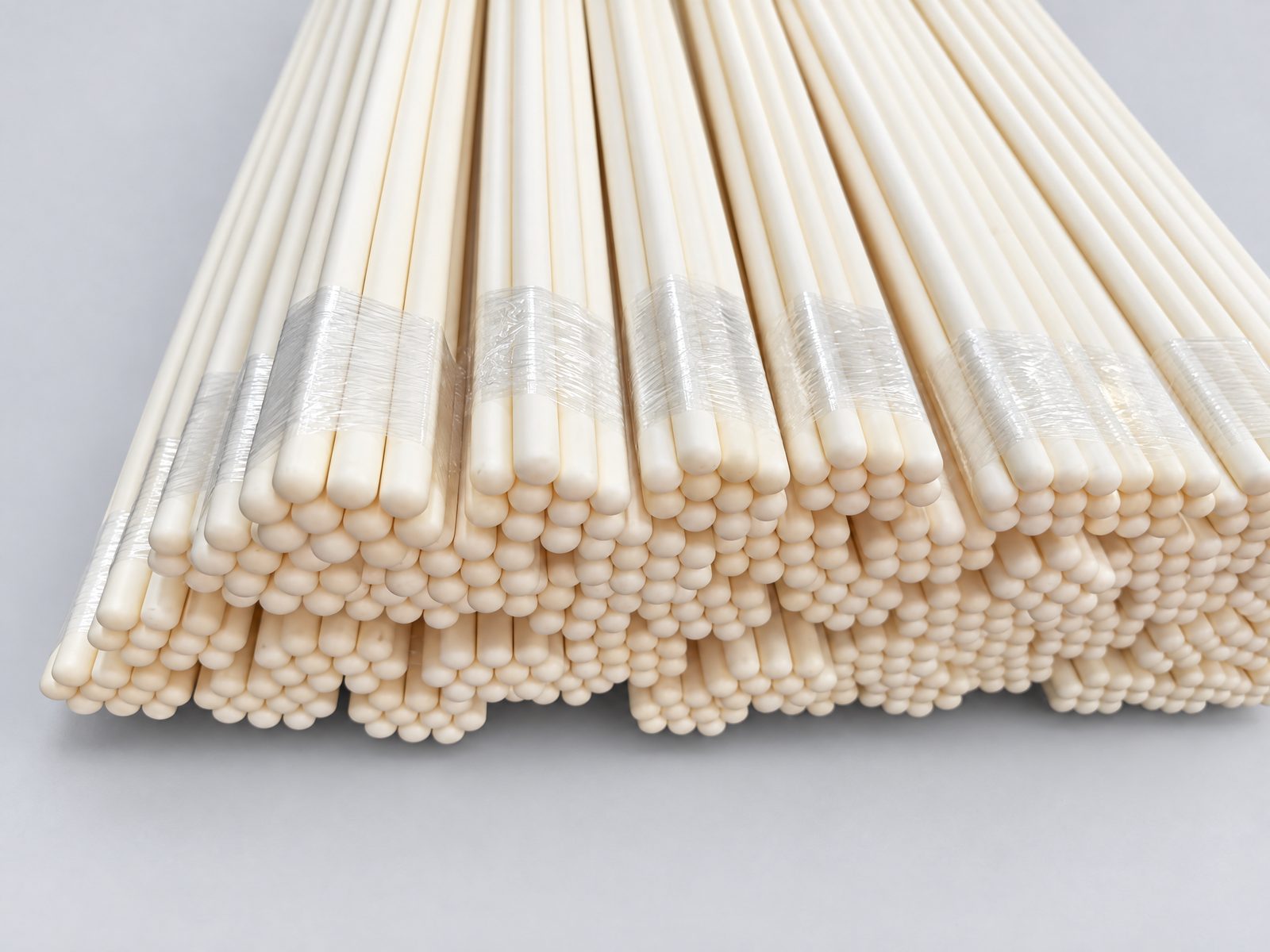
At GY Alumina, specifying a ceramic sheath or furnace tube starts with matching your part geometry and grade to the forming route. Suppose you are replacing an optical pyrometer sightline with a closed-end thermocouple protection tube or ordering a custom furnace tube. We form alumina ceramics by slip casting, pressing, extrusion, and hot pressing, up to OD 17 mm x ID 10 mm for extruded tubes and up to OD 100 mm x ID 90 mm x 1,000 mm for slip-cast tubes, alongside solid alumina rods in eight stock diameters from 2 mm to 12 mm at about 2,400 mm long with a +0.2 mm grinding allowance on the diameter. Selecting C799 alumina (99.5% Al2O3) gives dense corundum protection for high-temperature sensor assemblies.
Next, call out secondary operations directly on your drawing. We perform cut-to-length sizing, end slots, side holes and perforated tubes, and closed ends with drilled holes. Confirm your bore clearance against the thermocouple wire, multi-bore insulator, or insert rod before ordering.
- Grade: specify C799 alumina (99.5% Al2O3), 95% white alumina, or 99% and 99.5% Al2O3 for crucibles.
- Thermal conditions: state peak working temperature, ramp rate, mounting orientation, and atmosphere (air, vacuum, argon, or reducing gas).
- Dimensions: give OD, ID, overall length, end style (open both ends or one end closed), and required tolerances.
- Internal clearance: note the outer diameter of any wire, bead, or core rod that must reach the closed tip.
- Secondary features: mark dimensions and positions for end slots, side holes, perforations, or drilled tip holes.
- Quantity and stage: state batch quantity per item and whether you want approval samples before series production.
Ordering Custom or Stock Alumina Parts from GY Alumina
GY Alumina is the export brand of a Tangshan factory in China with 100+ customers served across thermocouple, furnace, laboratory, and industrial manufacturers. Alongside standard tubes, insulators, crucibles, boats, and rods, we make custom parts to your drawing or sample: round, elliptical, and square tubes (open or one end closed), single-, twin-, and multi-bore tubes and capillaries, threaded, ribbed, perforated, and slotted tubes, square bars and balls, and rings, washers, bushings, discs, and special shapes. Our ISO 9001:2015 certificate covers the manufacturing of ceramic protective tubes for thermocouples (that scope only).
Parts made to your drawing or sample usually start at 100 pieces per item and take 25 to 30 days to produce, with 5 to 10 free samples sent first for approval while the buyer pays courier freight. Standard stock sizes ship in about 3 days for small orders and about 7 days for bulk orders. Include your destination country and any wire clearance details with your request. Send your drawing, the grade and the quantity. We usually reply with a quote within two working days.
Questions buyers ask
- What is the typical emissivity of alumina ceramic?
- Alumina ceramic has no single fixed emissivity because its spectral emission depends on direction, partial semi-transparency, surface contamination, and high-temperature surface state, according to NIST spectral emissivity research. Engineered anodized or porous Al2O3 layers reach high infrared emission, including up to 0.92 on anodized 5657 aluminum alloy (NASA Tech Brief MSC-21963) and 96.5% on porous sintered alpha-alumina coatings (The American Ceramic Society).
- Why do infrared pyrometers read inaccurately on alumina furnace tubes?
- NIST research notes that ceramics can be partially semi-transparent, directional in their emission, and sensitive to surface contamination and high-temperature surface changes. In a hot furnace, radiation from heating elements behind a semi-transparent alumina wall can bleed through or reflect into a radiation thermometer and skew the reading.
- How is alumina emissivity measured at high temperatures?
- Laboratory spectral emissivity testing falls into two main groups: direct comparison of spectral radiation intensity from the sample against a blackbody under Planck's law, and spectral reflectance measurements under Kirchhoff's law. Above 2,000 °C, maintaining and identifying the physical and chemical state of the ceramic surface becomes the main testing challenge.
- Which alumina grade should I order for high-temperature thermocouple protection?
- Dense C799 alumina (99.5% Al2O3) is GY Alumina's standard corundum grade for high-temperature thermocouple protection tubes and insulators. Where a drawing names C 610, we supply 95% white alumina or our standard C799 alumina instead, and neither is mullite.
- What are the minimum order quantity and lead time for custom alumina parts?
- Custom parts made to your drawing or sample at GY Alumina usually start at 100 pieces per item and take 25 to 30 days to produce, preceded by 5 to 10 free approval samples with courier freight paid by the buyer. Standard stock sizes ship in about 3 days for small orders and about 7 days for bulk orders.
Sources
- NASA Tech Brief MSC-21963: High-Emittance, Low-Absorbance Thermal-Control Coating
- NASA Technical Note D-7027: Thermal Electromotive Force Change for Noble and Refractory-Metal Thermocouples at 1600 K
- NIST Publication: Spectral Emissivity Measurements
- NIST Standard Reference Database 150: Property Data Summary for Sintered Alumina
- The American Ceramic Society: Ceramic and Glass Radiative Coatings Overview
- Kyocera Fineceramics Europe GmbH: Degussit AL23 Material Datasheet
- Kyocera Fine Ceramics: Alumina Material Properties and Products
- Morgan Technical Ceramics: High-Performance Alumina Ceramics
- Morgan Technical Ceramics: Material Datasheets
- GY Alumina: Alumina and Corundum Grades Material Data
- GY Alumina: Alumina Ceramics Factory in Tangshan
- GY Alumina: Buyer FAQ on MOQ, Lead Time, Samples, and ISO 9001
- GY Alumina: Custom Alumina Parts Made to Drawing or Sample
Last checked .