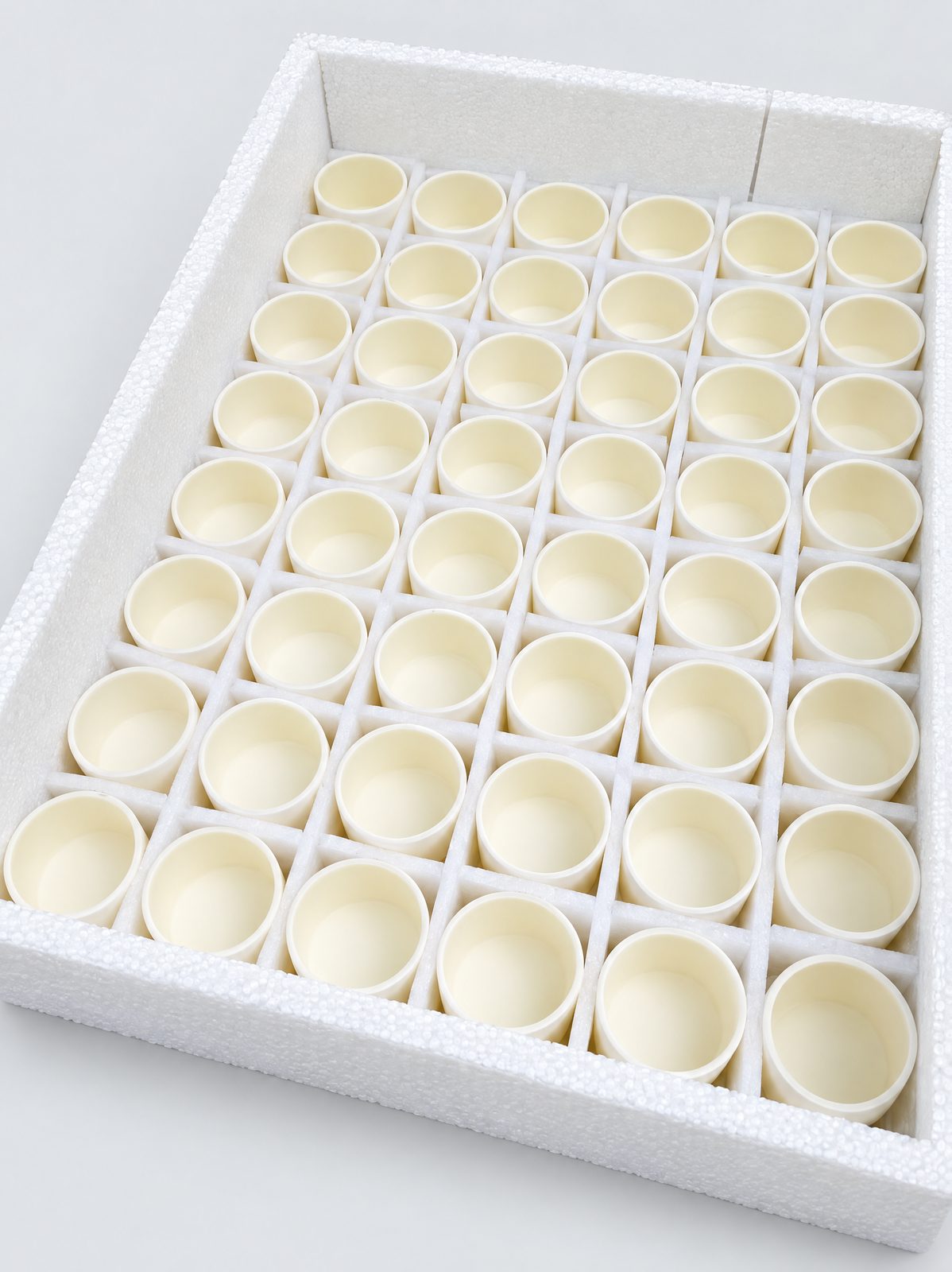
Alumina crucible prices are quoted per part specification rather than fixed on a single tariff because unit cost scales with vessel volume, Al2O3 purity grade, forming method, lid style, and order quantity. At GY Alumina, standard crucible and boat sizes ship from stock in about 3 days for small orders to about 7 days for bulk orders without custom tooling charges, while parts made to your drawing usually start at 100 pieces per item and take 25 to 30 days to produce. Multi-cycle reuse lowers your operating cost per furnace run, with NETZSCH recommending heating Al2O3 crucibles to about 900 °C to burn off organic residues and baking rinsed crucibles at 1500 °C in air between cycles.
What drives alumina crucible and boat prices
Five engineering variables set the unit cost of an alumina crucible or boat: interior volume and wall mass, Al2O3 purity, vessel geometry, post-firing dimensional tolerances, and order volume. Micro pans used in thermogravimetric analyzers hold microliter charges and sell in multi-piece packs, whereas laboratory and industrial melting vessels span milliliter to multi-hundred-milliliter capacities where raw powder weight, kiln space, and firing cycle length govern factory cost.
Geometry and tolerance callouts have as much price impact as capacity. Simple cylindrical, conical, and rectangular shapes formed to standard as-fired tolerances run directly through pressing or slip-casting molds without post-sintering machining. Precision Ceramics notes that an alumina body shrinks about 20% during sintering to reach full density, so holding very tight tolerances requires diamond grinding on the fully sintered ceramic, which is a time-consuming and costly operation. GY Alumina forms crucibles, boats, tubes, and custom shapes at our factory in Tangshan using slip casting, pressing, extrusion, and hot pressing, with secondary cutting to length, end slots, side holes, perforated tubes, and closed ends with drilled holes.
By our calculation from Almath Crucibles' recrystallized alumina product specifications, usable capacity per kilogram of fired ceramic rises from 125 ml/kg on the 20 ml CC22 cylindrical crucible (20 ml divided by 0.16 kg) to 300 ml/kg on the 45 ml CL30 conical crucible (45 ml divided by 0.15 kg) and 1,400 ml/kg on the 280 ml CL70 conical crucible (280 ml divided by 0.2 kg). Larger vessels cost more per piece because they occupy more kiln volume, yet they deliver more firing capacity per gram of sintered ceramic. Lids also affect total spend, as flat, stepped inner, outer rim, and rectangular lids are usually specified and priced as separate line items.
| Model | Vessel form | Capacity | Outside dimensions | Wall thickness | Unit weight |
|---|---|---|---|---|---|
| CC10 | Cylindrical | 1.75 ml | 10 mm OD x 39 mm H | 1.3 mm | Not stated |
| CC13 | Cylindrical | 2 ml | 13 mm OD x 26 mm H | 1.7 mm | Not stated |
| CL5 | Classic conical | 10 ml | 29.5 mm OD x 25 mm H | 1.8 mm | Not stated |
| CC22 | Cylindrical | 20 ml | 22 mm OD x 83 mm H | 1.9 mm | 0.16 kg |
| CC35 | Cylindrical | 27 ml | 41 mm OD x 32 mm H | 2.2 mm | Not stated |
| CL30 | Classic conical | 45 ml | 40.9 mm OD x 48 mm H | 2.3 mm | 0.15 kg |
| SS103 | Rectangular boat | 82 ml | 100 mm L x 49.2 mm W x 24.8 mm H | 2.3 mm | Not stated |
| CL70 | Classic conical | 280 ml | 80 mm OD x 90 mm H | 3.5 mm | 0.2 kg |
| SS200S | Rectangular saggar | 450 ml | 208 mm L x 111 mm W x 25 mm H | 3.5 mm | Not stated |
| CL96 | Classic conical | 700 ml | 98 mm OD x 145 mm H | 3.5 mm | Not stated |
How purchasing alumina crucibles from China optimizes cost efficiency
GY Alumina is the export brand of a Chinese factory in Tangshan that manufactures alumina crucibles, boats, and custom ceramic parts. Buying directly from a primary ceramic factory in China removes regional distributor markups and lets engineering and procurement teams align batch quantities with actual kiln runs.
Cost efficiency comes from matching your order structure to the factory's stock and custom production thresholds. Standard sizes in stock ship in about 3 days for small orders and about 7 days for bulk orders, reducing safety-stock inventory at your plant. When your furnace or sample holder requires a custom crucible or boat made to your drawing or physical sample, production usually starts at 100 pieces per item and takes 25 to 30 days.
Direct factory sourcing also protects quality and pre-production budgets before you commit to a full batch. Before running a custom order, we send 5 to 10 free samples for your approval while you pay only the courier freight, letting your lab test fit, thermal cycling, and melt compatibility first. An independent lab analyses one of our alumina tubes every year, recording 99.55% Al2O3 in 2024, 99.57% Al2O3 in 2025, and 99.61% Al2O3 in 2026. Our ISO 9001:2015 certificate covers the manufacturing of ceramic protective tubes for thermocouples (that scope only), and we have served 100+ customers.
- Check standard stock geometry first: selecting an existing cylindrical crucible or rectangular boat eliminates custom tooling and cuts dispatch time to about 3 to 7 days.
- Consolidate annual consumable demand on custom drawings: meeting the usual 100-piece minimum per item spreads mold preparation and kiln setup across a full production run of 25 to 30 days.
- Qualify with pre-production samples: test 5 to 10 free approval samples in your actual furnace atmosphere before releasing the main production batch.
- Group multi-item ceramic orders into one export shipment: combining crucibles, boats, lids, and furnace tubes from Tangshan reduces per-piece international courier or sea-crate freight.
How alumina purity grades change performance and cost
GY Alumina manufactures crucibles and boats in 99% and 99.5% Al2O3, with plain C799 alumina (99.5% Al2O3) serving as our standard high-purity corundum grade. Where a buyer's drawing names C 610, we supply 95% white alumina or our standard C799 alumina instead, and neither material is mullite. Specifying the lowest purity grade that satisfies your peak temperature and chemical contamination limits keeps your unit price efficient without sacrificing vessel integrity.
Lower-alumina technical grades around 95% to 96% Al2O3 contain a silicate glassy phase that lowers sintering cost and works well for general calcining, mechanical fixtures, and moderate furnace temperatures. Moving to 99% and 99.5% Al2O3 removes almost all glassy phase, raising corrosion resistance against fluxes, molten salts, and aggressive atmospheres while pushing working temperature higher. For its high-purity recrystallized alumina (above 99% Al2O3, including Alumina 99.5%), Almath Crucibles notes that MgO additions up to 0.05% control grain growth during sintering, closed porosity can be kept below 0.5%, and larger grain sizes up to 200 µm improve thermal shock resistance.
| Maker grade and Al2O3 content | Density | Flexural strength | Compressive strength | Thermal conductivity | Max temperature rating |
|---|---|---|---|---|---|
| Precision Ceramics CeramAlox 96 (96% Al2O3) | 3.75 g/cm3 | 200 to 300 MPa | 2000 MPa | 25 W/mK | 1600 °C (air or inert, no load) |
| Almath Crucibles Alumina 99.5% (99.5% Al2O3) | 3.8 g/cm3 | 375 MPa | 2500 MPa | 27.5 W/mK | 1750 °C |
TGA micro-crucibles vs laboratory and industrial vessels
Buyers searching for TGA alumina crucible cost encounter a different pricing structure than buyers ordering muffle-furnace or tube-furnace vessels. Thermal analysis pans must maintain ultra-low mass for signal resolution and strict bottom flatness so they make clean thermal contact with Differential Scanning Calorimetry (DSC) and Thermogravimetric Analysis (TGA) sensors without contaminating the cell.
NETZSCH supplies ceramic and metallic crucibles, slip-on plates, meshes, and baskets for DSC, DTA, TGA, and STA instruments by quotation when buyers submit the catalog order number, instrument type, and quantity. Because analytical ceramic pans and their lids can be reused across many runs, multi-cycle cleaning lowers the effective cost per measurement. For larger batch calcining, ash testing, and metal melting outside micro-balances, standard pressed or slip-cast crucibles and boats provide a much lower cost per milliliter of sample capacity.
Alumina vs alternative crucible materials
Read more
Before requesting an alumina quotation, verify that aluminum oxide matches both your furnace atmosphere and chemical charge. Precision Ceramics states that alumina is one of the most cost-effective technical ceramics, operating in both oxidizing and reducing atmospheres up to 1650 °C (2900 °F) and in vacuum environments up to 2000 °C (3600 °F), with strong resistance to acid and alkali attack at elevated temperatures.
When operating temperatures stay at or below 1000 °C unstressed (800 °C stressed) and you only need a small quantity of complex machined parts, Precision Ceramics notes that Macor machinable glass ceramic can reduce small-batch fabrication cost compared with diamond-ground alumina, though Macor has lower wear resistance and is vulnerable to thermal shock. Above alumina's thermal limit, buyers move to zirconia, boron nitride, or graphite in non-oxidizing furnaces, or to platinum for specialized oxide fusions where molten metals are absent. GY Alumina makes crucibles and boats in 99% and 99.5% Al2O3, alongside alumina thermocouple protection tubes, insulators, furnace tubes, solid alumina rods, and custom parts to drawing or sample.
| Crucible material and grade | Published max temperature | Key cost and application boundaries |
|---|---|---|
| Precision Ceramics Macor machinable glass ceramic | 1000 °C unstressed, 800 °C stressed | Lower small-batch machining cost, poor wear resistance, vulnerable to rapid thermal cycling |
| Alumina (Almath Crucibles ALM and Precision Ceramics CeramAlox) | 1750 °C (ALM), 1650 °C (2900 °F) air or reducing, 2000 °C (3600 °F) vacuum (CeramAlox) | Cost-effective oxide ceramic, strong acid and alkali resistance, reusable across furnace runs |
| Almath Crucibles Boron Nitride (BN) | 2000 °C | Higher temperature limit than alumina for specialized thermal environments |
| Almath Crucibles Fully-Stabilized Zirconia (FSZ) | 2250 °C | Zirconia exhibits the highest fracture toughness among oxide monolith ceramics (Precision Ceramics) |
| Almath Crucibles Pyrolytic Boron Nitride (PBN) | 2500 °C | High-purity vapor-deposited boron nitride grade above standard BN |
| Almath Crucibles Graphite Carbon (G) | 3000 °C | Highest temperature rating among the listed crucible materials |
| Platinum (Pt, NETZSCH cleaning guide) | Not stated | Alloys irreversibly with most metals at high temperature and dissolves in 1:1 HCl and HNO3 |
Lowering cost per run: thermal ramp rules and cleaning protocols
Read more
Preventing thermal shock cracking and cleaning residues properly can multiply the service life of each crucible and cut your annual consumable spend. For its ALM alumina crucibles (above 99% Al2O3), Almath Crucibles advises inspecting every crucible on arrival, never stacking crucibles inside one another, leaving at least 25 mm clearance from furnace heating elements (preferably at least 50 mm), and setting larger crucibles on a substrate plate of the same ceramic material. On larger ALM alumina crucibles, Almath Crucibles also recommends preheating where needed and holding a maximum heating and cooling rate of 5 °C per minute, while avoiding overfilling or over-compacting charges with higher thermal expansion than the ceramic wall.
When deposits build up after firing, both NETZSCH and the Iowa State University Chemical Instrumentation Facility publish multi-cycle alumina regeneration procedures. Under fume-hood safety controls, organic polymers, pyrolysis products, and carbon black burn off by heating the crucible in air or oxygen to about 900 °C (lowering the temperature in oxygen if reactive oxide fillers are present). Metal and alloy residues are leached in hydrochloric acid at 25% concentration or higher, or in a 1:1 mixture of concentrated HCl and HNO3, while water-soluble salts are boiled in distilled water. Never use hydrofluoric acid (HF) on alumina crucibles because HF dissolves the alumina body itself. If stable oxides have already reacted with the ceramic wall, the crucible must be discarded.
- Decant spent acid safely under a fume hood without capping fresh aqua regia waste until the next day, as NOx and HCl vapors continue fuming for several hours.
- Bake dried crucibles in an air muffle furnace to complete regeneration: at least 2 hours above 1200 °C under the university TGA protocol, or up to 1500 °C in air under the NETZSCH cleaning procedure.
- Cool the furnace to near room temperature at controlled ramp rates before removing the crucibles.
Specification checklist: what to send for an alumina crucible quote
GY Alumina uses six core data points to produce a detailed price quotation for alumina crucibles and boats, and sending complete operating details in your first inquiry ensures we quote the most economical forming method and grade for your run.
- Vessel shape and style: cylindrical crucible, conical or arc-shaped crucible, rectangular boat, or a special custom profile with a drawing or sample.
- Nominal dimensions, tolerances, and capacity: outside diameter (or length and width for boats), inside diameter, overall height, wall thickness, target volume in ml, and any critical fit tolerances.
- Lid requirement: state whether you need no lid, a flat round lid, an outer slip-over lid, a stepped inner lid, or a rectangular boat lid.
- Process charge, peak temperature, and atmosphere: name what you melt, sinter, or analyze, the maximum temperature in °C, heating rate, and whether the chamber runs in air, inert gas, reducing gas, or vacuum.
- Alumina purity grade: 99% Al2O3, our standard C799 alumina (99.5% Al2O3), or 95% white alumina where your drawing calls out C 610.
- Order quantity, samples, and destination: specify your target batch quantity (100 pieces minimum per item is usual for custom drawings, with 5 to 10 free samples available when you cover courier freight) plus your destination country and preferred shipping terms.
How to request an alumina crucible quotation
GY Alumina prepares itemized factory quotations based on your drawing, sample, or dimensional list. Send your drawing, the grade and the quantity. We usually reply with a quote within two working days.
Questions buyers ask
- Why are alumina crucibles quoted by specification instead of a flat unit price?
- Unit cost depends directly on ceramic mass, Al2O3 purity grade (such as 95% white alumina vs 99% and 99.5% C799 alumina), forming route, lid pairing, and batch volume. GY Alumina makes crucibles, boats, and custom shapes by slip casting, pressing, extrusion, and hot pressing, and prices each part according to its dimensions, grade, and quantity.
- What is the minimum order quantity and lead time when buying alumina crucibles from China?
- At GY Alumina in Tangshan, standard crucible and boat sizes in stock ship in about 3 days for small orders and about 7 days for bulk orders. Custom parts made to your drawing or sample usually start at 100 pieces per item and take 25 to 30 days to produce, with 5 to 10 free approval samples sent first while the buyer pays the courier.
- Can alumina crucibles be cleaned and reused to reduce consumable costs?
- Yes, thermal analysis and laboratory alumina crucibles can be reused across many runs when deposits have not chemically reacted with the Al2O3 wall. Organic residues burn off in air or oxygen at about 900 °C, metal contaminants dissolve in 25% or stronger HCl or 1:1 concentrated HCl and HNO3, and rinsed crucibles are baked in air above 1200 °C up to 1500 °C before cooling slowly.
- How fast can you heat and cool a large alumina crucible without cracking it?
- To prevent thermal shock failure on larger ALM alumina crucibles, Almath Crucibles recommends a maximum heating and cooling rate of 5 °C per minute, positioning the vessel at least 25 mm (preferably 50 mm) from furnace heating elements, and resting it on a ceramic substrate plate of the same material.
- What alumina grade does GY Alumina supply if a drawing specifies C799 or C 610?
- Our standard high-purity grade is C799 alumina at 99.5% Al2O3, and we make crucibles and boats in 99% and 99.5% Al2O3. Where a drawing names C 610, we supply 95% white alumina or our standard C799 alumina instead, and neither material is mullite.
Sources
- GY Alumina: Alumina Crucibles, Lids and Boats
- GY Alumina: Buyer FAQ on MOQ, Lead Time, Samples, and Testing
- GY Alumina: Alumina Ceramics Factory in Tangshan, China
- GY Alumina: Alumina and Corundum Grades Material Data
- Almath Crucibles: Alumina Ceramic Crucible Material Properties
- Almath Crucibles: Alumina Crucible Instructions and Handling
- Almath Crucibles: CL70 Classic Alumina Crucible 280ml
- Almath Crucibles: CL30 Classic Alumina Crucible 45ml
- Almath Crucibles: CC22 Cylindrical Alumina Crucible 20ml
- Almath Crucibles: Advanced Ceramic Crucibles Manufacturer and Services
- Precision Ceramics: Alumina Properties and Industrial Applications
- NETZSCH Analyzing and Testing: Recommendations for Cleaning Al2O3 and Pt Crucibles
- NETZSCH Analyzing and Testing: Consumables, Spare Parts and Accessories
- Iowa State University Chemical Instrumentation Facility: TGA Alumina Crucible Cleaning Procedure
Last checked .