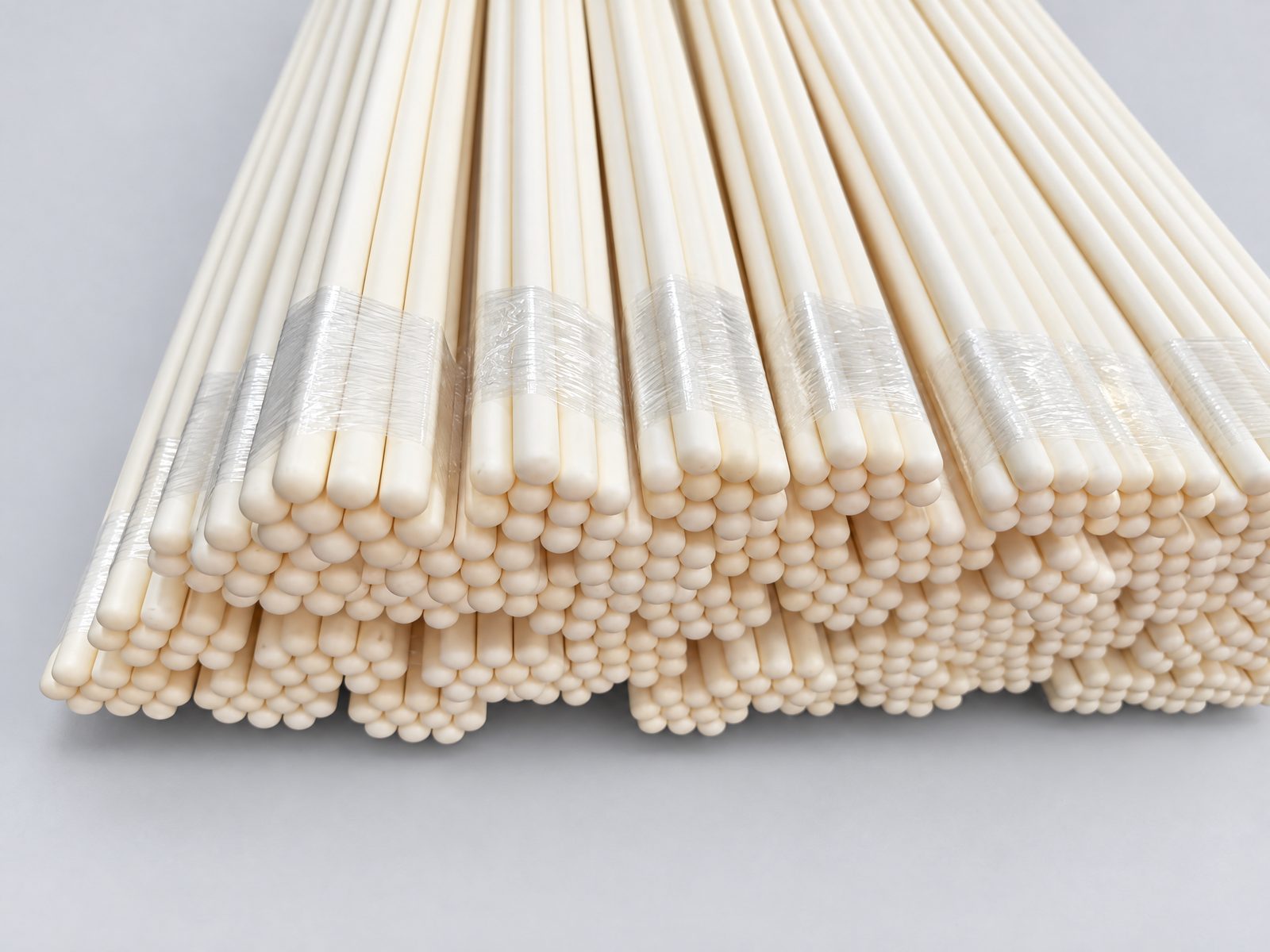
Alumina (aluminum oxide) has the chemical formula Al2O3 and a molecular mass of 101.9, with a density of 3.97 g/cm3 and a melting point of 2,054 °C according to International Chemical Safety Card 0351 from the International Labour Organization (ILO). In industrial technical ceramics, alumina chemical composition starts around 90% Al2O3 and rises through high-purity grades such as 99.5%, where the remaining percentage consists of sintering aids or trace oxides such as MgO, TiO2, CeO2, and Na2O. At GY Alumina, our standard grade is C799 alumina at 99.5% Al2O3, with yearly independent lab analyses recording 99.55% Al2O3 in 2024, 99.57% Al2O3 in 2025, and 99.61% Al2O3 in 2026.
Core Chemical Identity and Baseline Properties of Al2O3
Pure alumina is aluminum oxide, also referred to as aluminum trioxide or alpha-aluminum oxide. Anhydrous aluminum oxide carries the chemical formula Al2O3, CAS number 1344-28-1, and EC number 215-691-6. Its hard crystalline mineral form occurs in nature as corundum under CAS number 1302-74-5. Related aluminum-bearing minerals that occur in nature include bauxite, bayerite, boehmite, diaspore, and gibbsite.
In its pure state, aluminum oxide is a non-combustible white powder with no solubility in water. It possesses strong ionic and covalent interatomic bonding, and while it can exist in several crystalline phases, all revert to the stable hexagonal alpha phase at elevated temperatures. Because strong covalent bonding inhibits solid-state densification, The American Ceramic Society notes that pure alumina requires higher sintering temperatures than magnesium oxide or zinc oxide. Chemically, Accuratus reports that high-purity alumina resists attack by all gases except wet fluorine and resists all common reagents except hydrofluoric acid and phosphoric acid, though elevated-temperature attack occurs in the presence of alkali metal vapors, particularly in lower-purity grades.
| Property or Identifier | Value | Notes and Conditions |
|---|---|---|
| Chemical Formula | Al2O3 | Aluminum oxide / aluminum trioxide |
| CAS Registry Number (Alumina, EC 215-691-6 ) | 1344-28-1 | Anhydrous aluminum oxide |
| CAS Registry Number (Corundum) | 1302-74-5 | Naturally occurring hard crystalline form |
| Molecular Mass | 101.9 | Dimensionless molar mass per ICSC 0351 |
| Density | 3.97 g/cm3 | Baseline density for pure Al2O3 |
| Melting Point (Al2O3) | 2,054 °C | Standard aluminum oxide melting point |
| Melting Point (Corundum) | 2,015 °C | Reported separately for mineral corundum |
| Boiling Point | 3,000 °C | Atmospheric boiling point |
| Solubility in Water | None | Insoluble at room temperature |
| Occupational Exposure Limit (TLV) | 1 mg/m3 | As Time-Weighted Average (TWA) , A4 |
Alumina Purity Grades and Properties by Manufacturer
Unlike laboratory chemical reagents, industrial alumina ceramics are engineered multi-oxide bodies or high-purity sintered corundum. Precision Ceramics states that typical commercial alumina purities start at 90% Al2O3, alongside its CeramAlox Ultra Pure grade. Accuratus supplies technical alumina in purity ranges from 94% Al2O3, formulated as an easily metallizable composition for brazed and soldered assemblies, through high-purity grades such as 99.5% Al2O3 for demanding high-temperature service.
Every percentage point of Al2O3 changes the secondary glass-forming balance and working performance. Removing intergranular silicate phases raises density, stiffness, and heat transfer: in the Accuratus datasheets below, stepping from 94% Aluminum Oxide to 99.5% Aluminum Oxide raises sintered density from 3.69 g/cm3 to 3.89 g/cm3, elastic modulus from 300 GPa to 375 GPa, and thermal conductivity from 18 W/mK to 35 W/mK. Purity also controls high-temperature electrical insulation. While commercial grades from Accuratus (94% to 99.5% Aluminum Oxide) and Precision Ceramics (CeramAlox 96) exceed 10^14 ohm-cm volume resistivity at room temperature, Kyocera Fineceramics Europe's AO476O datasheet (at least 96% Al2O3, tested to JIS C 2141) shows resistivity dropping from above 10^14 ohm-cm at 20 °C to 10^10 ohm-cm at 300 °C and 10^8 ohm-cm at 500 °C.
GY Alumina supplies C799 alumina at 99.5% Al2O3 as our standard grade, and we make crucibles in 99% and 99.5% Al2O3. Where a buyer's drawing names C 610, we supply 95% white alumina or our standard C799 alumina instead. Neither of those grades is mullite.
| Manufacturer and Grade | Nominal Al2O3 | Density | Flexural Strength (25 °C) | Elastic / Young's Modulus | Thermal Conductivity | Dielectric Strength |
|---|---|---|---|---|---|---|
| Accuratus 94% Aluminum Oxide | 94% | 3.69 g/cm3 (230.4 lb/ft3) | 330 MPa (47 x 10^3 lb/in2) | 300 GPa (43.5 x 10^6 lb/in2) | 18 W/mK (125 BTU in/ft2 hr °F) | 16.7 ac-kV/mm (418 volts/mil) |
| Accuratus 96% Aluminum Oxide | 96% | 3.72 g/cm3 (232.2 lb/ft3) | 345 MPa (50 x 10^3 lb/in2) | 300 GPa (43.5 x 10^6 lb/in2) | 25 W/mK (174 BTU in/ft2 hr °F) | 14.6 ac-kV/mm (365 volts/mil) |
| Kyocera AO476O | At least 96% | 3.7 g/cm3 | 350 MPa | 320 GPa | 24 W/mK | 15 kV/mm |
| Precision Ceramics CeramAlox 96 | 96% | 3.75 g/cm3 | 200 to 300 MPa | 300 GPa | 25 W/mK | 9 kV/mm (DC) |
| Accuratus 99.5% Aluminum Oxide | 99.5% | 3.89 g/cm3 (242.8 lb/ft3) | 379 MPa (55 x 10^3 lb/in2) | 375 GPa (54.4 x 10^6 lb/in2) | 35 W/mK (243 BTU in/ft2 hr °F) | 16.9 ac-kV/mm (420 volts/mil) |
Role of Impurities, Low-Sodium Alumina, and Sintering Aids
Densifying raw Al2O3 powder without deformation, cracking, or abnormal grain growth requires tight control over minor oxides. As documented by The American Ceramic Society, manufacturers introduce sintering aids, functional oxide dopants that lower the required firing temperature, introduce dislocations, and enhance particle diffusion.
Each oxide additive or trace impurity limit in an alumina chemical analysis serves a distinct ceramic function:
- Sodium oxide (Na2O) in low-sodium alumina: Huber Advanced Materials specifies a low alkali and low soda content of Na2O below 0.1% for its Martoxid calcined aluminum oxides used in technical ceramics, electrical insulators, and refractories. Keeping Na2O below 0.1% supports moderate sintering temperatures and preserves high-temperature electrical insulation.
- Magnesium oxide (MgO) : Adding MgO causes grain boundary refinement in alumina, producing a homogeneous matrix with fewer pores and stronger mechanical properties.
- Chromium oxide and manganese oxide: Accuratus notes that additions of chrome oxide or manganese oxide change body color and improve hardness, listing white for its 94% and 96% Aluminum Oxide grades, ivory for its 99.5% Aluminum Oxide grade, and specialized flux additions in its 94% grade to improve metal-film consistency for brazing and soldering.
- Titanium dioxide (TiO2) and cerium oxide (CeO2) : In composite systems such as zirconia-toughened alumina (ZTA) , TiO2 can react with alumina during sintering to form an Al2TiO5 phase that impedes crack propagation, while CeO2 forms cerium hexa-aluminate (CeAl11O18) or cerium zirconate (Ce2Zr3O10) to reduce Vickers hardness and raise fracture toughness.
- Grain-boundary corrosion resistance: Because fluxing oxides segregate to grain boundaries, Kyocera Fineceramics Europe notes that largely dispensing with conventional sintering aids in high-purity grades brings the corrosion resistance of the grain boundary chamfer to its highest level.
Standards and Lab Verification for Alumina Composition
Read more
When specifying fabricated alumina components for regulated electrical and thermal equipment, engineers pair nominal Al2O3 percentages with international material and test standards. For fabricated parts and ceramic-to-metal seals used in electron devices, ASTM D2442-75R25 (Standard Specification for Alumina Ceramics for Electrical and Electronic Applications, updated June 25, 2025) establishes property limits and test methods for electrical, mechanical, thermal, and general properties of alumina bodies regardless of part geometry.
Dense sintered alumina datasheets also verify physical and dielectric performance against Japanese Industrial Standards (JIS) . On its AO476O alumina (at least 96% Al2O3) , Kyocera Fineceramics Europe reports 0% water absorption, dielectric constant 9.4, and volume resistivity under JIS C 2141, alongside Vickers hardness of 13.7 GPa at HV9.807N (JIS R 1610) , Poisson's ratio of 0.23 (JIS R 1602) , linear thermal expansion of 7.2 x 10^-6/K from 40 to 400 °C and 7.9 x 10^-6/K from 40 to 800 °C (JIS R 1618) , specific heat of 0.78 J/g K (JIS R 1611) , and a 200 °C thermal shock temperature difference (JIS R 1648) .
At GY Alumina, an independent lab analyzes one of our alumina tubes every year to verify Al2O3 purity, and our ISO 9001:2015 certificate covers the manufacturing of ceramic protective tubes for thermocouples.
Worked Example: Selecting an Alumina Grade for a Furnace Assembly
Consider an engineering scenario written by our team for an electric furnace operating at 1,680 °C in air with two ceramic components: (1) a closed-end thermocouple protection tube at OD 15 x ID 10 mm and 800 mm long, and (2) an external 400 °C terminal block holding brazed metal feedthrough pins.
Step 1: Evaluate the 1,680 °C protection tube against purity and silicate glass phases. Legacy drawings sometimes call for a 96% alumina body, which Precision Ceramics rates to a 1,600 °C maximum no-load temperature on CeramAlox 96 (compared to 1,750 °C (3,180 °F) no-load on Accuratus 99.5% alumina).
Step 2: Match the 15 x 10 x 800 mm tube to the factory's forming limits. GY Alumina forms parts by slip casting, pressing, extrusion, and hot pressing, with extruded tubes up to OD 17 x ID 10 mm and slip-cast tubes up to OD 100 x ID 90 x 1,000 mm. Because OD 15 x ID 10 mm sits inside our extrusion envelope, it can be extruded or slip cast, whereas larger furnace tubes are slip cast.
Step 3: Specify the external 400 °C brazed terminal block. Because the external block operates at 400 °C and requires brazed pin seals, Accuratus's 94% metallizable Aluminum Oxide composition supports consistent metal-film firing while still providing room-temperature volume resistivity above 10^14 ohm-cm.
Buyer Specification Checklist and GY Alumina Capabilities
Before releasing an engineering drawing or purchase order for GY Alumina tubes, insulators, rods, or crucibles, use this checklist written by our team to define the chemical grade and geometry:
- State the exact Al2O3 percentage and grade name: Write C799 (99.5% Al2O3) for high-temperature corundum tubes and insulators, 99% and 99.5% Al2O3 for crucibles, or 95% white alumina where lower-purity white alumina suits your temperature and atmosphere.
- Define the operating environment and impurity sensitivity: List peak temperature, heating rate, mechanical load, and exposure to vacuum, reducing gas, acids, alkalis, or alkali metal vapors. Note low-sodium requirements (such as Na2O below 0.1%) for high-voltage insulators or thermocouple sheaths.
- Check forming route and stock rod allowances: Match small-bore tubes and multi-bore insulators to extrusion and large-diameter sheaths to slip casting, and account for diameter grinding allowances on stock solid rods.
- Specify secondary operations and bore clearance: Mark cut-to-length dimensions, end slots, side holes, perforated walls, or closed ends with drilled holes, and confirm the bore against your wire or insert before ordering.
| Specification Area | GY Alumina Standard Detail | Buyer Notes |
|---|---|---|
| Standard Alumina Grade | C799 alumina (99.5% Al2O3) | Standard corundum grade for tubes, insulators, rods, and custom parts |
| Other Grades Supplied | 95% white alumina, 99% and 99.5% Al2O3 crucibles | Grade and maximum temperature confirmed per part in quotation |
| Forming Methods | Slip casting, pressing, extrusion, hot pressing | Max extruded: OD 17 x ID 10 mm, max slip-cast: OD 100 x ID 90 x 1,000 mm |
| Stock Solid Alumina Rods | Standard stock diameters | |
| Custom Order MOQ and Lead Time | Usually 100 pieces per item, 25 to 30 days | 5 to 10 free samples sent first (buyer pays courier) |
| Standard Stock Dispatch | About 3 days (small) to about 7 days (bulk) | Cut to ordered length before dispatch |
How to Order Alumina Parts from GY Alumina
GY Alumina manufactures thermocouple protection tubes, thermocouple insulators and multi-bore tubes, furnace tubes, crucibles and boats, solid alumina rods, and custom parts at our factory in Tangshan, with 100+ customers served. To your drawing or sample, we make round, elliptical, and square tubes (open or one end closed) , single-, twin-, and multi-bore tubes and capillaries, threaded, ribbed, perforated, and slotted tubes, solid rods, square bars, and balls, rings, washers, bushings, and discs, as well as crucibles, boats, and other custom shapes. If a design calls for processes not listed in our capabilities, such as isostatic pressing, injection molding, CNC or diamond grinding, lapping, polishing, green machining, or thin-film electronic substrates, you can still send your drawing for review and we will tell you plainly whether our forming routes suit your part.
Parts made to drawing usually start at 100 pieces per item and take 25 to 30 days to produce, with 5 to 10 free samples sent for approval first (the buyer pays the courier) , while standard sizes ship from stock in about 3 days for small orders to about 7 days for bulk orders. Include a dimensioned drawing or sample, OD, ID, and length with tolerances, required alumina grade, end configuration, any wire or insert that must pass through the bore, and order quantity. Send your drawing, the grade and the quantity. We usually reply with a quote within two working days.
Questions buyers ask
- What is the exact chemical formula and molecular mass of alumina?
- According to ILO International Chemical Safety Card 0351, alumina (aluminum oxide) has the chemical formula Al2O3, a molecular mass of 101.9, and CAS number 1344-28-1. It is a water-insoluble white powder with a density of 3.97 g/cm3, a melting point of 2,054 °C (2,015 °C for mineral corundum) , and a boiling point of 3,000 °C.
- What is the chemical composition of GY Alumina's C799 grade?
- At GY Alumina, our standard grade is C799 alumina at 99.5% Al2O3, and we make crucibles in 99% and 99.5% Al2O3. An independent laboratory analyzes one of our alumina tubes every year and recorded 99.55% Al2O3 in 2024, 99.57% Al2O3 in 2025, and 99.61% Al2O3 in 2026.
- What do you supply when a ceramic drawing specifies C 610?
- Where a drawing names C 610, GY Alumina supplies 95% white alumina or our standard C799 alumina (99.5% Al2O3) instead. Neither material is mullite.
- Why is low-sodium alumina (Na2O below 0.1%) important for technical ceramics?
- Huber Advanced Materials specifies a low alkali content of Na2O below 0.1% for its Martoxid calcined aluminas to combine high chemical purity, moderate sintering temperatures, and strong electrical insulation. Keeping alkali oxides low prevents high-temperature resistivity drops and reduces susceptibility to alkali vapor attack.
- Why are sintering aids like MgO added to alumina ceramics?
- Strong covalent and ionic bonding in pure alumina inhibits solid-state densification without very high firing temperatures. As documented by The American Ceramic Society, adding magnesium oxide (MgO) refines grain boundaries and reduces porosity, while TiO2 and CeO2 modify hardness and fracture toughness in alumina composites.
Sources
- ILO International Chemical Safety Card 0351: Aluminium Oxide
- Huber Advanced Materials: Calcined Aluminum Oxides (Martoxid)
- Precision Ceramics: Alumina Properties and Industrial Applications
- Accuratus: Aluminum Oxide (Al2O3) Ceramic Properties
- Kyocera Fineceramics Europe: Alumina Materials
- Kyocera Fineceramics Europe: AO476O Material Data Sheet
- ASTM D2442: Standard Specification for Alumina Ceramics for Electrical and Electronic Applications
- The American Ceramic Society: Exploring the Combined Effect of Multiple Oxide Inclusions on ZTA
- The American Ceramic Society: Fabricating Transparent Ceramics
- GY Alumina: Alumina and Corundum Grades Material Data
- GY Alumina: Alumina Ceramics Factory in Tangshan
- GY Alumina: Buyer FAQ (MOQ, Lead Time, Samples, ISO 9001)
- GY Alumina: Alumina Custom Parts Made to Drawing or Sample
Last checked .