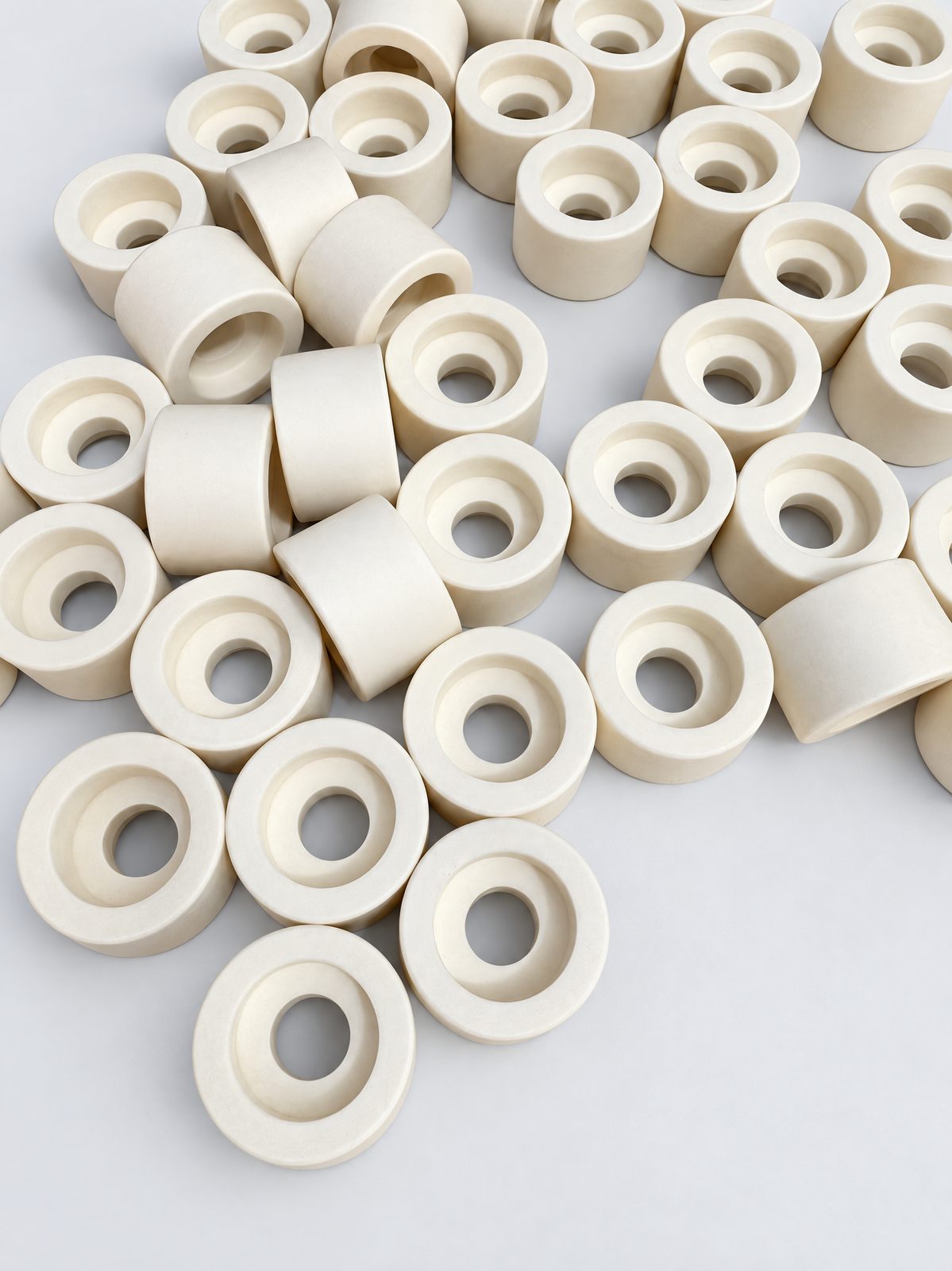
A porous alumina plate is an aluminum oxide ceramic sheet engineered with an open pore structure so gases and liquids pass evenly through the body for vacuum chucks, membrane supports, filtration, and flow distribution. Unlike dense alumina grades that Kyocera Fineceramics Europe lists at 0 Vol-% open porosity and 3.70 to 3.95 g/cm3 bulk density, engineered porous ceramics reach 30% or higher porosity under ASTM C1674-23 and require geometric density checks under ISO 18754:2020 Method B rather than water displacement. Specifying a plate accurately requires defining open porosity, pore size, ground flatness, and service temperature separately from standard dense alumina datasheets.
How a Porous Alumina Plate Works in Flow Distribution and Vacuum Chucks
According to Kyocera Fine Ceramics, porous ceramics contain pores engineered inside their crystal structure, with both total porosity and pore diameter controlled to target specifications so liquids and gases permeate directly through the solid body. Choosing an alumina porous ceramic plate starts with matching that internal pore network to the pressure drop, mechanical stiffness, and surface contact your equipment demands.
In porous ceramic plate flow distribution, pressurized gas or liquid enters a plenum behind the ceramic sheet and exits across thousands of interconnected microscopic passages rather than discrete drilled orifices. That distributed resistance equalizes velocity across the face, preventing jetting or channeling in fluidized beds, moisture absorption modules, and chemical reactors.
Buyers searching for a microporous alumina plate usually need one of four distinct component architectures, each built for a different load and flow regime:
- Alumina vacuum chuck plates: Kyocera Fine Ceramics produces high-precision porous vacuum chucks, stage parts, and integrated mirrors where high stiffness and fine surface profiles hold thin semiconductor wafers, glass panels, or films flat without localized suction dimples.
- Ceramic membrane supports and fuel cell plates: Kyocera Fine Ceramics applies porous ceramics to functional membrane supports and fuel cell components, where a rigid, permeable alumina plate backs a selective filtration layer or reactant diffusion zone against transmembrane pressure.
- Engineered channel filter and burner plates: ASTM C1674-23 covers porous ceramic plates and blocks with longitudinal cellular channels of 1 mm or larger and 30% or higher porosity used as high-temperature filters, catalytic conversion supports, and combustion burner plates.
- Kiln setter and debinding cover plates: High-purity alumina setters carry green parts through binder burnout and sintering while allowing evolving gases to vent from beneath the workpiece.
Porous vs. Dense Alumina Plates: Avoiding Datasheet Errors
A common catalog mistake in technical ceramics is listing dense alumina property tables on product pages for a porous ceramic filter plate. Kyocera Fine Ceramics notes in its alumina material property documentation that apparent density and bulk density share the exact same value only for dense materials, whereas porous ceramics list apparent solid density separately because internal pore volume lowers bulk mass per unit volume.
In its February 2025 datasheet for dense DEGUSSIT AL23 (above 99.5% alpha-Al2O3), Kyocera Fineceramics Europe records 0 Vol-% open porosity, 3.70 to 3.95 g/cm3 bulk density, 300 to 350 MPa four-point flexural strength, and 2,500 MPa compressive strength. Precision Ceramics similarly lists dense CeramAlox 96 (96% purity) at 3.75 g/cm3 density and 200 to 300 MPa flexural strength. None of those dense sheets pass gas or liquid.
When you introduce interconnected open porosity for vacuum hold-down or liquid filtration, bulk density, elastic modulus, and bending strength all drop below dense alumina values as a direct function of pore fraction and pore geometry. If a supplier quotation for a porous alumina plate shows 0% water absorption or a bulk density between 3.70 and 3.95 g/cm3, the table describes an impermeable dense substrate rather than a permeable porous body.
| Maker or Standard | Grade or Scope | Al2O3 Purity | Bulk Density | Open Porosity | Flexural Strength | Max Temp in Air |
|---|---|---|---|---|---|---|
| Precision Ceramics | CeramAlox 96 (dense) | 96% | 3.75 g/cm3 | Not stated (fully dense) | 200 to 300 MPa at 25 °C | 1,600 °C (no load) |
| Kyocera Fineceramics Europe | DEGUSSIT AL23 (dense) | Above 99.5% | 3.70 to 3.95 g/cm3 | 0 Vol-% | 300 to 350 MPa at 20 °C | 1,950 °C |
| ASTM C1674-23 | Engineered channel porous ceramics | Composition dependent | Architecture dependent | 30% or higher (typical) | Measured by 4-point flexure | Ambient test scope |
Testing Porosity, Density, and Strength Under ISO and ASTM Standards
Putting the wrong test standard on a purchase order creates inspection disputes when porous plates arrive at incoming quality control. Under ISO 18754:2020 (Edition 3, published in April 2020), Method A measures bulk density, apparent solid density, and apparent porosity by Archimedes liquid displacement, but the standard explicitly notes that Method A is not appropriate for apparent porosity above 10%, open porosity below 0.5%, or average pore sizes above 600 µm because water drainage and meniscus errors distort the reading.
For permeable plates above 10% porosity, ISO 18754 Method B determines bulk density solely from machined geometric dimensions and dry mass. Where liquid saturation data are needed on fired unglazed ceramic bodies and tiles, ASTM C0373-18R23 (active 2023 reapproval) defines vacuum saturation and boiling procedures for water absorption, apparent porosity, bulk density, and apparent specific gravity.
Mechanical qualification of porous plates also differs from dense ceramic bar testing. ASTM C1674-23 establishes ambient flexural strength testing for engineered porous ceramics and strongly recommends four-point bending (Test Method A1, or Test Method B using a 13 mm x 25 mm rectangular bar longer than 116 mm over a 90 mm outer support span) over three-point bending because three-point loading stresses a tiny volume and inflates strength numbers. The standard also notes that sonic resonance or impulse excitation should replace beam deflection for Young's modulus, and warns that standard continuum beam equations overestimate true wall fracture strength when the linear cell count across the shortest specimen thickness is low: 15 cells or more keeps nominal beam strength within 10% of honeycomb structure strength, 5 to 15 cells produces a 10% to 20% overvalue, and fewer than 5 cells produces a 20% to 100% overvalue.
| Standard Designation | Measurement Method | Properties Determined | Key Scope Limits for Buyers |
|---|---|---|---|
| ISO 18754:2020 Method A | Liquid displacement (Archimedes) | Bulk density, apparent solid density, apparent porosity | Unsuitable above 10% apparent porosity, below 0.5% open porosity, or above 600 µm pore size |
| ISO 18754:2020 Method B | Geometric dimensions and dry mass | Geometric bulk density | Requires regular machined plate or block geometry |
| ASTM C0373-18R23 | Vacuum saturation or boil method | Water absorption, bulk density, apparent porosity, specific gravity | Applies to fired unglazed ceramic whiteware and pressed or extruded tiles |
| ASTM C1674-23 | 4-point or 3-point ambient bending | Nominal beam, wall fracture, and cellular structure flexural strength | Engineered porous architectures (typically 30% or higher porosity). 15+ cells needed across thickness to keep continuum error within 10% |
Worked Example: Verifying Incoming Plate Porosity by Geometric Density
Read more
Example inspection calculation written by our team using ISO 18754 Method B and Almath Crucibles' published SUB3003001 plate geometry.
Before you bond a porous alumina plate into an aluminum or stainless-steel vacuum chuck housing, you can verify its bulk density dry on a bench scale without introducing immersion water into the pores. Almath Crucibles lists its dense sintered SUB3003001 alumina substrate at 300 mm length x 300 mm width x 1 mm height with a dry weight of 0.347 kg (347 g). Multiplying 30 cm x 30 cm x 0.1 cm gives a geometric volume of 90 cm3 (90,000 mm3). By our calculation from Almath Crucibles' SUB3003001 specification, dividing 347 g by 90 cm3 yields a dense geometric bulk density of 3.856 g/cm3.
Now apply that same dry Method B check to an incoming batch of custom porous plates ground to 300 mm x 300 mm x 1 mm. You measure length, width, and thickness with calibrated micrometers and calipers to confirm the 90 cm3 envelope, then weigh each dry plate. Because total porosity equals 1 minus the ratio of geometric bulk density to solid crystal density, a plate engineered with 30% total porosity (the baseline threshold in ASTM C1674-23) retains 70% of the solid mass per unit volume. On that 3.856 g/cm3 solid alumina basis, a 30% porous plate of identical 300 mm x 300 mm x 1 mm dimensions weighs 242.9 g (0.243 kg) with a geometric bulk density of 2.70 g/cm3. Tracking dry mass across a 10-piece sample lot immediately flags density drift or under-fired blanks before assembly.
Forming, Sintering Shrinkage, Diamond Grinding, and Mounting
Read more
Precision Ceramics states that alumina components are formed by die pressing, isostatic pressing, slip casting, extrusion, and injection molding, and can be machined in the green or biscuit state before firing. During final sintering, however, dense alumina shrinks linearly by about 20%, and Almath Crucibles notes that sintered alumina plates naturally tend to warp and bend in the kiln. Pre-sinter machining alone cannot hold micron-level chuck flatness or parallel thickness.
To flatten fired plates, Almath Crucibles uses automated CNC surface grinding with a resin-bonded diamond wheel, alongside ceramic laser cutting and diamond wire cutting capable of slicing slots as thin as 0.25 mm. On porous alumina plates, surface grinding and mounting require strict shop controls so machining debris and bonding adhesives do not blind the open surface pores:
Specify clean water coolant without oily grinding emulsions during diamond wheel dressing, followed by reverse-flow deionized water rinsing and oven drying. When integrating an alumina vacuum chuck plate or filter disc into a metal base, Precision Ceramics notes that alumina can be joined to metals or other ceramics by metallizing and brazing for high-temperature assemblies. For ambient cleanroom chucks, design a stepped perimeter ledge on the metal housing and seal only the outer 3 mm to 5 mm margin or use an O-ring groove, keeping low-viscosity epoxies away from the active central suction face.
Temperature Limits, Thermal Shock, and Regeneration Cleaning
Read more
Alumina retains mechanical rigidity and chemical stability far above polymeric or sintered-bronze filter media. Precision Ceramics states that alumina resists strong acids and alkalis at elevated temperatures and operates in oxidizing and reducing atmospheres up to 1,650 °C (2,900 °F) and in vacuum up to 2,000 °C (3,600 °F), while Almath Crucibles rates its SUB3003001 plate to 1,750 °C and Kyocera Fineceramics Europe lists a 1,950 °C air limit for DEGUSSIT AL23.
Rapid heating or cooling, rather than peak soak temperature, is what cracks flat ceramic plates during thermal regeneration or debinding cycles. Morgan Technical Ceramics explains that rapid cooling drops the exterior temperature faster than the core, placing the brittle surface into tension, and lists alumina's thermal downshock resistance delta at 170 to 300 °C under the Hasselmann quench test (compared with 400 °C for silicon carbide, 400 to 500 °C for zirconia, and 900 °C for silicon nitride). Furthermore, Kyocera Fineceramics Europe's DEGUSSIT AL23 datasheet shows thermal conductivity falling from 34.9 W/m·K at 20 °C to 6.8 W/m·K at 1,000 °C and 5.3 W/m·K at 1,500 °C, with a mean linear thermal expansion coefficient of 8.2 x 10^-6 /K from 20 to 1,000 °C. By our calculation from Kyocera Fineceramics Europe's DEGUSSIT AL23 datasheet, alumina loses 80.52% of its room-temperature thermal conductivity by 1,000 °C and 84.81% by 1,500 °C, meaning internal thermal gradients steepen sharply at furnace temperatures.
When regenerating clogged porous plates, match the cleaning method to how the plate is mounted. Unmounted monolithic setter and filter plates tolerate acid or alkali chemical washes, reverse-flow ultrasonic flushing, and controlled kiln burnout with slow heating and cooling ramps that stay well inside Morgan Technical Ceramics' 170 to 300 °C thermal shock window. Plates bonded into aluminum or steel vacuum chucks must never be thermally baked, because differential thermal expansion and adhesive breakdown will crack the ceramic or delaminate the seal.
Seven-Point Specification Checklist for Porous Ceramic Plates
Checklist written by our team for engineering drawings and supplier requests.
Before requesting a quotation for a porous alumina plate, define all seven parameters below on your drawing so suppliers quote the same permeable structure rather than substituting dense stock:
- Pore size metric and target micron rating: State mean pore diameter separately from maximum pore size, and clarify whether the plate acts as a depth filter, a ceramic membrane support, or a vacuum chuck diffuser.
- Open porosity percentage and geometric bulk density: Specify target open porosity by volume alongside the expected dry geometric bulk density range under ISO 18754 Method B.
- Flow rate at a defined pressure drop: Give the required gas or liquid volumetric flow across the active plate area at your working differential pressure and fluid temperature.
- Overall dimensions, thickness, and usable flow zone: Call out length, width (or outside diameter), thickness, and any unperforated or sealed perimeter border width.
- Flatness, parallelism, and pore-free surface finish: Define flatness and parallelism tolerances after diamond surface grinding, and require clean, unblinded surface pores free of grinding swarf.
- Alumina purity grade and color: Name the minimum Al2O3 content (such as 95%, 96%, or 99.5% Al2O3) so grain-boundary silica does not leach into corrosive liquids or stain sintered parts.
- Mechanical load, mounting method, and thermal cycle: State maximum differential pressure across the span, perimeter support width, chemical exposure, and heating or cooling ramp rates.
Custom Alumina Components and Order Terms at GY Alumina
GY Alumina manufactures dense alumina and corundum ceramic components to your drawing or sample at our factory in Tangshan, China, serving 100+ customers across furnace, thermocouple, laboratory, and industrial equipment companies. Our forming routes are slip casting, pressing, extrusion, and hot pressing, with corundum (99.5% Al2O3) ware sintered at about 1,760 °C.
While open-pore microporous filter media and CNC diamond-ground vacuum chucks require specialized porous formulations and surface-grinding lines, many flow-baffle, kiln-setter, and high-temperature fixture designs use dense alumina discs, rings, washers, boats, or mechanically perforated and slotted alumina components. We make custom discs, rings, washers, bushings, square bars, balls, crucibles and boats (in 99% and 99.5% Al2O3), round, elliptical, and square tubes, multi-bore tubes, and perforated or slotted tubes with cut lengths, end slots, side holes, or drilled closed ends, plus solid alumina rods in eight stock diameters from 2 to 12 mm (about 2,400 mm long with a +0.2 mm grinding allowance on the diameter).
Our standard grade is C799 alumina (99.5% Al2O3). An independent lab analyses one of our alumina tubes every year, recording 99.55% Al2O3 in 2024, 99.57% in 2025, and 99.61% in 2026, and our ISO 9001:2015 certificate covers the manufacturing of ceramic protective tubes for thermocouples. Where a drawing specifies C 610, we supply 95% white alumina or our standard C799 instead, and neither is mullite.
| Parameter | GY Alumina Recorded Specification |
|---|---|
| Standard alumina grades | C799 alumina (99.5% Al2O3) and 95% white alumina. Crucibles in 99% and 99.5% Al2O3 |
| Forming methods | Slip casting, pressing, extrusion, and hot pressing |
| Custom shapes to drawing or sample | Discs, rings, washers, bushings, rods, square bars, balls, crucibles, boats, and round, square, elliptical, multi-bore, perforated, or slotted tubes |
| Tube envelope benchmarks | Extruded tubes up to OD 17 x ID 10 mm. Slip-cast tubes up to OD 100 x ID 90 x 1,000 mm |
| Secondary factory operations | Cut to length, end slots, side holes, perforated tubes, and closed ends with drilled holes |
| Minimum order and samples | Custom parts to drawing usually start at 100 pieces per item. 5 to 10 free samples sent for approval first (buyer pays courier) |
| Production and stock lead times | 25 to 30 days for custom parts to drawing. About 3 days (small orders) to about 7 days (bulk) for stock sizes |
What to Include When Sending a Drawing for Review
If your high-temperature setter, spacer, or flow-distribution assembly uses a custom dense alumina disc, ring, boat, or a perforated or slotted tube made to drawing, include a 2D or 3D file (PDF, DWG, DXF, or STEP) or offer a physical sample for review. Mark the outside dimensions, hole or slot locations, critical tolerances, operating temperature, furnace atmosphere, mechanical load, preferred grade (C799 alumina or 95% white alumina), and required quantity.
Send your drawing, the grade and the quantity. We usually reply with a quote within two working days.
Questions buyers ask
- What is the difference between a porous alumina plate and a dense alumina plate?
- Kyocera Fine Ceramics defines porous ceramics as materials engineered with internal crystal-level pores of controlled size and volume so gases and liquids permeate through the plate. By contrast, dense alumina grades such as Kyocera Fineceramics Europe's DEGUSSIT AL23 have 0 Vol-% open porosity and 3.70 to 3.95 g/cm3 bulk density, blocking all fluid flow.
- Why does ISO 18754 Archimedes testing fail on high-porosity alumina plates?
- ISO 18754:2020 notes that Method A (Archimedes liquid displacement) is not appropriate when apparent porosity exceeds 10% or when average pore size exceeds 600 µm because liquid drainage errors reduce measurement accuracy. For permeable plates above 10% porosity, buyers should specify ISO 18754:2020 Method B, which calculates bulk density directly from machined geometric dimensions and dry mass.
- Why do alumina vacuum chuck plates require post-sinter diamond surface grinding?
- Precision Ceramics notes that sintering shrinks dense alumina linearly by about 20%, and Almath Crucibles explains that alumina plates tend to warp and bend during firing. Achieving micron-level flatness and parallel faces requires post-sinter CNC surface grinding with a diamond wheel, followed by thorough rinsing so ceramic swarf does not plug surface pores.
- How much thermal shock and temperature can alumina plates handle?
- Precision Ceramics rates alumina up to 1,650 °C (2,900 °F) in oxidizing or reducing atmospheres and 2,000 °C (3,600 °F) in vacuum, while Morgan Technical Ceramics lists an alumina thermal downshock limit of 170 to 300 °C. Bare monolithic plates can be thermally regenerated with slow heating and cooling ramps, whereas plates bonded to metal vacuum chucks must only be cleaned chemically or ultrasonically at ambient temperatures.
- What custom alumina parts and order quantities does GY Alumina supply?
- GY Alumina manufactures dense custom alumina discs, rings, washers, bushings, rods, boats, crucibles, and perforated or slotted tubes to your drawing or sample in C799 alumina (99.5% Al2O3) and 95% white alumina. Custom orders usually start at 100 pieces per item with 5 to 10 free samples for approval (buyer pays courier) and a 25 to 30 day production lead time.
Sources
- Kyocera Fine Ceramics: Porous Ceramics
- Kyocera Fine Ceramics: Alumina (Al2O3)
- Kyocera Fineceramics Europe: DEGUSSIT AL23 Datasheet
- Precision Ceramics: Alumina Properties and Industrial Applications
- Morgan Technical Ceramics: Thermal Shock Resistance in Ceramics
- Almath Crucibles: Alumina Plate and Machining Services
- Almath Crucibles: SUB3003001 Alumina Plate 300mm x 300mm x 1mm
- ISO 18754:2020 Determination of Density and Apparent Porosity
- ASTM C373 Standard Test Methods for Determination of Water Absorption and Associated Properties
- ASTM C1674-23 Standard Test Method for Flexural Strength of Advanced Ceramics with Engineered Porosity
- GY Alumina: Alumina and Corundum Material Data
- GY Alumina: Custom Alumina Components
- GY Alumina: Buyer FAQ
- GY Alumina: Alumina Ceramics Factory in Tangshan
Last checked .