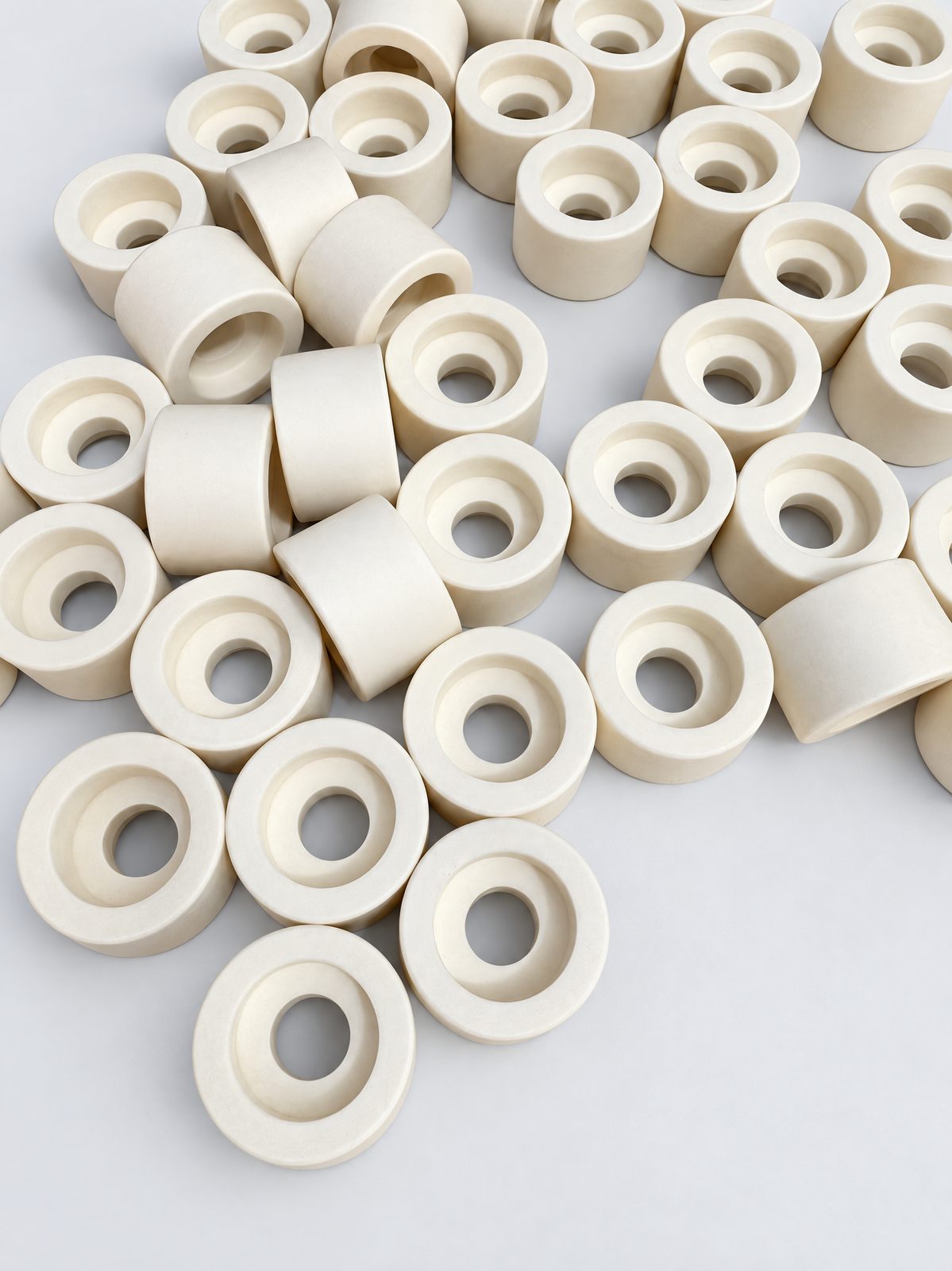
Conventional sintering of high-purity alpha-alumina typically requires about 1,700 °C according to NIST Standard Reference Database 150, while low temperature sintering of alumina lowers densification to between 835 °C and 1,500 °C through submicron powder packing, oxide sintering aids, viscous phases, or field-assisted equipment. In research reported by the American Ceramic Society in June 2026, 180 nm alumina formed by pressure filtration reached full density at 1,210 °C with a flexural strength of 829 MPa. For industrial furnace, thermocouple, and wear parts where high-temperature creep resistance matters most, standard corundum ware is sintered at about 1,760 °C.
Why Alumina Needs High Heat and What Low Temperature Sintering Means
Alpha-alumina (Al2O3) has a corundum crystal structure and a melting point of 2,050 °C (standard uncertainty 4 °C), as recorded in NIST Standard Reference Database 150. Strong covalent and ionic bonding gives alumina high chemical and thermal stability, slowing solid-state atomic diffusion during firing. In flexure between 1,200 °C and 1,800 °C under 100 MPa to 200 MPa, sintered alpha-alumina shows a creep activation energy of 325 kJ/mol (uncertainty 25 kJ/mol) and a stress exponent of 1.08 (uncertainty 0.05). Because solid-state diffusion moves slowly below 1,500 °C, conventional pressureless firing of 99.5% Al2O3 or higher alpha-alumina is typically performed at about 1,700 °C to reach at least 98% of theoretical density (3.984 g/cm3 at 20 °C) and a 5 µm nominal grain size.
Holding green bodies at conventional firing temperatures consumes substantial furnace energy and drives grain coarsening, which lowers mechanical strength and scatters light in optical ceramics. Low temperature sintering of alumina (also searched as low temp alumina sintering) lowers the alumina densification temperature below the 1,700 °C baseline by modifying green packing, adding reactive oxides or glass formers, or applying electrical fields and pressure.
| Sintering Regime | Documented Temperature | Primary Mechanism | Reported Outcome | Source |
|---|---|---|---|---|
| Cold and redox reactive sintering | Fraction of conventional firing temperatures | Transient solvent extraction (3 stages) or Ce(III) complex oxide eutectoid reaction | Above 95% theoretical density and below 5% net dimensional change in reactive route | NIST Ceramic AM Program |
| Viscous sol-gel sintering | 835 °C to 900 °C (studied across 25 °C to 1,184 °C)| | Viscous sintering before crystallization at 900 °C, then boria-fluxed flow | Peak linear shrinkage between 835 °C and 900 °C in high-alumina aluminoborosilicate | NASA TM-103969 |
| Submicron green-body optimization | 1,210 °C to 1,250 °C | 180 nm powder packed to 58% to 65% green density with narrow pore sizes | Full density, 0.46 µm to 0.54 µm grain size, 696 MPa to 829 MPa flexural strength | Journal of the American Ceramic Society |
| Multi-oxide composite sintering | 1,450 °C to 1,500 °C (3-hour dwell samples tested up to 1,650 °C)| | 5 wt.% each of MgO, TiO2, and CeO2 promoting diffusion and secondary phases in ZTA | 92.91% relative density at 1,450 °C and 94.80% relative density at 1,500 °C | Journal of the Korean Ceramic Society |
| Conventional corundum sintering | About 1,700 °C to 1,760 °C | Solid-state sintering of calcined alumina, often with trace MgO grain pinning | At least 98% theoretical density and dense industrial 99.5% Al2O3 ware | NIST SRD 150 and GY Alumina |
Raw Powder Reactivity and Green Body Packing Density
When an application rules out glass fluxes or transition-metal dopants, lowering the firing temperature starts with calcined powder selection and wet green forming. Huber Advanced Materials specifies for its Martoxid calcined aluminum oxides that moderate sintering temperatures alongside electrical insulation and wear resistance require ultra-fine particle size, an optimized particle size distribution, high ceramic reactivity, good suspension rheology, and low alkali content with Na2O below 0.1%. Keeping Na2O below 0.1% preserves high-temperature electrical resistance and avoids low-melting alkali silicate films.
Reactive submicron powders also need uniform green packing to densify below 1,300 °C without hard agglomerates trapping large pores. Studies from the May 2026 Journal of the American Ceramic Society tested 180 nm starting alumina particles formed by pressure filtration and spontaneous coagulation casting. Both methods yielded agglomerate-free green bodies with small pores and narrow pore distributions, delaying grain growth until higher relative density.
Pressure filtration packed the 180 nm powder to 65% green density and reached full sintered density at 1,210 °C, producing a 0.46 µm average grain size, 55.4% in-line transmittance, and 829 MPa flexural strength. Spontaneous coagulation casting reached 58% green density and required 1,250 °C for full density, yielding a 0.54 µm grain size, 51.6% in-line transmittance, and 696 MPa flexural strength. Higher green packing lowered the full-density firing temperature from 1,250 °C to 1,210 °C and raised flexural strength from 696 MPa to 829 MPa. By our calculation from that American Ceramic Society report, spontaneous coagulation casting held final sintered grains to 3 times the 180 nm starting particle diameter (0.54 µm versus 180 nm).
Alumina Sintering Aids, Viscous Phases, and Impurity Trade-Offs
Alumina sintering aids are functional oxide dopants or glass-forming additions mixed into the batch before firing. As summarized in an October 2023 technical review of Journal of the Korean Ceramic Society findings, dopants lower firing temperatures by introducing lattice dislocations, accelerating particle diffusion, refining grain boundaries, or forming tough secondary phases.
At still lower temperatures, glass-forming borates and silicates drive densification by viscous flow rather than solid-state diffusion. NASA Technical Memorandum 103969 (September 1992) examined 4 sol-gel synthesis methods for high-alumina aluminoborosilicate compacts across 5 shrinkage regions from 25 °C to 1,184 °C. Peak shrinkage occurred via amorphous viscous sintering between the 835 °C gel-to-glass transition and the 900 °C multiphasic crystallization temperature, followed above 900 °C by boria-fluxed viscous sintering competing with grain growth. Buyers reviewing low-temperature grades should verify which additive family a supplier uses before approving parts for high heat or electrical insulation.
| Additive or System | Reaction Phase or Mechanism | Documented Firing Window | Microstructural and Property Trade-Off |
|---|---|---|---|
| Magnesium oxide (MgO)| | Refines and pins alumina grain boundaries | About 1,700 °C in alpha-Al2O3, lower in doped composites | Homogeneous matrix with fewer residual pores and higher mechanical strength |
| Titanium dioxide (TiO2)| | Reacts with alumina to form Al2TiO5 when sufficient TiO2 is added | 1,450 °C to 1,650 °C in doped ZTA | Impedes crack propagation and raises fracture toughness |
| Cerium oxide (CeO2)| | Forms CeAl11O18 or Ce2Zr3O10 secondary phases | 1,450 °C to 1,650 °C in doped ZTA | Lowers Vickers hardness in exchange for higher fracture toughness |
| MgO + TiO2 + CeO2 (5 wt.% each) in ZTA | Combined diffusion enhancement and multi-phase toughening | 1,450 °C (15 wt.% YSZ) or 1,500 °C (5 wt.% YSZ) for 3 hours | 92.91% density and 12.03 MPa m1/2 toughness at 1,450 °C for loads, or 94.80% density and 14.15 GPa hardness at 1,500 °C for cutting inserts |
| Sol-gel aluminoborosilicate | Viscous flow up to 900 °C, then boria-fluxed viscous sintering | 835 °C to 1,184 °C | Rapid low-temp shrinkage, but multiphasic crystallization begins at 900 °C |
| Low-soda control (Na2O below 0.1%)| | Prevents low-melting alkali-silicate boundary films | Moderate to standard technical firing | Protects high-temperature strength, hardness, and electrical resistance |
Advanced Sintering Alumina: SPS, FAST, Microwave, and Cold Sintering
Read more
Where purity rules out liquid-phase fluxes, advanced sintering alumina processes replace long kiln soaks with electrical fields, electromagnetic waves, pressure, or reactive chemistry. International Journal of Applied Ceramic Technology studies (reviewed April 2023) compared spark plasma sintering (SPS), field-assisted sintering technique (FAST), and microwave sintering. On microwave-absorbing lithium aluminosilicate (beta-eucryptite), SPS reached 99% density in a 2-minute dwell and microwave sintering hit 99% density in 10 minutes, compared with about 90% density after 2 hours of conventional firing.
Those studies also flagged three production pitfalls. First, when alumina densified faster in SPS than in FAST under matched settings, sensor checks proved that SPS temperatures read at the outer sample-holder wall were about 100 degrees lower than at the sample center, whereas FAST pyrometers read closer to the core. Second, inherent carbon impurities from SPS tooling degrade optical properties. Third, fast 3-minute SPS holds in reducing conditions stripped oxygen from Ti3+-derived BaTiO3-delta nanoceramics, creating electrically conductive parts until post-firing oxidation trapped oxygen holes at grain boundaries to restore high permittivity and low loss (tan delta).
In ceramic 3D printing such as direct ink writing (DIW) and vat photopolymerization (VPP), post-build sintering drives shrinkage and flaws. A NIST Additive Manufacturing of Ceramics interlaboratory study (updated June 2026) across 6 international laboratories found that 7 flaw types caused 94% of flexural failures in printed alumina. To cut thermal stress, NIST developed capillary metrology identifying 3 solvent-extraction stages in cold sintering, plus a patented redox-driven reactive sintering method (PCT/US2025/039858) for Ce(III) complex oxides that offsets shrinkage with reaction expansion to reach above 95% theoretical density, sub-100 nm features, and below 5% net dimensional change.
Sintered Alumina Property Benchmarks and Grade Comparison
Lowering the firing temperature only works if the finished component survives your mechanical load and service heat. Kyocera Fineceramics Europe lists in its February 2025 datasheet for DEGUSSIT AL23 (alpha-Al2O3 above 99.5% purity, 0 Vol-% open porosity, 10 µm mean grain size) a bulk density of 3.70 g/cm3 to 3.95 g/cm3, 4-point flexural strength of 300 MPa to 350 MPa, compressive strength of 2,500 MPa, dynamic elastic modulus of 380 GPa, Vickers hardness (HV 1.0) of 17.1 GPa, dielectric breakdown strength of 20 kV/mm to 30 kV/mm, and a 1,950 °C maximum service temperature in air.
Even in glass-free alpha-alumina sintered around 1,700 °C, high heat accelerates creep and cuts strength. In NIST Standard Reference Database 150, flexural strength falls from 380 MPa at 20 °C to 300 MPa at 1,200 °C and 130 MPa at 1,500 °C. By our calculation from NIST Standard Reference Database 150, compressive strength at 1,400 °C (0.3 GPa) retains 10% of its 20 °C value (3.0 GPa), while creep rate at 150 MPa multiplies 6,150 times from 4 x 10⁻⁹ s-1 at 1,000 °C to 24,600 x 10-9 s-1 at 1,500 °C (passing 280 x 10-9 s-1 at 1,200 °C and 6,600 x 10-9 s-1 at 1,400 °C). Residual glass from low-temp fluxes softens much earlier, so furnace and thermocouple parts rely on high-temperature sintered corundum.
| Property | NIST Evaluated Alpha-Al2O3 (About 1,700 °C Sintered)| | Kyocera DEGUSSIT AL23 (Above 99.5% Alpha-Al2O3)| | Pressure-Filtered Submicron Al2O3 (1,210 °C Sintered)| |
|---|---|---|---|
| Al2O3 purity | 99.5% or higher | Above 99.5% | Not stated (180 nm starting Al2O3)| |
| Bulk density at 20 °C | 3.984 g/cm3 (at least 98% theoretical)| | 3.70 g/cm3 to 3.95 g/cm3 | Full density (from 65% green density)| |
| Grain size | 5 µm nominal | 10 µm mean | 0.46 µm average |
| Flexural strength at 20 °C | 380 MPa (300 MPa at 1,200 °C, 130 MPa at 1,500 °C)| | 300 MPa to 350 MPa (4-point)| | 829 MPa |
| Compressive strength at 20 °C | 3.0 GPa (0.4 GPa at 1,200 °C, 0.28 GPa at 1,500 °C)| | 2,500 MPa | Not stated |
| Elastic modulus at 20 °C | 416 GPa (338 GPa at 1,500 °C)| | 380 GPa | Not stated |
| Vickers hardness at 20 °C | 15 GPa (1 kg load, 2.5 GPa at 1,500 °C)| | 17.1 GPa (HV 1.0)| | Not stated |
| Fracture toughness at 20 °C | 3.5 MPa m1/2 (2.5 MPa m1/2 at 1,500 °C)| | Not stated | Not stated |
| Thermal conductivity | 33 W/m·K at 20 °C, 7.22 W/m·K at 1,000 °C, 6.23 W/m·K at 1,500 °C | 34.9 W/(m·K) at 20 °C, 6.8 W/(m·K) at 1,000 °C, 5.3 W/(m·K) at 1,500 °C | Not stated |
| Thermal expansion | 4.6 x 10⁻⁶ K-1 at 20 °C, 8.1 x 10⁻⁶ K-1 at 1,000 °C (from 0 °C)| | 8.2 x 10⁻⁶ /K (20 °C to 1,000 °C)| | Not stated |
Worked Example: Choosing Between Low-Temp Alumina and Sintered Corundum
Read more
Worked example written by our team. Suppose you need 150 single-bore support tubes (OD 14 mm x ID 8 mm x 500 mm long) carrying sensor leads horizontally at 1,400 °C in air, and you want to check whether low-temperature sintered alumina can replace high-temperature sintered corundum.
First, check thermal stability against your 1,400 °C operating temperature. Sol-gel aluminoborosilicate compacts densify by viscous sintering between 835 °C and 900 °C and boria-fluxed viscous flow up to 1,184 °C, while submicron 180 nm alumina pressure-filtered and sintered at 1,210 °C was consolidated well below a 1,400 °C service soak where creep and grain coarsening accelerate.
Second, match high-temperature properties and forming geometry. Evaluated 99.5% or higher alpha-alumina fired near 1,700 °C retains 210 MPa flexural strength and 343 GPa elastic modulus at 1,400 °C while keeping alkali leakage low. SPS dies and pressure-filtration cells produce flat discs rather than 500 mm tubes, whereas OD 14 mm x ID 8 mm fits standard ceramic extrusion (up to OD 17 mm x ID 10 mm at GY Alumina) fired at about 1,760 °C in C799 alumina, with 150 pieces clearing the usual 100-piece custom minimum.
Sintered Corundum Components Made by GY Alumina
GY Alumina is the export brand of our Chinese factory in Tangshan, making thermocouple protection tubes, thermocouple insulators and multi-bore tubes, furnace tubes, crucibles and boats, solid alumina rods, and custom parts to your drawing or sample. Laboratory low-temperature processes such as SPS, microwave sintering, submicron pressure filtration, and cold sintering are not used in our factory. We consolidate parts by slip casting, pressing, extrusion, and hot pressing, and sinter our corundum (99.5% Al2O3) ware at about 1,760 °C (a firing temperature, not a service rating).
Our standard grade is C799 alumina (99.5% Al2O3). Where a drawing names C 610, we supply 95% white alumina or our standard C799 instead, and neither is mullite. Crucibles are made in 99% and 99.5% Al2O3. An independent lab analyses one of our alumina tubes every year: 99.55% Al2O3 (2024), 99.57% (2025), and 99.61% (2026). Our ISO 9001:2015 certificate covers the manufacturing of ceramic protective tubes for thermocouples (that scope only), with 100+ customers served.
| Parameter | GY Alumina Capability |
|---|---|
| Alumina grades | C799 alumina (99.5% Al2O3), 95% white alumina (where drawings name C 610), and 99% and 99.5% Al2O3 for crucibles |
| Corundum firing temperature | About 1,760 °C for 99.5% Al2O3 ware (firing temperature, not a service rating) |
| Forming and tube limits | Slip casting (up to OD 100 mm x ID 90 mm x 1,000 mm), extrusion (up to OD 17 mm x ID 10 mm), pressing, and hot pressing |
| Stock solid alumina rods | 8 stock diameters from 2 mm to 12 mm, about 2,400 mm long, +0.2 mm diameter grinding allowance |
| Custom shapes to drawing | Round, elliptical, and square tubes (open or one end closed), single-, twin-, and multi-bore tubes and capillaries, threaded, ribbed, perforated, and slotted tubes, rods, square bars, balls, rings, washers, bushings, discs, crucibles, and boats |
| Secondary operations | Cut to length, end slots, side holes and perforated tubes, closed ends with drilled holes |
| Order terms and dispatch | Custom parts usually from 100 pieces, 25 to 30 days production, 5 to 10 free samples first (buyer pays courier), stock ships in about 3 days (small) to about 7 days (bulk)| |
Buyer Specification Checklist
Clear drawing notes prevent fit issues from green-to-fired shrinkage when ordering sintered corundum components from GY Alumina. Check these five details before sending your request.
- Dimensions and tolerances: State OD, ID, overall length, end style, and any slots or holes. Confirm the bore against your wire or probe before ordering.
- Material grade: Specify C799 alumina (99.5% Al2O3), 95% white alumina or C799 where a drawing names C 610, or 99% and 99.5% Al2O3 for crucibles.
- Operating conditions: Include peak temperature, heating and cooling rates, support orientation, and furnace atmosphere.
- Stock rod or custom drawing: Check whether our 2 mm to 12 mm stock rods (+0.2 mm grinding allowance) suit your part, or send your drawing or sample.
- Quantity and lead time: Plan for a usual 100-piece custom minimum per item and 25 to 30 days production, or standard sizes from stock in about 3 days (small orders) to about 7 days (bulk).
How to Request a Quote
GY Alumina makes custom components to your drawing or sample, and sends 5 to 10 free samples for approval before production runs (the buyer pays the courier).
Send your drawing, the grade and the quantity. We usually reply with a quote within two working days.
Questions buyers ask
- What is the typical sintering temperature of alumina versus low temperature sintering?
- Standard pressureless sintering of high-purity (99.5% Al2O3 or higher) alpha-alumina typically occurs at about 1,700 °C in NIST data, and GY Alumina fires 99.5% Al2O3 corundum ware at about 1,760 °C. Low temperature sintering reaches full density at 1,210 °C to 1,250 °C using 180 nm wet-formed powders, or achieves peak viscous shrinkage between 835 °C and 900 °C in sol-gel aluminoborosilicate compacts.
- Which alumina sintering aids lower firing temperature and refine grain size?
- Magnesium oxide (MgO) refines alumina grain boundaries and cuts pores, titanium dioxide (TiO2) forms crack-impeding Al2TiO5, and cerium oxide (CeO2) raises fracture toughness via cerium aluminate or zirconate phases. Zirconia-toughened alumina doped with 5 wt.% each of MgO, TiO2, and CeO2 reached 92.91% relative density at 1,450 °C and 94.80% at 1,500 °C.
- Why do spark plasma sintering studies report lower alumina sintering temperatures than FAST?
- Spark plasma sintering (SPS) setups typically measure temperature at the outer wall of the sample holder, reading about 100 degrees cooler than the center of the specimen. Field-assisted sintering technique (FAST) aims pyrometers closer to the sample core, explaining why alumina appeared to densify faster in SPS at matched setpoints.
- How much does green body density lower the alumina densification temperature?
- Using 180 nm alumina powders, raising green packing density from 58% (spontaneous coagulation casting) to 65% (pressure filtration) lowered the full-density firing temperature from 1,250 °C to 1,210 °C. The denser green body also held average grain size to 0.46 µm and raised flexural strength from 696 MPa to 829 MPa.
- Does GY Alumina use low temperature sintering or make custom corundum parts to drawing?
- GY Alumina forms parts by slip casting, pressing, extrusion, and hot pressing and sinters 99.5% Al2O3 corundum ware at about 1,760 °C rather than using laboratory low-temperature routes like SPS or cold sintering. Custom components made to your drawing or sample usually start at 100 pieces per item with 5 to 10 free approval samples (buyer pays courier) and 25 to 30 days production.
Sources
- NIST Standard Reference Database 150: Sintered Alumina Property Data Summary
- The American Ceramic Society: Fabricating Transparent Ceramics
- The American Ceramic Society: Multiple Oxide Inclusions on Zirconia Toughened Alumina
- The American Ceramic Society: Introduction to Advanced Sintering
- NIST: Additive Manufacturing of Ceramics
- NASA Technical Memorandum 103969: Sol-Gel Synthesis and Densification of Aluminoborosilicate Powders
- Kyocera Fineceramics Europe: DEGUSSIT AL23 Material Datasheet
- Huber Advanced Materials: Martoxid Calcined Aluminum Oxides
- GY Alumina: Alumina and Corundum Material Data
- GY Alumina: Factory and Manufacturing Process
- GY Alumina: Custom Alumina Components
- GY Alumina: Buyer FAQ
Last checked .