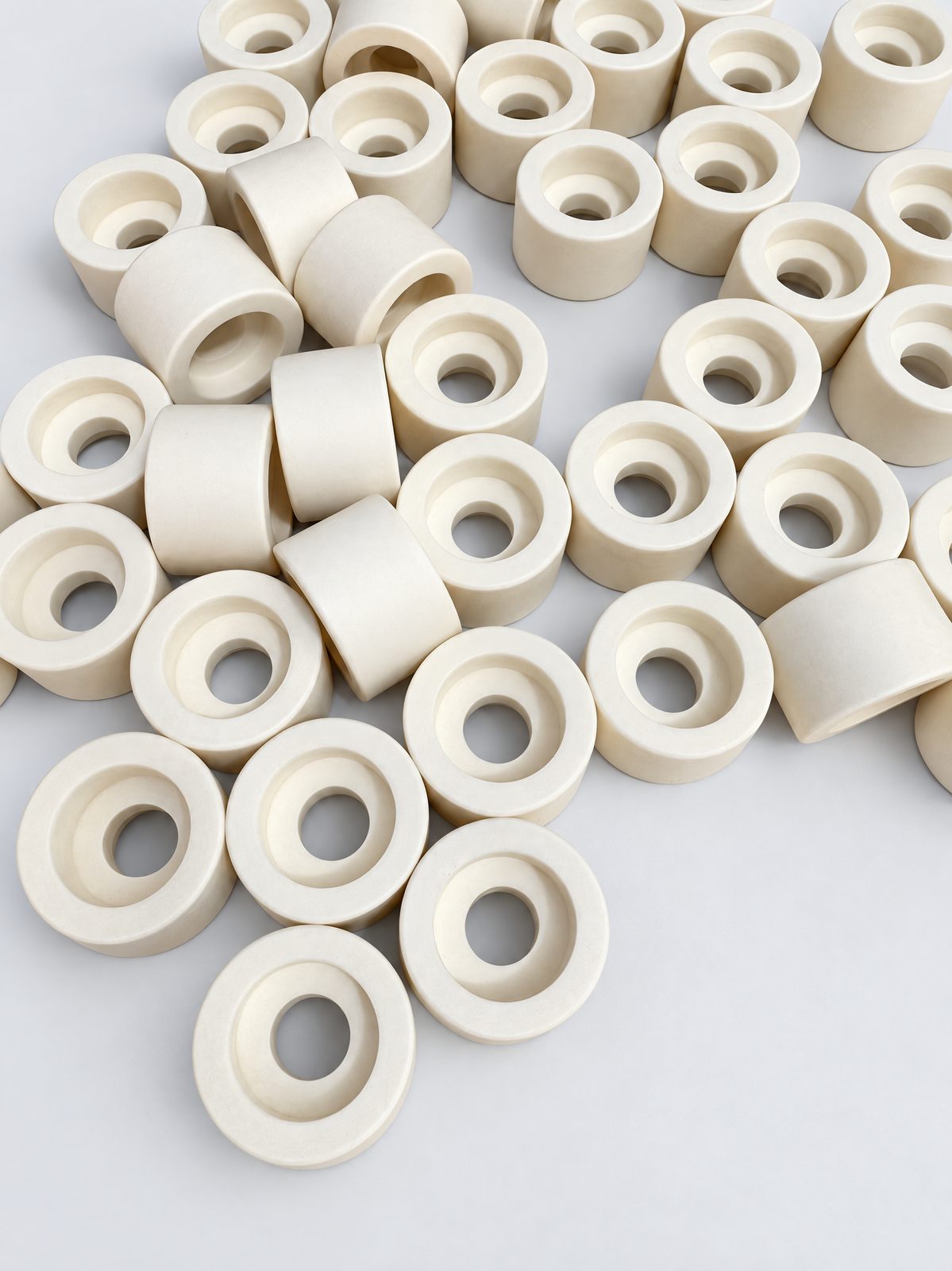
An alumina washer is a dense aluminum oxide (Al2O3) ceramic ring or stepped sleeve that electrically isolates fasteners, distributes compressive clamping force, and serves as a thermal or wear standoff in furnaces, vacuum chambers, and electronic assemblies. In Accuratus room-temperature material data, 99.5% Al2O3 reaches 2,600 MPa compressive strength, 16.9 ac-kV/mm dielectric strength, and a 1,750 °C (3,180 °F) no-load use limit. Ceramic washers are pressed, extruded, or diamond-ground into flat, shoulder, and seal-ring geometries to match metric or imperial hardware and custom part drawings.
What an Alumina Washer Does and Profiles Buyers Order
Engineers specify alumina ceramic washers where polymer spacers melt or outgas and metal washers create electrical shorts, galvanic corrosion, or magnetic interference. Alpha-phase aluminum oxide is the strongest and stiffest of the oxide ceramics according to Accuratus, combining electrical insulation from DC to GHz frequencies with high compressive load capacity and acid and alkali resistance at elevated temperatures.
One common point of confusion in supplier catalogs is conductivity. At the same time, it conducts heat far better than polymers or glass ceramics, reaching 18 W/mK to 45 W/mK near room temperature depending on purity. That dual behavior explains why thin alumina ceramic washers are used in IC packages and power electronics to move heat away from semiconductors while blocking high voltage.
For electrical and vacuum-tube hardware, ASTM D2442 (active edition D2442-75R25, Standard Specification for Alumina Ceramics for Electrical and Electronic Applications) sets testing methods and property limits for fabricated alumina parts used in electronic and electrical devices and ceramic-to-metal seals in electron devices, independent of part geometry.
Across industrial purchasing, ceramic washers fall into four recurring part types, often sourced as custom alumina components to an engineering drawing or physical sample:
- Flat insulating and standoff washers: Plain parallel rings placed under bolt heads, nuts, heating elements, or sensor mounts to spread compressive load and isolate electrical potential.
- Stepped shoulder washers (top-hat bushings): Flanged sleeves whose cylindrical barrel centers a metal screw inside a clearance hole so the bolt shank cannot arc or ground against a metal bulkhead.
- High-alumina ceramic seal washers and braze rings: Flat lapped wear faces for mechanical pumps and metering valves, or metallized rings brazed into hermetic feedthroughs and electron devices.
- Instrument and IC package spacers: Thin precision-sliced washers for microelectronic housings and laboratory thermal analyzers, including custom replacements made from a drawing or worn sample.
Alumina Grades Compared: 94%, 96%, and 99.5% Al2O3
At GY Alumina, we supply custom washers in C799 alumina (99.5% Al2O3) and 95% white alumina, within a commercial technical alumina family that starts at 85% Al2O3 across the industry. In lower-purity grades, the remaining balance consists of silica and sintering fluxes that lower firing temperature or promote glass-phase bonding during metallization. Morgan Technical Ceramics groups standard alumina (85% to 95%) for general electrical insulators and wear parts, and high-purity alumina (96% to 99.5%) for semiconductor equipment, analytical instruments, medical devices, and vacuum systems.
If your washer must be metallized and brazed into a hermetic ceramic-to-metal seal, Accuratus notes that 94% Al2O3 provides an easily metallizable white body while still delivering 2,100 MPa compressive strength and 16.7 ac-kV/mm dielectric strength. Precision Ceramics describes 96% alumina (CeramAlox 96) as an industry workhorse that balances mechanical and electrical performance with production cost. Moving to 99.5% Al2O3 shrinks the silicate grain-boundary phase, raising hardness, thermal conductivity, chemical inertness against hot corrosive media, and high-temperature resistivity.
Choosing between industrial alumina materials and grades follows the drawing callout and furnace environment. Our standard grade is C799 alumina at 99.5% Al2O3, and an independent lab analyzes one of our alumina tubes each year, recording 99.55% Al2O3 in 2024, 99.57% in 2025, and 99.61% in 2026. Where a drawing names C 610, we supply 95% white alumina or our standard C799 alumina instead, noting that neither grade is mullite.
Published property values vary by maker, forming method, and test specimen geometry. The table below compares room-temperature and maximum no-load figures from three manufacturers across five purity levels.
| Maker and Grade | Al2O3 Content | Density (g/cm3) | Compressive / Flexural Strength (MPa) | Thermal Conductivity (W/mK) | Dielectric Strength (kV/mm) | Max No-Load Temp (°C) |
|---|---|---|---|---|---|---|
| Accuratus 94% Al2O3 | 94% | 3.69 g/cm3 | 2,100 MPa / 330 MPa | 18 W/mK | 16.7 ac-kV/mm | 1,700 °C (3,090 °F) |
| Accuratus 96% Al2O3 | 96% | 3.72 g/cm3 | 2,100 MPa / 345 MPa | 25 W/mK | 14.6 ac-kV/mm | 1,700 °C (3,090 °F) |
| Precision Ceramics CeramAlox 96 | 96% | 3.75 g/cm3 | 2,000 MPa / 200 MPa to 300 MPa | 25 W/mK | 9 kV/mm (DC) | 1,600 °C |
| Accuratus 99.5% Al2O3 | 99.5% | 3.89 g/cm3 | 2,600 MPa / 379 MPa | 35 W/mK | 16.9 ac-kV/mm | 1,750 °C (3,180 °F) |
| Kyocera DEGUSSIT AL23 | Above 99.5% | 3.70 g/cm3 to 3.95 g/cm3 | 2,500 MPa / 300 MPa to 350 MPa | 34.9 W/m·K (at 20 °C) | 20 kV/mm to 30 kV/mm | 1,950 °C |
Clamping Load, Torque Limits, and Why Ceramic Lock Washers Fail
Most ceramic washer failures happen during wrench tightening rather than in high-temperature service. Sintered alumina is exceptionally strong in pure axial compression, reaching 2,000 MPa to 3,500 MPa across the grades in the table above, yet it is brittle in tension and bending. By our calculation from Accuratus data for 99.5% Al2O3, compressive strength (2,600 MPa) is 6.86 times flexural strength (379 MPa). In Precision Ceramics data for CeramAlox 96, compressive strength (2,000 MPa) is 14.29 times direct tensile strength (140 MPa).
That strength ratio dictates how you bolt an alumina washer into an assembly. When a nut or bolt head bears down on a warped metal flange, a weld bead, or a punched burr, the ceramic ring bridges the high spots and bends like a beam. Because alumina has a Young's modulus of 300 GPa to 400 GPa and fracture toughness of 3.5 MPa·m^1/2 to 4.5 MPa·m^1/2 across Accuratus and Precision Ceramics grades, it cannot yield locally to redistribute a point load. A tiny burr under a steel screw head turns moderate wrench torque into tensile hoop stress that splits the washer radially.
Some general hardware sites list ceramic split-lock or ceramic Belleville cone washers alongside flat rings. Treat those claims with caution. Spring washers work by large elastic deflection, and sintered alumina has almost zero strain tolerance before brittle fracture. When a high-temperature bolted joint needs live spring preload to absorb thermal expansion, keep the alumina washer completely flat and place a metallic Belleville spring washer on the cooler end of the tie rod or outside the hot zone.
To keep clamping loads purely compressive, seat the ceramic washer against flat, machined metal faces, add a broad flat metal washer under the hex nut or bolt head so wrench rotation does not gouge the ceramic edge, and specify a light edge chamfer on the drawing where handling chips or sharp corner contact could start a crack.
Thermal Standoff, Thermal Shock, and Vacuum Outgassing
Maximum no-load temperature ratings on datasheets (1,600 °C to 1,950 °C in air depending on grade) tell only part of the thermal story. Thermal conductivity in dense alumina drops steeply as temperature climbs. In Kyocera's DEGUSSIT AL23 datasheet, thermal conductivity measures 34.9 W/m·K at 20 °C, 6.8 W/m·K at 1,000 °C, and 5.3 W/m·K at 1,500 °C. By our calculation from that Kyocera table, thermal conductivity falls by 80.5% between 20 °C and 1,000 °C. A high-purity alumina washer therefore helps spread heat in room-temperature electronics while acting as a much stronger thermal choke between hot furnace internals and cooled support frames above 1,000 °C.
Rapid temperature swings limit alumina long before melting or softening. Morgan Technical Ceramics explains that fast cooling shrinks a ceramic part's outer skin against a still-hot core, putting the surface into tension. Measured by the Hasselmann quench test, alumina has a thermal downshock resistance of 170 °C to 300 °C delta T. If your bolted fixture faces sudden cold gas quenching or direct thermal shock steeper than that window, thinner washer cross-sections, slower ramp rates, or a higher-shock ceramic from the comparison below should be evaluated.
For ultra-high vacuum (UHV), electron-beam, and semiconductor chambers, fully sintered high-purity alumina provides 0% open porosity in both Accuratus and Kyocera DEGUSSIT AL23 datasheets, preventing trapped moisture pockets during pump-down. Accuratus reports that high-purity alumina is usable in oxidizing and reducing atmospheres to 1,925 °C, while vacuum weight loss ranges from 10^-7 g/cm2·sec to 10^-6 g/cm2·sec between 1,700 °C and 2,000 °C (Precision Ceramics notes vacuum service up to 2,000 °C or 3,600 °F). Chemically, dense alumina resists all gases except wet fluorine and resists common acids, alkalis, and solvents except hydrofluoric acid, phosphoric acid, and hot alkali metal vapors, which attack silicate phases first in lower-purity bodies.
| Ceramic Material | Thermal Downshock Resistance (Delta °C) |
|---|---|
| Alumina | 170 °C to 300 °C |
| Silicon Carbide | 400 °C |
| Zirconia | 400 °C to 500 °C |
| Silicon Nitride | 900 °C |
Worked Example: Sizing an M4 Insulating Shoulder and Flat Washer Pair
Read more
Suppose you need to electrically isolate an M4 bolt passing through a 4.0 mm thick grounded metal bracket inside a 600 °C vacuum heater, with a 2 kV DC potential on the fastener. A single flat alumina washer under the bolt head leaves the 4 mm bolt shank exposed inside the bracket hole, so the joint needs a stepped shoulder washer on one side and a matching flat alumina washer on the opposite face.
Start with radial clearances. Ceramic fasteners and mating hardware in metric M3, M4, M5, and M6 thread sizes are standard across laboratory assemblies, as seen in Almath Crucibles' M3 to M6 alumina fastener range. Because most stainless steel and nickel-alloy bolts expand faster when heated than alumina (whose mean linear coefficient of thermal expansion is 8.2 x 10^-6 /K from 20 °C to 1,000 °C in Kyocera's DEGUSSIT AL23 data), a tight slip fit at 20 °C can seize and split the ceramic sleeve at 600 °C. Specifying a clearance ID above 4.0 mm with a one-sided bore tolerance, following the same fit logic used in alumina tube tolerances, guarantees the bolt passes freely at peak temperature without radial bursting.
Next, check axial step height and voltage margin. If the bracket is 4.0 mm thick, make the cylindrical sleeve of the shoulder washer shorter than 4.0 mm (for instance 3.5 mm) so its tip never bottoms out against the opposing flat alumina washer. That gap ensures tightening torque compresses the thick flange faces against the bracket rather than crushing the thin cylindrical barrel. For dielectric breakdown through the flange wall, Precision Ceramics lists 9 kV/mm DC at 25 °C on 96% Al2O3, and Accuratus lists 16.9 ac-kV/mm on 99.5% Al2O3. By our calculation, a 2.0 mm thick flange provides about 18 kV to 34 kV of room-temperature bulk puncture strength, leaving generous margin for high-temperature resistivity drop while a wide outer diameter increases surface creepage distance in vacuum or air.
How Alumina Washers Are Formed, Sliced, and Ground
Read more
How a supplier forms a ceramic washer depends on diameter, thickness, batch size, and tolerance. Dry die pressing, extrusion, slip casting, hot pressing, isostatic pressing, and injection molding are all used across the industry, following the same powder milling and high-temperature densification principles as how alumina tubes are made. Before firing, pressed or extruded blanks are chalk-soft in the green or biscuit state and easy to shape, and suppliers such as Almath Crucibles also sell biscuit-fired alumina for labs that machine prototypes in-house.
Densification in the kiln drives large volume change. Precision Ceramics notes that sintering causes an alumina body to shrink by about 20%, which prevents green-state machining alone from holding tight final tolerances. On unground handmade ceramic hardware, Almath Crucibles lists general as-fired production tolerances at about +/-10% of nominal dimensions. Sintered alumina also tends to warp slightly in firing.
When an IC package, mechanical seal, or precision standoff needs micron-level flatness and parallel faces, manufacturers finish the fired body with diamond tooling. Almath Crucibles uses CNC surface grinders with resin-bonded diamond wheels to grind warped sintered alumina flat to exact thickness. It also uses diamond-tipped drills and grinding pads to machine bores and steps. For thin parts, single-wire diamond saws (cutting slots as thin as 0.25 mm) slice washers with clean square ends from sintered tubes or rods. Morgan Technical Ceramics and Precision Ceramics likewise list diamond grinding, lapping, laser machining, and polishing for tight-tolerance seal and metrology surfaces.
GY Alumina manufactures custom rings, washers, bushings, and discs to your drawing or physical sample at our factory in Tangshan using four forming routes: pressing, extrusion, slip casting, and hot pressing. After forming, our factory performs cutting to length, end slots, side holes, and closed ends with drilled holes. For reference on our tube envelopes, our largest extruded tube today is OD 17 mm x ID 10 mm and our largest slip-cast tube is OD 100 mm x ID 90 mm x 1,000 mm. A buyer can send a washer drawing for our team to review the dimensions and tolerances.
Specification Checklist for Custom Ceramic Washer Drawings
Unlike stamped steel washers, custom ceramic washers are made to print or sliced from tubular blanks. Leaving unspecified features on a CAD model forces the estimator to guess whether an edge needs a press-formed finish or multi-pass diamond grinding, which drives up tooling and unit cost. Include these seven details on every RFQ drawing:
- Outer diameter (OD), inner diameter (ID), and overall thickness in millimeters, plus barrel OD and step length on shoulder washers.
- Explicit tolerances on each critical dimension, using one-sided tolerances on the ID where a bolt, pin, or thermocouple wire must pass through without binding.
- Flatness, parallelism, and surface roughness callouts only on faces that actually seal or carry high clamping pressure, leaving non-contact surfaces as-fired to save machining cost.
- Alumina purity grade (such as 95% white alumina, C799 at 99.5% Al2O3, or a metallizable 94% body if you plan subsequent brazing).
- Operating peak temperature, heating and cooling ramp rate (delta T), mechanical clamping load, and atmosphere (air, reducing gas, chemical vapor, or vacuum).
- Edge break or chamfer requirements on the ID and OD corners, and root radius allowance at the flange-to-sleeve junction of a shoulder washer to avoid stress risers.
- Order quantity and whether the run is a prototype check or recurring production.
Ordering Custom Washers, Samples, and Lead Times
At GY Alumina, custom rings, washers, bushings, and discs made to your drawing or sample usually start at a minimum order of 100 pieces per item. Before full kiln production begins, we send 5 to 10 free samples for your approval, with the buyer paying the courier. Once samples are approved, production usually takes 25 to 30 days, while standard sizes ship from stock in about 3 days for small orders to about 7 days for bulk orders.
Our factory in Tangshan has served 100+ customers across furnace, thermocouple, lab, and industrial companies. Note that our ISO 9001:2015 certificate covers the manufacturing of ceramic protective tubes for thermocouples (that scope only). Send your drawing, the grade, and the quantity. We usually reply with a quote within two working days.
Questions buyers ask
- Are alumina washers electrically conductive or insulating?
- At the same time, they conduct heat well near room temperature (18 W/mK to 45 W/mK), making them effective thermal pads in electronic packages that still require high-voltage isolation.
- Can alumina ceramic be used as a split lock washer or Belleville spring washer?
- No, sintered alumina has an elastic modulus of 300 GPa to 400 GPa and low fracture toughness (3.5 MPa·m^1/2 to 4.5 MPa·m^1/2), so it snaps rather than flexing like spring steel. Use flat or stepped shoulder alumina washers strictly in axial compression, and place a metal Belleville washer on the cold end of the bolt if live thermal-expansion preload is needed.
- Why do tight-tolerance alumina washers require diamond grinding after sintering?
- Precision Ceramics notes that pressed or green-machined alumina shrinks by about 20% during sintering, while Almath Crucibles notes that sintered alumina can warp slightly in the kiln and carries about +/-10% general tolerances when unmachined. Grinding or slicing the fully dense ceramic with diamond wheels, drills, or wire saws is the only way to hold micron-level thickness, flatness, and bore concentricity.
- Can alumina washers operate in ultra-high vacuum and corrosive chemicals?
- Yes, dense sintered 99.5% alumina has 0% open porosity according to Accuratus and Kyocera DEGUSSIT AL23 datasheets, and Accuratus reports vacuum weight loss of 10^-7 g/cm2·sec to 10^-6 g/cm2·sec between 1,700 °C and 2,000 °C. It resists all gases except wet fluorine and resists acids, alkalis, and organic solvents except hydrofluoric acid, phosphoric acid, and hot alkali metal vapors.
- What is GY Alumina's minimum order quantity and lead time for custom ceramic washers?
- Custom washers, rings, bushings, and discs made to your drawing or physical sample at GY Alumina usually start at 100 pieces per item and take 25 to 30 days to produce. We send 5 to 10 free pre-production samples first for your approval (you cover courier shipping) and usually reply with a quote within two working days.
Sources
- Accuratus: Aluminum Oxide (Al2O3) Ceramic Properties
- Precision Ceramics: Alumina Properties and Industrial Applications
- KYOCERA Fineceramics Europe: DEGUSSIT AL23 Material Data Sheet (February 2025)
- Morgan Technical Ceramics: Thermal Shock Resistance in Ceramics
- Morgan Technical Ceramics: High-Performance Alumina Ceramic Components
- ASTM International: D2442 Standard Specification for Alumina Ceramics for Electrical and Electronic Applications
- Almath Crucibles: Machined Alumina Ceramics
- Almath Crucibles: Diamond Wire Cutting Services
- Almath Crucibles: Ceramic Fasteners
- GY Alumina: Alumina Custom Parts Made to Drawing or Sample
- GY Alumina: Alumina and Corundum Grades Material Data
- GY Alumina: Buyer FAQ (MOQ, Lead Time, Samples, ISO 9001)
- GY Alumina: Alumina Ceramics Factory in Tangshan, China
Last checked .