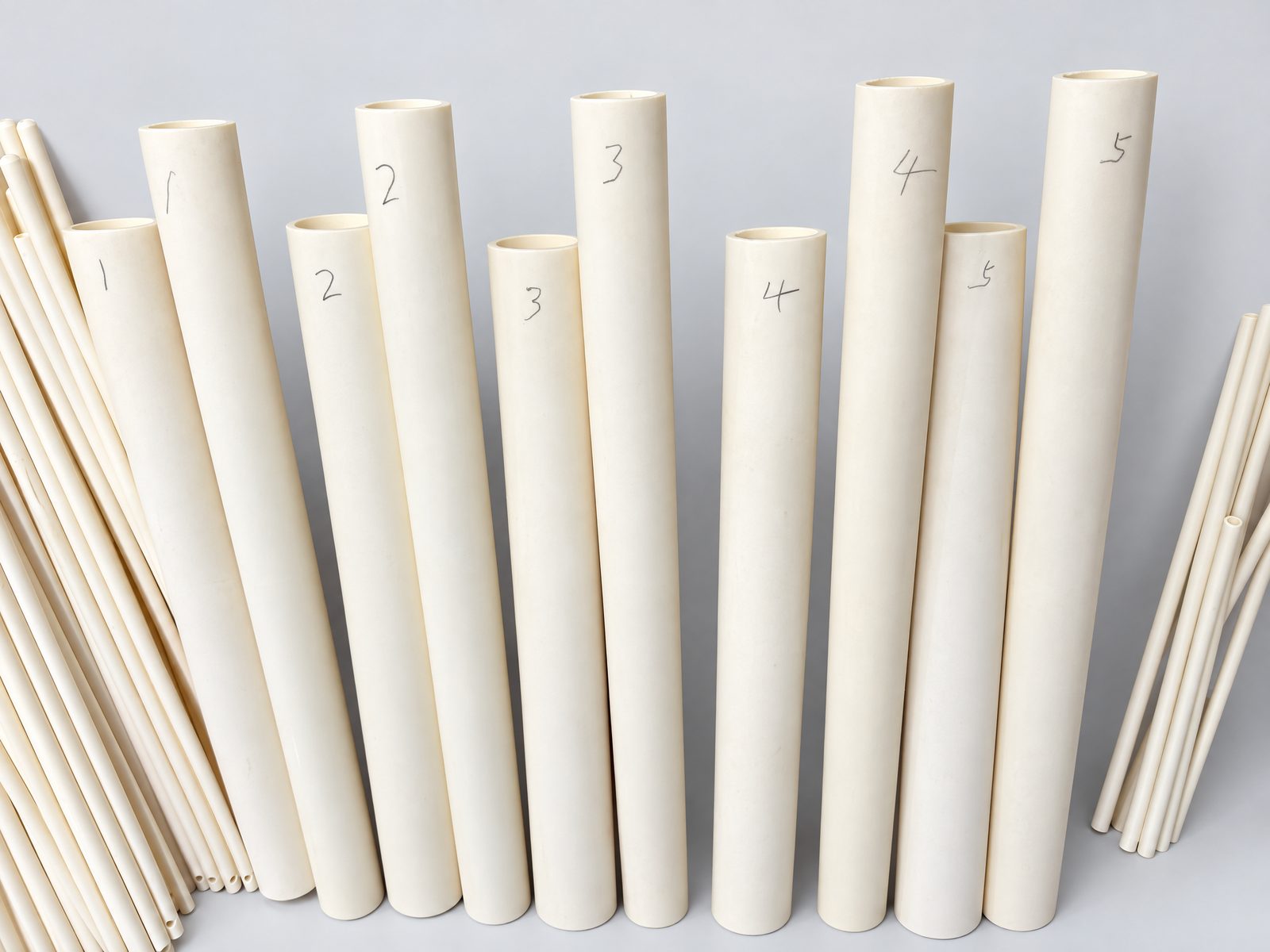
A complete alumina tube RFQ specification defines six items on your drawing or inquiry: outer diameter (OD), inner diameter (ID), overall length with an explicit cut tolerance, end and bore geometry, ceramic grade, and operating temperature and atmosphere. Leaving dimensions to general as-fired defaults risks poor assembly fit because DIN 40680 allows +/- 1% to +/- 2% length variation above 1,000 mm, while vacuum service caps gas-tight C 799 working tubes at 1,400 °C in Nabertherm data and 1,500 °C in Carbolite and MTI furnace systems rather than their 1,800 °C air limit. Stating mating insert sizes, heating ramp rates, and order quantity up front lets the factory confirm tooling and quote without redesign delays.
Critical Technical Specifications of Alumina Ceramic Tubes
Missing bore tolerances and unstated furnace atmospheres are the main causes of delayed ceramic quotations and cracked tubes in service. Unlike machined metal pipe, technical ceramic tubes shrink during firing and keep their kiln-fired cross-section unless post-firing grinding is ordered.
Manufacturers review the same core parameters on furnace working tubes, closed-end thermocouple protection sheaths, and miniature multi-bore insulators. Morgan Technical Ceramics extrudes micro rods and single-hole or multi-hole tubes from 0.635 mm to 10.16 mm (0.025 in to 0.400 in) outer dimension and standard tubes from 0.5 mm to 45 mm OD, while furnace builders such as Nabertherm and Carbolite specify working tubes up to 170 mm OD and 200 mm OD.
Lock down six technical blocks on every alumina tube RFQ specification:
- Cross-section and total length: Nominal OD, nominal ID (or wall thickness), and overall length in millimeters, noting which diameter controls assembly fit.
- Tube configuration and features: Open both ends, closed one end, single-bore, twin-bore, or multi-bore (with bore diameter, pitch, and web thickness), plus any slots, side holes, perforations, or drilled closed ends.
- Material grade and gas-tightness: Al2O3 percentage or ceramic class (such as dense gas-tight C 799 versus porous C 530).
- Dimensional and form tolerances: Explicit millimeter tolerances on OD, ID, cut length, and straightness (bow per meter) instead of relying on general as-fired defaults.
- Mating hardware and end condition: Clean wet-cut ends for fiber plugs versus ground sealing zones for water-cooled O-ring flanges, plus the OD of any rod, wire, or boat entering the bore.
- Operating duty and quantity: Continuous and peak temperature, heating and cooling ramp rates, atmosphere or vacuum level, internal gas pressure, and batch size.
Alumina Grade and Working Tube Specifications by Maker
European furnace drawings often name ceramic grade classes such as C 530, C 610, or C 799, while North American and Asian drawings state minimum Al2O3 content such as 95%, 99%, or 99.5% Al2O3. Writing both the class and the Al2O3 percentage prevents unwanted substitutions between mullite and corundum.
In Nabertherm's working tube specifications, C 530 (Sillimantin) is a porous tube for air up to 1,300 °C, C 610 (Pythagoras) is a gas-tight mullite ceramic rated to 1,400 °C in air and 1,200 °C in vacuum, and C 799 (Alsint) is a gas-tight high-purity alumina rated to 1,800 °C in air and 1,400 °C in vacuum. Carbolite rates tube furnaces for air and modified atmospheres up to 1,600 °C with silicon carbide (SiC) elements and 1,800 °C with molybdenum disilicide (MoSi2) elements, capping vacuum at 1,500 °C and recommending at least 100 °C of furnace margin above your working setpoint. MTI Corporation specifies its TA80D1000 tube (above 99% Al2O3, 80.4 +/- 1 mm (3.165 +/- 0.04 in) OD by 70.5 +/- 1 mm (2.775 +/- 0.04 in) ID by 1,000 mm long) to 1,700 °C (3,092 °F) after room-temperature evacuation testing to 10^-7 Torr.
At GY Alumina, our standard grade is C799 alumina (99.5% Al2O3), and an independent lab analyses one of our alumina tubes every year: 99.55% Al2O3 (2024), 99.57% (2025), and 99.61% (2026). Where a drawing names C 610, we supply 95% white alumina or our standard C799 alumina instead, and neither grade is mullite.
| Maker and Grade | Gas-Tight | Max Temp in Air | Max Temp in Vacuum | Published Ramp Rate Limit |
|---|---|---|---|---|
| Nabertherm C 530 (Sillimantin) | No | 1,300 °C | Not possible | Unlimited below 120 mm OD, 200 K/h from 120 mm OD |
| Nabertherm C 610 (Pythagoras) | Yes | 1,400 °C | 1,200 °C | 300 K/h below 120 mm OD, 200 K/h from 120 mm OD |
| Nabertherm C 799 (Alsint) | Yes | 1,800 °C | 1,400 °C | 300 K/h below 120 mm OD, 200 K/h from 120 mm OD |
| MTI TA80D1000 (above 99% Al2O3) | Yes (tested to 10^-7 Torr at room temp) | 1,700 °C (3,092 °F) | 1,500 °C max | Below 5 °C/min heating or cooling, gradient below 10 °C/min |
| MTI General Alumina Tube | Yes | 1,800 °C | 1,500 °C max | At most 5 °C/min above 1,500 °C heating and above 800 °C cooling |
| Carbolite Ceramic Work Tube (SiC / MoSi2) | Yes (dense alumina) | 1,600 °C (SiC) / 1,800 °C (MoSi2) | 1,500 °C max | At most 5 °C/min heating rate |
| Nabertherm Quartz Glass | Yes | 1,100 °C | 950 °C | Unlimited across diameters |
Critical Factors When Specifying a Precision-Length Alumina Tube
Specifying overall tube length requires more than matching the heated zone. Three mechanical and thermal factors determine both the nominal length and the cut tolerance on your drawing.
First, sealing hardware sets cold-end overhang. An open-air tube with two ceramic fiber plugs only spans the furnace casing, whereas vacuum or gas tubes need extended ends plus internal refractory tube blocks at both ends of the casing (as required by MTI and Carbolite) to protect O-ring seals from radiant heat. By our calculation from Nabertherm's working tubes table, changing a 120 x 105 mm C 799 tube from air service (830 mm) to water-cooled vacuum flange service (1,440 mm) adds 610 mm to total length, or 305 mm per end.
Second, general ceramic standards leave loose length limits unless you call out a wet-cut tolerance. Under DIN 40680, tubes above 1,000 mm allow +/- 1% length variation in the medium class and +/- 2% in the coarse class. By our calculation from DIN 40680, +/- 2% on a 1,440 mm vacuum tube equals +/- 28.8 mm (a 57.6 mm span), enough to miss fixed flange stands. Always write a millimeter cut tolerance on your RFQ.
Third, match length features to mounting hardware and thermal expansion. Carbolite supports horizontal extended tubes with external brackets and outfits vertical furnaces with a top guide bracket and a weight-bearing lower clamp. On Nabertherm RSRC and RSRB rotary furnaces (1,540 mm, 1,790 mm, and 2,040 mm ceramic tubes in 80 x 65 mm and 110 x 95 mm sizes), standard work tubes include mounted drive sleeves while spare tubes ship without sleeves. Leave axial slip clearance at cold brackets so thermal expansion never places the tube in tension or bending.
DIN 40680 Ceramic Tube Tolerances, Bore Fit, and End Preparation
Nabertherm specifies form and position tolerances on C 530, C 610, and C 799 working tubes to DIN 40680, the German standard for as-fired ceramics without post-firing grinding. As reproduced in Morgan Haldenwanger's 2026 price list, DIN 40680 assigns pressed parts and extruded parts up to 30 mm to the medium class, and cast, turned, and extruded parts from 30 mm upward to the coarse class.
For vacuum sealing, as-fired surfaces above 30 mm OD may not seal against O-rings. Nabertherm specifies ground tube ends on C 610 and C 799 vacuum tubes for water-cooled flanges, and Carbolite builds TS1 and TS3 split-body furnaces so flanged tubes drop straight in. Diamond OD grinding is a specialized post-firing operation offered by furnace OEMs and grinding shops. At GY Alumina, we form parts by slip casting, pressing, extrusion, and hot pressing and perform cut-to-length, end slots, side holes, perforations, and closed ends with drilled holes. Send your drawing so we can confirm the tolerances we hold on your geometry.
| Nominal Dimension Range | DIN 40680 Medium (Pressed, and Extruded up to 30 mm) | DIN 40680 Coarse (Cast, Turned, and Extruded 30 mm and above) |
|---|---|---|
| Up to 4 mm | +/- 0.15 mm | Not applicable |
| Over 8 to 10 mm | +/- 0.30 mm | Not applicable |
| Over 10 to 13 mm | +/- 0.35 mm | Not applicable |
| Over 20 to 25 mm | +/- 0.50 mm | Not applicable |
| Over 30 to 35 mm | Not applicable | +/- 2.0 mm |
| Over 45 to 50 mm | Not applicable | +/- 2.5 mm |
| Over 60 to 70 mm | Not applicable | +/- 3.0 mm |
| Over 450 to 500 mm (length) | +/- 6.80 mm | +/- 14.0 mm |
| Over 500 to 600 mm (length) | +/- 7.60 mm | Not stated in selected rows |
| Over 1,000 mm (length) | +/- 1% of length | +/- 2% of length |
Vacuum Softening, Gas Pressure, and Thermal Ramp Rules
Read more
Stating your pressure, chemical exposure, and heating speed lets the factory verify wall thickness and grade selection before quoting. MTI notes that alumina begins to soften above 1,500 °C and strictly prohibits pulling vacuum above 1,500 °C because atmospheric pressure collapses a softened tube wall.
Positive internal gas pressure is tightly capped on sealed working tubes. MTI specifies setting the gas tank regulator below 1.1 atm, keeping outlet valves open during filling, and never exceeding 1.2 atm inside the tube so end flanges cannot blow off.
Alumina Tube RFQ Specification Checklist and Worked Example
Paste the eight-point checklist below into your inquiry or drawing notes so every engineering and commercial field is clear in the first message.
Worked RFQ example written by our team for illustration: Open-both-ends furnace working tube, 80 mm OD x 70 mm ID x 1,200 mm length (5 mm wall). Tolerances: as-fired OD and ID (+/- 2.0 mm acceptable, confirm in quote), wet-cut length +/- 1.5 mm, bow within 1.5 mm over 1,200 mm. Fit: must pass a 62 mm wide alumina boat crucible and slip through 84 mm ID vestibule collars with fiber plugs at both ends. Grade: C799 alumina (99.5% Al2O3). Duty: 1,600 °C continuous in flowing argon at 1.05 atm, 4 °C/min heat-up and cool-down ramp, horizontal mount. Features: square-cut ends, no holes or slots. Quantity: 10 pieces initial order (100 pieces annual forecast), ship to Chicago, USA, include yearly lab analysis report.
- 1. Configuration: Open both ends, closed one end, single-bore, twin-bore, or multi-bore (bore ID, pitch, and web thickness).
- 2. Nominal dimensions: OD, ID, wall thickness, and overall length in millimeters.
- 3. Tolerances: +/- mm limits on OD, ID (use +x/-0 if an insert slides inside), cut length, and straightness (mm/m).
- 4. Mating fit and end seal: Insert or boat OD, plus fiber plug ends versus ground O-ring flange zones.
- 5. Grade: C799 alumina (99.5% Al2O3) or 95% white alumina, noting any legacy C 610 or C 530 callout.
- 6. Duty cycle: Continuous and peak °C, ramp rate (°C/min), horizontal/vertical/rotary orientation, atmosphere or vacuum, and gas pressure.
- 7. Secondary work: Cut to length, end slots, side holes, perforations, or drilled closed ends.
- 8. Order details: Quantity, 5 to 10 approval samples if needed, test report request, and destination country.
GY Alumina Capabilities, Forming Envelopes, and Cost Drivers
Read more
GY Alumina manufactures alumina and corundum parts at our factory in Tangshan, China. Across the industry, makers match forming routes to cross-section: Morgan Haldenwanger, for example, uses extrusion, casting, and isostatic pressing for custom sizes. At our factory, we use extrusion (up to OD 17 x ID 10 mm today), slip casting (up to OD 100 x ID 90 x 1,000 mm), pressing, and hot pressing.
Unit price and lead time depend mainly on four choices: selecting an existing stock OD/ID cross-section cut to length versus new die or mold tooling, keeping functional as-fired diameter tolerances versus tight selection limits, adding secondary slotting or drilling steps, and ordering custom drawings at or above standard batch sizes.
| Specification Area | GY Alumina Capability | How to Specify on Your RFQ |
|---|---|---|
| Alumina grades | C799 alumina (99.5% Al2O3), 95% white alumina, and 99% or 99.5% Al2O3 for crucibles | Name C799 (99.5% Al2O3) or 95% white alumina. If your print says C 610, tell us which grade fits your duty |
| Yearly lab analysis | Independent lab tube test: 99.55% (2024), 99.57% (2025), 99.61% Al2O3 (2026) | Ask for our yearly lab analysis report with your quote |
| ISO 9001:2015 scope | Covers manufacturing of ceramic protective tubes for thermocouples | Note if thermocouple protection tube scope certificate is needed |
| Forming and max tube sizes | Extrusion (up to OD 17 x ID 10 mm), slip casting (up to OD 100 x ID 90 x 1,000 mm), pressing, hot pressing | Design custom tubes within these envelopes or ask us to confirm stock furnace sizes |
| Secondary operations and rods | Cut to length, slotting, drilling, and solid alumina rods | Attach a drawing showing hole or slot positions, or state rod diameter and cut length |
| MOQ, samples, and lead time | Stock sizes: about 3 days (small) to about 7 days (bulk). Custom parts: usually 100 pcs MOQ, 25 to 30 days, 5 to 10 free samples (buyer pays courier) | State prototype and batch quantities, and note if you want approval samples first |
How to Send Your Drawing or Sample for Quotation
GY Alumina has served 100+ customers in furnace manufacturing, temperature sensing, laboratory research, and industrial heating. Alongside standard furnace tubes and thermocouple protection tubes, we make custom parts to your drawing or sample: open-end and closed-end tubes, single-bore, flat twin-bore, and multi-bore tubes, slotted and drilled tubes, solid rods, crucibles, boats, and special shapes.
Send your drawing, the grade and the quantity. We usually reply with a quote within two working days.
Questions buyers ask
- What are the critical technical specifications of alumina ceramic tubes for an RFQ?
- Specify the outer diameter (OD), inner diameter (ID), overall length with cut tolerance, end and bore layout (open both ends, closed one end, or multi-bore), alumina grade (such as C799 99.5% Al2O3 or 95% white alumina), and quantity. Include the working temperature, ramp rate, atmosphere or vacuum level, and the diameter of any rod, wire, or boat entering the bore.
- What are the critical factors when specifying a precision-length alumina tube?
- Account for cold-end overhang for water-cooled O-ring flanges and internal refractory blocks, support bracket or rotary sleeve positions, axial thermal expansion clearance, and an explicit wet-cut length tolerance. Leaving length to DIN 40680 as-fired defaults allows +/- 1% to +/- 2% variation over 1,000 mm, so always write a millimeter tolerance on your drawing.
- What tolerances apply under DIN 40680 for ceramic furnace tubes?
- DIN 40680 medium (pressed parts and extruded parts up to 30 mm) allows +/- 0.15 mm up to 4 mm, +/- 0.30 mm over 8 to 10 mm, +/- 0.50 mm over 20 to 25 mm, and +/- 1% on lengths over 1,000 mm. DIN 40680 coarse (cast, turned, and extruded parts from 30 mm upward) allows +/- 2.0 mm over 30 to 35 mm, +/- 3.0 mm over 60 to 70 mm, and +/- 2% on lengths over 1,000 mm.
- What is the difference between C 799 and C 610 on a ceramic tube drawing?
- Where a drawing names C 610, GY Alumina supplies 95% white alumina or our standard C799 alumina (99.5% Al2O3) instead, noting that neither is mullite.
- Why is a gas-tight alumina working tube rated lower in vacuum than in air?
- Alumina begins to soften above 1,500 °C, allowing external atmospheric pressure to collapse an evacuated tube wall. MTI and Carbolite prohibit vacuum operation above 1,500 °C on alumina working tubes, and Nabertherm caps its C 799 vacuum tubes at 1,400 °C.
- What minimum order quantity and lead time apply to custom alumina tubes at GY Alumina?
- Custom parts made to your drawing or sample usually start at 100 pieces per item and take 25 to 30 days to produce, with 5 to 10 free samples sent first for approval (the buyer pays the courier). Standard sizes ship from stock in about 3 days for small orders and about 7 days for bulk orders, and we usually reply with a quote within two working days.
Sources
- Nabertherm Working Tubes Specification Sheet
- Nabertherm Laboratory Furnaces Catalog
- Carbolite Laboratory and Industrial Ovens and Furnaces General Catalogue
- MTI Corporation TA80D1000 Alumina Ceramic Tube Specification
- MTI Corporation Setup and Use Tips for Tubes and Vacuum Flanges
- Morgan Technical Ceramics Extruded Ceramic Products
- Morgan Advanced Materials Haldenwanger Customised Products
- GY Alumina DIN 40680 Tolerances Guide
- GY Alumina Material Data
- GY Alumina Factory and Capabilities
- GY Alumina Buyer FAQ
Last checked .