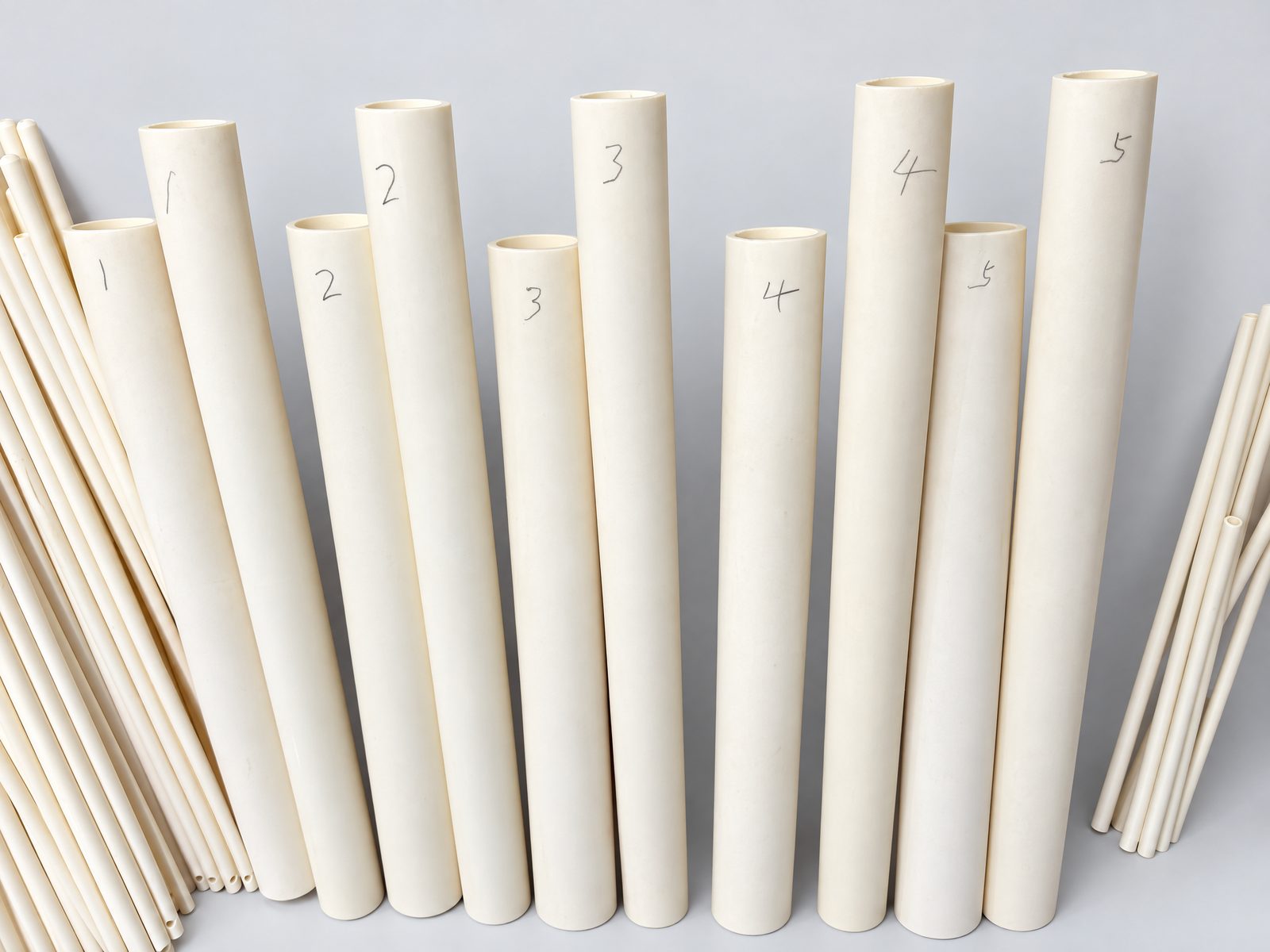
The price of an alumina ceramic tube depends on its purity grade, outer and inner diameters, length, end geometry, and whether the ends require grinding for vacuum flanges. In Nabertherm's working tube specifications, ceramic tubes step up in rating and price tier from porous C 530 (up to 1300 °C in air) to gas-tight C 610 (up to 1400 °C in air and 1200 °C in vacuum) and high-purity C 799 (up to 1800 °C in air and 1400 °C in vacuum). Because dimensions, tolerances and order quantities change forming and firing costs, GY Alumina quotes each order individually. We usually reply with a quote within two working days.
What Drives Alumina Tube Price
Ceramic alumina furnace tubes and thermocouple protection tubes are not priced by weight alone. Seven specifications determine the unit cost and any tooling setup: material purity, cross-section, length, end configuration, surface grinding, batch quantity, and export packing.
GY Alumina uses four forming methods at our factory in Tangshan: slip casting, pressing, extrusion and hot pressing. Small cross-sections are extruded up to our largest extruded tube size today of OD 17 mm x ID 10 mm. Larger tubes are slip cast up to our largest slip-cast size of OD 100 mm x ID 90 mm x 1,000 mm.
When comparing quotes across suppliers, verify that each offer matches on these cost drivers:
- Purity and material class: Moving from porous aluminosilicates (C 530) or mullite classes (C 610) to high-purity corundum such as C799 alumina requires purer raw powder and higher sintering temperatures.
- Outer diameter (OD), inner diameter (ID) and wall thickness: Wider diameters take up more kiln space per firing cycle, and thicker walls need longer drying and firing schedules.
- End geometry and secondary operations: Open-both-ends (BEO) tubes cost less to form than closed-one-end (COE) tubes. Secondary operations we perform include cutting to the ordered length, slotting, and drilling side holes where the drawing calls for it.
- End grinding and hardware: Standard ceramic working tubes follow as-fired tolerances such as DIN 40680-1 (published August 1983). Vacuum tubes need ground ends for water-cooled O-ring flanges, and rotary furnace tubes need mounted drive sleeves.
- Quantity and stock status: Stock sizes cut to length avoid mold charges, while custom profiles require minimum quantities to cover tooling and setup.
- Crating and freight: Rigid ceramic tubes require cushioned wooden crating, adding dimensional weight to air or sea shipments to prevent transit breakage.
Comparing Alumina Ceramic Tubes: Grades, Performance and Prices
Buyers comparing alumina ceramic tubes across grades, performance and prices most often evaluate C 530, C 610 and C 799. Under European standard DIN EN 60672-3 (published February 1999, implementing IEC 60672-3:1997), ceramic insulating materials are grouped into numbered classes. Morgan Advanced Materials manufactures Haldenwanger tubes across these classes under the names Sillimantin 60 (C 530), Pythagoras (C 610) and Alsint (C 799).
In Nabertherm's working tube specifications, these three classes serve distinct temperature and budget tiers, alongside quartz glass and metallic tubes for buyers weighing alumina vs quartz tubes. C 530 is a porous sillimanite tube for air furnaces up to 1300 °C and cannot hold gas or vacuum. C 799 is the gas-tight high-purity alumina tier rated up to 1800 °C in air and 1400 °C in vacuum, though aggressive atmospheres can reduce maximum allowed temperatures.
At GY Alumina, our standard grade is C799 alumina (99.5% Al2O3). Where a buyer's drawing names C 610, we supply 95% white alumina or our standard C799 instead, and neither is mullite.
| Supplier and Grade | Tube Outside Diameter | Max Heat-Up Ramp | Max Temp in Air | Max Temp in Vacuum | Gas Tight | Tolerance Basis |
|---|---|---|---|---|---|---|
| Nabertherm C 530 (Sillimantin ) | Below 120 mm / From 120 mm | Unlimited (below 120 mm) / 200 K/h (from 120 mm ) | 1300 °C | Not possible | No | DIN 40680 |
| Nabertherm C 610 (Pythagoras ) | Below 120 mm / From 120 mm | 300 K/h (below 120 mm) / 200 K/h (from 120 mm ) | 1400 °C | 1200 °C | Yes | DIN 40680 |
| Nabertherm C 799 (Alsint ) | Below 120 mm / From 120 mm | 300 K/h (below 120 mm) / 200 K/h (from 120 mm ) | 1800 °C | 1400 °C | Yes | DIN 40680 |
| Nabertherm Quartz glass | All listed diameters | Unlimited | 1100 °C | 950 °C | Yes | Nominal dimensions, tolerances on request |
| Nabertherm FeCrAl-Alloy (APM ) | All listed diameters | Unlimited | 1300 °C | 1100 °C | Yes | Nominal dimensions, tolerances on request |
| MTI Corporation above 99% Al2O3 (TA50D / TA60D / TA80D ) | 51 mm to 80.4 mm (2 in to 3.165 in ) | Below 5 °C/min (300 K/h ) | 1700 °C (3092 °F) to 1800 °C | 1500 °C (25.4 mm to 76.2 mm / 1 in to 3 in) / below 1200 °C (80 mm to 101.6 mm / 3.15 in to 4 in ) | Yes (evacuated to 10^-7 Torr on TA50D700, TA60D1000, TA80D1000, and 10^-4 Torr via turbopump on TA-50D-M1200 ) | Stated per SKU (+/- 1 mm OD and +/- 1 mm to +/- 2 mm ID on 1000 mm and 1200 mm tubes ) |
How Tube Dimensions, Wall Thickness and End Finishes Scale the Quote
Within a single grade, standard furnace tube sizes and end preparations drive major differences in price. Ordering a short air-operation tube when you later add O-ring vacuum flanges forces you to buy a second, longer tube so the seals stay cool outside the furnace casing.
Nabertherm's working tube catalog shows how geometry scales across air, rotary and vacuum setups. Standard C 799 air tubes run from 380 mm to 1,080 mm long, whereas C 799 vacuum tubes extend from 990 mm to 1,470 mm and add precision-ground ends for water-cooled flanges. By our calculation from Nabertherm's working tube table, an 80 mm x 70 mm C 799 tube grows from 530 mm for air operation (Article No. 692071669) to 990 mm for vacuum operation (Article No. 692070190), an increase of 460 mm (86.8% longer) plus cylindrical end grinding.
| Supplier and Grade | Application Type | Outer x Inner Diameter | Wall Thickness (Calculated ) | Standard Lengths | End Configuration |
|---|---|---|---|---|---|
| Nabertherm C 530 | Static furnaces (R / RS, air ) | 40 mm x 30 mm to 170 mm x 150 mm | 5 mm (40 mm to 80 mm OD) / 10 mm (120 mm to 170 mm OD ) | 450 mm, 700 mm, 850 mm, 1100 mm, 1350 mm | Open ends, as-fired DIN 40680 |
| Nabertherm C 530 / C 610 | Rotary furnaces (RSRC / RSRB ) | 80 mm x 65 mm, 110 mm x 95 mm | 7.5 mm | 1540 mm, 1790 mm, 2040 mm | Work tube includes mounted rotary drive sleeves, spare tube without sleeves |
| Nabertherm C 610 Vacuum | Vacuum operation (R / RS / RHTC ) | 50 mm x 40 mm to 170 mm x 150 mm | 5 mm (50 mm to 80 mm OD) / 10 mm (120 mm to 170 mm OD ) | 650 mm, 900 mm, 1230 mm, 1480 mm, 1730 mm | Ground tube ends for water-cooled flanges |
| Nabertherm C 799 Standard | High-temp air (RHTC / RHTH / RHTV ) | 50 mm x 40 mm, 80 mm x 70 mm, 120 mm x 105 mm | 5 mm (50 mm to 80 mm OD) / 7.5 mm (120 mm OD ) | 380 mm, 450 mm, 530 mm, 600 mm, 690 mm, 830 mm, 1080 mm | Open ends with two fiber plugs (not gas-tight ) |
| Nabertherm C 799 Vacuum | High-temp vacuum (RHTC / RHTH / RHTV ) | 50 mm x 40 mm, 80 mm x 70 mm, 120 mm x 105 mm | 5 mm (50 mm to 80 mm OD) / 7.5 mm (120 mm OD ) | 990 mm, 1140 mm, 1210 mm, 1440 mm, 1470 mm | Ground tube ends for water-cooled flanges |
| MTI Corporation above 99% Al2O3 | Lab processing tubes (TA50D / TA60D / TA80D ) | 51 mm x 40 mm, 51.5 mm x 41.8 mm, 60.5 mm x 51.5 mm, 80.4 mm x 70.5 mm | 4.5 mm to 5.5 mm | 700 mm, 1000 mm, 1200 mm | Open ends for O-ring sealing flanges and refractory blocks |
How Sourcing Alumina Tubes from China Optimizes Total Cost of Ownership
When procurement teams ask how purchasing alumina ceramic tubes from China optimizes total cost of ownership (TCO), the savings come from more than the unit ex-works quote. True TCO combines unit price, tooling, freight, sealing hardware, safety stock, and the replacement rate from thermal cracking or contamination.
Sourcing alumina tubes directly from GY Alumina's factory in Tangshan lowers TCO in three practical ways:
- Sample verification before full tooling runs: A bore or flange mismatch can scrap an entire custom batch. For parts made to drawing, we send 5 to 10 free samples for approval first (the buyer pays the courier) before running the 100-piece production order in 25 to 30 days.
- Fast dispatch on stock sizes to cut inventory carrying costs: Holding large spare-tube inventories ties up capital, while stockouts halt production. Standard sizes ship from our stock in about 3 days for small orders and about 7 days for bulk orders.
- Verified yearly alumina purity: High silica or alkali impurities cause tubes to sag early or poison noble metal thermocouples. An independent lab analyses one of our alumina tubes every year, recording 99.55% Al2O3 in 2024, 99.57% in 2025, and 99.61% in 2026, and our ISO 9001:2015 certificate covers the manufacturing of ceramic protective tubes for thermocouples.
Preventing Thermal Cracking, Vacuum Collapse and Warranty Losses
Read more
Premature tube failure is the fastest way to inflate your annual furnace budget. As MTI Corporation states in its Setup and Use Tips and tube datasheets, alumina processing tubes are consumable items and carry zero warranty once used. Protecting your TCO depends on strict ramp limits, vacuum ceilings, and internal hardware.
First, enforce heating and cooling ramp limits. Both Carbolite and MTI Corporation limit ceramic work tube heating and cooling rates to below 5 °C/min (300 K/h). MTI's Setup and Use Tips specify keeping heating below 5 °C/min above 1500 °C and cooling below 5 °C/min above 800 °C. Nabertherm sets the same 300 K/h ceiling on C 610 and C 799 tubes below 120 mm OD, and lowers the maximum ramp to 200 K/h (3.33 °C/min by our calculation) from 120 mm OD upward. MTI also warns operators to keep multi-zone thermal gradients below 100 °C per 25.4 mm (100 °C/in) on 51.5 mm and 51 mm tubes, below 100 °C/min on 60.5 mm tubes, and below 10 °C/min on 80.4 mm tubes.
Second, respect softening limits under vacuum and pressure limits under gas. MTI prohibits pulling a vacuum above 1500 °C because alumina softens and atmospheric pressure collapses the tube, and restricts larger 80 mm to 101.6 mm (3.15 in to 4 in) tubes to below 1200 °C under vacuum. Carbolite likewise limits tube furnace vacuum operation to 1500 °C, while Nabertherm rates C 799 to 1400 °C and C 610 to 1200 °C in vacuum. For positive gas flow, MTI requires setting the gas regulator below 1.1 atm, keeping vacuum valves open while filling, and never exceeding 1.2 atm (with a gas flow limit below 200 ccm on 50 mm datasheets) so flanges are not blown off.
Third, use radiation blocks, boats, and arrival inspections. MTI requires inserting refractory tube blocks inside both ends of the furnace casing to shield flange O-rings and stabilize heat, and loading samples inside alumina or quartz boats rather than directly on the tube wall. Because consumables carry no post-firing warranty, MTI instructs buyers to inspect packages before signing for delivery, retain original packing materials if damaged, take photos, and report transit damage immediately.
Worked Example: Specifying a Tube Without Overpaying
Read more
Consider a worked example written by our team using Nabertherm's published working tube rules and GY Alumina's production limits. Suppose you need 5 tubes for a horizontal 80 mm bore furnace firing metal oxide powder in static air at 1,550 °C.
First, choose the grade: Nabertherm rates C 530 to 1300 °C and C 610 to 1400 °C in air, so neither survives 1,550 °C. You select C799 alumina.
Second, match the length and ends to air service: Because you use ceramic fiber plugs in static air rather than water-cooled O-ring vacuum flanges, you avoid paying for a 1,440 mm vacuum tube with ground ends and specify an 830 mm or 1,000 mm open-both-ends tube with standard cut ends.
Third, confirm the forming route and stock status: At OD 80 mm x ID 70 mm x 1,000 mm, the tube is above GY Alumina's extrusion limit (OD 17 mm x ID 10 mm) and within our slip-casting capacity (OD 100 mm x ID 90 mm x 1,000 mm). Choosing a stocked standard size lets a 5-piece order ship directly from stock without a custom tooling run. In operation, keeping ramps below 300 K/h (5 °C/min) and placing powders in alumina boats prevents thermal and chemical failure.
Buyer Specification Checklist
Sending complete technical details on your first inquiry lets our team confirm the forming method, alumina tube tolerances, and export crating without delay. Check these six items before sending your drawing:
- OD, ID and length in mm: Note whether the outer diameter must clear a furnace bore or gland, or whether an inner rod or thermocouple assembly must slide inside the bore.
- Dimensional and straightness tolerances: State your required plus/minus tolerances on OD, ID, length and camber, or note if general as-fired tolerances such as DIN 40680-1 apply on your drawing.
- Material grade: Specify C799 alumina, or 95% white alumina where your drawing calls for C 610.
- End style and machining: State both ends open or one end closed, plus any cut slots or drilled side holes.
- Operating environment: Include peak temperature, horizontal or vertical mounting, ramp rate, and atmosphere (air, inert gas, reducing gas, or vacuum).
- Quantity and destination: List the order quantity, whether you want pre-production samples for approval, and the destination country.
Ordering Custom and Stock Tubes from GY Alumina
GY Alumina supplies stocked standard furnace and protection tubes cut to your ordered length, as well as custom tubes, rods, crucibles and boats formed to your drawing or sample. Send your drawing, the grade and the quantity. We usually reply with a quote within two working days.
Questions buyers ask
- What is the difference between C 530, C 610 and C 799 ceramic working tubes?
- In Nabertherm's working tube specifications, C 530 is a porous tube rated up to 1300 °C in air with no vacuum capability. C 610 is gas-tight up to 1400 °C in air and 1200 °C in vacuum, while C 799 is gas-tight high-purity alumina rated up to 1800 °C in air and 1400 °C in vacuum. Where a drawing specifies C 610, GY Alumina supplies 95% white alumina or our standard C799 alumina.
- Why do vacuum alumina furnace tubes cost more than air tubes?
- In Nabertherm's catalog, vacuum tubes in C 610 and C 799 are much longer than standard air tubes so the seals sit outside the heated zone, and they require ground ends for water-cooled flanges. Buyers must also budget for sealing flanges and internal refractory radiation blocks.
- What heating and cooling rate prevents an alumina tube from cracking?
- Carbolite and MTI Corporation both limit ceramic work tube heating and cooling rates to below 5 °C/min (300 K/h). Nabertherm sets a 300 K/h maximum heat-up ramp on C 610 and C 799 tubes below 120 mm OD, and lowers the limit to 200 K/h for tubes from 120 mm OD upward.
- Can an alumina tube operate under vacuum above 1500 °C?
- No. MTI Corporation and Carbolite prohibit vacuum use above 1500 °C because the alumina softens and atmospheric pressure collapses the tube. MTI further limits 80 mm to 101.6 mm (3.15 in to 4 in) tubes to below 1200 °C under vacuum, and Nabertherm rates C 799 vacuum tubes to 1400 °C.
- Do alumina furnace tubes carry a warranty against cracking, and what is GY Alumina's lead time?
- MTI Corporation classifies ceramic working tubes as consumables with no warranty once used, so buyers should inspect packages before accepting delivery and use alumina boats with below 5 °C/min ramps. At GY Alumina, stocked sizes ship in about 3 to 7 days, while custom parts made to drawing take 25 to 30 days after sample approval.
Sources
- Nabertherm: Working Tubes Technical Specifications
- Nabertherm: Laboratory Furnaces and Working Tubes Catalog
- Carbolite: Laboratory and Industrial Ovens and Furnaces Catalogue
- MTI Corporation: 80 OD x 70 ID x 1000 mm Alumina Tube (TA80D1000 )
- MTI Corporation: 60.5 OD x 51.5 ID x 1000 mm Alumina Tube (TA60D1000 )
- MTI Corporation: 50 OD x 42 ID x 700 mm Alumina Tube (TA50D700 )
- MTI Corporation: 50 OD x 40 ID x 1200 mm Alumina Tube (TA-50D-M1200 )
- MTI Corporation: Setup and Use Tips for Tubes and Vacuum Flanges
- Morgan Advanced Materials: Haldenwanger High-Temperature Ceramic Tubes
- DIN Media: DIN EN 60672-3:1999-02 Ceramic and Glass-Insulating Materials
- DIN Media: DIN 40680-1:1983-08 Ceramic Components Admissible Tolerances
- GY Alumina: Alumina and Corundum Grades Material Data
- GY Alumina: Alumina Ceramics Factory in Tangshan, China
- GY Alumina: Buyer FAQ on MOQ, Lead Time, Samples and ISO 9001
Last checked .