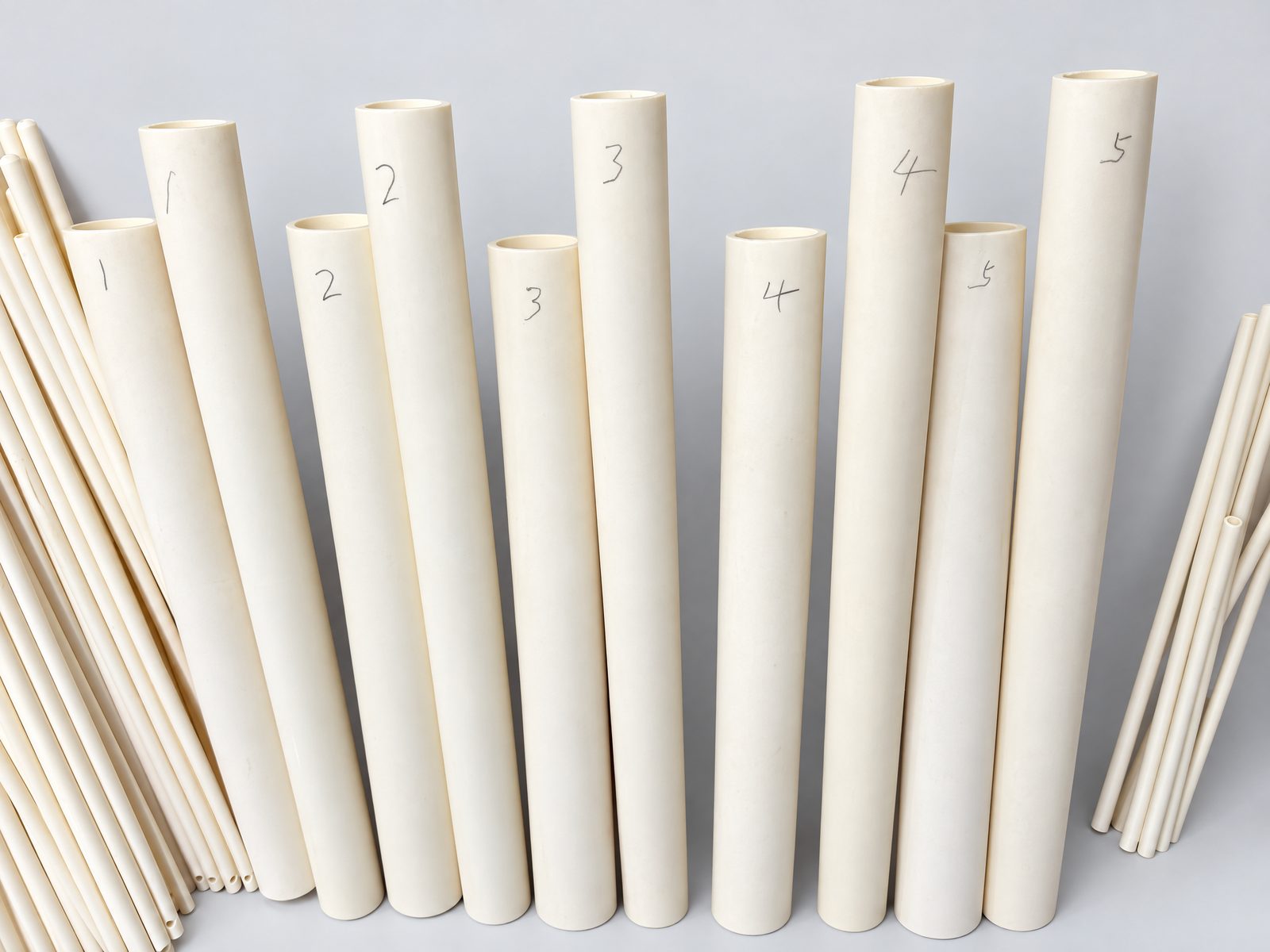
Alumina ceramic tubes resist strong acids, alkalis, and corrosive gases at elevated temperatures because alpha-aluminum oxide (Al2O3) is already a stable, fully oxidized compound with zero water solubility and a melting point of 2,054 °C (International Chemical Safety Card 0351). Precision Ceramics reports that high-purity alumina operates in both oxidizing and reducing atmospheres up to 1,650 °C (2,900 °F) and in vacuum up to 2,000 °C (3,600 °F). At GY Alumina, our standard C799 alumina (99.5% Al2O3) is sintered at about 1,760 °C to keep silica and iron impurities low for consistent corrosion resistance in chemical reactors and tube furnaces.
Why Alumina Tubes Resist Acids, Alkalis, and Oxidation
Aluminum oxide (Al2O3), also called alumina or corundum in its hard crystalline form (CAS 1302-74-5), is chemically inert in most industrial process streams. According to International Chemical Safety Card (ICSC) 0351 prepared for the ILO and WHO, alpha-aluminum oxide (CAS 1344-28-1) has a molecular mass of 101.9, a density of 3.97 g/cm3, a melting point of 2,054 °C (with crystalline corundum melting at 2,015 °C), a boiling point of 3,000 °C, and no solubility in water.
Because the aluminum atom is already bonded to oxygen in a stable state, alumina tubes do not oxidize or scale when heated in air. Precision Ceramics states that alumina offers good resistance to strong acids and alkalis even at elevated temperatures, alongside bio-inertness and low erosion levels. Huber Advanced Materials likewise notes that its Martoxid calcined aluminum oxides provide resistance to wear, temperature, and corrosion when formulated with high chemical purity and low alkali content (Na2O below 0.1%).
When you select an alumina tube for a chemical reactor, acid line, or controlled-atmosphere furnace, chemical durability is directly tied to the ceramic's purity and density. A dense, low-porosity wall prevents corrosive liquids and gases from penetrating the ceramic body, keeping mechanical strength intact across long thermal cycles.
- Oxidation resistance: Al2O3 is a fully oxidized ceramic and is not combustible in air or oxygen-rich furnace zones.
- Acid and alkali stability: Resists strong acid and alkali attack at elevated temperatures where metallic tubes corrode or contaminate the batch.
- Zero water absorption in dense grades: Prevents liquid chemical permeation and dampens internal spalling during heating.
- Low alkali leaching: High-purity calcined alumina feedstocks keep soda content (Na2O) below 0.1% to protect sensitive catalysts and semiconductor wafers.
| Property | Recorded Value | Chemical Duty Implication | Source |
|---|---|---|---|
| Chemical Formula and Mass | Al2O3 / 101.9 | Stable oxide structure prevents further atmospheric oxidation | ICSC 0351 |
| Theoretical Density | 3.97 g/cm3 | Baseline for calculating fired ceramic porosity and permeation resistance | ICSC 0351 |
| Melting Point (Alumina / Corundum) | 2,054 °C / 2,015 °C | Maintains solid phase well above industrial chemical reaction temperatures | ICSC 0351 |
| Boiling Point | 3,000 °C | Negligible evaporation at ambient and moderate furnace temperatures | ICSC 0351 |
| Solubility in Water | None | Will not dissolve or hydrolyze in aqueous wash or steam streams | ICSC 0351 |
| Oxidizing and Reducing Limit | Up to 1,650 °C | Operates in both oxygen-rich and reducing gas atmospheres | Precision Ceramics |
How Purity Grades Govern Chemical Corrosion Consistency
In industrial alumina tubes, corrosion resistance consistency depends on what sits between the aluminum oxide grains. Commercial aluminas are sintered with fluxing additives or natural mineral impurities, primarily silica (SiO2), iron oxide (Fe2O3), and alkali oxides (Na2O). During firing, silica forms an intergranular silicate phase along the grain boundaries. Strong acids and hot alkalis attack this silicate boundary long before they affect the alpha-alumina crystals.
Precision Ceramics compares its regular 96% grade (CeramAlox 96) with its CeramAlox Ultra Pure grade. Moving from CeramAlox 96 to CeramAlox Ultra Pure, bulk density increases from 3.75 g/cm3 to 3.98 g/cm3, hardness increases from 12 GPa to 18 GPa, room-temperature flexural strength rises from 200-300 MPa to 500-600 MPa, and the no-load maximum temperature in air and inert gas steps up from 1,600 °C to 1,750 °C.
If your reactor runs aggressive acid vapors or requires zero trace leaching, stepping up to a 99.5% or higher corundum grade removes the vulnerable glassy phase.
| Property | Unit | CeramAlox 96 (96% Al2O3) | CeramAlox Ultra Pure |
|---|---|---|---|
| Bulk Density | g/cm3 | 3.75 | 3.98 |
| Compressive Strength | MPa | 2,000 | 3,500 |
| Tensile Strength | MPa | 140 | 200 |
| Flexural Strength at 25 °C | MPa | 200-300 | 500-600 |
| Hardness | GPa | 12 | 18 |
| Young's Modulus | GPa | 300 | 400 |
| Thermal Conductivity at 25 °C | W/mK | 25 | 45 |
| CTE (25 °C to 700 °C) | 10^-6 /K | 7.0 | 8.0 |
| Maximum Temperature in Air (No Load) | °C | 1,600 | 1,750 |
| Maximum Temperature in Inert Gas (No Load) | °C | 1,600 | 1,750 |
| Volume Resistivity at 25 °C | ohm-cm | Above 10^14 | Above 10^16 |
Corrosive Gases, Vacuum, and Alkali Vapor in Furnace Tubes
Chemical reactor tubes and furnace work tubes rarely face a single stress in isolation. High temperatures accelerate chemical kinetics, while mechanical load and atmosphere composition shift the ceiling at which the tube stays gas-tight and rigid.
According to Precision Ceramics, alumina tubes can be used in both oxidizing and reducing atmospheres up to 1,650 °C and in vacuum environments up to 2,000 °C, with no-load maximum ratings in air and inert atmospheres of 1,600 °C for 96% alumina and 1,750 °C for its Ultra Pure grade. Alumina furnace tubes in air withstand up to 1,750 °C mounted vertically and 1,650 °C mounted horizontally because a horizontal tube carries its own weight across the span, while vacuum, load, fast heating, and alkali vapor bring the limit down.
At GY Alumina, our corundum furnace tubes are sintered at about 1,760 °C (a firing temperature, not a service rating). When chemical etching or alkali vapor attacks the inner wall of a tube at high heat, it roughens the surface and lowers the softening threshold of the grain boundaries. Under horizontal span loads or fast heating ramps, those chemically etched surfaces become stress concentrators that can initiate thermal shock cracks or tube sag.
- Oxidizing and inert gas streams: Stable up to the maximum temperature rating of the selected purity grade without oxide scaling.
- Reducing gas atmospheres: Precision Ceramics rates alumina up to 1,650 °C in reducing environments.
- Alkali vapor exposure: Sodium, potassium, and flux vapors react with ceramic grain boundaries at high heat, requiring lower operating temperatures and high-purity C799 corundum to slow boundary attack.
- Vacuum operation: Reduces the safe working temperature compared to ambient pressure when structural loads are applied across a heated span.
GY Alumina Grades, Annual Lab Purity Tests, and Forming Methods
GY Alumina manufactures furnace tubes, thermocouple protection tubes, multi-bore insulators, crucibles, boats, solid rods, and custom ceramic parts at our factory in Tangshan, China. Our standard grade is C799 alumina. Where an engineering drawing names C 610, we supply 95% white alumina or our standard C799 instead. Neither is mullite. For crucibles, we supply 99% and 99.5% Al2O3.
To verify batch consistency for buyers who need low trace contamination and steady acid corrosion resistance, an independent lab analyses one of our alumina tubes every year. The recorded Al2O3 purity results are 99.55% in 2024, 99.57% in 2025, and 99.61% in 2026. Our ISO 9001:2015 certificate covers the manufacturing of ceramic protective tubes for thermocouples (that scope only).
We form ceramic bodies using four routes: slip casting, pressing, extrusion, and hot pressing, with maximum tube dimensions by route listed in the table below. For solid alumina rods, we hold eight stock diameters from 2 to 12 mm, about 2,400 mm long, with a +0.2 mm grinding allowance on the diameter.
| Parameter or Capability | Recorded Specification | Buyer Application Note |
|---|---|---|
| Standard Corundum Grade | C799 alumina | Standard grade for furnace work tubes, protection tubes, and custom parts |
| Alternative Drawing Grade | 95% white alumina or C799 alumina | Supplied where a drawing calls for C 610, and neither is mullite |
| Crucible Purity Grades | 99% and 99.5% Al2O3 | Available for chemical melting, calcining, and lab boats |
| Sintering Temperature | About 1,760 °C | Kiln firing temperature for corundum ware, not a service rating |
| Largest Extruded Tube | OD 17 x ID 10 mm | Suitable for small-bore chemical capillaries, sheaths, and insulators |
| Largest Slip-Cast Tube | OD 100 x ID 90 x 1,000 mm | Suitable for large-bore chemical reactors and process furnace tubes |
Machining, Secondary Operations, and Custom Reactor Shapes
Read more
Chemical reactors and gas-dosing systems often require features beyond a plain open pipe, such as gas-inlet perforations, thermocouple slots, or sealed ends.
At GY Alumina, we perform secondary operations in our factory to prepare tubes for direct reactor installation: cutting to ordered length, cutting end slots, drilling side holes and perforated tube patterns, and forming closed ends with drilled holes. We also manufacture custom shapes to your drawing or sample across our slip casting, pressing, extrusion, and hot pressing lines.
| Category | Available Configurations | How to Specify on Your Drawing |
|---|---|---|
| Tube Cross-Sections | Round, elliptical, and square tubes (open both ends or one end closed) | State outer dimensions, wall thickness or ID, and end geometry |
| Bore Configurations | Single-bore, twin-bore, and multi-bore tubes and capillaries | Specify bore diameter, bore count, and wire or insert diameter |
| Surface and Wall Features | Threaded, ribbed, perforated, and slotted tubes | Mark pitch, hole diameters, slot width, and positions from tube end |
| Secondary Tube Operations | Cut to length, end slots, side holes, closed ends with drilled holes | Provide tolerance on overall length and hole location |
| Solid and Structural Parts | Solid rods, square bars, balls, rings, washers, bushings, and discs | State outer dimensions, bore or thickness, and overall length |
| Containment Ware | Crucibles, boats, and custom shapes to drawing or sample | Specify crucible grade and overall capacity or dimensions |
Worked Example: Selecting a Tube for an Acid-Vapor Tube Furnace
Read more
Worked example written by our team. The engineering scenario is invented to show how to match purity, forming route, and order terms to a chemical process.
Suppose you are specifying an open-ended process tube for a horizontal chemical vapor reactor running acidic chloride and oxidizing gases at 1,550 °C, with a required outer diameter of 60 mm, an inner diameter of 50 mm, an overall length of 1,000 mm, and two 5 mm side holes near one end for gas purge fittings.
First, check the forming route against tube dimensions. At GY Alumina, your 60 x 50 x 1,000 mm tube exceeds extrusion limits and falls squarely within our slip-cast range, while our secondary operations cover cutting to length and drilling the two 5 mm side holes.
Second, select the purity grade. A 95% white alumina tube contains roughly 5% non-alumina binders that can etch in hot acid vapors at 1,550 °C. Specifying our standard C799 alumina minimizes intergranular silicate attack and handles high-temperature oxidizing and acid environments.
Third, plan your sampling and batch schedule. Because the tube includes custom side holes to your drawing, it follows our custom production schedule rather than stock dispatch, so request pre-production samples for reactor approval before running the main batch.
Buyer Specification Checklist and Order Terms
Before you send your request to GY Alumina, use the checklist and order-terms table below to make sure your drawing or email covers every detail needed to confirm chemical and dimensional compatibility.
- Dimensions and geometry: Outer diameter (OD), inner diameter (ID), overall length in mm, and whether ends are open, closed, or drilled.
- Alumina grade: State C799 alumina for high-purity chemical and high-temperature service, or 95% white alumina where appropriate.
- Secondary features: Attach a drawing showing any end slots, side holes, perforations, threads, or ribs.
- Insert or mating fit: Confirm the bore against your wire, boat, or sensor insert before ordering so clearance is verified.
- Chemical and thermal duty: Note your maximum working temperature, furnace orientation, heating ramp rate, and the acids, alkalis, or gases present.
- Order quantity and sample needs: State the batch quantity and whether you require pre-production samples for reactor testing.
| Order Type | Minimum Order Quantity | Pre-Production Samples | Typical Lead Time |
|---|---|---|---|
| Standard Stock Sizes (Small Orders) | Confirmed per quotation | 5-10 free samples available, buyer pays courier | Ships in about 3 days |
| Standard Stock Sizes (Bulk Orders) | Confirmed per quotation | 5-10 free samples available, buyer pays courier | Ships in about 7 days |
| Custom Parts to Drawing or Sample | Usually 100 pieces per item | 5-10 free samples sent for approval first, buyer pays courier | 25-30 days to produce |
How to Order Stock and Custom Alumina Tubes
With 100+ customers served across furnace, thermocouple, laboratory, and industrial equipment companies, GY Alumina supplies both standard sizes cut to length from stock and custom ceramic components manufactured to your drawing or sample.
Send your drawing, the grade and the quantity. We usually reply with a quote within two working days.
Questions buyers ask
- Does high-purity alumina resist strong acids and alkalis at high temperatures?
- Yes. Precision Ceramics states that alumina offers good resistance to strong acids and alkalis even at elevated temperatures, and International Chemical Safety Card 0351 records zero water solubility and a melting point of 2,054 °C for alpha-aluminum oxide.
- Why does 99.5% C799 alumina resist chemical corrosion better than 95% or 96% alumina?
- Higher purity grades reduce the intergranular glassy phase that corrosive media attack first. At GY Alumina, an independent lab test on our C799 alumina tube recorded 99.61% Al2O3 in 2026, leaving less than 0.4% total non-alumina constituents.
- Can alumina furnace tubes be used in both oxidizing and reducing gas atmospheres?
- Yes. According to Precision Ceramics, alumina can be used in both oxidizing and reducing atmospheres up to 1,650 °C and in vacuum environments up to 2,000 °C.
- What does GY Alumina supply when a chemical reactor drawing specifies C 610?
- Where a drawing names C 610, we supply 95% white alumina or our standard C799 alumina instead. Neither is mullite.
- What are the largest alumina tube sizes and secondary hole options at GY Alumina?
- Our largest extruded tube today is OD 17 x ID 10 mm, and our largest slip-cast tube is OD 100 x ID 90 x 1,000 mm. We cut tubes to length, cut end slots, drill side holes and perforated patterns, and make closed ends with drilled holes to your drawing.
- Can I get free alumina tube samples to test in my chemical process before ordering?
- Yes. We send 5-10 free samples for your approval before a production order runs, and you pay only the courier freight.
Sources
- ICSC 0351: Aluminium Oxide
- Precision Ceramics: Alumina Properties and Industrial Applications
- Huber Advanced Materials: Calcined Aluminum Oxides Martoxid
- GY Alumina: Alumina and Corundum Grades Material Data
- GY Alumina: Alumina and Corundum Furnace Tubes
- GY Alumina: Buyer FAQ on MOQ, Lead Time, Samples, and ISO 9001
- GY Alumina: Alumina Ceramics Factory in Tangshan, China
Last checked .