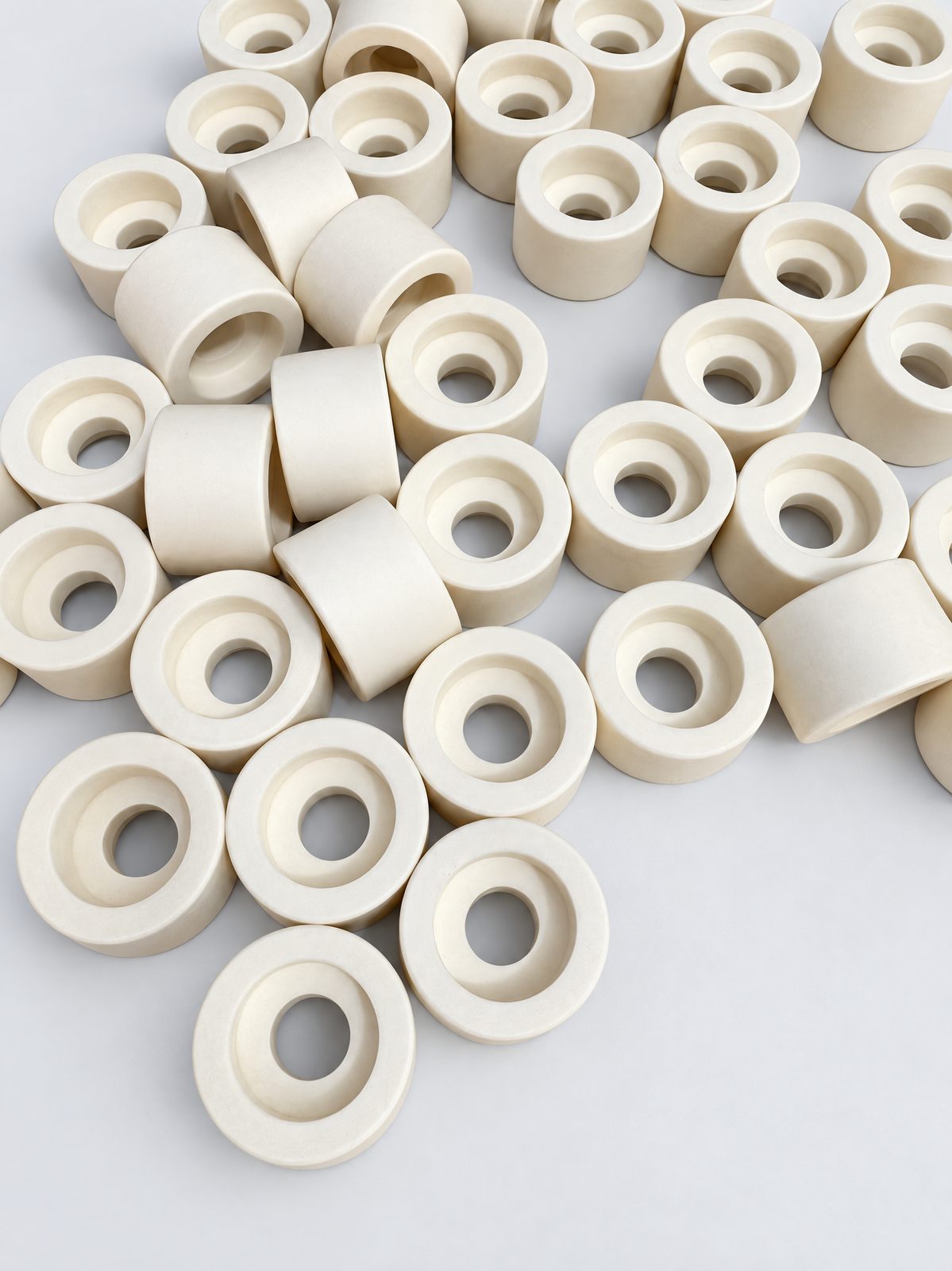
A rectangular alumina tray is a flat-bottomed aluminum oxide ceramic vessel built to hold powders, green compacts, or melts during calcination, sintering, annealing, and laboratory material analysis. Depending on alumina purity, published maximum operating temperatures in air reach 1,600 °C under no load for Precision Ceramics CeramAlox 96, 1,750 °C for Almath Crucibles' recrystallized alumina, and 1,950 °C for Kyocera DEGUSSIT AL23. Standard rectangular vessels span capacities from 0.2 ml boats to 1,750 ml deep crucibles, and custom shapes can be formed to an engineering drawing.
Tray, Boat, Rectangular Crucible, or Saggar: Choosing the Right Geometry
Buyers searching for an alumina tray rectangular or comparing alumina rectangular trays across supplier catalogs encounter four overlapping names: combustion trays, flat-bottom boats, straight-sided rectangular crucibles, and rectangular saggars. Whether a supplier catalog lists an alumina ceramic tray, rectangular trays for annealing, or straight-walled boats, all four share a flat rectangular base and vertical or near-vertical walls, yet each geometry serves a distinct loading pattern when deploying rectangular alumina trays in high-temperature processing.
A shallow combustion tray pairs a wide floor with low 20 mm to 30 mm walls so furnace gases reach a thin powder bed evenly during calcining, ashing, or annealing. Narrow rectangular boats keep width between 9 mm and 31 mm and height between 6 mm and 17 mm so the carrier slides cleanly inside a round furnace work tube. Straight-sided rectangular crucibles raise wall height up to 97 mm to hold deeper powder batches or aggressive glass and metal melts without spilling, while rectangular saggars thicken the walls to 9 mm to carry heavy bulk charges on a box-kiln hearth.
Match external length and width to your furnace hot zone before picking volume. When a catalog size leaves wasted hearth area or touches a tube wall, buyers order custom alumina ceramic parts formed to drawing.
| Vessel format | Reference item | External L x W x H | Wall thickness | Capacity | Primary furnace role |
|---|---|---|---|---|---|
| Combustion tray | Kyocera DEGUSSIT AL23 222-11100-0500 | 100 mm x 50 mm x 30 mm | 4 mm | 95 ml | Shallow-bed calcining, annealing, and lab analysis |
| Flat-bottom boat | Kyocera DEGUSSIT AL23 221-11130-0310 | 130 mm x 31 mm x 17 mm | 3 mm | 27 ml | Sample carrier inside cylindrical work tubes |
| Rectangular crucible | Almath Recrystallized Alumina SS84 | 81 mm x 56.6 mm x 41 mm | 2.6 mm | 130 ml | Deeper powder charges and melt containment |
| Rectangular saggar | Almath Recrystallized Alumina SSP200TS | 200 mm x 107 mm x 102 mm | 9 mm | 1,500 ml | Thick-wall bulk powder firing on kiln hearths |
Published Standard Sizes and Internal Clearance Checks
Many distributor pages omit external length or confuse millimeter dimensions with milliliter volume, turning furnace layout into guesswork. The table below compiles complete standard size series from Kyocera Fineceramics Europe (DEGUSSIT AL23, AL24, and AL25 boats and combustion trays) and Almath Crucibles (recrystallized alumina SS and SSP rectangular series), listing external length, width, height, wall thickness, and capacity side by side.
Wall thickness scales upward with footprint to resist handling damage and floor warpage. Kyocera steps wall thickness from 2 mm on 32 mm boats to 3 mm and 4 mm on 50 mm to 100 mm AL23 combustion trays, 5 mm on its 145 mm AL24 tray, and 10 to 15 mm on its 205 mm by 125 mm AL25 tray. Almath keeps standard crucible walls between 1.63 mm and 4 mm across volumes from 1.63 ml to 1,750 ml, and increases wall thickness to 9 mm on its 1,500 ml SSP200TS saggar.
Check both internal floor clearance and unground tolerance before ordering a stock vessel for a solid compact or fixture pocket. On the Almath SS84 rectangular crucible (81 mm external length, 56.6 mm external width, 41 mm external height, and 2.6 mm wall thickness), by our calculation from the Almath SS84 datasheet and rectangular category specification, subtracting two 2.6 mm walls leaves a nominal 75.8 mm by 51.4 mm internal floor, while Almath's stated handmade tolerance of plus or minus 10% means external length can span 72.9 mm to 89.1 mm.
| Maker and grade | Item code | Length | Width | Height | Wall thickness | Capacity |
|---|---|---|---|---|---|---|
| Kyocera DEGUSSIT AL23 | 221-11032-0090 (boat) | 32 mm | 9 mm | 6 mm | 2 mm | 0.2 ml |
| Almath Recrystallized Alumina | SS22 | 21.8 mm | 12 mm | 11.05 mm | 1.63 mm | 1.63 ml |
| Kyocera DEGUSSIT AL23 | 222-11050-0250 (tray) | 50 mm | 25 mm | 20 mm | 3 mm | 12 ml |
| Almath Recrystallized Alumina | SS50 | 50 mm | 25 mm | 16 mm | 2 mm | 20 ml |
| Kyocera DEGUSSIT AL23 | 222-11050-0500 (tray) | 50 mm | 50 mm | 20 mm | 3 mm | 26 ml |
| Kyocera DEGUSSIT AL23 | 222-11075-0500 (tray) | 75 mm | 50 mm | 20 mm | 4 mm | 35 ml |
| Almath Recrystallized Alumina | SS100 | 99 mm | 99 mm | 12 mm | 2.7 mm | 64.4 ml |
| Kyocera DEGUSSIT AL23 | 222-11100-0500 (tray) | 100 mm | 50 mm | 30 mm | 4 mm | 95 ml |
| Kyocera DEGUSSIT AL24 | 222-21145-0850 (tray) | 145 mm | 85 mm | 30 mm | 5 mm | 212 ml |
| Almath Recrystallized Alumina | SS200WB | 200 mm | 148 mm | 25 mm | 4 mm | 533 ml |
| Kyocera DEGUSSIT AL25 | 222-22205-1250 (tray) | 205 mm | 125 mm | 50 mm | 10 to 15 mm | 660 ml |
| Almath Recrystallized Alumina | SS200T | 197 mm | 98 mm | 97 mm | 4 mm | 1,750 ml |
Alumina Purity Grades and Material Properties by Manufacturer
Alumina purity sets both peak service temperature and resistance to grain-boundary chemical attack. Morgan Technical Ceramics groups commercial compositions into standard alumina (85% to 95%, or 90% to 98% for general industrial duty) and high-purity grades above 98% (including 96% to 99.5% for analytical and vacuum equipment) that raise chemical inertness, wear resistance, and dielectric strength.
When comparing alumina and corundum grades on European drawings, check ceramic class codes carefully. In IEC 60672, C 610 designates a mullite class rather than high-alumina corundum, whereas high-purity fired ware uses compositions of 99% Al2O3 and higher, such as C799 alumina (99.5% Al2O3). Kyocera notes that low silicon dioxide (SiO2) content in DEGUSSIT oxide ceramics increases corrosion resistance against aggressive metal or glass melts and extends tray service life.
Full sintering closes off open pores against liquid wicking and gas trapping. In Kyocera's February 2025 DEGUSSIT AL23 datasheet, the alpha-alumina grade (above 99.5% Al2O3) reaches 0 Vol-% open porosity, a 10 micrometer mean grain size, 3.70 to 3.95 g/cm3 bulk density, and 17.1 GPa Vickers hardness (HV 1.0).
| Property | Precision Ceramics CeramAlox 96 | Kyocera DEGUSSIT AL23 | Almath Recrystallized Alumina (SS84) |
|---|---|---|---|
| Al2O3 purity | 96% | Above 99.5% | High-purity recrystallized |
| Bulk density | 3.75 g/cm3 | 3.70 to 3.95 g/cm3 | Not stated |
| Open porosity | Not stated | 0 Vol-% | Not stated |
| Flexural strength | 200 to 300 MPa (at 25 °C) | 300 to 350 MPa (at 20 °C) | Not stated |
| Compressive strength | 2,000 MPa | 2,500 MPa | Not stated |
| Thermal conductivity | 25 W/mK (at 25 °C) | 34.9 W/(m K) (at 20 °C) | Not stated |
| Thermal expansion (CTE) | 7.0 x 10^-6 /K (25 to 700 °C) | 8.2 x 10^-6 /K (20 to 1,000 °C) | Not stated |
| Max working temperature in air | 1,600 °C (no load) | 1,950 °C | 1,750 °C |
Atmosphere Limits, Thermal Shock, and Hearth Loading Rules
Rectangular alumina vessels work across air, inert gas, reducing gas, and vacuum when peak temperature matches the atmosphere and load. Precision Ceramics lists a no-load limit in air and inert gas of 1,600 °C for CeramAlox 96, and states that alumina operates in oxidizing and reducing atmospheres up to 1,650 °C (2,900 °F) and in vacuum up to 2,000 °C (3,600 °F). Because Kyocera DEGUSSIT AL23 has 0 Vol-% open porosity, it also serves in ultra-high vacuum systems without outgassing. Precision Ceramics adds that alumina resists strong acid and alkali attack at elevated temperatures, though solidified glass or flux residue left in a tray creates uneven thermal contraction on subsequent cycles.
Thermal shock causes far more tray failures than softening. Morgan Technical Ceramics notes that ceramic melting points typically exceed 2,000 °C, yet alumina has a modest Hasselmann thermal downshock resistance (delta °C) of 170 to 300 °C. During fast cooling, the outer ceramic surface cools and shrinks faster than the hot core, putting the exterior in tension and opening cracks.
Falling thermal conductivity at high temperature steepens those wall gradients. In Kyocera DEGUSSIT AL23, thermal conductivity drops from 34.9 W/(m K) at 20 °C to 6.8 W/(m K) at 1,000 °C and 5.3 W/(m K) at 1,500 °C. By our calculation from the Kyocera DEGUSSIT AL23 datasheet, conductivity at 1,000 °C is 19.5% of its 20 °C value, and at 1,500 °C it is 15.2%. Follow these four operating checks to prevent cracking and warpage:
- Support the entire flat base on a level hearth plate rather than bridging across end rails, since 1,600 °C to 1,750 °C datasheet ratings assume no mechanical load.
- Use gradual heating and cooling ramps, slowing rates further on wide trays or 5 mm to 15 mm thick walls so temperature drops stay inside Morgan Technical Ceramics' 170 to 300 °C downshock delta.
- Leave expansion clearance around hearth frames, push-rod tracks, and lids, allowing at least 0.80 mm per 100 mm of length on Kyocera DEGUSSIT AL23 heated to 1,000 °C.
- Dedicate separate trays to incompatible melts or powders and inspect corners and bases between runs for hairline thermal-stress cracks.
| Ceramic material | Thermal downshock resistance (delta °C) | Selection role compared with alumina trays |
|---|---|---|
| Alumina | 170 to 300 °C | Primary oxide choice for clean calcining, corrosive melts, and electrical insulation under controlled ramps |
| Silicon carbide | 400 °C | Higher downshock margin for kiln furniture where carbon-bearing non-oxide ware is acceptable |
| Zirconia | 400 to 500 °C | Higher fracture toughness and quench margin. Almath offers matching rectangular crucibles in zirconia and ZTA |
| Silicon nitride | 900 °C | High rapid-cooling tolerance for foundry and structural fixtures |
Forming Routes, 20% Sintering Shrinkage, and Buyer Specification Checklist
Read more
How a rectangular vessel is formed governs microstructure, wall uniformity, and tooling cost. Across the industry, Precision Ceramics, Kyocera, and Morgan Technical Ceramics list dry pressing, high-pressure pressing, isostatic pressing, slip casting, extrusion, and ceramic injection molding. Kyocera uses high-pressure pressing on laboratory combustion trays and boats for homogeneous density and shape accuracy, whereas plaster-mold slip casting and manual forming suit deep or large-volume vessels.
Precision Ceramics states that full sintering densification causes an alumina body to shrink about 20%. Because of that 20% firing shrinkage, green or biscuit machining before sintering cannot hold tight final tolerances, and Almath Crucibles lists general handmade tolerances of plus or minus 10% of nominal size on unground rectangular crucibles. Achieving tight flatness or precise outer dimensions requires diamond grinding after sintering, so specify tight dimensional tolerances on your drawing only where fixtures or automated handling demand them.
Include these six details on your quote request so the manufacturer can confirm the forming method, grade, and fit:
- Part drawing or physical sample showing external length, width, and height in mm.
- Wall thickness, floor thickness, and inner corner radii.
- Critical tolerances, noting any one-sided internal clearance needed to accept a solid compact or setter.
- Required Al2O3 purity grade, such as 99% Al2O3, C799 alumina (99.5% Al2O3), or 95% white alumina.
- Peak temperature, furnace atmosphere (air, inert, reducing, or vacuum), thermal cycle, and contacting charge material.
- Order quantity, approval sample needs, and whether side holes or slots are required.
Custom Alumina Boats, Crucibles, and Ordering from GY Alumina
GY Alumina is the export brand of a factory in Tangshan, China that makes thermocouple protection tubes, thermocouple insulators and multi-bore tubes, furnace tubes, crucibles and boats, solid alumina rods, and custom parts to a buyer's drawing or sample. We supply crucibles in 99% and 99.5% Al2O3, and our standard grade for custom parts is C799 alumina (99.5% Al2O3). Where a drawing names C 610, we supply 95% white alumina or our standard C799 instead, and neither is mullite. An independent laboratory analyses one of our alumina tubes every year, recording 99.55% Al2O3 in 2024, 99.57% in 2025, and 99.61% in 2026. Our ISO 9001:2015 certificate covers the manufacturing of ceramic protective tubes for thermocouples, with 100+ customers served.
Our factory forms ware by slip casting, pressing, extrusion, and hot pressing, with corundum (99.5% Al2O3) ware undergoing sintering at about 1,760 °C, which is a firing temperature rather than a service rating. Secondary operations we perform include cutting to length, end slots, side holes and perforated tubes, and closed ends with drilled holes. Custom parts we make to drawing or sample include round, elliptical, and square tubes, single-, twin-, and multi-bore tubes, threaded, ribbed, perforated, and slotted tubes, solid rods, square bars, balls, rings, washers, bushings, discs, and crucibles, boats, and other shapes to drawing. Operations such as diamond grinding, lapping, polishing, green machining, isostatic pressing, and injection molding are outside those processes, and our team reviews customer drawings to confirm feasibility.
Parts to drawing usually start at 100 pieces per item and take 25 to 30 days to produce, with 5 to 10 free samples sent for approval first while the buyer pays the courier. Standard sizes ship from stock in about 3 days for small orders to about 7 days for bulk orders. Send your drawing, the grade and the quantity. We usually reply with a quote within two working days.
Questions buyers ask
- What is the difference between a rectangular alumina tray, a boat, and a saggar?
- Combustion trays combine a wide rectangular base with low 20 mm to 30 mm walls (such as Kyocera's 100 mm x 50 mm x 30 mm tray) for open-surface calcining and annealing. Boats use narrow 9 mm to 31 mm widths to slide inside round furnace tubes, whereas rectangular crucibles and thick-walled saggars (such as Almath's 9 mm wall SSP200TS) hold deeper melts or heavy bulk powder loads.
- What is the maximum operating temperature of a rectangular alumina tray?
- Peak temperature depends on purity, load, and atmosphere. Published ratings in air span from 1,600 °C under no load for Precision Ceramics CeramAlox 96 (96% Al2O3) and 1,750 °C for Almath Crucibles' recrystallized alumina up to 1,950 °C for Kyocera DEGUSSIT AL23 (above 99.5% Al2O3).
- Can rectangular alumina trays be used in reducing gas or vacuum furnaces?
- Yes, within atmosphere-specific limits. Precision Ceramics states that alumina operates in oxidizing and reducing atmospheres up to 1,650 °C (2,900 °F) and in vacuum up to 2,000 °C (3,600 °F), while Kyocera notes that DEGUSSIT AL23's 0 Vol-% open porosity suits ultra-high vacuum systems.
- Why do rectangular alumina trays crack during cooling?
- Morgan Technical Ceramics explains that rapid cooling chills and contracts the outer ceramic surface faster than the hot interior, putting the brittle exterior in tension. Alumina has a thermal downshock resistance delta of 170 to 300 °C, so controlled cooling ramps and full flat hearth support prevent fracture.
- What is the minimum order and lead time for custom rectangular shapes at GY Alumina?
- At GY Alumina, custom crucibles, boats, and shapes made to your drawing or sample usually start at 100 pieces per item and take 25 to 30 days to produce, with 5 to 10 free samples sent for approval first while the buyer pays the courier. Standard sizes ship from stock in about 3 days for small orders to about 7 days for bulk orders.
Sources
- Precision Ceramics: Alumina Properties and Industrial Applications
- KYOCERA Fineceramics Europe: Crucibles, Boats, and Combustion Trays
- KYOCERA Fineceramics Europe: DEGUSSIT AL23 Material Datasheet (February 2025)
- Almath Crucibles Ltd.: Rectangular Ceramic Crucibles and Saggars
- Almath Crucibles Ltd.: SS84 Rectangular Alumina Crucible 130ml
- Morgan Technical Ceramics: Thermal Shock Resistance in Ceramics
- Morgan Technical Ceramics: High-Performance Alumina Ceramic Components
- GY Alumina: Alumina Crucibles, Lids and Boats
- GY Alumina: Alumina and Corundum Grades Material Data
- GY Alumina: Custom Parts Made to Drawing or Sample
- GY Alumina: Alumina Buying Guides
- GY Alumina: Buyer FAQ (MOQ, Lead Time, Samples, ISO 9001)
- GY Alumina: Alumina Ceramics Factory in Tangshan, China
Last checked .