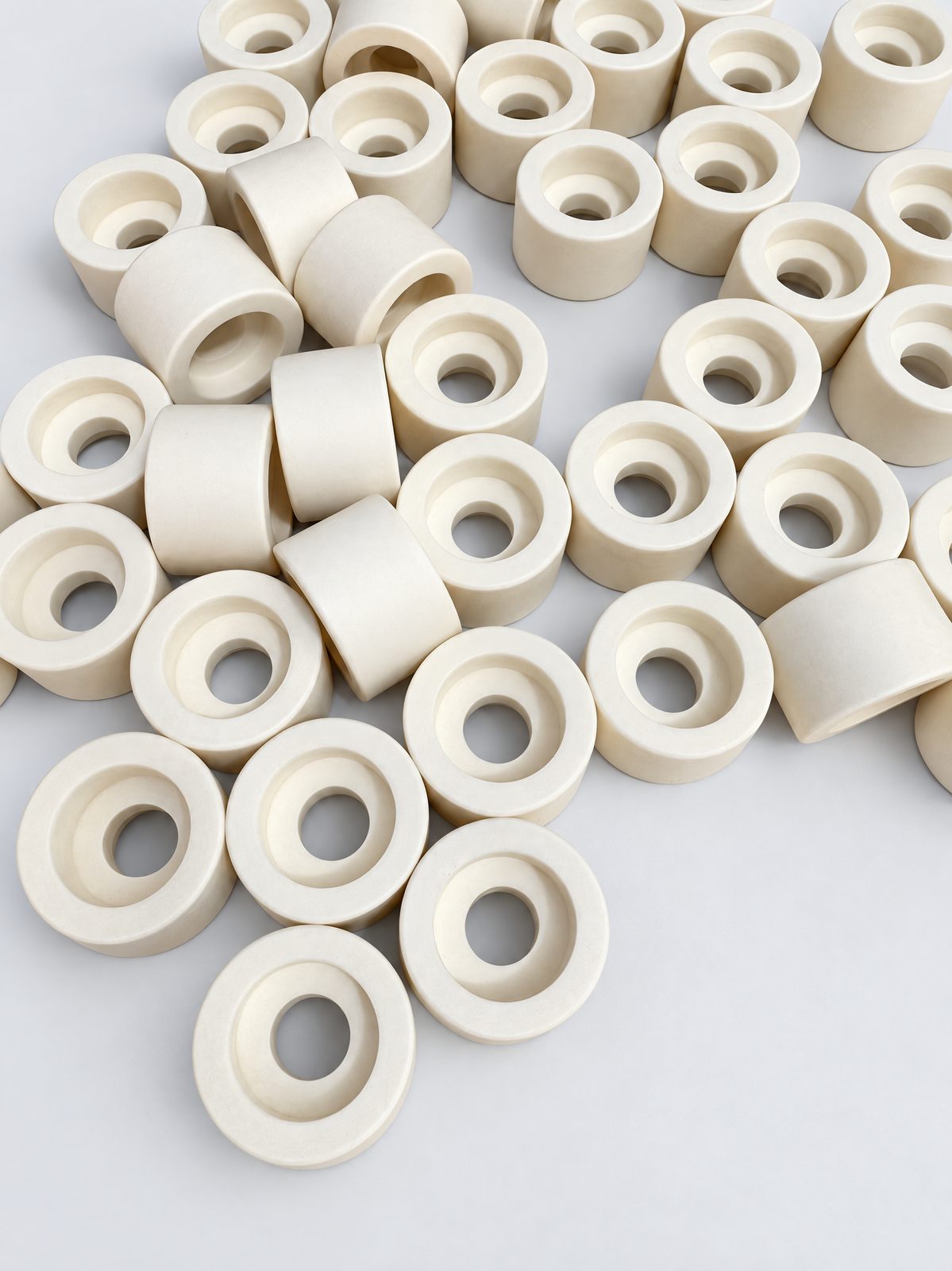
An alumina sleeve is a cylindrical aluminum oxide (Al2O3) component fitted over a rotating shaft, pump plunger, electrical conductor, or sensor to guard against abrasive wear, chemical corrosion, and extreme heat. Commercial dense grades run from 94% Al2O3 upward, with Accuratus listing a compressive strength of 2,600 MPa (377 x 10^3 lb/in2) and a no-load maximum use temperature of 1,750 °C (3,180 °F) for 99.5% alumina. Depending on bore clearances and surface finish requirements, tubular sleeves and bushings are either pressed, extruded, or slip cast to drawing, or diamond ground after firing to remove sintering shrinkage.
Sleeve, Bushing, or Liner Tube: Matching the Part to Your Assembly
Suppliers and drawings often use sleeve, bushing, liner, and sheath interchangeably for hollow cylindrical Al2O3 parts. In mechanical and thermal design, however, each geometry carries a different load and requires different tolerances on the inner diameter (ID), outer diameter (OD), and wall thickness.
Naming the exact function on your print keeps you from paying for precision grinding on surfaces that sit in open air, whether you are replacing a worn pump part or ordering custom alumina components formed to a print. Industrial buyers generally specify one of five cylindrical configurations.
- Alumina shaft sleeve (Al2O3 ceramic shaft sleeve): Mounts over a metal drive shaft in pumps, agitators, mills, compressors, turbines, and marine drive shaft seals to take mechanical seal friction, slurry abrasion, and chemical attack in place of the metal shaft, as described by Kyocera Fineceramics Europe.
- Piston and pump wear sleeve: Pairs a fine-grain, polished cylindrical liner with a mating ceramic plunger or rotary element, such as Morgan Technical Ceramics Hilox pump sleeves and low-impurity over-98% alumina piston and sleeve pump sets for corrosive media.
- Custom alumina bushing and bearing bush: Guides a moving rod, wire, or rotating journal under radial load, or spaces mechanical components apart in chemical valves and unlubricated vacuum or water-lubricated sliding bearings.
- High-voltage feedthrough and welding insulator sleeve: Isolates conductors, X-ray and vacuum feedthrough pins, cartridge heaters, and welding torches from electrical breakdown and heat, using grades such as Morgan A950 (95% Al2O3) for metallized high-voltage bushings and Sintox FA (95% Al2O3) for welding nozzles and stress-relieving insulators.
- Abrasion liner tube and protective sheath: Lines pipe elbows, pneumatic transfer chutes, furnace chambers, or temperature sensors, using open-ended corundum tubes or one-end-closed thermocouple protection tubes.
Alumina Purity Grades Compared: 94% Al2O3 and Higher
Evaluating alumina materials and grades starts with aluminum oxide content and grain-boundary chemistry. Lower-purity technical grades between 94% and 96% Al2O3 use additives that readily accept molybdenum-manganese metallizing for high-temperature brazing of assemblies. Higher-purity corundum grades at 99.5% Al2O3 strip out glassy grain-boundary phases to raise hardness, thermal conductivity, high-temperature electrical resistivity, and acid or alkali resistance.
In Accuratus's Aluminum Oxide property tables, stepping up from 96% Al2O3 to 99.5% Al2O3 raises room-temperature compressive strength from 2,100 MPa to 2,600 MPa and increases thermal conductivity from 25 W/mK to 35 W/mK. Across the wider purity range in the table below, no-load air temperature ratings span 1,600 °C on regular 96% alumina up to 1,950 °C on Kyocera Fineceramics Europe's ivory DEGUSSIT AL23 (above 99.5% alpha-Al2O3, 0 Vol-% open porosity, 10 micrometer mean grain size, 17.1 GPa Vickers HV 1.0 hardness, and 20 kV/mm to 30 kV/mm electrical breakdown strength).
Check legacy European drawings carefully before ordering. At GY Alumina, our standard grade is C799 alumina (99.5% Al2O3), and where a drawing names C 610 we supply 95% white alumina or our standard C799 instead. Neither is mullite.
| Maker and Grade | Al2O3 Content | Density | Compressive Strength | Flexural Strength | Elastic Modulus | Thermal Conductivity | Max No-Load Temp (Air) |
|---|---|---|---|---|---|---|---|
| Accuratus 94% Aluminum Oxide | 94% | 3.69 g/cm3 (230.4 lb/ft3) | 2,100 MPa (304.5 x 10^3 lb/in2) | 330 MPa (47 x 10^3 lb/in2) | 300 GPa (43.5 x 10^6 lb/in2) | 18 W/mK (125 BTU in/ft2 hr °F) | 1,700 °C (3,090 °F) |
| Accuratus 96% Aluminum Oxide | 96% | 3.72 g/cm3 (232.2 lb/ft3) | 2,100 MPa (304.5 x 10^3 lb/in2) | 345 MPa (50 x 10^3 lb/in2) | 300 GPa (43.5 x 10^6 lb/in2) | 25 W/mK (174 BTU in/ft2 hr °F) | 1,700 °C (3,090 °F) |
| Precision Ceramics CeramAlox 96 | 96% | 3.75 g/cm3 | 2,000 MPa | 200 to 300 MPa | 300 GPa | 25 W/mK | 1,600 °C |
| Accuratus 99.5% Aluminum Oxide | 99.5% | 3.89 g/cm3 (242.8 lb/ft3) | 2,600 MPa (377 x 10^3 lb/in2) | 379 MPa (55 x 10^3 lb/in2) | 375 GPa (54.4 x 10^6 lb/in2) | 35 W/mK (243 BTU in/ft2 hr °F) | 1,750 °C (3,180 °F) |
| Kyocera DEGUSSIT AL23 | Above 99.5% | 3.70 to 3.95 g/cm3 | 2,500 MPa | 300 to 350 MPa | 380 GPa | 34.9 W/mK (at 20 °C) | 1,950 °C |
Forming, Sintering Shrinkage, and Diamond Grinding for Shaft Fits
In the wider technical ceramics industry, Precision Ceramics notes that alumina blanks are formed by extrusion, die pressing, isostatic pressing, slip casting, or injection molding, and can be shaped in the unfired green or biscuit state into intricate profiles. During high-temperature firing to reach full density, however, the alumina body shrinks by about 20%. Because of that 20% linear shrinkage, pre-sintered machining alone cannot hold micron-level shaft-fit or concentricity tolerances.
When an alumina sleeve for a shaft requires a precision bearing journal, tight runout control, or a polished dynamic seal face, the fully sintered part must be finished using diamond grinding wheels and tools. If you only need a small prototype batch of low-wear electrical spacers operating below 800 °C under stress (or 1,000 °C unstressed) without rapid thermal cycling, Precision Ceramics points out that Macor machinable glass-ceramic can avoid diamond-grinding tooling costs, whereas Zirconia or Zirconia Toughened Alumina (ZTA) is chosen when higher fracture toughness and bending strength outweigh alumina's cost advantage.
Understanding how alumina tubes are made clarifies which sleeve geometries can be used directly as sintered. Insulating sleeves, thermocouple sheaths, welding shrouds, and loose-fit guide bushings routinely run with as-sintered surfaces and cut ends, avoiding post-fire OD and ID grinding altogether.
At GY Alumina, we form cylindrical and special-shaped parts by slip casting, pressing, extrusion, and hot pressing, sintering our corundum (99.5% Al2O3) ware at about 1,760 °C (a kiln firing temperature, not a service rating). Our secondary factory operations cover cutting to length, end slots, side holes, perforated tubes, and one-end-closed tubes with drilled holes. For buyers who machine or finish-grind precision pins and shafts in their own grinding shop, we also supply solid alumina rods in eight stock diameters from 2 mm to 12 mm, about 2,400 mm long, with a +0.2 mm grinding allowance on the diameter.
Thermal Expansion, Shaft Mounting, and Thermal Shock Limits
Read more
Mounting a rigid Al2O3 sleeve over a metal shaft requires close attention to tensile stress and differential thermal expansion. In Precision Ceramics' mechanical properties table, CeramAlox 96 pairs 2,000 MPa compressive strength with 140 MPa tensile strength (alongside 12 GPa hardness and 4.5 MPa m1/2 fracture toughness). Dense alumina carries heavy axial compression with ease, yet fractures quickly if an expanding internal metal shaft pushes outward on the bore and places the sleeve wall in circumferential hoop tension.
Alumina expands slowly when heated: CeramAlox 96 has a coefficient of thermal expansion (CTE) of 6.3 x 10^-6 /K from 25 °C to 300 °C and 7.0 x 10^-6 /K from 25 °C to 700 °C, and Kyocera's February 2025 DEGUSSIT AL23 datasheet lists 8.2 x 10^-6 /K from 20 °C to 1,000 °C (alongside 900 J/(kg K) specific heat at 20 °C and 0.22 Poisson's ratio). When fitting an alumina sleeve onto a metal pump or agitator shaft, size the radial bore clearance for peak operating temperature rather than room temperature, cushion axial clamping ends with compliant gaskets so metal shoulders never point-load the ceramic face, or specify a metallizable 94% to 99.5% grade for brazed sleeve-to-metal subassemblies.
| Ceramic Material | Thermal Downshock Resistance (Delta °C) |
|---|---|
| Alumina | 170 to 300 °C |
| Silicon Carbide | 400 °C |
| Zirconia | 400 to 500 °C |
| Silicon Nitride | 900 °C |
Chemical Corrosion, Vacuum Outgassing, and Impurity Control
Read more
Chemical pump sleeves, valve bushings, and furnace liners often sit directly in hot acids, caustics, or vacuum chambers where stainless alloys pit or gall. Accuratus reports that dense alpha-phase alumina resists attack by all gases except wet fluorine and resists all common chemical reagents except hydrofluoric acid and phosphoric acid. High-purity alumina is usable in both oxidizing and reducing atmospheres up to 1,925 °C, and exhibits a low vacuum weight-loss rate of 10^-7 g/cm2 sec to 10^-6 g/cm2 sec across 1,700 °C to 2,000 °C.
At elevated temperatures, alkali metal vapors attack glassy silicate phases along ceramic grain boundaries, particularly in lower-purity formulations. For aggressive chemical pumps, medical seals, and semiconductor plasma chambers, Morgan Technical Ceramics offers over-98% alumina grades formulated without free silica in the grain boundaries, one of which holds soda and silica impurities below 100 ppm, while AL 995 (99.5% Al2O3) provides vacuum-tight, low-particle insulation for flow meters, pressure sensors, and process chambers. For electrical sleeves, Accuratus lists volume resistivity above 10^14 ohm-cm and AC dielectric strength of 14.6 ac-kV/mm (365 volts/mil) on 96% Al2O3 and 16.9 ac-kV/mm (420 volts/mil) on 99.5% Al2O3, with dielectric constants at 1 MHz of 9.0 and 9.8.
For high-temperature industrial tubes and custom corundum parts at GY Alumina, an independent laboratory analyses one of our alumina tubes every year for chemical composition, recording 99.55% Al2O3 in 2024, 99.57% Al2O3 in 2025, and 99.61% Al2O3 in 2026.
Specification Checklist: What to Put on an Alumina Sleeve Drawing
Setting practical alumina tube tolerances and clear functional datums before releasing a print prevents shaft binding during assembly and avoids specifying costly diamond grinding on non-contact surfaces. Review six engineering details on your drawing before requesting quotations.
- Inner bore clearance at operating temperature: Specify nominal ID and tolerance direction so the bore clears the mating shaft, wire, or sensor rod at your highest process temperature. Confirm the bore against your shaft or wire before ordering.
- Outer diameter, wall symmetry, and length: State OD and overall length in millimeters, and keep wall thickness as uniform as the assembly permits to minimize thermal gradients during sintering and thermal cycling.
- Alumina grade by Al2O3 percentage: Write the required purity explicitly, such as 95% white alumina or C799 alumina (99.5% Al2O3), rather than relying on legacy refractory designations like C 610 without a material note.
- As-sintered versus ground surfaces: Mark which cylindrical surfaces sit free as thermal or electrical barriers (usable as sintered) and which dynamic seal or bearing journals require post-sinter diamond grinding and polishing.
- End geometry and through-features: Dimension cut-to-length ends, end slots, radial side holes, perforation patterns, or one-end-closed tips with drilled holes from a single end datum.
- Operating environment and load profile: Note peak temperature, heating and cooling rates, corrosive reagents or alkali vapors, electrical voltage, and whether mechanical clamping loads act axially in compression.
Custom Bushings, Tubes, and Order Terms at GY Alumina
GY Alumina is the export brand of a Chinese factory in Tangshan serving 100+ customers across furnace, thermocouple, laboratory, and industrial equipment manufacturing. We manufacture custom bushings, rings, washers, discs, open-ended and one-end-closed tubes (round, elliptical, and square), single-, twin-, and multi-bore tubes and capillaries, threaded, ribbed, perforated, and slotted tubes, solid rods, square bars, balls, crucibles (99% Al2O3 and 99.5% Al2O3), and boats to your drawing or physical sample.
We form parts using slip casting, pressing, extrusion, and hot pressing in C799 alumina (99.5% Al2O3) as well as 95% white alumina. Today our largest extruded tube is OD 17 x ID 10 mm and our largest slip-cast tube is OD 100 x ID 90 x 1,000 mm. Our ISO 9001:2015 certificate covers the manufacturing of ceramic protective tubes for thermocouples (that scope only).
| Parameter | GY Alumina Specification |
|---|---|
| Standard Material Grade | C799 alumina (99.5% Al2O3) |
| Supply for C 610 Drawings | 95% white alumina or C799 alumina (neither is mullite) |
| Forming Processes | Slip casting, pressing, extrusion, and hot pressing |
| Secondary Factory Operations | Cut to length, end slots, side holes, perforated tubes, closed ends with drilled holes |
| Largest Extruded Tube | OD 17 x ID 10 mm |
| Largest Slip-Cast Tube | OD 100 x ID 90 x 1,000 mm |
| Stock Solid Alumina Rods | 8 diameters from 2 mm to 12 mm, about 2,400 mm long (+0.2 mm diameter grinding allowance) |
| Custom MOQ and Samples | Usually 100 pieces per item, with 5 to 10 free samples for approval first (buyer pays courier) |
| Production and Stock Lead Times | 25 to 30 days for parts to drawing, about 3 days (small orders) to 7 days (bulk) from stock |
What to Send with Your Quote Request
If your assembly uses an as-sintered alumina bushing, ring, washer, slotted or perforated sleeve, tubular liner, one-end-closed sheath, or stock rod blank with a +0.2 mm grinding allowance, you can send your drawing or sample details for review. Include the OD, ID, and overall length with tolerances, any shaft or insert diameter that has to pass through the bore, the operating temperature and atmosphere, and your target batch quantity.
Send your drawing, the grade and the quantity. We usually reply with a quote within two working days.
Questions buyers ask
- What does an alumina sleeve do on a pump or agitator shaft?
- An alumina shaft sleeve fits over a rotating metal shaft in pumps, agitators, mills, compressors, turbines, and marine drive shaft seals to absorb mechanical wear, chemical corrosion, and heat. Its high hardness, corrosion resistance, and thermal conductivity protect the underlying drive shaft during continuous stress and thermal cycling.
- Why do tight-tolerance alumina shaft sleeves require diamond grinding?
- Firing an alumina component to full density shrinks the ceramic body by about 20%, which prevents green or biscuit machining before firing from holding tight final shaft-fit tolerances. Once fully sintered, dense alumina is hard enough that tight dimensional tolerances and polished sealing faces can only be machined with diamond grinding tools.
- What temperatures and chemicals can a high-purity alumina sleeve handle?
- Depending on purity and manufacturer, no-load air ratings span 1,600 °C to 1,950 °C, and high-purity alumina operates in oxidizing and reducing atmospheres up to 1,925 °C. Dense alumina resists all gases except wet fluorine and all common chemical reagents except hydrofluoric acid and phosphoric acid, though alkali metal vapors attack grain boundaries at elevated temperatures.
- How do you keep a ceramic shaft sleeve from cracking during operation?
- Size the inner bore with enough radial clearance at peak temperature so thermal expansion of the metal shaft never puts the ceramic wall into circumferential hoop tension, since dense alumina is over 14 times stronger in compression than in tension. Avoid sudden cooling drops exceeding alumina's 170 °C to 300 °C thermal downshock range, and avoid point-loading the ends.
- Can GY Alumina manufacture custom alumina bushings and tubular sleeves to a drawing?
- Yes, GY Alumina produces custom bushings, rings, washers, open-ended tubes, perforated or slotted tubes, and one-end-closed tubes to your drawing or sample in C799 alumina (99.5% Al2O3) and 95% white alumina via slip casting, pressing, extrusion, or hot pressing. Custom items usually start at 100 pieces with 5 to 10 free approval samples sent first (the buyer pays the courier) and take 25 to 30 days to produce.
Sources
- Precision Ceramics: Alumina Properties and Industrial Applications
- KYOCERA Fineceramics Europe: Sliding Rings, Bearing Bushes, Protection Sleeves
- KYOCERA Fineceramics Europe: DEGUSSIT AL23 Material Data Sheet (February 2025)
- Accuratus: Aluminum Oxide (Al2O3) Material Properties
- Morgan Technical Ceramics: Thermal Shock Resistance in Ceramics
- Morgan Technical Ceramics: 90-98% Aluminas
- Morgan Technical Ceramics: Over 98% Aluminas
- Morgan Technical Ceramics: Hilox Durable Alumina Ceramic
- GY Alumina: Custom Alumina Parts Made to Drawing or Sample
- GY Alumina: Alumina and Corundum Grades Material Data
- GY Alumina: Buyer FAQ on MOQ, Lead Time, Samples, and ISO 9001
- GY Alumina: Alumina Ceramics Factory in Tangshan, China
Last checked .