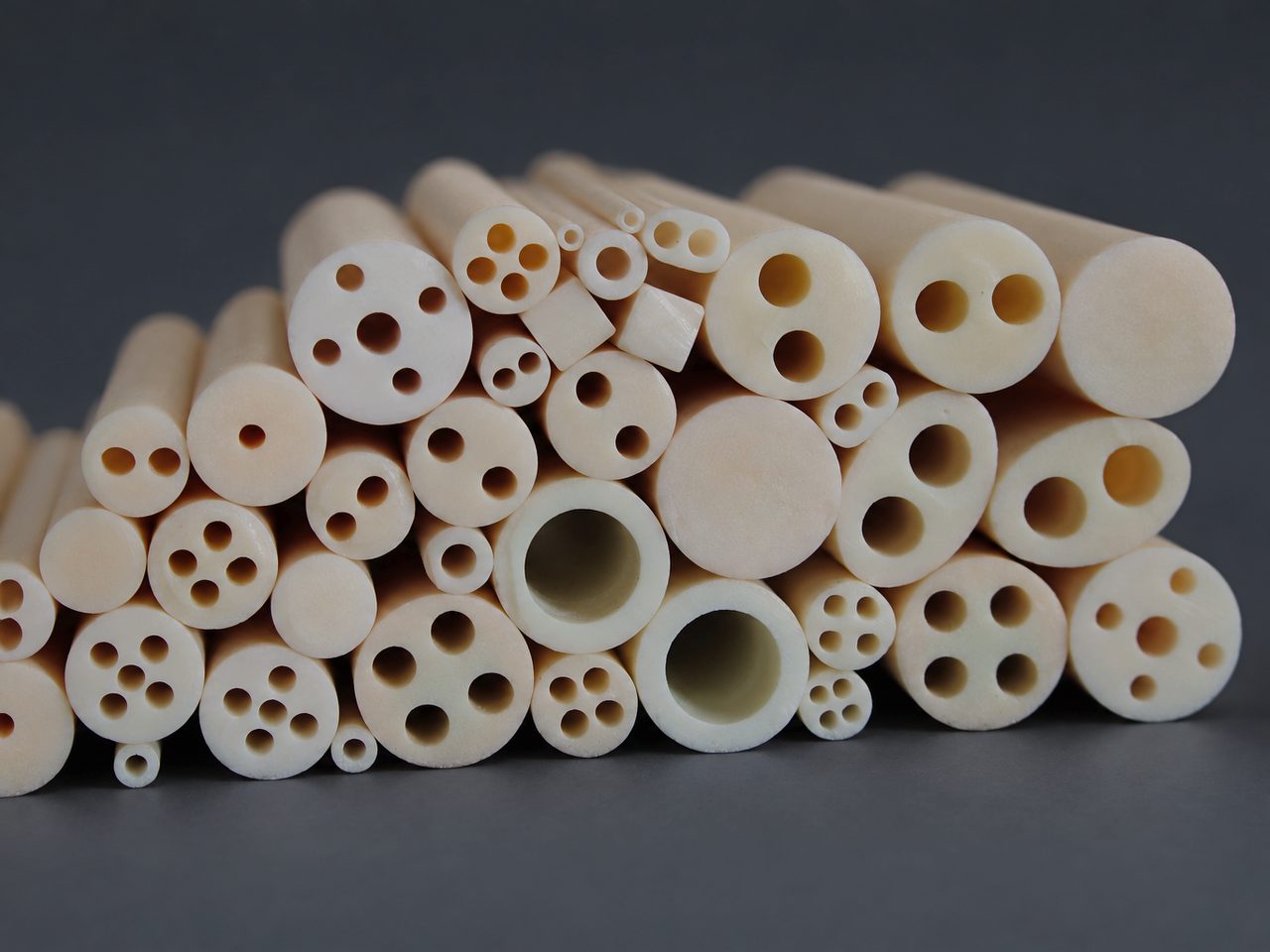
Manufacturing an alumina ceramic plate runs through five stages: ball-milling aluminum oxide powder with binders, forming a green blank by tape casting, dry pressing, cold isostatic pressing, or slip casting, burning out binders, sintering at high temperature, and diamond grinding to flatness. During sintering, the alumina body shrinks by about 20% in each direction, according to Precision Ceramics, and flat blanks tend to warp or bend as they densify. Holding tight thickness and flatness tolerances therefore requires post-sinter CNC surface grinding with diamond wheels.
Step-by-Step Alumina Plate Manufacturing Process
Every technical alumina plate starts with inorganic alpha-aluminum oxide (Al2O3) powder selected for controlled purity, particle size, and distribution. Manufacturers adjust the raw batch to match the target grade, ranging from about 90% Al2O3 up to high-purity grades such as 99.5% across commercial datasheets. Accuratus notes that additions such as chrome oxide or manganese oxide increase hardness and change color, while other oxide additions help metal films bond during later metallizing. In high-purity recrystallized grades above 99% Al2O3, Almath Crucibles limits magnesium oxide (MgO) additions to at most 0.05% to control grain growth during firing, and Kyocera Fineceramics Europe largely dispenses with sintering aids to protect grain boundaries from corrosion.
In the Kyocera production flow, raw powder and a solvating liquid such as water enter a rotating ball mill filled with ceramic grinding balls. Binder and dispersant additions keep fine particles evenly suspended in the resulting slurry. For dry-pressed plates, this slurry is atomized inside a hot-air spray dryer to produce free-flowing spherical granules that fill press dies evenly. For thin substrates and cast ware, the liquid slurry moves directly to tape casting or absorbent molds.
Once formed into an unfired green compact, the ceramic is chalk-like and easy to cut with super-hard drills and tools. Engineers machine complex outlines, holes, or steps in this green or pre-fired biscuit state while scaling every dimension up to compensate for firing shrinkage. The parts then enter temperature-controlled kilns. Initial heating drives off moisture and organic binders. At peak sintering temperatures below the melting point, solid-state mass transfer fuses particles across contact points from an initial compression-molded volumetric filling rate of about 60%, eliminating open pores. Depending on the ceramic grade, firing runs in air, vacuum, or non-oxidizing atmospheres. Where extreme density is needed, Kyocera notes that parts pre-sintered to almost 95% of theoretical density can undergo hot isostatic pressing (HIP) at 1,000 to 2,000 atmospheres of gas pressure.
After cooling, sintered alumina reaches extreme hardness and can only be machined with diamond tooling. Plates that need precise thickness, parallel faces, or mirror finishes move to diamond surface grinding, polishing, laser cutting, or diamond wire slicing before final dimensional and physical inspection.
- Stage 1, Milling and granulation: Ball-mill alpha-Al2O3 powder with water, dispersants, and binders into a uniform slurry, then use liquid slurry directly or spray-dry it into spherical press granules.
- Stage 2, Green plate forming: Shape the sheet or blank by doctor-blade tape casting, uniaxial dry pressing, cold isostatic pressing, slip casting, extrusion, injection molding, or hot pressing.
- Stage 3, Green or biscuit machining: Pre-machine holes, pockets, and outer contours before full densification to minimize expensive diamond grinding time.
- Stage 4, Binder burnout and sintering: Heat in controlled kilns to remove moisture and binders, then sinter to zero open porosity (or below 0.5% closed porosity in modern high-purity firing).
- Stage 5, Post-sinter finishing and inspection: Grind flat with diamond wheels, slice slots or outer profiles by laser or diamond wire, apply metallization if specified, and inspect dimensions.
| Forming Method | Feedstock Form | How the Blank Is Shaped | Typical Flat Geometry |
|---|---|---|---|
| Tape casting | Liquid slurry with binder and solvent | Doctor blade spreads slurry into a continuous thin green film | Thin electronic substrates, multilayer IC packages, chip capacitor sheets |
| Uniaxial dry pressing | Spray-dried spherical granules | Top and bottom punches compact powder inside a rigid metal die | High-volume machinery wear plates, washers, discs, insulator pads |
| Cold isostatic pressing (CIP) ) | Dry raw powder | Hydraulic fluid pressurizes powder sealed inside a flexible rubber mold | Thick blanks and large billets for green machining into plates |
| Slip casting | Slurry with liquid media and dispersant | Absorbent plaster mold draws out liquid to solidify a dense wall | Large refractory plates, furnaceware, crucibles, custom hollow shapes |
| Hot pressing | Raw ceramic powder | Simultaneous heat and uniaxial pressure inside a carbon mold | Simple flat discs and dense low-porosity plates |
| Extrusion | Clay-like plasticized paste | Forced under pressure through a shaped orifice die | Long strips, square bars, continuous flat profiles, tubes |
Shrinkage, Warpage Control, and Diamond Surface Grinding
Firing shrinkage is the central engineering constraint in ceramic plate manufacturing. According to Precision Ceramics, full sintering densification causes an alumina body to shrink by about 20% in each linear direction. Small local differences in green density or kiln temperature create slight variations in that shrinkage, making it impossible to hold very tight dimensional tolerances through pre-sinter green machining alone.
By our calculation from Precision Ceramics' 20% linear shrinkage figure, a sintered dimension equals 80% of its green dimension, meaning tooling engineers must size the unfired green compact to 1.25 times the target as-fired dimension before adding extra stock for post-sinter diamond grinding. Take a finished substrate measuring 130 mm x 130 mm x 1 mm, which is a standard recrystallized plate size made by Almath Crucibles (SUB130130). By our calculation from that 20% shrinkage rate, the green blank must start at 162.5 mm x 162.5 mm x 1.25 mm just to reach nominal fired size, plus additional thickness allowance if both faces will be ground flat.
Thin, wide alumina sheets also try to warp and bend as they densify in the kiln. Almath Crucibles addresses this firing camber by mounting sintered blanks onto an automated CNC surface grinder equipped with a magnetic mounting system and a resin-bonded diamond wheel, abrading both faces to exact thickness and flatness. Because fully dense alumina reaches 12 GPa to 18 GPa in hardness depending on purity, diamond is the only abrasive hard enough to cut it cleanly.
Secondary profiling and circuit preparation also happen after firing. Almath Crucibles uses ceramic laser cutting for sheet profiles and single-wire diamond wire cutting to crop, dice, wafer, and cut narrow features such as 0.25 mm thin slots. For electronic and vacuum assemblies, Kyocera, Morgan Technical Ceramics, and Precision Ceramics apply post-sinter polishing, glazing (used on thermal printhead substrates to reduce surface voids), or metallic paste firing and electroplating so the alumina plate can be brazed or soldered directly to copper sheets or metal housings.
Alumina Ceramic Plates in the Manufacturing Industry and Downtime Reduction
Across industrial plants, alumina ceramic plates replace metal, polymer, and glass components wherever heat, sliding abrasion, high voltage, or acid attack force frequent maintenance stops. Understanding how alumina ceramic plates in the manufacturing industry prevent premature part failure helps plant engineers target recurring downtime bottlenecks.
Mechanical wear and erosion cause a large share of unplanned line stoppages in powder handling, papermaking, textiles, and fluid metering. Precision Ceramics lists room-temperature hardness of 12 GPa and compressive strength of 2,000 MPa even on its 96% alumina. Compared with machinable glass-ceramics such as Macor, which Precision Ceramics notes has lower wear resistance and maximum use limits of 1,000 °C unstressed and 800 °C stressed, sintered alumina wear pads, tap plates, and abrasive flow deflector plates run far longer between changeovers.
Chemical inertness eliminates corrosion-driven downtime in semiconductor wet benches, metering valves, and chemical reactors. Accuratus states that dense alpha-alumina resists attack by all gases except wet fluorine and resists all common chemical reagents except hydrofluoric acid and phosphoric acid. Where hot alkali metal vapors are present, stepping up from a 94% or 96% grade to an above-99% purity removes the silicate glassy phases at the grain boundaries that otherwise corrode first.
To prevent ceramic plates themselves from cracking and causing furnace downtime, process engineers must respect thermal shock limits. When a hot ceramic plate cools rapidly, its outer skin contracts against a warmer core, generating surface tensile stress. Morgan Technical Ceramics reports a thermal downshock resistance of 170 to 300 delta °C for alumina, compared with 400 °C for silicon carbide, 400 to 500 °C for zirconia, and 900 °C for silicon nitride. Keeping plate thickness uniform, avoiding sharp internal corners, and controlling furnace ramp rates keep thermal gradients inside that safe window.
- Heavy wear and material handling: Abrasive flow deflector plates, chute wear pads, tap plates, valve seats, and papermaking dewatering elements.
- Semiconductor and LCD equipment: Wafer boats, electrostatic chucks, vacuum chucks, plasma-resistant chamber plates, polishing plates, and pad dressing plates.
- Electronics and power modules: Tape-cast thick-film and polished thin-film substrates, glazed printhead substrates, and high-strength plates compatible with direct-bonded copper.
- High-temperature kiln furniture: Ceramic setters, firing pads, heating element supports, and refractory hearth plates.
99% and High-Purity Alumina Setter Plates for MIM Sintering
Read more
In powder metallurgy, technical ceramic firing, and metal injection molding (MIM) sintering, green parts lose their structural stiffness during binder burnout and peak-temperature densification. They rely on flat ceramic setter plates to carry their weight without sagging, sticking, or picking up chemical contamination. High-purity alumina setters above 99% Al2O3 (including 99.5% recrystallized alumina) are widely used as kiln furniture when furnace cycles exceed the limits of mullite or silicon-bonded refractories.
Two material traits drive the choice of 99% and higher-purity alumina setter plates for MIM and specialty sintering: clean chemistry and atmosphere flexibility. Almath Crucibles notes that above-99% alumina sinters into an essentially single-phase ceramic free of glassy grain-boundary phases, preventing flux migration into metal or ceramic workpieces up to a maximum working temperature of 1,750 °C on its SUB130130 and SUB145145 plates. For protective furnace atmospheres used during metal sintering, Precision Ceramics states that alumina operates in both oxidizing and reducing atmospheres up to 1,650 °C (2,900 °F) and in vacuum up to 2,000 °C (3,600 °F). Accuratus further records high-purity alumina service in oxidizing and reducing atmospheres up to 1,925 °C, with vacuum weight loss between 10^-7 and 10^-6 g/(cm2·sec) over 1,700 °C to 2,000 °C.
Setter thickness and thermal cycling schedules must account for how alumina conducts heat at sintering temperatures. In the February 2025 Kyocera DEGUSSIT AL23 datasheet (above 99.5% alpha-Al2O3), thermal conductivity measures 34.9 W/(m·K) at 20 °C, drops to 6.8 W/(m·K) at 1,000 °C, and reaches 5.3 W/(m·K) at 1,500 °C. Because heat equalizes across the plate more than five times slower at peak sintering heat while mean linear thermal expansion reaches 8.2 x 10^-6/K (20 °C to 1,000 °C), thin setters such as 1 mm to 5 mm plates shed thermal gradients faster and survive repeated furnace cycles with less cracking than thick slabs.
Alumina Plate Grades and Properties Compared Across Makers
Selecting an alumina grade is a trade-off between ease of metallizing, mechanical wear life, chemical purity, and peak working temperature. Accuratus groups standard technical aluminas from 94% Al2O3, which contains glassy phase additives that make fired metal films bond reliably for brazed assemblies, through 96% Al2O3 for general electronic substrates and mechanical wear pads, up to 99.5% Al2O3 for aggressive chemical and high-heat service. Almath Crucibles likewise supplies its SUB130130 recrystallized alumina plate with a maximum working temperature of 1,750 °C.
Buyers also encounter European ceramic class codes on older drawings. Where higher mechanical strength or alkali resistance is needed than mullite provides, engineers step up to 95% or 96% alumina or to high-purity C799 alumina (99.5% Al2O3). Notice in the table below how density, elastic stiffness, room-temperature thermal conductivity, and maximum use temperature all climb as Al2O3 purity rises.
| Maker and Grade | Al2O3 Purity | Bulk Density | Flexural Strength | Elastic Modulus | Thermal Conductivity | Max No-Load Temp (Air) |
|---|---|---|---|---|---|---|
| Accuratus 94% | 94% | 3.69 g/cm3 (230.4 lb/ft3)) | 330 MPa (47 x 10^3 lb/in2)) | 300 GPa (43.5 x 10^6 lb/in2)) | 18 W/(m·K) (125 BTU·in/(ft2·hr·°F))) | 1,700 °C (3,090 °F)) |
| Accuratus 96% | 96% | 3.72 g/cm3 (232.2 lb/ft3)) | 345 MPa (50 x 10^3 lb/in2)) | 300 GPa (43.5 x 10^6 lb/in2)) | 25 W/(m·K) (174 BTU·in/(ft2·hr·°F))) | 1,700 °C (3,090 °F)) |
| Precision Ceramics CeramAlox 96 | 96% | 3.75 g/cm3 | 200 to 300 MPa | 300 GPa | 25 W/(m·K) ) | 1,600 °C |
| Accuratus 99.5% | 99.5% | 3.89 g/cm3 (242.8 lb/ft3)) | 379 MPa (55 x 10^3 lb/in2)) | 375 GPa (54.4 x 10^6 lb/in2)) | 35 W/(m·K) (243 BTU·in/(ft2·hr·°F))) | 1,750 °C (3,180 °F)) |
| Kyocera DEGUSSIT AL23 (Feb 2025) ) | Above 99.5% | 3.70 to 3.95 g/cm3 | 300 to 350 MPa | 380 GPa | 34.9 W/(m·K) at 20 °C | 1,950 °C |
Custom Flat Shapes, Discs, and Capabilities at GY Alumina
Read more
GY Alumina manufactures alumina and corundum ceramic parts at our factory in Tangshan, serving 100+ customers across furnace, thermocouple, laboratory, and industrial equipment companies. Our standard alumina materials and grades center on plain C799 alumina (99.5% Al2O3), which we sinter at about 1,760 °C (a kiln firing temperature, not a service rating). An independent lab analyzes one of our alumina tubes every year, recording 99.55% Al2O3 in 2024, 99.57% in 2025, and 99.61% in 2026. Where a buyer's drawing calls out C 610 (a mullite ceramic class in IEC 60672-1, which Precision Ceramics lists at 60% Al2O3), we supply 95% white alumina or our standard C799 instead, as neither grade is mullite. For crucibles, we produce 99% and 99.5% Al2O3.
Comparing tube forming alongside pressed ware helps clarify which geometries fit our production lines. In our factory, we shape parts using four forming methods: slip casting, pressing, extrusion, and hot pressing. Our secondary operations cover cutting to length, end slots, side holes and perforated tubes, and closed ends with drilled holes. Alongside thermocouple protection tubes (covered by our ISO 9001:2015 certificate for the manufacturing of ceramic protective tubes for thermocouples), multi-bore insulators, furnace tubes up to OD 100 x ID 90 x 1,000 mm by slip casting (and OD 17 x ID 10 mm by extrusion), and solid alumina rods stocked in eight diameters from 2 mm to 12 mm at about 2,400 mm long with a +0.2 mm diameter grinding allowance, we make custom alumina components to your drawing or physical sample.
Through our pressing, slip-casting, extrusion, and hot-pressing routes, we manufacture flat and custom shapes to your drawing or sample, including discs, washers, rings, bushings, square bars, balls, boats, crucibles, and other special shapes.
Buyer Specification Checklist
Complete part specifications prevent quoting delays and unnecessary machining costs across electronic substrates, diamond-ground wear pads, and pressed corundum discs or boats. Specify diamond-ground tolerances only on the faces and features that mate with other parts, and allow standard as-sintered tolerances on non-contact edges.
- Technical drawing or sample: Attach a 2D or 3D file (PDF, DWG, DXF, or STEP) or arrange to send a physical sample.
- Critical dimensions and tolerances: Call out length, width or diameter, thickness, flatness or camber limits, and one-sided tolerances on any through-holes or bores that must clear a pin or wire.
- Surface finish and machining state: State clearly which faces can remain as-sintered and which faces require post-sinter grinding, slotting, or drilled holes.
- Al2O3 purity grade: Name your required purity (such as 95% white alumina or C799 at 99.5% Al2O3) based on chemical exposure, metallizing needs, and temperature.
- Operating environment and thermal cycle: Include peak temperature, mechanical load, furnace atmosphere (air, reducing gas, vacuum, or alkali vapor), and heating or cooling ramp rates.
- Order quantity and stage: State the piece count and whether you are qualifying 5 to 10 approval samples or scheduling a production run.
- Destination and packing needs: Note your delivery country and preferred shipping terms for export crating.
How to Order and Lead Times
At GY Alumina, custom parts made to your drawing or sample usually start at 100 pieces per item and take 25 to 30 days to produce. Before running the full batch, we send 5 to 10 free samples for your approval, with the buyer paying the courier freight. Standard catalog sizes in stock ship in about 3 days for small orders and about 7 days for bulk orders.
Send your drawing, the grade, and the quantity. We usually reply with a quote within two working days.
Questions buyers ask
- Why can't alumina plates be machined to tight tolerances before sintering?
- According to Precision Ceramics, alumina shrinks by about 20% in each direction during sintering as interparticle pores close. Because shrinkage varies slightly across the part, tight thickness and flatness tolerances can only be achieved after firing by grinding with diamond tools.
- How is warpage corrected on sintered alumina ceramic plates?
- Sintered alumina plates tend to bend and warp during kiln firing. Manufacturers such as Almath Crucibles correct this camber on automated CNC surface grinders using a magnetic mounting setup and a resin-bonded diamond wheel to grind both faces flat and parallel.
- Which forming process is used for thin alumina electronic substrates versus thick wear plates?
- Kyocera produces continuous thin green sheets for electronic substrates and multilayer packages by tape casting liquid slurry under a doctor blade. Thicker structural wear plates, discs, and blanks are typically made by uniaxial dry pressing in metal dies, cold isostatic pressing in rubber molds, or slip casting.
- Why are above-99% alumina setter plates used in high-temperature and MIM sintering?
- High-purity recrystallized alumina above 99% Al2O3 forms a dense single-phase ceramic without glassy grain-boundary phases, which Almath Crucibles notes resists chemical reaction up to 1,750 °C. Precision Ceramics also rates alumina up to 1,650 °C (2,900 °F) in oxidizing and reducing atmospheres and 2,000 °C (3,600 °F) in vacuum.
- What custom flat ceramic parts and order terms does GY Alumina offer?
- GY Alumina makes discs, washers, rings, bushings, square bars, boats, crucibles, and custom shapes to drawing in 95% white alumina and C799 alumina (99.5% Al2O3) using slip casting, pressing, extrusion, and hot pressing. Custom parts usually start at 100 pieces with 25 to 30 days production lead time, and 5 to 10 free samples (buyer pays courier) are sent for approval first.
Sources
- Kyocera Fine Ceramics Production Process
- Kyocera Alumina (Al2O3) Material and Products
- Kyocera Fineceramics Europe DEGUSSIT AL23 Datasheet (February 2025)
- Kyocera Fineceramics Europe Alumina Overview
- Precision Ceramics Alumina Properties and Machining
- Precision Ceramics Alumina and Mullite Tubes and Rods
- Almath Crucibles SUB130130 Recrystallized Alumina Plate
- Almath Crucibles Automated CNC Surface Grinding and Ceramic Services
- Morgan Technical Ceramics Thermal Shock Resistance
- Morgan Technical Ceramics High-Performance Alumina
- Accuratus Aluminum Oxide (Al2O3) Material Properties
- GY Alumina Materials and Corundum Grades
- GY Alumina Factory and Capabilities
- GY Alumina Custom Components Made to Drawing
- GY Alumina Buyer FAQ
Last checked .