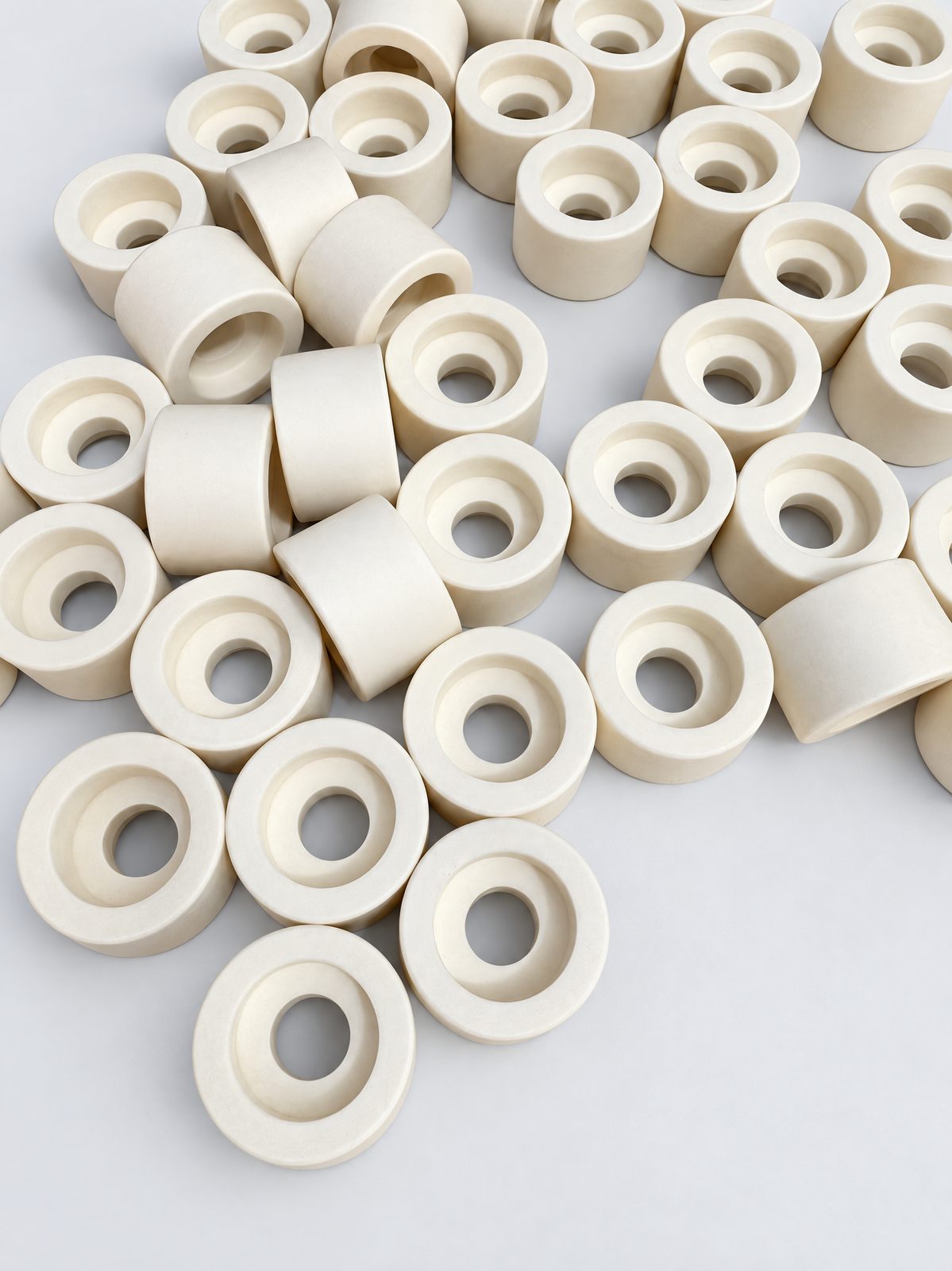
An alumina plate for electronics serves as an electrically insulating, heat-dissipating base or circuit substrate in power modules, high-voltage assemblies, and radio-frequency equipment. Commercial grades from 94% to 99.5% Al2O3 deliver room-temperature thermal conductivity from 18 W/m K in Accuratus 94% alumina to 35 W/m K in Accuratus 99.5% alumina, with volume resistivity above 10^14 ohm-cm. Specifying the right part starts with separating bare thermal insulators from metallized circuit substrates, matching purity to frequency and heat load, and setting post-firing tolerances only on active surfaces.
How Alumina Plates Work in Power Electronic Systems
Buyers specifying an alumina plate in power electronic systems are usually sourcing one of two distinct part types: a bare ceramic thermal insulator plate or a finished circuit substrate. Separating these two categories early prevents quotation delays and mismatched supplier capabilities.
Bare thermal and structural insulator plates sit between heat-generating components and metal cold plates or grounded housings, conducting heat away while blocking high voltage. Kyocera Fineceramics Europe lists heat-dissipating structural substrates, power module substrates, electrical insulator parts, ceramic feedthroughs, and vacuum circuit-breaker components among its technical alumina parts, while Almath Crucibles supplies flat rectangular recrystallized alumina sheets such as its 100 mm x 100 mm x 10 mm SUB100100 plate (0.385 kg, 1750 °C maximum working temperature). Circuit substrates undergo specialized surface preparation or conductive metallization so traces and dies bond directly to the ceramic. Kyocera Global groups these into thick-film, thin-film, and polished substrates for electronics, while Accuratus, Morgan Technical Ceramics, and Precision Ceramics note that alumina accepts fired metallizing layers such as moly-manganese (on Morgan Technical Ceramics AL995) for high-temperature brazing of vacuum-tight assemblies.
Two international standards anchor drawing callouts. ASTM D2442 (active edition D2442-75R25), Standard Specification for Alumina Ceramics for Electrical and Electronic Applications, sets electrical, mechanical, thermal, and general property limits and test methods for fabricated electronic alumina parts and ceramic-to-metal seals regardless of geometry. Internationally, IEC 60672-1:1995 (published June 27, 1995, stability date 2029) classifies ceramic electrical insulating materials, and IEC 60672-3:1997 (published October 17, 1997, stability date 2029) gives property specifications for individual classes including high-alumina C 799.
Alumina Ceramic Plates in the Electronics Industry: Grades Compared
Across alumina ceramic plates in the electronics industry, Al2O3 purity controls grain-boundary chemistry for metallization, bulk thermal conductivity, and dielectric loss. Sintering additives create glassy secondary phases that aid fired paste adhesion at lower firing temperatures, whereas removing glassy phases boosts thermal conductivity, electrical resistance, and corrosion resistance.
At 94% to 96% Al2O3, technical alumina serves general insulators and brazed assemblies. Accuratus describes its 94% alumina as an easily metallizable composition with 18 W/m K thermal conductivity and 330 MPa flexural strength, where targeted body additions improve fired metal film consistency. Stepping up to 96% Al2O3 raises room-temperature thermal conductivity to 25 W/m K in both Accuratus 96% alumina and Precision Ceramics CeramAlox 96 for balanced cost and performance.
Above 99% Al2O3, glassy phases largely disappear. Almath Crucibles notes that MgO additions up to 0.05% control grain growth while modern firing keeps closed porosity below 0.5%. In Accuratus's room-temperature tables, moving from 96% alumina to 99.5% alumina raises thermal conductivity from 25 W/m K to 35 W/m K and lowers the 1 kHz dissipation factor from 0.0011 to 0.0002. Morgan Technical Ceramics highlights low particle generation in its 99.5% AL995 grade for semiconductor chambers, sputtering targets, lasers, and klystron or x-ray power tubes.
| Manufacturer and Grade | Al2O3 Purity | Density (g/cm3) | Flexural Strength (MPa) | Thermal Conductivity (W/m K) | Dielectric Strength (kV/mm) | Dielectric Constant (1 MHz) | Loss or Dissipation |
|---|---|---|---|---|---|---|---|
| Accuratus 94% Alumina | 94% | 3.69 | 330 | 18 | 16.7 AC (418 V/mil) | 9.1 | 0.0007 (at 1 kHz) |
| Accuratus 96% Alumina | 96% | 3.72 | 345 | 25 | 14.6 AC (365 V/mil) | 9.0 | 0.0011 (at 1 kHz) |
| Precision Ceramics CeramAlox 96 | 96% | 3.75 | 200 to 300 | 25 | 9 DC | 9.8 | 0.0001 (at 1 MHz) |
| Morgan Technical Ceramics AL995 | 99.5% | 3.86 | 310 | 29.3 | 31.5 DC (800 V/mil) | 9.58 (at 10 MHz) | 0.00003 (at 10 MHz) |
| Accuratus 99.5% Alumina | 99.5% | 3.89 | 379 | 35 | 16.9 AC (420 V/mil) | 9.8 | 0.0002 (at 1 kHz) |
| Kyocera DEGUSSIT AL23 | Above 99.5% | 3.70 to 3.95 | 300 to 350 | 34.9 (at 20 °C) | 20 to 30 | - | - |
High-Frequency RF and High-Temperature Electrical Data
Room-temperature 1 MHz values shift once circuits enter gigahertz frequencies or exceed 300 °C.
Volume resistivity drops sharply with heat. Beyond the Morgan AL995 values in the table below, Kyocera's April 3, 2023 datasheet for AO479O (at least 99% Al2O3, JIS C 2141) records above 10^14 ohm*cm at 20 °C, 10^10 ohm*cm at 300 °C, and 10^8 ohm*cm at 500 °C. At 1000 °C under ASTM D1829, Almath Crucibles reports 2 x 10^6 ohm-cm for its 99.5% alumina.
Always check specimen thickness and voltage waveform when comparing breakdown ratings. Almath Crucibles reports 8.7 AC kV/mm for its 99.5% alumina under ASTM D116 on a thick 6.25 mm specimen, whereas Kyocera's February 2025 DEGUSSIT AL23 datasheet lists 20 kV/mm to 30 kV/mm under DIN EN 60243-1 and Morgan AL995 lists 31.5 DC kV/mm (800 V/mil). Thicker plates and AC waveforms yield lower kV/mm figures than thin DC test pieces.
| Property and Frequency | Value at 25 °C | Value at 300 °C | Value at 500 °C |
|---|---|---|---|
| Dielectric constant K1 at 10 MHz | 9.58 | 9.92 | 10.20 |
| 9.30 | - | - | |
| Dielectric constant K1 at 8500 MHz (8.5 GHz) | 9.37 | 9.61 | 9.82 |
| Dissipation factor at 10 MHz | 0.00003 | 0.00009 | 0.00040 |
| Dissipation factor at 1000 MHz (1 GHz) | 0.00014 | - | - |
| Dissipation factor at 8500 MHz (8.5 GHz) | 0.00009 | 0.00014 | 0.00025 |
| Loss factor at 8500 MHz | 0.00084 | 0.00135 | 0.00245 |
| Volume resistivity (ohm.cm) | Above 10^14 | 2.0 x 10^11 | 2.2 x 10^9 |
Worked Example: Sizing Thermal Resistance Across a Plate
You can check ideal through-thickness conduction between 96% and 99.5% alumina using Fourier's conduction equation, Rth = d / (k x A), where d is thickness in meters, k is thermal conductivity in W/m K, and A is active heat-transfer area in square meters.
Take a worked case written by our team using Accuratus room-temperature data: a 70 W power resistor sits on an active footprint of 25 mm x 40 mm (1000 mm2, or 0.001 m2) across a 1 mm (0.001 m) alumina plate. By our calculation from Accuratus's datasheets, 96% alumina (k = 25 W/m K) gives an ideal bulk resistance of 0.001 m / (25 W/m K x 0.001 m2) = 0.04 K/W and a 2.8 °C temperature rise at 70 W. Upgrading that 1 mm plate to Accuratus 99.5% alumina (k = 35 W/m K) lowers bulk resistance to 1/35 K/W and cuts the ceramic temperature drop to 2.0 °C.
That 0.8 °C gap shows why surface contact matters: an insulating air gap under a bowed as-fired plate adds more thermal resistance than stepping from 96% to 99.5% purity. Reserve 99.5% grades for tight thermal budgets, gigahertz loss limits, or clean vacuum duty, and account for conductivity drops in hot zones. In Kyocera DEGUSSIT AL23 (DIN EN ISO 18755), thermal conductivity falls from 34.9 W/m K at 20 °C to 6.8 W/m K at 1000 °C and 5.3 W/m K at 1500 °C.
Alumina vs Rival Electronic Ceramics: AlN, Silicon Nitride, ZTA, and Macor
Read more
Alumina handles most electrical insulation jobs cost-effectively with high compressive strength (2000 MPa to 3500 MPa across Precision Ceramics grades), but four operating demands favor another technical ceramic.
| Ceramic Material | Thermal Downshock Delta T (°C) | Primary Engineering Advantage | Key Trade-Off Reported in Sources |
|---|---|---|---|
| Alumina (Al2O3) | 170 to 300 | Cost-effective DC-to-GHz insulation, high hardness, 1600 °C to 1950 °C max no-load air ratings | Requires post-firing diamond grinding for tight tolerances, moderate thermal shock |
| Silicon Nitride (Si3N4) | 900 | Very low thermal expansion and highest thermal downshock rating in Morgan's table | Chosen for severe thermal cycling rather than baseline insulation cost |
| Zirconia (ZrO2) | 400 to 500 | Highest fracture toughness among oxide monolith ceramics (Precision Ceramics) | Lower thermal downshock resistance than silicon nitride |
| Aluminum Nitride (AlN / Shapal Hi M Soft) | - | High thermal conductivity with electrical insulation (machinable in Shapal Hi M Soft) | Selected when heat dissipation exceeds alumina's 18 W/m K to 45 W/m K range |
| Macor Machinable Glass Ceramic | - | Machinable with conventional tools, cutting small-batch cost | Capped at 1000 °C unstressed and 800 °C stressed, lower wear and shock resistance |
Forming, Sintering Shrinkage, Machining, and Mounting Design
Read more
Across the ceramics industry, makers form alumina by dry pressing, isostatic pressing, slip casting, extrusion, or injection molding, and machine green or biscuit-fired bodies into complex shapes before final firing. Full densification during sintering shrinks the alumina body by approximately 20%, as reported by Precision Ceramics. Because pre-sintered machining cannot hold ultra-tight dimensions across 20% shrinkage, tight flatness, parallelism, and fine finishes require post-firing diamond grinding, lapping, polishing, CNC diamond milling, laser cutting, or diamond wire cutting (processes listed by Precision Ceramics and Almath Crucibles). Kyocera notes that fine high-purity microstructures support fine machining for thin-film and polished surfaces, whereas as-fired pressed faces lower cost where standard tolerances fit.
Design mechanical mounts around brittle mechanics rather than sheet metal rules. Alumina combines high compressive strength (2500 MPa in Kyocera DEGUSSIT AL23) with much lower tensile strength (140 MPa to 200 MPa in Precision Ceramics data). Clamping onto a warped heatsink puts the plate into bending tension, so use flat mating faces, compliant thermal interface layers, or even spring-clip pressure to keep loads compressive.
Allow for differential expansion and chemical exposure at elevated temperatures. On Morgan AL995, the coefficient of thermal expansion climbs from 6.9 x 10^-6 /°C (25 °C to 200 °C) to 8.3 x 10^-6 /°C (400 °C to 600 °C) and 9.4 x 10^-6 /°C (800 °C to 1000 °C). Accuratus notes that high-purity alumina operates in oxidizing and reducing atmospheres to 1925 °C (Precision Ceramics cites 1650 °C or 2900 °F for general grades in air and 2000 °C or 3600 °F in vacuum, with Accuratus recording vacuum weight loss of 10^-7 to 10^-6 g/cm2.sec from 1700 °C to 2000 °C), resisting all gases except wet fluorine and all common reagents except hydrofluoric and phosphoric acid. Specify 99.5% or higher purity around hot alkali metal vapors, which attack glassy phases in lower-purity grades.
Buyer Specification Checklist for Electronic Alumina Plates
Run through this seven-point checklist written by our team before sending drawings out for quotation. Calling out tight tolerances and ground finishes only on active mating faces avoids unnecessary machining cost.
- Part function: State whether you need a bare thermal insulator plate, a pressed structural spacer or disc, a polished thin-film carrier, or a metallized substrate for brazing.
- Purity and standard: Specify minimum Al2O3 content (such as 95%, 96%, or 99.5% / C799) and any applicable standard such as ASTM D2442-75R25 or IEC 60672-3:1997.
- Envelope and critical tolerances: Give length, width or outer diameter, and thickness in millimeters, separating critical fit tolerances from open as-fired dimensions.
- Surface condition and flatness: Note whether as-fired pressed faces work or if active thermal faces need post-firing grinding, lapping, or polishing.
- Holes, slots, and clearances: Dimension hole diameters, slot widths, and edge distances, and name any mating pin, wire, or fastener diameter that must pass through.
- Electrical duty: List peak AC or DC voltage, operating frequency (DC, MHz, or GHz), and required insulation resistance at peak temperature.
- Thermal and chemical environment: State operating temperature, wattage, cooling ramp delta T (against alumina's 170 °C to 300 °C downshock range), and vacuum or vapor exposure.
What GY Alumina Makes and What to Send for a Quote
GY Alumina manufactures industrial alumina and corundum parts at our factory in Tangshan, China, with 100+ customers served across furnace, thermocouple, laboratory, and industrial companies. Specialist substrate factories produce thin tape-cast electronic wafers, diamond-lapped thin-film carriers, and metallized DBC or DPC boards. At GY Alumina, our product lines cover thermocouple protection tubes, thermocouple insulators and multi-bore tubes, furnace tubes, crucibles and boats (99% and 99.5% Al2O3), solid alumina rods (eight stock diameters from 2 mm to 12 mm, about 2,400 mm long, with a +0.2 mm grinding allowance on the diameter), and custom ceramic parts made to your drawing or sample.
Using slip casting, pressing, extrusion, and hot pressing, we make custom discs, rings, washers, bushings, solid rods, square bars, balls, round, elliptical, and square tubes (open or one end closed), multi-bore tubes and capillaries, threaded, ribbed, perforated, and slotted tubes, crucibles, boats, and other shapes to drawing. Secondary operations in our factory include cutting to length, end slots, side holes and perforated tubes, and closed ends with drilled holes.
Our standard grade is C799 alumina (99.5% Al2O3), with corundum ware sintered at about 1,760 °C (a firing temperature, not a service rating). Where a drawing names C 610, we supply 95% white alumina or our standard C799 alumina instead, and neither is mullite. An independent lab analyzes one of our alumina tubes each year, recording 99.55% Al2O3 (2024), 99.57% (2025), and 99.61% (2026), and our ISO 9001:2015 certificate covers the manufacturing of ceramic protective tubes for thermocouples.
Custom parts to drawing or sample usually start at 100 pieces per item and take 25 to 30 days to produce, with 5 to 10 free samples sent for approval first (you pay the courier), while standard stock sizes ship in about 3 days for small orders to about 7 days for bulk orders. When inquiring on a custom disc, spacer, or component, include a PDF, DWG, DXF, or STEP drawing (or sample), critical tolerances, any mating pin or wire size, operating temperature, and destination country. Send your drawing, the grade and the quantity. We usually reply with a quote within two working days.
Questions buyers ask
- What is the difference between an alumina thermal plate and an electronic ceramic substrate?
- A bare alumina thermal plate acts as a passive electrical insulator and heat spreader clamped between hot components and a chassis or cold plate. An electronic ceramic substrate (such as the thick-film, thin-film, and polished substrates listed by Kyocera, or moly-manganese metallized parts noted by Morgan Technical Ceramics) receives specialized surface finishing or conductive layers so circuits and dies bond directly to the ceramic.
- Should I choose 96% or 99.5% alumina for electronic components?
- Choose 96% alumina (25 W/m K thermal conductivity in Accuratus and Precision Ceramics data) for general electrical insulators, cost-sensitive substrates, and fired metallization. Choose 99.5% alumina (29.3 W/m K to 35 W/m K across Morgan AL995, Kyocera DEGUSSIT AL23, and Accuratus 99.5%) when your design requires higher thermal conductivity than 96% alumina, lower gigahertz loss, or high purity in vacuum and semiconductor chambers.
- Which standards cover alumina ceramics used in electrical and electronic equipment?
- ASTM D2442 (active edition D2442-75R25) sets electrical, mechanical, thermal, and general property requirements and test methods for fabricated electronic alumina parts and ceramic-to-metal seals. Internationally, IEC 60672-1:1995 classifies ceramic electrical insulating materials and IEC 60672-3:1997 lists typical property specifications for individual classes including C 799.
- Why do tight-tolerance alumina plates need diamond grinding after firing?
- Precision Ceramics reports that alumina bodies shrink by approximately 20% during sintering to reach full density. Because pre-sintered green machining cannot hold ultra-tight final dimensions across that 20% shrinkage, parts needing tight flatness, thickness, or hole tolerances are ground, lapped, or machined with diamond tools after firing.
- What custom alumina parts does GY Alumina make to drawing?
- GY Alumina makes custom ceramic parts to drawing or sample in C799 alumina (99.5% Al2O3) and 95% white alumina via pressing, slip casting, extrusion, and hot pressing, including discs, rings, washers, bushings, bars, rods, tubes, and special shapes. Custom items usually start at 100 pieces per item with 5 to 10 free approval samples (buyer pays courier) and a 25 to 30 day production lead time.
Sources
- Precision Ceramics: Alumina Properties and Industrial Applications
- Accuratus: Aluminum Oxide (Al2O3) Ceramic Properties
- Morgan Technical Ceramics: AL995 High Purity Alumina Datasheet
- Morgan Technical Ceramics: Thermal Shock Resistance in Ceramics
- Morgan Technical Ceramics: High-Performance Alumina Ceramics
- Kyocera Fineceramics Europe: DEGUSSIT AL23 Datasheet (February 2025)
- Kyocera Fineceramics Europe: AO479O Alumina Datasheet (April 2023)
- Kyocera Fineceramics Europe: Alumina Materials and Products
- Kyocera Global: Fine Ceramics Products by Industry
- Almath Crucibles: Alumina Ceramic Material Properties
- Almath Crucibles: SUB100100 Alumina Plate 100mm x 100mm x 10mm
- ASTM International: ASTM D2442 Standard Specification for Alumina Ceramics for Electrical and Electronic Applications
- IEC Webstore: IEC 60672-1:1995 Ceramic and Glass Insulating Materials - Part 1
- IEC Webstore: IEC 60672-3:1997 Ceramic and Glass-Insulating Materials - Part 3
- GY Alumina: Custom Alumina Components Made to Drawing or Sample
- GY Alumina: Alumina and Corundum Grades Material Data
- GY Alumina: Alumina Ceramics Factory in Tangshan
- GY Alumina: Buyer FAQ on MOQ, Lead Time, Samples, and ISO 9001
Last checked .