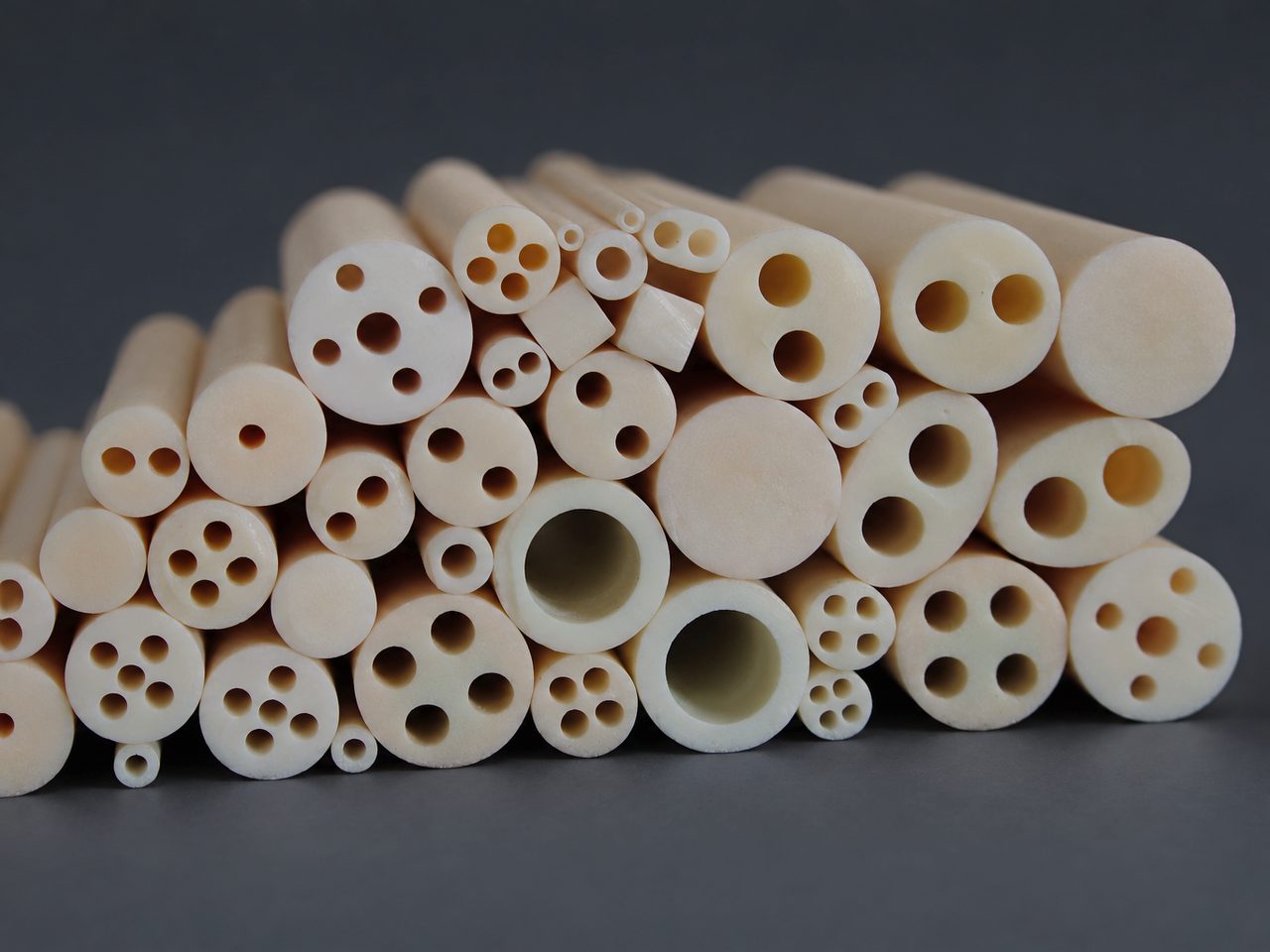
An alumina pin (aluminum oxide or Al2O3 pin) is a hard, electrically insulating ceramic cylinder or stepped dowel used as a welding centering pin, fixture locating pin, high-temperature furnace support, or metrology pin gauge. Published 99.5% Al2O3 grades reach 2600 MPa compressive strength and 1750 °C (3180 °F) no-load temperature in Accuratus datasheets, while post-sinter diamond grinding holds tolerances down to ±.01mm in Precision Ceramics machining specifications. Choose your grade and geometry around compressive seating, thermal shock limits, and whether your part needs finish diamond grinding or an extruded rod blank.
What an Alumina Pin Does Across Welding, Furnaces and Gauging
Searchers looking for an alumina pin, alumina ceramic pin, or aluminum oxide pin are usually buying one of three distinct engineering parts. Catalog pages often mix them together, even though their tolerances, surface finishes, and failure modes differ sharply.
The first group covers Al2O3 locating pins, ceramic positioning pins, and welding centering pins for automated assembly and resistance welding. In KYOCERA Fineceramics Europe's welding equipment line, technical ceramic centering pins fix, convey, and shape metals such as iron or aluminum. Because sintered aluminum oxide is electrically insulating, weld current cannot shunt or arc through the locating pin into the fixture base. Kyocera also notes that ceramic centering pins have low surface adhesion so molten weld spatter does not build up, and their high operating temperature reduces coolant demand around the weld zone.
The second group covers high-temperature furnace pins, kiln support pins, and electrical insulator pins. Precision Ceramics lists heating element supports and high-voltage or high-temperature insulators among core applications for its 96% and higher-purity alumina grades, while Accuratus notes high-purity alpha alumina operates in both oxidizing and reducing atmospheres up to 1925 °C, alongside general industrial service in Precision Ceramics data up to 1650 °C (2900 °F) in oxidizing or reducing atmospheres and up to 2000 °C (3600 °F) in vacuum. These pins hang or align components where metal alloy pins soften, oxidize, or short out heating elements.
The third group covers alumina ceramic pin gauges, precision shafts, axles, and wear dowels. Morgan Technical Ceramics produces precision-machined alumina metrology components, metering valves, and sliding bearings, and Precision Ceramics machines tight-tolerance shafts, axles, and wire guides for abrasive or corrosive service. In chemical valves and analytical instruments, Accuratus notes that alumina resists attack from all gases except wet fluorine and all common reagents except hydrofluoric acid and phosphoric acid.
- Welding centering pins and Al2O3 locating pins: electrically isolate stamped sheet metal and weld nuts, prevent current shunting, and stop weld spatter build-up.
- Furnace and insulator support pins: align heating elements, sample holders, and refractory assemblies in air, inert gas, reducing gas, or vacuum without metal creep.
- Alumina ceramic pin gauges and wear shafts: hold dimensional stability under sliding friction in metrology fixtures, semiconductor handling, and corrosive chemical equipment.
Alumina Pin Properties by Grade and Manufacturer
Industrial alumina is produced in purity tiers from 85% Al2O3 upward, with sintering additives or dopants such as chrome oxide or manganese oxide sometimes added to adjust hardness, color, or metallization behavior. Morgan Technical Ceramics groups component grades into standard alumina at 85% to 95% Al2O3 for general wear parts and electrical insulators, and high-purity alumina at 96% to 99.5% Al2O3 for semiconductor equipment, analytical instruments, medical devices, and vacuum systems.
Moving from 94% or 96% alumina up to 99.5% Al2O3 reduces the glassy silicate grain-boundary phase. As the published manufacturer values below show, higher purity raises bulk density, elastic stiffness (375 GPa elastic modulus in Accuratus 99.5% Al2O3), hardness, thermal conductivity, and high-temperature alkali resistance. Accuratus notes that alkali metal vapors attack alumina at elevated temperatures, particularly in lower-purity compositions, while 94% alumina remains a preferred choice when the ceramic pin must be metallized and brazed into a metal collar.
Notice that higher purity does not turn alumina into a ductile material. Fracture toughness stays between 3.5 MPa m^1/2 and 4.5 MPa m^1/2 across the 94% to 99.5% grades in the table below, so a 99.5% locating pin still requires proper shoulder seating and protection from side-impact blows.
| Maker and Grade | Al2O3 Purity | Density | Flexural Strength | Compressive Strength | Hardness | Thermal Conductivity | Max Temp in Air |
|---|---|---|---|---|---|---|---|
| Accuratus 94% Al2O3 | 94% | 3.69 g/cm3 | 330 MPa | 2100 MPa | 1175 kg/mm2 | 18 W/mK | 1700 °C (3090 °F) no load |
| Accuratus 96% Al2O3 | 96% | 3.72 g/cm3 | 345 MPa | 2100 MPa | 1100 kg/mm2 | 25 W/mK | 1700 °C (3090 °F) no load |
| Precision Ceramics CeramAlox 96 | 96% | 3.75 g/cm3 | 200-300 MPa | 2000 MPa | 12 GPa | 25 W/mK | 1600 °C no load |
| Accuratus 99.5% Al2O3 | 99.5% | 3.89 g/cm3 | 379 MPa | 2600 MPa | 1440 kg/mm2 | 35 W/mK | 1750 °C (3180 °F) no load |
| Kyocera DEGUSSIT AL23 | Above 99.5% | 3.70-3.95 g/cm3 | 300-350 MPa | 2500 MPa | 17.1 GPa (HV 1.0)| | 34.9 W/mK at 20 °C | 1950 °C |
Alumina vs Zirconia, Silicon Nitride, ZTA and Macor for Pins
Alumina is the default technical ceramic for wear pins and electrical locating dowels when sliding abrasion, voltage isolation, and part cost drive the specification. Every grade in the table above delivers volume resistivity above 10^14 ohm-cm at room temperature, alongside dielectric strength from 9 kV/mm DC in CeramAlox 96 up to 20-30 kV/mm in Kyocera DEGUSSIT AL23.
Heavy mechanical shock or extreme thermal quenching pushes fixture designers toward three alternative pin ceramics. Kyocera manufactures welding centering pins in alumina, zirconia, and silicon nitride so buyers can match the ceramic to the mechanical impact and thermal cycle of the station. Precision Ceramics points out that zirconia has the highest fracture toughness among monolith oxide ceramics, while Zirconia Toughened Alumina (CeramAlloy ZTA) blends an alumina matrix with zirconia to keep alumina's high hardness alongside higher fracture toughness and bending strength.
Thermal shock resistance separates silicon nitride from oxide ceramics in water-cooled or rapid-cycle welding guns. Morgan Technical Ceramics lists thermal downshock resistance (delta °C) at 900 °C for silicon nitride, 400-500 °C for zirconia, 400 °C for silicon carbide, and 170-300 °C for alumina. By our calculation from Morgan Technical Ceramics's thermal downshock table, silicon nitride tolerates 3 times the rapid temperature drop of alumina's 300 °C upper limit (a 600 °C wider quench margin). For low-quantity fixture prototypes that never see weld spatter or heavy sliding wear, Macor machinable glass ceramic cuts with conventional tooling for lower small-batch cost in Precision Ceramics's comparison, though it drops in wear resistance, thermal shock tolerance, and temperature ceiling to 1000 °C unstressed and 800 °C stressed.
| Material | Key Mechanical and Thermal Traits | Primary Pin Use Case |
|---|---|---|
| Alumina (Al2O3_ | 12-18 GPa hardness and 2000-3500 MPa compressive strength in CeramAlox grades, 170-300 °C Morgan thermal downshock | Abrasion-resistant locating pins, electrical insulator pins, furnace supports, and metrology pins |
| Zirconia (ZrO2_ | Highest fracture toughness among monolith oxide ceramics in Precision Ceramics data, 400-500 °C Morgan thermal downshock | Welding centering pins and sheet-metal locating dowels exposed to part-loading knocks |
| Zirconia Toughened Alumina (ZTA_ | Combines high alumina hardness with higher fracture toughness and bending strength in CeramAlloy ZTA | High-wear positioning pins needing extra chip resistance over straight alumina |
| Silicon Nitride (Si3N4_ | Low thermal expansion and 900 °C thermal downshock resistance in Morgan's comparison | Severe thermal-cycle welding centering pins and cooled projection-welding tooling |
| Macor Glass Ceramic | Machinable with standard tools, lower wear resistance, max 1000 °C unstressed and 800 °C stressed | Small-quantity, low-wear insulating fixture prototypes without rapid thermal cycling |
Forming, Shrinkage and Diamond Grinding Tolerances
How an alumina pin is formed and finished determines both its unit cost and the tolerances you can put on your drawing. Across the technical ceramics industry, manufacturers shape green alumina bodies by dry or die pressing, extrusion, slip casting, isostatic pressing, and ceramic injection molding. Extrusion efficiently produces constant-cross-section round rods, square bars, and single- or multi-bore profiles, whereas pressing or green machining creates stepped heads, tapers, and flanges.
Green or biscuit-fired alumina cuts readily into complex stepped pin geometries, including external threads, cross-holes, and flats. However, Precision Ceramics notes that sintering to full density shrinks the alumina body by about 20%. Because kiln shrinkage varies slightly with part cross-section and orientation, as-sintered surfaces work well for furnace blanket pins, non-contact shanks, and clearance shoulders, while tight press-fit or locating diameters require post-sinter diamond machining.
Once sintered to Mohs 8 to 9 hardness (12 GPa to 18 GPa), alumina can only be sized with diamond wheels and diamond tooling. As the machining table below shows, post-sinter diamond grinding holds tighter general tolerances and finer surface finishes than CNC turning, while 5-axis and CNC milling centers with a 1000mm in X by 510mm in Y bed capacity and 250mm turning diameter add synchronized rigid tapping for internal threads. Where a ceramic pin must attach permanently to a metal base or vacuum feedthrough, Morgan Technical Ceramics notes that alumina can be metallized and furnace-brazed into ceramic-to-metal assemblies.
| Machining Process | General Tolerance | Tight Achievable Tolerance | Surface Finish Grade |
|---|---|---|---|
| Diamond Grinding | ±.02mm | ±.01mm | N2/N3 |
| CNC Turning (up to 250mm diameter_ | ±.03mm | ±.01mm | N4/N5 |
Preventing Brittle Fracture, Bending Failure and Thermal Fit Issues
Read more
Nearly every premature alumina pin failure in a fixture traces back to one of three avoidable design mistakes: loading a slender pin in cantilever bending, trapping the ceramic shank inside an expanding or clamping metal bore without compliance, or quenching a hot pin past its thermal shock threshold.
First, design around alumina's wide gap between compressive and tensile strength. In Precision Ceramics's CeramAlox 96 datasheet, compressive strength is 2000 MPa while tensile strength is 140 MPa. By our calculation from that CeramAlox 96 table, the material is about 14.3 times stronger in compression than in tension. When a heavy stamping hits the tip of a long, unsupported locating pin sideways, the root of the pin sees tensile bending stress rather than pure compression. Keep unsupported pin projection as short as the stamping allows, seat stepped pins against a flat, square shoulder so clamping forces stay axial, and specify generous fillet radii at diameter steps alongside entry chamfers on the locating tip.
Second, account for thermal expansion where a ceramic pin mounts into a metal fixture block or furnace holder. Published mean linear thermal expansion coefficients reach 7.0 x 10^-6 /K from 25 °C to 700 °C in CeramAlox 96 and 8.2 x 10^-6 /K from 20 °C to 1000 °C in Kyocera DEGUSSIT AL23. Size metal mounting bores, bushings, and mechanical retainers with enough radial clearance or axial compliance so heating and cooling cycles neither loosen pin alignment nor pinch the ceramic shank.
Third, manage cooling rates in cycled furnaces and cooled weld tooling. Morgan Technical Ceramics explains that rapid cooling drops the outer skin temperature of a ceramic faster than its core, putting the contracting skin into tension until surface cracks initiate once the temperature drop crosses 170-300 °C for alumina. That internal temperature gradient grows steeper at furnace temperatures because alumina conducts heat much less rapidly when hot: in Kyocera's DEGUSSIT AL23 datasheet, thermal conductivity falls from 34.9 W/mK at 20 °C to 6.8 W/mK at 1000 °C and 5.3 W/mK at 1500 °C. Avoid blasting hot alumina pins directly with cold water jets or cold compressed air immediately after high-temperature exposure.
- Keep loads compressive: back stepped locating pins with a flat seating shoulder and shorten unsupported cantilever length where side loads occur.
- Eliminate stress risers: replace sharp internal step corners with smooth radii and add lead-in chamfers on the pin nose so sheet-metal holes self-center without edge chipping.
- Size mounting bores for thermal expansion: give metal mounting bores and retainers radial clearance or axial compliance so thermal cycling neither loosens alignment nor pinches the ceramic shank.
- Stay inside the 170-300 °C downshock window: use controlled air cooling or switch to zirconia or silicon nitride when tooling sees direct liquid quenching.
Specification Checklist for Ordering Custom Alumina Pins
Read more
Most quotation delays on custom ceramic pins happen because a metal dowel drawing is sent straight to a ceramic shop without adjusting tolerances, corner radii, or grade callouts. A metal shop assumes uniform ground tolerances everywhere, whereas diamond-grinding non-functional surfaces on sintered alumina adds machine time without improving fixture accuracy.
Before sending a request for quotation, review your drawing against the six buyer checkpoints below so the factory can confirm the right forming method and quote only the operations your assembly actually needs.
- 2D drawing and 3D model: send a dimensioned PDF alongside a DWG, DXF, or STEP file (or a physical sample to measure) showing overall length, shank diameter, head or step diameters, chamfers, and any central bore or cross-hole.
- Functional vs non-functional tolerances: mark only the mating locating diameter and seating shoulder for tight tolerances, leave clearance faces to standard sintered tolerances, and use one-sided tolerances if a pin must always clear a mating hole or wire.
- Alumina grade by purity: state 95% white alumina, 96% Al2O3, or C799 alumina (99.5% Al2O3). If a drawing names C 610, note whether 95% white alumina or C799 alumina fits your thermal environment, as neither is mullite.
- Operating conditions: list continuous and peak temperature in °C, heating and cooling rates, electrical voltage if used as an insulator, mechanical side-load or clamping method, and any exposure to alkali vapors or acids.
- Order volume and sample batch: state the series quantity alongside how many pre-production approval samples your tooling team needs for fixture tryout.
- Individual protective packing: request foam grids, sleeves, or separated layers so hard ceramic pins cannot knock against each other in international transit and chip locating edges.
What GY Alumina Supplies: Solid Alumina Rods and Custom Shapes
GY Alumina manufactures alumina and corundum industrial ceramics at our factory in Tangshan, China, serving 100+ customers across furnace, thermocouple, laboratory, and industrial equipment companies. We supply solid alumina rods, thermocouple protection tubes, thermocouple insulators and multi-bore tubes, furnace tubes, crucibles and boats, and custom parts made to your drawing or sample.
We form custom parts to your drawing or sample by slip casting, pressing, extrusion, and hot pressing: round, elliptical, and square tubes (open or one end closed), single-, twin-, and multi-bore tubes and capillaries, threaded, ribbed, perforated, and slotted tubes, solid rods, square bars, and balls, rings, washers, bushings, and discs, plus crucibles, boats, and other shapes to drawing. Our largest extruded tube today is OD 17 mm x ID 10 mm, and our largest slip-cast tube is OD 100 mm x ID 90 mm x 1,000 mm. Secondary factory operations include cutting to length, end slots, side holes and perforated tubes, and closed ends with drilled holes.
Our standard grade is C799 alumina (99.5% Al2O3). Where a drawing names C 610, we supply 95% white alumina or our standard C799 alumina instead, and neither is mullite. An independent lab analyzes one of our alumina tubes every year, recording 99.55% Al2O3 in 2024, 99.57% in 2025, and 99.61% in 2026, and our ISO 9001:2015 certificate covers the manufacturing of ceramic protective tubes for thermocouples (that scope only).
| Item | GY Alumina Recorded Specification |
|---|---|
| Custom forming methods | Slip casting, pressing, extrusion, and hot pressing to buyer drawing or sample |
| Shapes we make | Solid rods, square bars, balls, rings, washers, bushings, discs, tubes, crucibles, boats, and shapes to drawing |
| Secondary operations | Cut to length, end slots, side holes and perforated tubes, closed ends with drilled holes |
| Alumina grades | Standard C799 alumina at 99.5% Al2O3, plus 95% white alumina where drawings name C 610 |
| Custom MOQ and samples | Usually from 100 pieces per item, with 5-10 free approval samples first while buyer pays courier |
| Production and stock lead time | 25-30 days for parts to drawing, about 3 days for small stock orders to about 7 days for bulk |
Custom Order Quantities, Free Samples and Lead Times
At GY Alumina, standard sizes in stock are cut to your ordered length and ship in about 3 days for small orders and about 7 days for bulk orders. Custom parts made to your drawing or sample usually start at 100 pieces per item and take 25-30 days to produce.
Before full production runs on a custom order, we send 5-10 free samples for your approval first while the buyer pays the courier. You can submit your drawing or sample details for review to confirm the grade, dimensions, and schedule for your part. Send your drawing, the grade and the quantity. We usually reply with a quote within two working days.
Questions buyers ask
- Why do resistance welding fixtures use alumina centering pins instead of metal pins?
- According to KYOCERA Fineceramics Europe, technical ceramic centering pins are electrically insulating and have low adhesion so no weld spatter build-up occurs. They prevent weld current from shunting through the locating pin, resist sliding wear when parts load and unload, and withstand high operating temperatures with reduced coolant use.
- What dimensional tolerances can diamond grinding hold on sintered alumina pins?
- Because alumina shrinks by about 20% during sintering, tight locating diameters require post-sinter diamond machining. Precision Ceramics specifies general diamond-grinding tolerances of ±.02mm and precision tolerances down to ±.01mm with an N2/N3 surface finish, while CNC turning starts at a ±.03mm general tolerance with an N4/N5 surface finish.
- Should I choose alumina, zirconia, or silicon nitride for a ceramic locating pin?
- Kyocera supplies welding centering pins in all three materials depending on mechanical impact and thermal cycling. Alumina suits high-abrasion and electrical-insulation fixtures without heavy blows, Precision Ceramics notes zirconia provides the highest fracture toughness among monolith oxide ceramics, and Morgan Technical Ceramics rates silicon nitride for thermal downshock up to a 900 °C delta versus 170-300 °C for alumina.
- How much rapid cooling can an alumina pin withstand without thermal shock cracking?
- Morgan Technical Ceramics lists a thermal downshock resistance of 170-300 °C (delta °C) for alumina. Cooling the surface faster than that threshold puts the contracting outer skin into tensile stress against the hotter core and initiates surface cracks, so hot alumina pins should not be quenched with cold water jets.
- Can GY Alumina make custom alumina rods, bushings, and shapes to a drawing or sample?
- Yes. GY Alumina forms solid rods, square bars, balls, rings, washers, bushings, discs, tubes, crucibles, boats, and special shapes to your drawing or sample by slip casting, pressing, extrusion, and hot pressing in C799 alumina at 99.5% Al2O3 or 95% white alumina. Custom orders usually start at 100 pieces per item with 5-10 free approval samples first (the buyer pays the courier) and take 25-30 days to produce.
Sources
- Precision Ceramics - Alumina Properties and Industrial Applications
- Precision Ceramics - Ceramics Machining and Grinding
- KYOCERA Fineceramics Europe - Welding Rollers and Centring Pins
- KYOCERA Fineceramics Europe - DEGUSSIT AL23 Material Data Sheet
- Morgan Technical Ceramics - Thermal Shock Resistance in Ceramics
- Morgan Technical Ceramics - High-Performance Alumina Ceramic Components
- Accuratus - Aluminum Oxide Al2O3 Material Properties
- GY Alumina - Custom Alumina Components Made to Drawing or Sample
- GY Alumina - Alumina and Corundum Grades Material Data
- GY Alumina - Buyer FAQ: MOQ, Lead Time, Samples and ISO 9001
- GY Alumina - Alumina Ceramics Factory in Tangshan, China
Last checked .