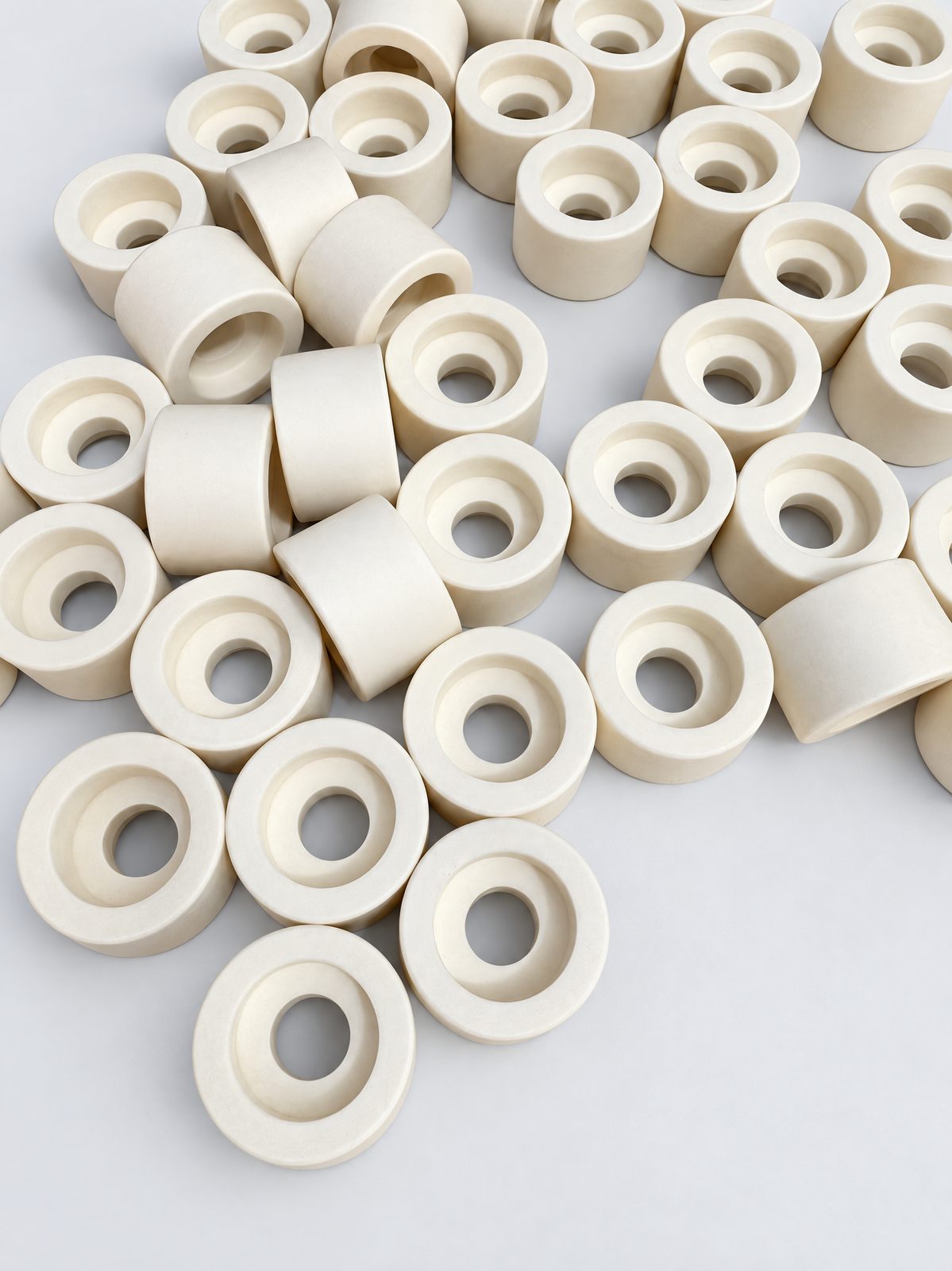
An alumina nozzle is a hard, electrically insulating aluminum oxide (Al2O3) component built to direct shielding gas, abrasive blast media, high-speed yarn or fluids in high-wear and high-heat equipment. Commercial 99.5% alumina operates under no load up to 1,750 °C (3,180 °F) in Accuratus material data, while DEGUSSIT AL23 is rated up to 1,950 °C in air in Kyocera Fineceramics Europe's February 2025 datasheet. Because alumina tolerates rapid cooling drops of 170 to 300 °C according to Morgan Technical Ceramics, buyers match the ceramic grade and wall profile to both the wear load and the thermal cycle.
Where Alumina Nozzles Work Across Welding, Blasting and Dispensing
Buyers searching for an alumina nozzle are usually sourcing parts for one of five distinct jobs: gas shielding cups for TIG and automated arc welding torches, abrasive shot blast nozzles, precision micro-dispensing tips, textile yarn guides and oiling nozzles, or molten metal casting and atomization systems. Alpha-phase aluminum oxide handles the bulk of general industrial nozzle work because it is the strongest and stiffest of the oxide ceramics, combining electrical insulation with acid, alkali and abrasion resistance.
In TIG and industrial welding torches, ceramic gas nozzles surround the electrode to direct shielding gas smoothly over the weld pool while insulating the live collet body from the workpiece. High-temperature mechanical strength keeps the cup round under radiant arc heat, and the non-wetting oxide surface resists weld spatter buildup compared with bare metal cups. Where automated welding guns or confined joints subject the cup to heavy spatter impact and steep thermal cycling, Kyocera notes that silicon nitride nozzles and nozzle covers are adopted to extend part life beyond what standard oxide cups handle.
In surface preparation and slurry handling, Precision Ceramics lists shot blast nozzles across all three of its CeramAlox alumina grades (regular-purity 96%, high-purity and Ultra Pure), along with abrasive flow deflector cones in the Ultra Pure grade. High hardness (12 GPa at 96% Al2O3, 14 GPa in the high-purity grade and 18 GPa in the Ultra Pure grade) slows bore enlargement from high-velocity grit so the blast stream holds pressure and aim over long shifts. In high-speed textile machines, alumina serves in thread processing nozzles and oiling nozzles because its low surface friction prevents filament snagging and yarn fraying.
For electronics assembly and laboratory instruments, ceramic dispensing and suction nozzles solve a machining flaw common to small metal needles. Drilling miniature metal tips leaves microscopic burrs that trap paste and shift droplet volume, whereas grinding co-fired ceramics produces a burr-free orifice with controlled concentricity. Depending on tip wall thickness and impact risk, manufacturers make micro-dispensing nozzles in fine-grain zirconia or high-purity alumina.
Foundry engineers also evaluate technical ceramics for metal foundry and casting hardware. While dense technical ceramics have melting points typically above 2,000 °C, rapid cooling creates a steep thermal gradient across the ceramic wall. Where thermal shock exceeds alumina's 170 to 300 °C rapid-cooling delta, Morgan Technical Ceramics lists higher thermal downshock resistance in zirconia (400 to 500 °C), zirconia-toughened alumina and silicon nitride (900 °C), and Kyocera highlights silicon nitride for molten aluminum foundry and casting parts.
Alumina Nozzle Grades and Material Properties by Maker
Commercial alumina nozzles are grouped by Al2O3 weight percentage, typically spanning 94% and 96% standard technical grades up to 99.5% corundum (designated C 799 in IEC 60672). Lower silicate glass content at 99.5% and above raises bulk density, elastic modulus, thermal conductivity and chemical resistance at high temperatures, while 94% to 96% bodies cost less to press, green-machine and metallize for brazed assemblies.
Body color is a visual clue to purity and additives, though it never replaces a chemical analysis report. Unpigmented 94% and 96% aluminum oxide fires bright white, and 99.5% pure alpha alumina fires to a warm ivory tone. When you see pink or reddish-brown TIG welding gas nozzles and textile thread guides, that color comes from deliberate oxide doping: Accuratus notes that manufacturers add chrome oxide or manganese oxide to an alumina body to raise hardness and shift its color.
Published properties vary between manufacturers based on grain size, pressing or casting method and firing schedule. The table below compiles room-temperature and maximum no-load values directly from three producers so you can benchmark candidate grades side by side.
| Maker and Grade | Al2O3 Purity | Density (g/cm3) | Flexural Strength (MPa) | Compressive Strength (MPa) | Thermal Conductivity (W/m·K) | Max No-Load Temp (°C) |
|---|---|---|---|---|---|---|
| Accuratus 94% Aluminum Oxide | 94% | 3.69 (230.4 lb/ft3) | 330 (47 x 10^3 lb/in2) | 2100 (304.5 x 10^3 lb/in2) | 18 (125 BTU·in/ft2·hr·°F) | 1700 (3090 °F) |
| Accuratus 96% Aluminum Oxide | 96% | 3.72 (232.2 lb/ft3) | 345 (50 x 10^3 lb/in2) | 2100 (304.5 x 10^3 lb/in2) | 25 (174 BTU·in/ft2·hr·°F) | 1700 (3090 °F) |
| Precision Ceramics CeramAlox 96 | 96% | 3.75 | 200-300 | 2000 | 25 | 1600 |
| Accuratus 99.5% Aluminum Oxide | 99.5% | 3.89 (242.8 lb/ft3) | 379 (55 x 10^3 lb/in2) | 2600 (377 x 10^3 lb/in2) | 35 (243 BTU·in/ft2·hr·°F) | 1750 (3180 °F) |
| Kyocera Fineceramics Europe DEGUSSIT AL23 (Feb 2025) | Above 99.5% | 3.70-3.95 | 300-350 | 2500 | 34.9 (at 20 °C) | 1950 (in air) |
Alumina vs Zirconia, Silicon Nitride, Metal and Ruby Nozzles
Choosing between alumina and an alternative nozzle material comes down to three failure modes: thermal shock cracking, mechanical chipping at thin tips, and bore wear. When a hot nozzle cools suddenly (for example when shielding gas post-flow stops early or cold purge gas hits a hot furnace nozzle), the outer skin contracts faster than the hot interior. That temperature gradient pulls the surface into tensile stress and initiates cracks if the drop crosses the ceramic's critical delta.
By our calculation from Morgan Technical Ceramics' thermal downshock table, silicon nitride's 900 °C rapid-cooling rating is 3 times the 300 °C upper limit of alumina. That gap explains why alumina handles steady radiant heat in standard TIG cups and furnace injectors, whereas silicon nitride takes over in cyclic robotic welding, high-amperage AC arc zones and molten aluminum foundry hardware. Zirconia sits between them at a 400 to 500 °C downshock delta while offering the highest room-temperature fracture toughness among monolithic oxide ceramics (1,000 MPa 3-point flexural strength in Kyocera ZO201N zirconia).
Zirconia Toughened Alumina (ZTA) bridges oxide hardness and crack resistance by dispersing zirconia into an alumina matrix, retaining high wear resistance while boosting bending strength and thermal shock tolerance. By contrast, Precision Ceramics notes that Macor machinable glass-ceramic cuts small-batch production cost, yet tops out at 1,000 °C unstressed (800 °C stressed) with lower wear resistance and higher thermal-shock vulnerability than alumina.
In micro-dispensing, alumina and zirconia compete against stainless steel needles and synthetic ruby tips. Kyocera also notes that while ruby nozzles can be made from 0.02 mm inner diameters, ruby requires thicker walls and shorter tips that interfere with nearby components, whereas thin-walled ceramic tips reach up to 3.00 mm in straight length at lower cost than ruby.
| Ceramic Material | Thermal Downshock Delta (°C) | Primary Material Advantage | Documented Nozzle and High-Heat Roles |
|---|---|---|---|
| Alumina (Al2O3) | 170-300 | High hardness (12-18 GPa) and high-temperature electrical resistivity | Shot blast nozzles, abrasive deflectors, textile yarn and oiling nozzles, general gas cups |
| Silicon Carbide (SiC) | 400 | High thermal conductivity and high-temperature wear stability | Refractory kiln components, foundry parts and abrasive slurry wear hardware |
| Zirconia (ZrO2) | 400-500 | High fracture toughness and 1,000 MPa flexural strength (ZO201N) | Micro-dispensing tips, reagent suction nozzles and impact-prone wear guides |
| Silicon Nitride (Si3N4) | 900 | Very low thermal expansion and extreme thermal shock resistance | Heavy-duty welding nozzles, welding nozzle covers and molten aluminum casting parts |
Ceramic Nozzle Holders, Thermal Expansion and Metal Joining
Read more
Mounting a ceramic nozzle inside a metal holder requires clearance for thermal expansion mismatch: Kyocera Fineceramics Europe lists DEGUSSIT AL23 alumina with a mean linear thermal expansion coefficient of 8.2 x 10^-6 /K from 20 to 1,000 °C, whereas Kyocera's nozzle material table lists SUS304 stainless steel at 18.7 x 10^-6 /K from 20 to 500 °C. If a cooled metal holder stays near room temperature while the ceramic heats up, a tight bore without expansion clearance can pinch the expanding alumina, whereas an uncooled stainless steel collar that heats along with the nozzle grows faster than the ceramic and can loosen its grip unless spring-loaded.
For permanent or hermetic nozzle holders, technical ceramics offer three proven attachment styles across industry catalogs. Precision dispensing tips mount into SUS303, SUS304 or nickel-plated brass bodies using a Luer taper or double thread. Where vacuum tightness or high-pressure sealing is required, 94% to high-purity aluminas can be metallized and brazed directly to metal flanges.
Forming Routes, Sintering Shrinkage and Bore Tolerances
Read more
How an alumina nozzle is formed depends on its symmetry, wall thickness and batch volume. Straight cylindrical nozzles, multi-bore gas injectors and capillaries are extruded through dies, whereas large-diameter cones and thick-walled refractory sleeves are slip cast in plaster molds or pressed. For complex miniature tapers, internal threads and thin-walled wear inserts across large production runs, specialized ceramic processors also use cold isostatic pressing or ceramic injection molding (CIM), along with green or biscuit machining before final firing.
Every buyer specifying tolerances on a ceramic nozzle drawing needs to account for firing shrinkage. Precision Ceramics notes that sintering densifies the alumina body and causes it to shrink by about 20% in each direction, making it impossible to hold very tight tolerances with pre-sintering green or biscuit machining alone. As-fired commercial tolerances typically resemble the ±3% standard tolerance (with a ±0.3 mm minimum) that Kyocera lists for textile alumina nozzles. Once fired and fully sintered, Precision Ceramics notes that alumina can only be machined using diamond grinding methods, where diamond-coated tools abrade the dense ceramic to achieve very tight tolerances.
| Nozzle Category | Material | Published Size Range (mm) | Published Dimensional Tolerance | Inner Bore Roughness Ra (micrometers) |
|---|---|---|---|---|
| Textile Machinery Nozzle | Alumina | 32 mm x 41 mm x T12 mm standard nozzle | ±3% standard (minimum ±0.3 mm) | - |
| Micro-Hole Precision Nozzle | Zirconia (ZO201N) | ID 0.1 mm to below 2.5 mm (and above 2.5 mm to 6 mm), length 1 mm to 200 mm | ID ±0.008 mm (below 2.5 mm), OD ±0.01 mm, concentricity 0.005 mm | From 0.1 micrometers (0.160 micrometers measured sample) |
| Semiconductor Dispenser Nozzle | Zirconia |
Specification Checklist for a Custom Ceramic Nozzle Drawing
Send complete operating and dimensional details on your first inquiry to prevent requoting delays and thermal cracking in service.
Check these six items on your print before requesting a quote:
- Geometry and bore profile: State the outer diameter, inner bore diameter, overall length, internal step or taper angles, and whether the tip is open, slotted, side-drilled or closed with drilled orifices. If an electrode, wire or pin must pass cleanly through the bore, specify a one-sided minimum ID tolerance so shrinkage never pinches the insert.
- Alumina purity grade: Specify your required Al2O3 content, such as 95% white alumina for general wear and insulation or C799 (99.5% Al2O3) for high-purity, high-temperature corundum service.
- Chemical media and atmosphere: List all gases, slags, acids or vapors touching the hot bore. High-purity alumina resists all gases except wet fluorine and resists common reagents except hydrofluoric acid and phosphoric acid, while hot alkali metal vapors attack lower-purity silicate phases.
- Peak temperature and cooling rate: Give both the steady working temperature and the fastest heating or cooling step in °C per minute or quench delta, checking rapid downshocks against alumina's 170 to 300 °C window.
- Holder interface and clamping method: Mark which external shoulder, flange, rib or thread seats inside your nozzle holder, and keep sharp internal corners radiused so clamping loads stay in compression.
- Batch quantity and sample plan: State both the initial trial quantity and expected repeat batch size so tooling and forming method selection match your volume.
Custom Alumina Shapes and Ordering Terms at GY Alumina
GY Alumina is the export brand of our industrial ceramics factory in Tangshan, China, serving 100+ customers across furnace, thermocouple, laboratory and industrial companies. We manufacture custom alumina and corundum parts to your engineering drawing or physical sample alongside our thermocouple protection tubes, thermocouple insulators and multi-bore tubes, furnace tubes, crucibles, boats and solid alumina rods, and you can send your drawing for review.
At our factory, parts are formed by slip casting, pressing, extrusion and hot pressing, followed where specified by secondary cut-to-length finishing, end slots, side holes, perforated tubes and closed ends with drilled holes. Custom configurations we make to drawing include round, elliptical and square tubes (open or one end closed), single-, twin- and multi-bore tubes and capillaries, threaded, ribbed, perforated and slotted tubes, solid rods, square bars and balls, rings, washers, bushings and discs, and crucibles, boats and other shapes to drawing. Extruded tubes today run up to OD 17 x ID 10 mm, and slip-cast tubes run up to OD 100 x ID 90 x 1,000 mm. We also supply solid alumina rods in eight stock diameters from 2 to 12 mm, about 2,400 mm long, with a +0.2 mm grinding allowance on the diameter.
Our standard material is C799 alumina at 99.5% Al2O3 (sintered at about 1,760 °C, which is our kiln firing temperature rather than a service rating), and our crucibles are made in 99% and 99.5% Al2O3. Where a buyer's drawing names C 610, we supply 95% white alumina or our standard C799 alumina instead (neither grade is mullite). An independent laboratory analyses one of our alumina tubes every year, recording 99.55% Al2O3 in 2024, 99.57% in 2025 and 99.61% in 2026. Our ISO 9001:2015 certificate covers the manufacturing of ceramic protective tubes for thermocouples (that scope only).
Custom parts made to your drawing or sample usually start at 100 pieces per item and take 25 to 30 days to produce. Before running the full batch, we send 5 to 10 free samples for your dimensional and fit approval, with courier freight paid by the buyer, while stock standard sizes ship in about 3 days for small orders to about 7 days for bulk orders. Send your drawing, the grade and the quantity. We usually reply with a quote within two working days.
Questions buyers ask
- Why are some alumina welding nozzles pink while others are white or ivory?
- Unpigmented technical alumina fires white at 94% and 96% Al2O3 and ivory at 99.5% Al2O3, as recorded in Accuratus and Kyocera Fineceramics Europe datasheets. According to Accuratus, manufacturers add chrome oxide or manganese oxide to the ceramic body when they want to boost hardness and produce a pink or colored part.
- Why do alumina nozzles crack during rapid cooling or molten metal contact?
- Rapid surface cooling shrinks the outer skin of a nozzle against a hot core, creating tensile stress across the ceramic wall. Morgan Technical Ceramics lists alumina's thermal downshock resistance at a 170 to 300 °C sudden temperature drop, which is why severe thermal-shock applications switch to zirconia (400 to 500 °C) or silicon nitride (900 °C).
- How do ceramic dispensing nozzles improve accuracy compared to metal or ruby tips?
- Compared with ruby tips, ceramic nozzles allow thinner tip walls and straight lengths up to 3.00 mm at lower cost for tight circuit-board clearances.
- Which chemicals and gases attack an alumina nozzle in service?
- Accuratus material data states that high-purity alumina resists attack by all gases except wet fluorine and resists all common reagents except hydrofluoric acid and phosphoric acid. At high temperatures, alkali metal vapors also degrade alumina, particularly in lower-purity grades.
- What are the minimum order quantity and lead time for custom alumina parts at GY Alumina?
- Custom alumina parts made to your drawing or sample usually start at 100 pieces per item and take 25 to 30 days to produce. Before full production begins, we send 5 to 10 free samples for your approval (you cover the courier cost).
Sources
- Accuratus: Aluminum Oxide Al2O3 Ceramic Properties
- Precision Ceramics: Alumina Properties and Industrial Applications
- Kyocera Fineceramics Europe: DEGUSSIT AL23 Datasheet (February 2025)
- Morgan Technical Ceramics: Thermal Shock Resistance in Ceramics
- Morgan Technical Ceramics: High-Performance Alumina Ceramic Components
- Kyocera: Fine Ceramics for Industrial Machinery
- Kyocera: Textile Machinery Ceramic Parts
- Kyocera: Dispenser Nozzle for High-Precision Device Mounting
- Kyocera: High Precision Ceramic Nozzle with Micro Hole
- GY Alumina: Alumina and Corundum Grades Material Data
- GY Alumina: Custom Parts Made to Drawing or Sample
- GY Alumina: Buyer FAQ on MOQ, Lead Time and Samples
- GY Alumina: Alumina Ceramics Factory in Tangshan
Last checked .