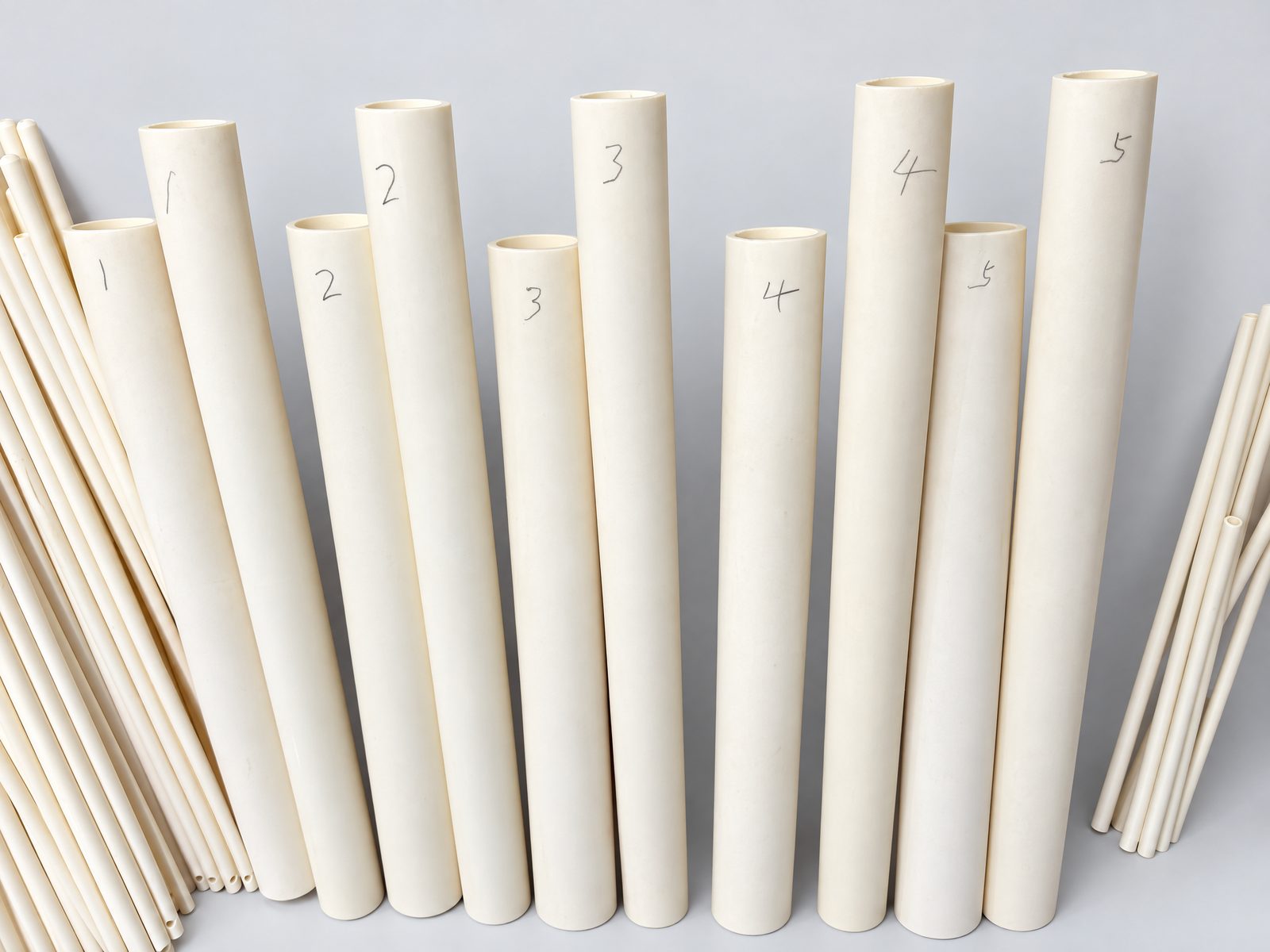
An alumina furnace tube RFQ specification must state the outer diameter, inner diameter, overall length, tolerances, end configuration, alumina grade, operating temperature, heating ramp rate, atmosphere or vacuum level, and order quantity. Writing plain alumina tube fails in a 1,700 °C inquiry because lower ceramic classes stop at 1,300 °C to 1,400 °C, and even gas-tight C 799 working tubes rated by Nabertherm to 1,800 °C in air drop to 1,400 °C under vacuum. Defining your cold-end seal interface and duty cycle upfront prevents thermal-shock cracking, vacuum softening, and requoting delays.
Why plain 'alumina tube' is not enough in a 1,700 °C furnace inquiry
Buyers sending a 1,700 °C furnace inquiry often write 'alumina tube' on a purchase request without naming a ceramic class or process atmosphere. Furnace builders split oxide working tubes into porous aluminosilicates, gas-tight mullites, and dense high-purity corundum. In Nabertherm's working tube specifications, porous C 530 (Sillimantin) stops at 1,300 °C in air and cannot hold vacuum, while gas-tight C 610 (Pythagoras) stops at 1,400 °C in air and 1,200 °C in vacuum. For sealed atmosphere tube furnaces, Nabertherm specifies extended gas-tight C 610 working tubes up to 1,300 °C and C 799 working tubes above 1,300 °C.
Peak air ratings do not carry over to continuous dwell or vacuum service. Carbolite states across its tube furnace lines that maximum continuous operating temperature sits 100 °C below maximum temperature, and recommends at least 100 °C of extra heating range above your desired working temperature. In Carbolite's atmosphere selection chart, silicon carbide tube furnaces run air and modified atmospheres up to 1,600 °C and molybdenum disilicide tube furnaces reach 1,800 °C, yet both cap vacuum service at 1,500 °C. MTI Corporation likewise states in its tube setup guide that alumina tubes soften above 1,500 °C and strictly prohibits vacuum above 1,500 °C because atmospheric pressure collapses the softened wall.
Wider tube bores pull the safe vacuum ceiling down even further, and furnace orientation changes the mechanical hardware attached to the ceramic body. On MTI Corporation's TA-50D-M1200 high-purity alumina tube datasheet, vacuum operation is prohibited above 1,500 °C for a 25.4 mm to 76.2 mm (1 in to 3 in) diameter tube and restricted to 1,200 °C for an 80.01 mm to 101.6 mm (3.15 in to 4 in) diameter tube. Nabertherm's high-temperature MoSi2 furnaces run horizontally or vertically up to 1,800 °C with static C 799 tubes, whereas its batch and continuous rotary furnaces up to 1,300 °C use tubes with mounted drive sleeves for the rotary drive and unmounted spare tubes. Leaving vacuum pressure, bore diameter, dwell duration, or mounting orientation off your RFQ risks ordering a tube that softens, binds, or fractures on its first heating cycle.
| Material class | Tube OD (mm) | Max heat-up ramp (K/h) | Tmax in air (°C) | Tmax in vacuum (°C) | Gas tight |
|---|---|---|---|---|---|
| C 530 (Sillimantin) | Below 120 mm | Unlimited | 1,300 °C | Not possible | No |
| C 530 (Sillimantin) | From 120 mm | 200 K/h | 1,300 °C | Not possible | No |
| C 610 (Pythagoras) | Below 120 mm | 300 K/h | 1,400 °C | 1,200 °C | Yes |
| C 610 (Pythagoras) | From 120 mm | 200 K/h | 1,400 °C | 1,200 °C | Yes |
| C 799 (Alsint) | Below 120 mm | 300 K/h | 1,800 °C | 1,400 °C | Yes |
| C 799 (Alsint) | From 120 mm | 200 K/h | 1,800 °C | 1,400 °C | Yes |
| Quartz glass | All diameters | Unlimited | 1,100 °C | 950 °C | Yes |
| FeCrAl-Alloy (APM) | All diameters | Unlimited | 1,300 °C | 1,100 °C | Yes |
Alumina protection tubes vs working tubes: lab furnace spec logic
Purchasing teams sometimes mix up process working tubes and thermocouple protection tubes because both use high-purity alumina, yet their geometry and tolerance logic differ completely. A working tube is the main process chamber, usually open on both ends, sized so its outer diameter clears the furnace bore and seals inside O-ring end flanges while its inner diameter holds boats and insulation blocks. Carbolite notes that heat losses at both ends make the uniform temperature zone shorter than the heated length, so single-zone furnaces use end insulation plugs to stabilize the center and three-zone furnaces add independent end heaters to extend the uniform length.
A protection tube is a narrower, one-end-closed sheath isolating sensor wires from the batch atmosphere. Nabertherm notes that chamber control measures temperature outside the working tube to protect sensors from aggressive batches, which can create a large temperature gap from the batch inside, whereas charge control places an internal thermocouple inside the working tube for fast, accurate batch control. Carbolite's work tube packages include a 3 mm diameter probe thermocouple up to 1,200 °C and a 10 mm diameter gland with a PTFE seal above 1,200 °C to accept type R or type B probe thermocouple assemblies.
Mounting orientation and multi-zone temperature steps also belong in your specification logic. In vertical Carbolite tube furnaces, a lower work tube support clamp and upper guide bracket hold the ceramic tube in position, while insulation plugs and radiation shields require metallic hangers with a thermocouple access groove unless supported by end seals. In multi-zone horizontal furnaces, MTI Corporation warns operators to keep the axial thermal gradient below 100 °C per 25.4 mm (100 °C/in) on its 50 mm tube and heating gradients below 10 °C/min on its 80 mm tube so sharp zone transitions do not crack the alumina wall.
- Working tube spec logic: Open both ends, controlled by cold-end outer diameter tolerance for flange O-rings (such as Carbolite's +1.5 mm to -1 mm acceptable OD window) and cold-end overhang length.
- Protection tube spec logic: Closed one end, controlled by inner bore clearance and straightness so twin-bore or multi-bore alumina insulators slide to the closed tip without binding.
- Crucible separation rule: MTI Corporation specifies placing samples in an alumina or quartz crucible boat rather than touching the working tube wall directly, preventing chemical attack and local thermal shock.
Alumina purity grades, standards, and GY Alumina options
GY Alumina reviews drawings written to both European ceramic class codes and percentage purity sheets. European furnace catalogs classify insulating and refractory ceramics under IEC 60672-1:1995 (Definitions and classification) and DIN EN 60672-3:1999-02 (Specifications for individual materials, adopting IEC 60672-3:1997). Morgan Advanced Materials supplies its Haldenwanger tubes in classes including C 530 (Sillimantin 60), C 610 (Pythagoras mullite), and C 799 (Alsint) under DIN EN 60672, while Carbolite pairs mullite C 610 work tubes with 1,200 °C to 1,350 °C furnaces and recrystallized alumina work tubes with 1,600 °C and 1,800 °C models. On percentage-based lab furnace sheets, buyers also cap silicate fluxes that soften at high heat: MTI Corporation specifies Al2O3 above 99%, SiO2 below 0.25%, and CaO + MgO below 0.3% on its TA-50D-M1200 tube for oxidizing and reducing duty up to 1,700 °C.
Our standard grade is C799 alumina (99.5% Al2O3). An independent lab analyzes one of our alumina tubes every year, recording 99.55% Al2O3 in 2024, 99.57% Al2O3 in 2025, and 99.61% Al2O3 in 2026. Where a drawing names C 610, which Carbolite and Morgan classify as mullite, we supply 95% white alumina or our standard C799 alumina instead. Neither grade is mullite, so state both your working temperature and your process gas atmosphere on the RFQ so the right alumina grade is confirmed in your quotation.
| Source or supplier | Grade or class callout | Composition notes | Primary furnace tube role |
|---|---|---|---|
| IEC 60672 / Nabertherm | C 530 | Porous aluminosilicate ceramic | Air-only working tubes up to 1,300 °C, not gas tight |
| IEC 60672 / Carbolite / Morgan | C 610 | Gas-tight mullite ceramic | Gas-tight working tubes up to 1,300 °C or 1,400 °C max in air |
| MTI Corporation (TA-50D-M1200) | High purity above 99% Al2O3 | SiO2 below 0.25%, CaO + MgO below 0.3% | Oxidizing and reducing atmospheres up to 1,700 °C |
| GY Alumina | C799 alumina | Lab-analyzed tube samples: 99.55% Al2O3 (2024), 99.57% Al2O3 (2025), 99.61% Al2O3 (2026) | Standard grade for protection tubes, furnace tubes, rods, and custom parts |
| GY Alumina | 95% white alumina | 95% Al2O3 (not mullite) | Supplied as an alternative where a buyer drawing names C 610 |
Dimensions, DIN 40680 tolerances, and cold-end extensions
Every furnace tube RFQ needs four dimensional callouts: outer diameter (OD), inner diameter (ID) or wall thickness, overall length, and the permissible tolerance on each. Nabertherm specifies form and position tolerances on its C 530, C 610, and C 799 working tubes according to DIN 40680 (DIN 40680-1:1983-08 covers admissible dimensional tolerances for electrical ceramic components). Commercial furnace tubes carry measurable as-sintered diameter bands: MTI Corporation lists OD 51 mm +/- 1 mm and ID 40 mm +/- 2 mm on its 1,200 mm tube, and OD 80.4 mm +/- 1 mm (3.165 in +/- 0.04 in) with ID 70.5 mm +/- 1 mm (2.775 in +/- 0.04 in) on its 1,000 mm tube. Always verify both your furnace bore and your flange seal bore against your OD tolerance before ordering, noting whether the tube slides through a solid housing (such as Carbolite's 32 mm to 125 mm OD universal TF range) or drops into a hinged split body (such as Carbolite's 60 mm to 200 mm OD TS split-tube range).
Overall length depends on whether the tube runs open to air or carries gas-tight end seals outside the insulated casing. In Nabertherm's C 799 working tube tables, a 50 mm x 40 mm air tube runs 380 mm to 830 mm long, whereas the vacuum C 799 tube with ground ends for water-cooled flanges runs 990 mm, 1,140 mm, or 1,440 mm. By our calculation from Nabertherm's C 799 table, stepping from the longest 50 mm x 40 mm air tube (830 mm) to the longest vacuum tube (1,440 mm) adds 610 mm of overhang, or 305 mm per end when centered, to keep elastomer seals cool. The larger 120 mm x 105 mm C 799 tube steps from 830 mm in air to 1,440 mm in vacuum for the exact same 610 mm extension.
Wall thickness also scales with bore diameter to balance mechanical strength against radial thermal gradients during heating and cooling. By our calculation from Nabertherm's C 799 working tube table, a 50 mm OD x 40 mm ID tube has a 5 mm wall (10% of OD), an 80 mm OD x 70 mm ID tube keeps a 5 mm wall (6.25% of OD), and a 120 mm OD x 105 mm ID tube steps up to a 7.5 mm wall (6.25% of OD).
Thermal ramp limits, pressure boundaries, and end seals
Read more
Positive gas pressure inside a ceramic tube must stay near atmospheric pressure. MTI Corporation instructs operators to set tank pressure regulators below 1.1 atm, keep outlet vacuum valves open while filling, constrain gas flow below 200 ccm on its 50 mm tube, and never exceed 1.2 atm because internal pressure buildup can catapult metal flanges off the tube ends. Under vacuum, Carbolite's work tube package 3 reaches 5 x 10^-5 mbar and its stainless steel end seals reach 10^-6 mbar depending on the pump, while MTI Corporation records room-temperature evacuation to 10^-7 Torr on its 80 mm tube and 10^-4 Torr via turbopump on its 50 mm tube. Nabertherm requires evacuating the tube while cold to protect the vacuum pump and notes that aggressive atmospheres can lower the maximum permissible tube temperature.
Match your tube end geometry and internal thermal blocks to your sealing hardware on the RFQ. MTI Corporation specifies always inserting refractory tube blocks inside both ends of the furnace casing before tightening vacuum flanges so radiant heat does not degrade the flange seals. In Nabertherm's catalog, gas supply system 1 pairs unground standard tubes with porous ceramic fiber plugs for unsealed non-flammable gas, system 15 pairs extended tubes up to 1,300 °C and 120 mm OD with stainless steel type 1.4301 heat radiation inserts without cooling water (never opened hot and not for turbomolecular pumps), and system 2 requires ground tube ends for water-cooled flanges with NW9 water connectors.
High-purity vacuum and flammable reducing gases require dedicated flange fittings and safety interlocks. Carbolite's stainless steel end seals fit extended tubes of 32 mm, 46 mm, 60 mm, 86 mm, 100 mm, 150 mm, and 200 mm OD using NW16, NW25, NW40, or ISO-K 63 vacuum fittings, pairing metal radiation shields up to 1,200 °C and ceramic radiation shields above 1,200 °C for dust-free runs below 10^-3 mbar, while its low-leakage package 4 uses 2 L/min to 4 L/min of flange cooling water. When running hydrogen, both Carbolite and Nabertherm require dedicated gas safety systems, such as Nabertherm's gas supply system 4 with a safety PLC controller, nitrogen purge panel, magnetic shutoff valve, and monitored exhaust gas torch.
- Ramp ceiling: At most 5 °C/min (300 K/h, or 5 K/min) below 120 mm OD, and 200 K/h (3.33 K/min) from 120 mm OD upward in Nabertherm's table.
- Pressure boundary: Regulator set below 1.1 atm and absolute tube pressure never above 1.2 atm per MTI Corporation.
- Cold-end hardware: Specify porous fiber plugs for air, metal or ceramic radiation shields for clean vacuum, and water-cooled flanges for sealed high-temperature duty.
Worked example and nine-point alumina tube RFQ checklist
Rewriting a vague inquiry shows how complete engineering callouts eliminate back-and-forth engineering holds. Below is a worked example written by our team for an invented buyer project.
Incomplete request: 'Quote 5 pieces alumina tube, 80 mm OD x 1,000 mm length, for 1,700 °C vacuum furnace.' This request stalls immediately because it omits inner diameter, cold-end OD seal tolerances, whether 1,700 °C occurs under vacuum (which collapses alumina above 1,400 °C to 1,500 °C), and how much cold-end overhang extends past the hot zone.
Complete RFQ specification: 'Item: Open-both-ends furnace working tube. Grade: C799 alumina. Size: OD 80 mm x ID 70 mm x 1,000 mm length, with permissible OD tolerance at both 150 mm cold ends for O-ring compression seals plus length and straightness limits stated on attached drawing. Ends: Plain cut square, unglazed. Duty: 1,650 °C continuous dwell in flowing argon (1.05 atm max, 150 ccm), cold evacuation to 10^-3 mbar at room temperature before backfill (no vacuum above 1,200 °C), 3 °C/min max heating and cooling ramps with refractory end blocks. Quantity: 5 pieces if stock, or quote custom MOQ and approval sample terms.'
When setting your purchase quantity, factor in spare working tubes alongside your initial build count. Furnace suppliers such as MTI Corporation classify ceramic processing tubes as consumable components outside equipment warranty coverage and advise inspecting shipping crates and packaging immediately upon delivery. If a rigid boat carrier, radiation shield rod, or internal thermocouple sheath must slide through the bore, note that minimum clearance on your drawing so bore tolerance is controlled in the right direction. Use the nine-point checklist below on every RFQ.
- Tube geometry: Round, elliptical, or square profile, open both ends or closed one end, single-bore or multi-bore.
- Nominal dimensions: Outer diameter (OD in mm), inner diameter (ID in mm), and overall length (mm).
- Tolerances: Permissible +/- mm on OD, ID (note one-sided bore clearance if an insert must pass inside), length, and straightness.
- End features: Cut square ends, end slots, side holes, perforations, or closed end with drilled hole, plus flange seal type.
- Material grade: Plain C799 alumina or 95% white alumina (where a drawing names C 610).
- Thermal cycle: Continuous temperature (°C), peak temperature (°C), horizontal or vertical mounting, and max ramp rate (°C/min).
- Atmosphere and pressure: Air, inert or reducing gas, gas pressure (atm), or vacuum level (mbar or Torr) and max temperature under vacuum.
- Quantity and samples: Initial order quantity, recurring forecast, and whether 5 free samples to 10 free samples are needed for approval.
- Delivery details: Destination country, preferred Incoterms, and any request for our yearly independent lab chemical analysis report.
GY Alumina capabilities, order terms, and quote requests
GY Alumina manufactures furnace tubes, thermocouple protection tubes, multi-bore insulators, rods, crucibles, and custom ceramic parts at our factory in Tangshan by slip casting, pressing, extrusion, and hot pressing. Our largest extruded tube today is OD 17 mm x ID 10 mm, and our largest slip-cast tube is OD 100 mm x ID 90 mm x 1,000 mm. Secondary operations we perform include cutting to length, end slots, side holes, perforated tubes, and closed ends with drilled holes. Beyond round open-end and closed-end tubes, we make elliptical and square tubes, single-, twin-, and multi-bore capillaries, threaded and ribbed tubes, solid alumina rods in eight stock diameters from 2 mm to 12 mm at about 2,400 mm long with a +0.2 mm grinding allowance on the diameter, square bars, balls, rings, washers, bushings, discs, and crucibles, boats, and other shapes to drawing. If your vacuum flange requires post-sintered diamond OD grinding or a ground sealing face finish outside our listed operations, note that callout on your drawing for review.
Standard sizes ship from stock in about 3 days for small orders to about 7 days for bulk orders. Custom parts made to your drawing or sample usually start at 100 pieces per item and take 25 days to 30 days to produce, with 5 free samples to 10 free samples sent for approval first while the buyer pays the courier. Our ISO 9001:2015 certificate covers the manufacturing of ceramic protective tubes for thermocouples, with 100+ customers served. Send your drawing, the grade and the quantity. We usually reply with a quote within two working days.
Questions buyers ask
- Why is specifying just 'alumina tube' not enough for a 1,700 °C furnace inquiry?
- Ceramic working tubes span distinct classes: in Nabertherm's catalog, porous C 530 stops at 1,300 °C and gas-tight C 610 stops at 1,400 °C in air. Even high-purity C 799 tubes rated to 1,800 °C in air drop to 1,400 °C under vacuum in Nabertherm's table, and MTI Corporation strictly prohibits vacuum above 1,500 °C because softened alumina collapses.
- What heating and cooling ramp rate should I specify for an alumina furnace tube?
- Carbolite and MTI Corporation both limit heating and cooling rates on ceramic alumina work tubes to at most 5 °C/min to prevent thermal-shock fracture. Nabertherm specifies a maximum heat-up ramp of 300 K/h (5 K/min) for C 610 and C 799 tubes below 120 mm OD, and lowers the limit to 200 K/h for tubes from 120 mm OD upward.
- What is the difference between C 799 and C 610 on a European ceramic tube drawing?
- Carbolite and Morgan Advanced Materials identify C 610 as a mullite ceramic class used for gas-tight working tubes up to 1,300 °C or 1,400 °C in air, whereas C 799 is high-purity alumina used above 1,300 °C. At GY Alumina, our standard grade is C799 alumina, and where a drawing names C 610 we supply 95% white alumina or C799 instead, neither of which is mullite.
- How much positive gas pressure can an alumina furnace working tube handle?
- Alumina tube furnaces are built for vacuum or near-atmospheric gas flow rather than positive internal pressure. MTI Corporation instructs operators to set gas tank regulators below 1.1 atm, keep outlet valves open while filling, and never exceed 1.2 atm inside the tube so end flanges are not blown off.
- What is the largest alumina tube GY Alumina makes, and what are the lead times?
- GY Alumina makes extruded tubes up to OD 17 mm x ID 10 mm and slip-cast tubes up to OD 100 mm x ID 90 mm x 1,000 mm. Standard stock sizes ship in about 3 days for small orders and about 7 days for bulk orders, while custom parts to drawing usually start at 100 pieces and take 25 days to 30 days after 5 free samples to 10 free samples are approved (buyer pays courier).
Sources
- Nabertherm Working Tubes Technical Specifications
- Nabertherm Laboratory Furnaces Catalog
- Carbolite Laboratory and Industrial Ovens and Furnaces General Catalogue
- Carbolite Work Tube Packages for Inert and Vacuum Atmosphere
- Carbolite Work Tube Accessories for Tube Furnaces
- MTI Corporation Setup and Use Tips for Tubes and Vacuum Flanges
- MTI Corporation 50 OD x 40 ID x 1200mm High Purity Alumina Tube (TA-50D-M1200)
- MTI Corporation 80 OD x 70 ID x 1000mm Alumina Ceramic Tube (TA80D1000)
- IEC 60672-1:1995 Ceramic and Glass Insulating Materials, Part 1
- DIN EN 60672-3:1999-02 Specifications for Individual Materials
- DIN 40680-1:1983-08 Ceramic Components for Electrical Purposes, Admissible Tolerances
- Morgan Advanced Materials Haldenwanger High-Temperature Ceramic Tubes
- GY Alumina Materials and Corundum Grades
- GY Alumina Factory Capabilities and Lab Test Records
- GY Alumina Buyer FAQ: MOQ, Lead Time, Samples, ISO 9001
Last checked .