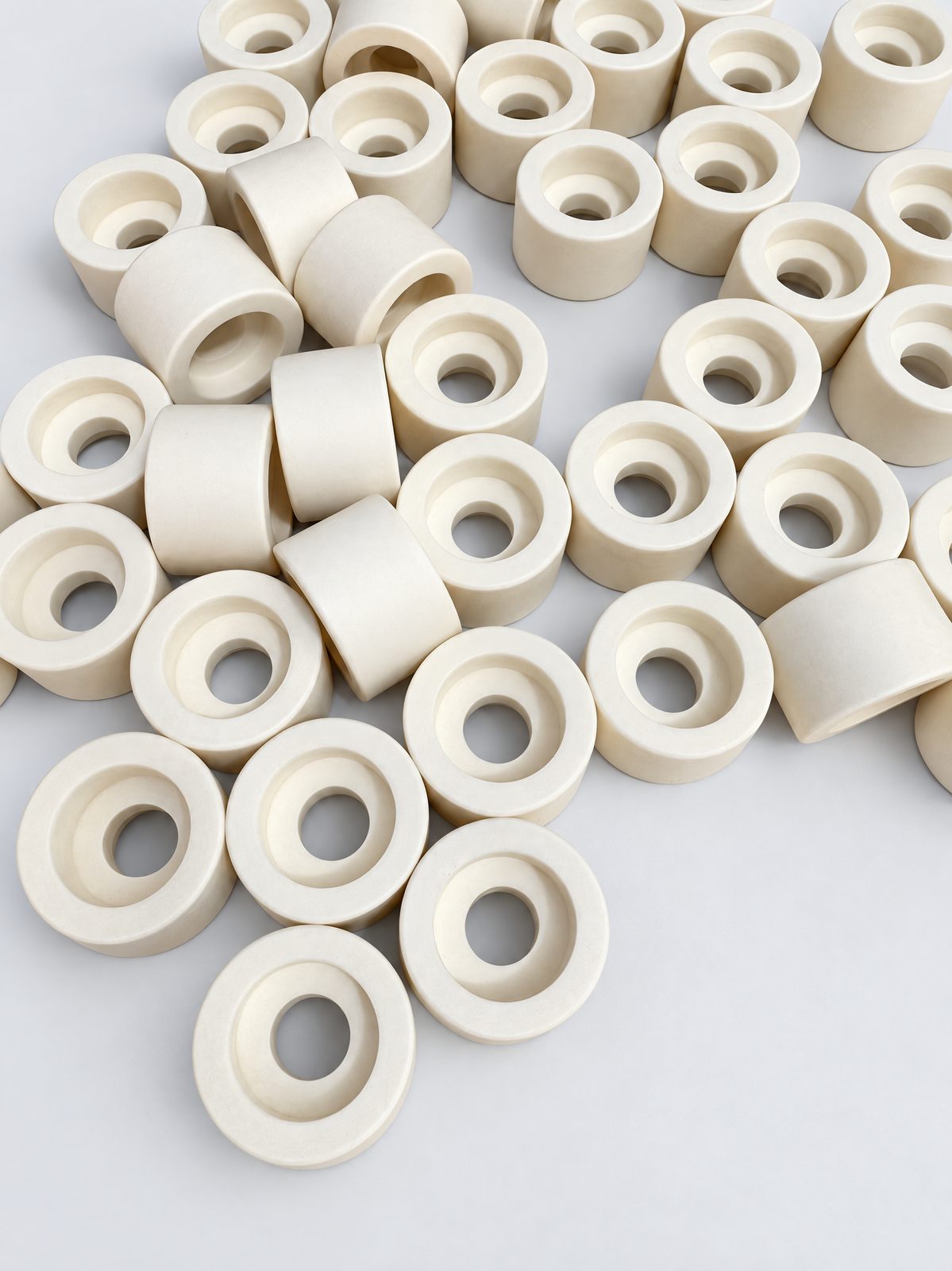
An alumina disc is a flat, solid circular component made from aluminum oxide (Al2O3) ceramic for furnace support, electrical insulation, wear protection, and thin-film sputtering. Commercial technical grades include 94% to 99.5% Al2O3, with no-load maximum service temperatures reaching 1750 °C (3180 °F) for Accuratus 99.5% Al2O3 alumina and 1950 °C in air for Kyocera DEGUSSIT AL23. At GY Alumina, we make custom alumina discs to your drawing or sample in C799 alumina (99.5% Al2O3) and 95% white alumina, usually starting at 100 pieces per item.
What an alumina disc is and how it differs from rings, substrates, and filters
An alumina ceramic disc (also called a corundum disc at high purity) is a monolithic flat circular plate of sintered aluminum oxide (Al2O3) defined by two primary dimensions: outside diameter (OD) and thickness (height). Unlike ceramic rings, washers, and bushings, which carry a central inside diameter (ID) bore for bolts, shafts, or thermocouple wires, a standard disc has a solid center.
Buyers searching for an alumina disc usually need one of four distinct ceramic products, and separating them early prevents quoting delays. Dense structural and furnace discs have 0% open porosity (as listed on Accuratus 94% to 99.5% Al2O3 alumina datasheets and Kyocera Fineceramics Europe's DEGUSSIT AL23 datasheet) and serve as crucible lids, tube furnace baffles, setter plates, and wear pads. Thin-film, thick-film, and polished substrates (manufactured by producers such as Kyocera for power modules and thermal printheads) are thin plates finished for circuit metallization and tight flatness.
Recrystallized alumina sputtering targets are thick dense discs mounted in vacuum deposition chambers, such as Almath Crucibles' SUB55 (50 mm OD x 5 mm height, 0.04 kg) and SUB15 (100 mm OD x 5 mm height, 0.05 kg) discs in 95% purity alumina. Porous ceramic discs are gas-permeable filter or kiln plates where apparent density differs from bulk density, trading gas tightness and flexural strength for lighter weight and thermal shock tolerance. Finally, automotive carbon-ceramic brake discs are fiber-reinforced friction composites rather than monolithic Al2O3 technical ceramics.
Alumina disc grades and published properties by manufacturer
Technical alumina is produced in purity grades from 85% Al2O3 upward by adjusting sintering additives. Lower-purity white bodies (94% to 96% Al2O3) contain silicate glassy phases that aid sintering and subsequent metallization for brazed assemblies. High-purity ivory corundum bodies (99.5% Al2O3) reduce grain-boundary silicates to raise flexural strength, chemical resistance, thermal conductivity, and electrical resistivity at elevated temperatures.
Because ceramic properties depend on powder formulation and forming method, engineering values vary across manufacturers even at the same nominal percentage. The table below compares published room-temperature and thermal data from Accuratus, Precision Ceramics, and Kyocera Fineceramics Europe (February 2025 datasheet).
Purity affects heat transfer across a disc just as strongly as mechanical strength. By our calculation from Accuratus' material property data, moving from 96% Al2O3 (25 W/m·K) to 99.5% Al2O3 (35 W/m·K) increases room-temperature thermal conductivity by 1.4 times (40% higher). Where electrical insulation and ceramic-to-metal sealing govern the design, ASTM D2442-75(2025), Standard Specification for Alumina Ceramics for Electrical and Electronic Applications (updated June 25, 2025), defines standard property limits and test methods for fabricated alumina parts regardless of geometry.
| Maker and Grade | Al2O3 Purity | Bulk Density | Flexural Strength | Compressive Strength | Thermal Conductivity (20 °C to 25 °C) | Max Service Temp (Air) | Dielectric Strength |
|---|---|---|---|---|---|---|---|
| Accuratus 94% Al2O3 | 94% | 3.69 g/cm3 (230.4 lb/ft3) | 330 MPa (47 x 10^3 lb/in2) | 2100 MPa (304.5 x 10^3 lb/in2) | 18 W/m·K (125 BTU·in/ft2·hr·°F) | 1700 °C (3090 °F) no load | 16.7 ac-kV/mm (418 V/mil) |
| Accuratus 96% Al2O3 | 96% | 3.72 g/cm3 (232.2 lb/ft3) | 345 MPa (50 x 10^3 lb/in2) | 2100 MPa (304.5 x 10^3 lb/in2) | 25 W/m·K (174 BTU·in/ft2·hr·°F) | 1700 °C (3090 °F) no load | 14.6 ac-kV/mm (365 V/mil) |
| Precision Ceramics CeramAlox 96 | 96% | 3.75 g/cm3 | 200 MPa to 300 MPa | 2000 MPa | 25 W/mK | 1600 °C no load | 9 kV/mm DC |
| Accuratus 99.5% Al2O3 | 99.5% | 3.89 g/cm3 (242.8 lb/ft3) | 379 MPa (55 x 10^3 lb/in2) | 2600 MPa (377 x 10^3 lb/in2) | 35 W/m·K (243 BTU·in/ft2·hr·°F) | 1750 °C (3180 °F) no load | 16.9 ac-kV/mm (420 V/mil) |
| Kyocera DEGUSSIT AL23 | Above 99.5% | 3.70 g/cm3 to 3.95 g/cm3 | 300 MPa to 350 MPa | 2500 MPa | 34.9 W/m·K | 1950 °C | 20 kV/mm to 30 kV/mm |
Service temperature, thermal shock, and chemical limits
When sizing a disc for a furnace or reactor, separate three different temperatures: maximum continuous service temperature, sintering temperature, and melting point. Morgan Technical Ceramics notes that technical ceramics have melting points typically exceeding 2000 °C, while continuous working limits sit lower and depend on load and atmosphere. Precision Ceramics lists no-load maximum temperatures of 1600 °C for CeramAlox 96 and 1750 °C for CeramAlox Ultra Pure in air or inert gas, and notes in its general guidance that alumina operates up to 1650 °C (2900 °F) in oxidizing and reducing atmospheres and up to 2000 °C (3600 °F) in vacuum. Accuratus reports that high-purity alumina is usable to 1925 °C in oxidizing and reducing atmospheres, with vacuum weight loss between 10^-7 g/cm2·sec and 10^-6 g/cm2·sec from 1700 °C to 2000 °C.
Rapid cooling cracks dense alumina discs far more easily than steady heat. As Morgan Technical Ceramics explains, cooling chills the outer surface faster than the core, putting the brittle exterior under tensile stress when the warm interior resists contraction. Thermal gradients also steepen at high temperature because alumina's thermal conductivity falls as it heats up: Kyocera's DEGUSSIT AL23 drops from 34.9 W/m·K at 20 °C to 6.8 W/m·K at 1000 °C and 5.3 W/m·K at 1500 °C.
To avoid thermal cracking and high-temperature sag, heat and cool dense discs gradually, shield hot tube-furnace baffles from cold gas blasts, never set a red-hot disc onto a cold metal table, and support wide thin discs across a flat hearth rather than bridging an open span under load. Chemically, Accuratus states that high-purity alumina resists all gases except wet fluorine and resists all common liquid reagents except hydrofluoric acid and phosphoric acid. At elevated temperatures, alkali metal vapors attack the ceramic, particularly in lower-purity grades with higher silicate content.
| Material or Test Condition | Source | Reported Value | Design Implication for Discs |
|---|---|---|---|
| Alumina thermal downshock (delta T) | Morgan Technical Ceramics | 170 °C to 300 °C | Avoid cold air drafts, water quench, and rapid furnace door openings |
| Silicon carbide thermal downshock | Morgan Technical Ceramics | 400 °C | Higher quench margin than monolithic alumina |
| Zirconia thermal downshock | Morgan Technical Ceramics | 400 °C to 500 °C | Higher fracture toughness slows crack propagation |
| Silicon nitride thermal downshock | Morgan Technical Ceramics | 900 °C | Low thermal expansion gives highest shock resistance in group |
| DEGUSSIT AL23 conductivity at 20 °C | Kyocera Fineceramics Europe | 34.9 W/m·K | Fast heat spreading across disc at room temperature |
| DEGUSSIT AL23 conductivity at 1000 °C | Kyocera Fineceramics Europe | 6.8 W/m·K | Steeper through-thickness thermal gradient above 1000 °C |
| DEGUSSIT AL23 conductivity at 1500 °C | Kyocera Fineceramics Europe | 5.3 W/m·K | Slow cooling rates needed to limit surface tensile stress |
Industrial applications from furnace setters to lab sample holders
Read more
Alumina discs appear across thermal analysis instruments, vacuum coaters, high-temperature furnaces, fluid handling valves, and high-voltage equipment. In analytical and metrology laboratories, Accuratus lists sample holders and instrumentation parts for thermal property test machines among primary uses of fine-grain alumina. Small flat alumina discs serve as sample pan liners, reference discs, and pressure sample holder disks in differential thermal analyzers and thermal diffusivity instruments, keeping reactive metal or powder specimens from sticking to sensors.
In furnace and kiln work, dense discs act as crucible covers, sample setter plates, firing pads (listed by Kyocera for high-purity alumina), and radiation baffles inside alumina furnace tubes. In physical vapor deposition, recrystallized alumina discs such as Almath Crucibles' 50 mm x 5 mm (SUB55) and 100 mm x 5 mm (SUB15) plates (both rated to 1750 °C in 95% purity alumina) serve as dielectric sputtering targets and circular backing plates.
In mechanical and fluid systems, Kyocera and Morgan Technical Ceramics supply alumina faucet valve discs, metering valve plates, mechanical seal rings, and semiconductor polishing and dressing plates. High hardness (12 GPa to 18 GPa across Precision Ceramics' CeramAlox 96 and Ultra Pure grades, and 17.1 GPa Vickers HV 1.0 on Kyocera DEGUSSIT AL23) lets mated ceramic valve discs shear abrasive slurries without galling. In electrical systems, alumina's volume resistivity (above 10^14 ohm-cm at 25 °C for 94% to 99.5% Al2O3 alumina grades at Accuratus and Precision Ceramics, and above 10^16 ohm-cm for CeramAlox Ultra Pure) makes circular discs reliable high-voltage standoffs, RF windows, and vacuum feedthrough insulators.
How alumina discs are formed, sintered, and machined
Read more
Across the technical ceramics industry, manufacturers shape alumina discs by dry pressing (die pressing), isostatic pressing, slip casting, extrusion, or ceramic injection molding, as outlined by Precision Ceramics and Morgan Technical Ceramics. Unfired (green) or partially fired (biscuit) blanks are soft enough to turn, drill, and mill into custom profiles with conventional tooling.
Pre-sintering machining cannot hold tight final tolerances on its own. Precision Ceramics notes that high-temperature sintering shrinks the alumina body by approximately 20% to reach full density. Because slight variations in powder packing create small shrinkage differences across a diameter or thickness, tight flatness, parallelism, and micrometer-level diameter tolerances require post-sintering diamond surface grinding, CNC milling with diamond wheels, laser machining, lapping, or polishing. Where small prototype quantities below 800 °C to 1000 °C do not justify diamond grinding, Precision Ceramics notes that machinable glass-ceramic (rated to 1000 °C unstressed and 800 °C stressed) is sometimes chosen instead, though with lower wear and thermal shock resistance.
At GY Alumina, our factory in Tangshan manufactures custom alumina and corundum parts to your drawing or sample using four forming routes: slip casting, pressing, extrusion, and hot pressing. Under custom components, we make rings, washers, bushings, and discs, along with round, elliptical, and square tubes, multi-bore insulators, solid rods, square bars, balls, crucibles, and boats. Our standard grade is C799 alumina (99.5% Al2O3), sintered at about 1,760 °C (our kiln firing temperature, not a service temperature rating). Where a drawing calls out C 610, we supply 95% white alumina or our standard C799 alumina instead, neither of which is mullite.
Our factory secondary operations are cutting to length, end slots, side holes and perforated tubes, and closed ends with drilled holes. For buyers who machine small cylindrical spacers or thin discs in their own diamond-grinding shop, we also supply solid alumina rods in eight stock diameters from 2 mm to 12 mm, about 2,400 mm long, with a +0.2 mm grinding allowance on the diameter. If your disc drawing calls for lapped optical flatness, thin-film substrate polishing, or tight diamond-ground GD&T callouts, send the drawing for review and we will confirm what we can make directly as-fired or pressed.
Specification checklist for custom alumina discs
Putting complete operating and dimensional details on your drawing prevents over-specifying tight tolerances that require expensive post-sintering diamond grinding. Check these six items before sending an inquiry.
- Outside diameter (OD) and thickness (height) in mm, with explicit bilateral or one-sided tolerances on only the dimensions that mate with another part.
- Center and edge geometry: state clearly whether the part is a solid disc, a ring or washer with a center ID bore, or a plate with mounting holes or slots.
- Material grade: specify 95% white alumina or C799 alumina (99.5% Al2O3). If an older legacy print names C 610, note whether 95% white alumina or C799 suits your temperature and atmosphere.
- Thermal cycle and mechanical load: list peak temperature, heating and cooling profile, and whether the disc sits flat on a hearth or spans an open support.
- Atmosphere and chemical contact: state whether the disc runs in air, inert gas, hydrogen, vacuum, or chemical vapors, and check for hydrofluoric acid, phosphoric acid, wet fluorine, or hot alkali vapors.
- Surface condition and quantity: state whether an as-sintered pressed or cast surface works for your setter, lid, or insulator, and list both prototype sample count and production batch quantity.
How to order custom alumina discs from GY Alumina
GY Alumina supplies custom-formed alumina discs, rings, washers, and bushings directly from our factory in Tangshan to furnace builders, laboratories, thermocouple manufacturers, and industrial equipment companies, with 100+ customers served. An independent lab analyzes one of our alumina tubes every year, recording 99.55% Al2O3 in 2024, 99.57% Al2O3 in 2025, and 99.61% Al2O3 in 2026. Our ISO 9001:2015 certificate covers the manufacturing of ceramic protective tubes for thermocouples (that scope only).
Parts made to your drawing or physical sample usually start at 100 pieces per item and take 25 days to 30 days to produce. Before running the full batch, we send 5 samples to 10 free samples for your approval, and you pay only the courier freight. If your project also uses standard stock tubes or rods, stock sizes ship in about 3 days for small orders and about 7 days for bulk orders.
Send your drawing, the grade and the quantity. We usually reply with a quote within two working days.
Questions buyers ask
- What is the maximum operating temperature of an alumina ceramic disc?
- Service limits depend on purity, load, and atmosphere rather than alumina's melting point (which Morgan Technical Ceramics notes typically exceeds 2000 °C for technical ceramics). Published no-load ratings in air range from 1600 °C for Precision Ceramics CeramAlox 96 to 1750 °C (3180 °F) for Accuratus 99.5% Al2O3 alumina and 1950 °C for Kyocera DEGUSSIT AL23 (above 99.5% Al2O3).
- Why cannot tight alumina disc tolerances be held before sintering?
- Precision Ceramics reports that sintering shrinks an alumina body by approximately 20% as it densifies. While green or biscuit blanks are easy to machine into complex shapes prior to firing, achieving very tight final dimensional tolerances requires diamond grinding after the disc is fully sintered.
- Which chemicals attack alumina ceramic discs?
- According to Accuratus, high-purity alumina resists all gases except wet fluorine and resists all common chemical reagents except hydrofluoric acid and phosphoric acid. At high temperatures, alkali metal vapors also degrade alumina, especially lower-purity grades.
- How is an alumina disc different from an alumina washer, ring, or porous filter?
- A standard alumina disc is a solid flat circular sheet with no center hole and 0% open porosity in dense grades such as Accuratus 94% to 99.5% Al2O3 alumina and Kyocera DEGUSSIT AL23. Rings and washers add an inside bore, while porous ceramic discs leave interconnected pores for gas filtration or vacuum chucking.
- What does GY Alumina supply if a disc drawing specifies C 610?
- Where a buyer's drawing names C 610, GY Alumina supplies either 95% white alumina or our standard C799 alumina (99.5% Al2O3) instead, neither of which is mullite.
- What is the minimum order quantity and lead time for custom discs at GY Alumina?
- Custom parts made to your drawing or sample usually start at 100 pieces per item and take 25 days to 30 days to produce. We send 5 samples to 10 free samples for approval before full production (the buyer pays the courier), and we usually reply with a quote within two working days.
Sources
- Precision Ceramics: Alumina Properties and Industrial Applications
- Accuratus: Aluminum Oxide (Al2O3) Ceramic Properties
- KYOCERA Fineceramics Europe: DEGUSSIT AL23 Material Datasheet (February 2025)
- KYOCERA Global: Alumina (Al2O3) Fine Ceramics
- Morgan Technical Ceramics: Thermal Shock Resistance in Ceramics
- Morgan Technical Ceramics: High-Performance Alumina Ceramic Components
- Almath Crucibles: SUB15 100mm OD x 5mm H Alumina Disc
- Almath Crucibles: SUB55 50mm OD x 5mm H Alumina Sputtering Target
- ASTM International: ASTM D2442-75(2025) Standard Specification for Alumina Ceramics
- GY Alumina: Custom Alumina and Industrial Ceramic Components
- GY Alumina: Alumina and Corundum Material Data
- GY Alumina: Buyer FAQ on MOQ, Lead Time, and Samples
- GY Alumina: Alumina Ceramics Factory in Tangshan
Last checked .