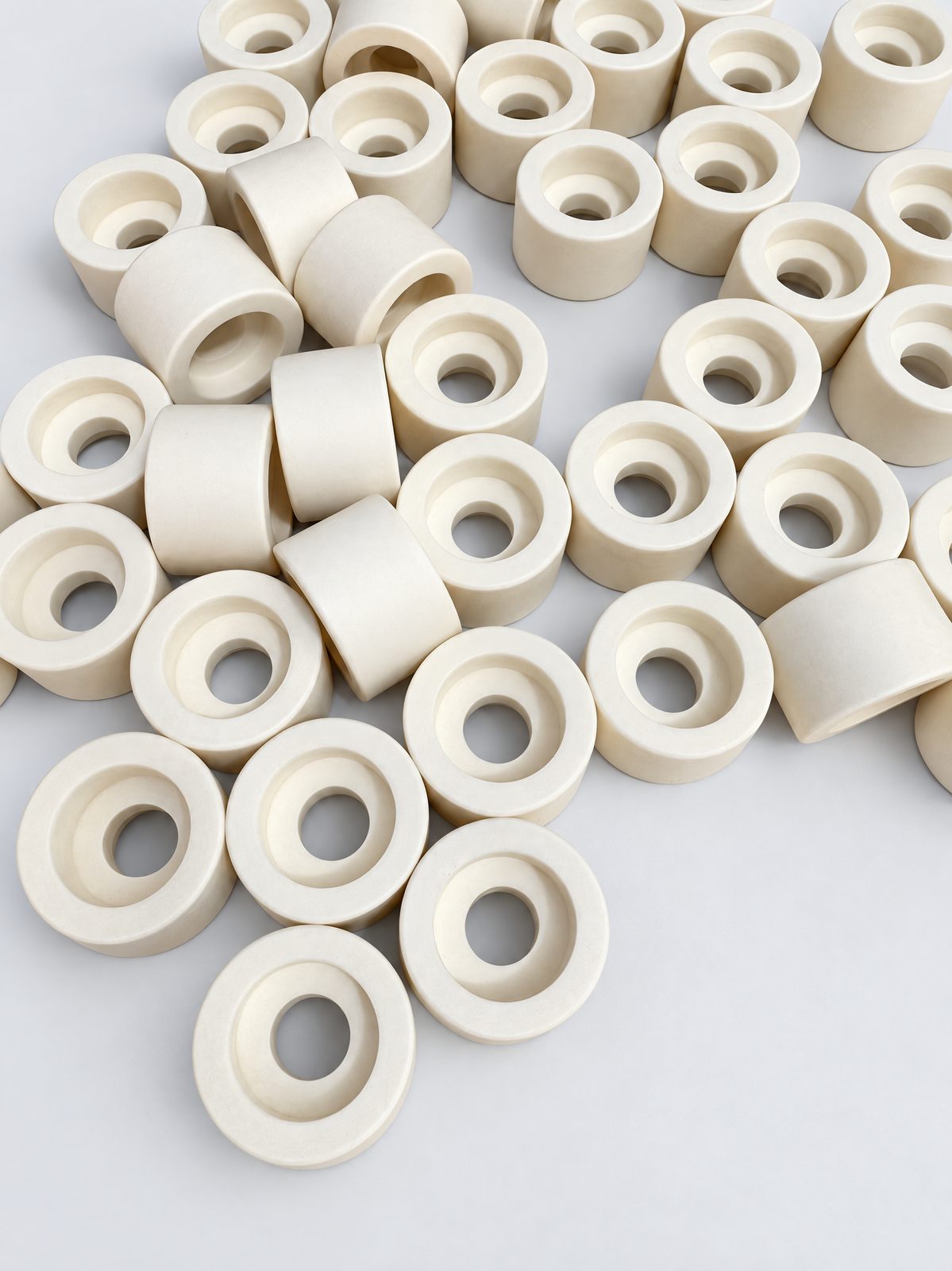
Alumina ceramic rings are dense circular components made of aluminum oxide (Al2O3) used as mechanical seal rings, slide rings, electrical standoff insulators, and wear spacers in corrosive or high-temperature equipment. Depending on purity, these industrial ceramic rings withstand maximum unloaded temperatures from 1,600 °C to 1,950 °C in air and reach a compressive strength of 2,500 MPa on Kyocera Fineceramics Europe's DEGUSSIT AL23 datasheet (February 2025). GY Alumina manufactures custom C799 (99.5% Al2O3) and 95% white alumina rings, washers, bushings, and discs to your drawing or sample.
What an alumina ring does and which geometries exist
When you specify an alumina ring, you are choosing the strongest and stiffest material among the oxide ceramics. Accuratus notes that aluminum oxide has strong ionic interatomic bonding, and all of its crystalline phases revert at high temperatures into the hexagonal alpha phase used for structural ceramic parts. That alpha structure resists strong acids and alkalis at high temperatures, provides electrical insulation from direct current to gigahertz frequencies, and resists abrasion in moving equipment.
Buyers use the term industrial ceramic rings to cover several distinct mechanical and electrical parts. In fluid handling and plant machinery, precision-ground rings act as ceramic seal rings and alumina slide rings that run against mating faces in pumps, metering valves, and rotary joints. In electrical and high-vacuum systems, rings serve as high-voltage standoff insulators, spacer washers, and metallized rings for brazed feedthroughs. Beyond standard pressed or extruded rings, specialized ring terms appear on engineering drawings and purchase requests:
- Ceramic seal rings and alumina slide rings: Precision-finished rings used in pumps, faucet valves, metering valves, and mechanical and plant engineering where hardness, low erosion, and chemical inertness prevent leaks.
- Alumina ceramic ring slice: A thin wafer, slotted ring, or segmented arc cut from a sintered alumina tube or solid cylinder. Almath Crucibles uses a single-wire diamond cutting machine to wafer, slice, dice, and crop ultra-hard alumina, cutting slots as thin as 0.25 mm.
- Alumina ceramic retaining ring: In high-temperature fixtures, furnaces, and semiconductor chambers, rigid ceramic rings locate or hold mating parts in place. Unlike a metallic spring clip that flexes to snap into a shaft groove, sintered alumina has an elastic modulus of 300 GPa to 400 GPa and zero ductility, so a ceramic retaining ring must be installed as a captured collar, bolted flange ring, or thermal shrink-fit band rather than stretched over a shaft.
- Alumina Raschig rings: Open cylinders of roughly equal outside diameter and length packed into chemical towers and corrosive gas scrubbers. In chemical processing, dense alumina resists attack by all gases except wet fluorine and all common reagents except hydrofluoric acid and phosphoric acid, according to Accuratus.
- Alumina ring gear: A toothed or notched ceramic ring used for low-impact indexing or metering in corrosive or high-temperature fluids. Because alumina has a fracture toughness of 3.5 to 5 MPa·m1/2 across commercial datasheets, gear teeth cannot take heavy shock loads and require green-state CNC milling or post-sintering diamond grinding or laser cutting.
Alumina grades and property tables across manufacturers
Selecting the right alumina ring starts with the aluminum oxide percentage. Lower-purity technical grades (94% to 96% Al2O3) include silicate glassy phases or fluxing additives that aid sintering and make the ceramic easier to metallize for brazing, while keeping part cost down. High-purity grades (above 98% Al2O3, such as 99.5%) minimize glassy grain-boundary phases to maximize corrosion resistance, electrical resistivity, hardness, and maximum working temperature.
Almath Crucibles notes that high-purity alumina forms a dense, essentially single-phase body during sintering, where small additions of magnesium oxide (MgO) up to 0.05% control grain growth and modern firing keeps closed porosity below 0.5%. Accuratus also notes that manufacturers can add chrome oxide or manganese oxide to increase hardness and change the body color, or adjust the recipe to help metal films fire onto the ceramic for soldered and brazed assemblies.
Every ceramic manufacturer tests its own body recipes and forming methods, so datasheet numbers vary between producers even at the same nominal purity. The table below compares published room-temperature and thermal properties for six commercial alumina grades from Accuratus, Precision Ceramics, Almath Crucibles, and Kyocera Fineceramics Europe.
| Property | Accuratus 94% Al2O3 | Accuratus 96% Al2O3 | Precision Ceramics CeramAlox 96 (96%) | Accuratus 99.5% Al2O3 | Almath Crucibles 99.5% Al2O3 | Kyocera DEGUSSIT AL23 (above 99.5%) |
|---|---|---|---|---|---|---|
| Density (g/cm3) | 3.69 (230.4 lb/ft3) | 3.72 (232.2 lb/ft3) | 3.75 | 3.89 (242.8 lb/ft3) | 3.8 | 3.70 to 3.95 |
| Color | White | White | Not stated | Ivory | White | Ivory (elfenbein) |
| Flexural strength (MPa) | 330 (47 lb/in2 x 10^3) | 345 (50 lb/in2 x 10^3) | 200 to 300 | 379 (55 lb/in2 x 10^3) | 375 | 300 to 350 |
| Compressive strength (MPa) | 2,100 (304.5 lb/in2 x 10^3) | 2,100 (304.5 lb/in2 x 10^3) | 2,000 | 2,600 (377 lb/in2 x 10^3) | 2,500 | 2,500 |
| Elastic modulus (GPa) | 300 (43.5 lb/in2 x 10^6) | 300 (43.5 lb/in2 x 10^6) | 300 | 375 (54.4 lb/in2 x 10^6) | 350 | 380 |
| Poisson's ratio | 0.21 | 0.21 | 0.23 | 0.22 | Not stated | 0.22 |
| Fracture toughness KIC (MPa·m1/2) | 3.5 | 3.5 | 4.5 | 4 | 4 to 5 | Not stated |
| Hardness | 1,175 Kg/mm2 | 1,100 Kg/mm2 | 12 GPa | 1,440 Kg/mm2 | 82 GPa (Rockwell 45N) | 17.1 GPa (HV 1.0) |
| Max use temp in air, no load (°C) | 1,700 (3,090 °F) | 1,700 (3,090 °F) | 1,600 | 1,750 (3,180 °F) | 1,750 | 1,950 |
| 18 (125 BTU·in/ft2·hr·°F) | 25 (174 BTU·in/ft2·hr·°F) | 25 | 35 (243 BTU·in/ft2·hr·°F) | 27.5 | 34.9 | |
| CTE (10^-6 /K or /°C) | 8.1 (4.5 x 10^-6 /°F) | 8.2 (4.6 x 10^-6 /°F) | 6.3 (25-300 °C) / 7.0 (25-700 °C) | 8.4 (4.7 x 10^-6 /°F) | 8.2 (25-1,000 °C) | 8.2 (20-1,000 °C) |
| Dielectric strength (kV/mm) | 16.7 AC (418 V/mil) | 14.6 AC (365 V/mil) | 9 DC | 16.9 AC (420 V/mil) | 8.7 AC (6.25 mm) | 20 to 30 |
| Dielectric constant at 1 MHz | 9.1 | 9.0 | 9.8 | 9.8 | Not stated | Not stated |
| Volume resistivity at 25 °C (ohm·cm) | Above 10^14 | Above 10^14 | Above 10^14 | Above 10^14 | 2 x 10^6 (at 1,000 °C) | Not stated |
Thermal shock, vacuum limits, and when to pick another ceramic
High compressive strength does not protect a ceramic ring from rapid cooling. Morgan Technical Ceramics explains that when a ceramic cools rapidly, its outer surface drops in temperature faster than its core. The cooling outer layer tries to contract while the hot interior resists it, putting the outer skin into tension and starting surface cracks.
Morgan Technical Ceramics measures this limit using the Hasselmann method, heating flexural test coupons and quenching them in a cooled fluid to find the critical temperature drop (delta °C) where bending strength drops sharply. In Morgan's comparison table, alumina has a thermal downshock resistance of 170 to 300 °C, while Almath Crucibles lists a water-quench delta Tc of 200 °C for its 99.5% alumina grade. If your ring faces severe thermal cycling or mechanical impact that exceeds alumina's limits, compare the alternatives described by Morgan Technical Ceramics and Precision Ceramics:
- Silicon nitride (Si3N4): Rated by Morgan Technical Ceramics for a thermal downshock resistance of 900 °C.
- Zirconia (ZrO2) and Zirconia Toughened Alumina (ZTA): Morgan rates zirconia for a 400 to 500 °C thermal downshock resistance. Precision Ceramics notes that zirconia has the highest fracture toughness of all monolithic oxide ceramics, while ZTA composites combine alumina's hardness with zirconia's increased fracture toughness and bending strength.
- Silicon carbide (SiC): Rated by Morgan Technical Ceramics for a 400 °C thermal downshock limit.
- Macor machinable glass ceramic: Precision Ceramics notes that for small quantities, Macor avoids the cost of diamond grinding because it can be machined with standard metalworking tools. However, Macor is limited to a maximum use temperature of 1,000 °C unstressed and 800 °C stressed, is vulnerable to thermal shock, and has poor wear resistance compared to alumina.
| Condition or Parameter | Published Value | Source and Grade |
|---|---|---|
| Thermal conductivity at 20 °C | 34.9 W/m·K | Kyocera DEGUSSIT AL23 (above 99.5% Al2O3) |
| Thermal conductivity at 1,000 °C | 6.8 W/m·K | Kyocera DEGUSSIT AL23 (above 99.5% Al2O3) |
| Thermal conductivity at 1,500 °C | 5.3 W/m·K | Kyocera DEGUSSIT AL23 (above 99.5% Al2O3) |
| Specific heat capacity at 20 °C | 900 J/(kg·K | Kyocera DEGUSSIT AL23 (above 99.5% Al2O3) |
| Specific heat capacity at room temperature | 880 J/Kg·°K (0.21 Btu/lb·°F | Accuratus 94%, 96%, and 99.5% Al2O3 |
| Oxidizing and reducing atmosphere limit | Up to 1,925 °C (Accuratus) / up to 1,650 °C (2,900 °F) (Precision Ceramics FAQ | Accuratus high-purity alumina / Precision Ceramics |
| Vacuum atmosphere limit and weight loss | Up to 2,000 °C (3,600 °F). Weight loss 10^-7 to 10^-6 g/cm2·sec from 1,700 °C to 2,000 °C | Precision Ceramics FAQ / Accuratus |
How alumina rings are formed, sintered, and diamond ground
Read more
Across the technical ceramics industry, manufacturers form alumina rings by dry die pressing, isostatic pressing, extrusion, slip casting, hot pressing, or ceramic injection molding. Precision Ceramics notes that in the unfired green state or partially fired biscuit state, an alumina blank can be machined relatively easily into complex shapes using traditional cutting methods.
However, green machining alone cannot produce ultra-tight ring tolerances. As Precision Ceramics explains, firing the alumina body to full density causes it to shrink by approximately 20%. In addition, Almath Crucibles notes that sintered alumina tends to warp and bend during firing. Because of that 20% sintering shrinkage and kiln distortion, holding tight flatness, roundness, or diameter tolerances requires post-sintering machining with diamond tools.
During post-sintering finishing, manufacturers use resin-bonded diamond wheels on automated CNC surface grinders, cylindrical grinders, and 4th- and 5th-axis milling centers to abrade the hard ceramic to final size. For fluid-tight seal rings, valve seats, and metering valves, Morgan Technical Ceramics and Kyocera Fineceramics Europe list lapping, polishing, and laser machining to achieve fine surface qualities. When a ring must be joined into a metal housing for a vacuum-tight feedthrough or hermetic seal, Morgan Technical Ceramics and ASTM D2442-75(2025) (Standard Specification for Alumina Ceramics for Electrical and Electronic Applications) cover fabricated alumina parts that are metallized and brazed into ceramic-to-metal assemblies. Accuratus points out that 94% alumina is an easily metallizable composition for fired metal films and subsequent brazing.
Worked example: calculating thermal expansion and heat drop for a 100 mm ring
When you mount an alumina ring inside or around a metal shaft or housing that heats up, you must calculate how much the ring grows and how much heat transfer drops at furnace temperatures. Below is a worked calculation by our team using the published figures on Kyocera Fineceramics Europe's DEGUSSIT AL23 datasheet (February 2025).
Suppose your assembly uses a high-purity alumina ring with a 100 mm outside diameter at 20 °C, and the system heats up to 1,000 °C (a temperature rise of 980 K). Kyocera's DEGUSSIT AL23 datasheet lists a mean linear coefficient of thermal expansion of 8.2 x 10^-6 /K from 20 °C to 1,000 °C. By our calculation from Kyocera Fineceramics Europe's DEGUSSIT AL23 datasheet, multiplying 100 mm by 8.2 x 10^-6 /K and by 980 K gives a diametrical expansion of 0.8036 mm, bringing the ring's hot outside diameter to 100.8036 mm at 1,000 °C. If that ring sits inside a metal sleeve with a higher expansion rate, a cold press-fit will loosen when hot. If a metal shaft sits inside the ceramic ring's bore, the metal shaft will expand faster than the 0.8036 mm bore growth and can crack the ring in hoop tension unless you leave radial clearance.
You should also account for the steep drop in thermal conductivity as the ring heats up. On the same DEGUSSIT AL23 datasheet, thermal conductivity is 34.9 W/m·K at 20 °C, drops to 6.8 W/m·K at 1,000 °C, and reaches 5.3 W/m·K at 1,500 °C. By our calculation from Kyocera Fineceramics Europe's DEGUSSIT AL23 datasheet, thermal conductivity at 1,000 °C is 19.48% of its 20 °C value (an 80.52% reduction), and at 1,500 °C it is 15.19% of its 20 °C value (an 84.81% reduction). High-temperature rings insulate against heat flow much more strongly at 1,000 °C to 1,500 °C than room-temperature datasheets suggest.
What GY Alumina makes and how we produce custom rings
At GY Alumina, we manufacture custom alumina ceramic rings, washers, bushings, and discs to your drawing or physical sample at our factory in Tangshan. Our standard grade is C799 alumina (99.5% Al2O3). Where an engineering drawing calls out C 610, we supply 95% white alumina or our standard C799 alumina instead. Neither material is mullite.
We form custom parts using four in-house forming routes: slip casting, pressing, extrusion, and hot pressing. After forming and firing, the secondary operations we perform in our factory are cutting to ordered length, cutting end slots, drilling side holes and perforated patterns, and making closed ends with drilled holes.
If your ring is cut or sized from tubular stock, our factory's current tube size limits give you a clear baseline when preparing a drawing. Our largest extruded tube today is OD 17 x ID 10 mm, and our largest slip-cast tube is OD 100 x ID 90 x 1,000 mm. An independent lab analyses one of our alumina tubes every year, recording 99.55% Al2O3 in 2024, 99.57% in 2025, and 99.61% in 2026. Our ISO 9001:2015 certificate covers the manufacturing of ceramic protective tubes for thermocouples. We have served 100+ customers.
Checklist: how to specify an alumina ring and request a quote
Putting complete specifications on your drawing prevents delays during engineering review. Confirm the bore clearance against your mating pin, wire, or shaft before ordering.
Use this engineering checklist written by our team when preparing your specification:
- Drawing or sample: Prepare a dimensioned engineering drawing or arrange to supply a physical sample.
- Nominal dimensions and tolerances: State the outside diameter (OD), inside diameter (ID), and thickness or length in millimeters, marking which tolerances are critical for your assembly.
- Secondary features: Call out any required end slots, side holes, or perforations with their sizes and positions.
- Material grade: Specify C799 alumina (99.5% Al2O3) or 95% white alumina, or note if your drawing lists C 610.
- Operating conditions: State the working temperature, heating and cooling rate, mechanical load, and chemical atmosphere (air, vacuum, reducing gas, acids, or alkali vapors).
- Order volume and sample needs: State the required quantity and whether your team needs approval samples before full production.
Order quantities, free samples, and lead times at GY Alumina
At GY Alumina, custom parts made to your drawing or sample usually start at 100 pieces per item and take 25 to 30 days to produce. Before running full production, 5 to 10 free samples are sent for approval first (the buyer pays the courier), while standard sizes ship from stock in about 3 days for small orders to about 7 days for bulk orders.
Our team reviews custom ring, washer, bushing, and disc drawings against our slip casting, pressing, extrusion, and hot pressing routes and secondary operations. Send your drawing for review with the grade and the quantity, and we usually reply with a quote within two working days.
Questions buyers ask
- Can GY Alumina make custom alumina ceramic rings to our CAD drawing or sample?
- Yes. GY Alumina manufactures custom rings, washers, bushings, and discs to your drawing or physical sample in C799 alumina (99.5% Al2O3) or 95% white alumina using slip casting, pressing, extrusion, or hot pressing.
- What is the minimum order quantity and lead time for custom alumina rings?
- At GY Alumina, custom parts made to a drawing or sample usually start at 100 pieces per item and take 25 to 30 days to produce. We send 5 to 10 free samples for your approval before production runs, and the buyer pays the courier freight.
- Why do tight-tolerance alumina rings require diamond grinding after sintering?
- Precision Ceramics notes that while alumina can be machined easily in its unfired green or biscuit state, firing the part to full density causes approximately 20% shrinkage. Holding tight final tolerances requires grinding the sintered ceramic with diamond tools.
- How is an alumina ceramic ring slice cut from a cylinder or tube?
- Almath Crucibles uses single-wire diamond cutting machines and laser cutters to wafer, slice, crop, and dice ultra-hard alumina, cutting slots as narrow as 0.25 mm.
- Can alumina ceramic rings be metallized and brazed to metal housings?
- Yes. Morgan Technical Ceramics and Accuratus state that alumina supports fired metallization and brazing (with 94% alumina noted by Accuratus as an easily metallizable grade) to create hermetic ceramic-to-metal seals and vacuum-tight feedthroughs, a use also covered by ASTM D2442-75(2025).
- What thermal shock temperature drop can an alumina ring survive?
- Morgan Technical Ceramics lists a Hasselmann thermal downshock resistance of 170 to 300 °C for alumina, and Almath Crucibles lists a water-quench delta Tc of 200 °C for its 99.5% alumina grade.
Sources
- Precision Ceramics: Alumina Properties and Industrial Applications
- Kyocera Fineceramics Europe: DEGUSSIT AL23 Datasheet (February 2025
- Kyocera Fineceramics Europe: Alumina Material and Products Overview
- Morgan Technical Ceramics: Thermal Shock Resistance in Ceramics
- Morgan Technical Ceramics: High-Performance Alumina Ceramic Components
- Accuratus: Aluminum Oxide (Al2O3) Material Properties
- Almath Crucibles: Alumina Material Properties
- Almath Crucibles: Advanced Ceramic Machining Services
- ASTM D2442-75(2025) Standard Specification for Alumina Ceramics for Electrical and Electronic Applications
- GY Alumina: Custom Alumina Components Made to Drawing or Sample
- GY Alumina: Alumina and Corundum Material Data
- GY Alumina: Buyer FAQ on MOQ, Lead Time, Samples, and ISO 9001
- GY Alumina: Alumina Ceramics Factory in Tangshan
Last checked .