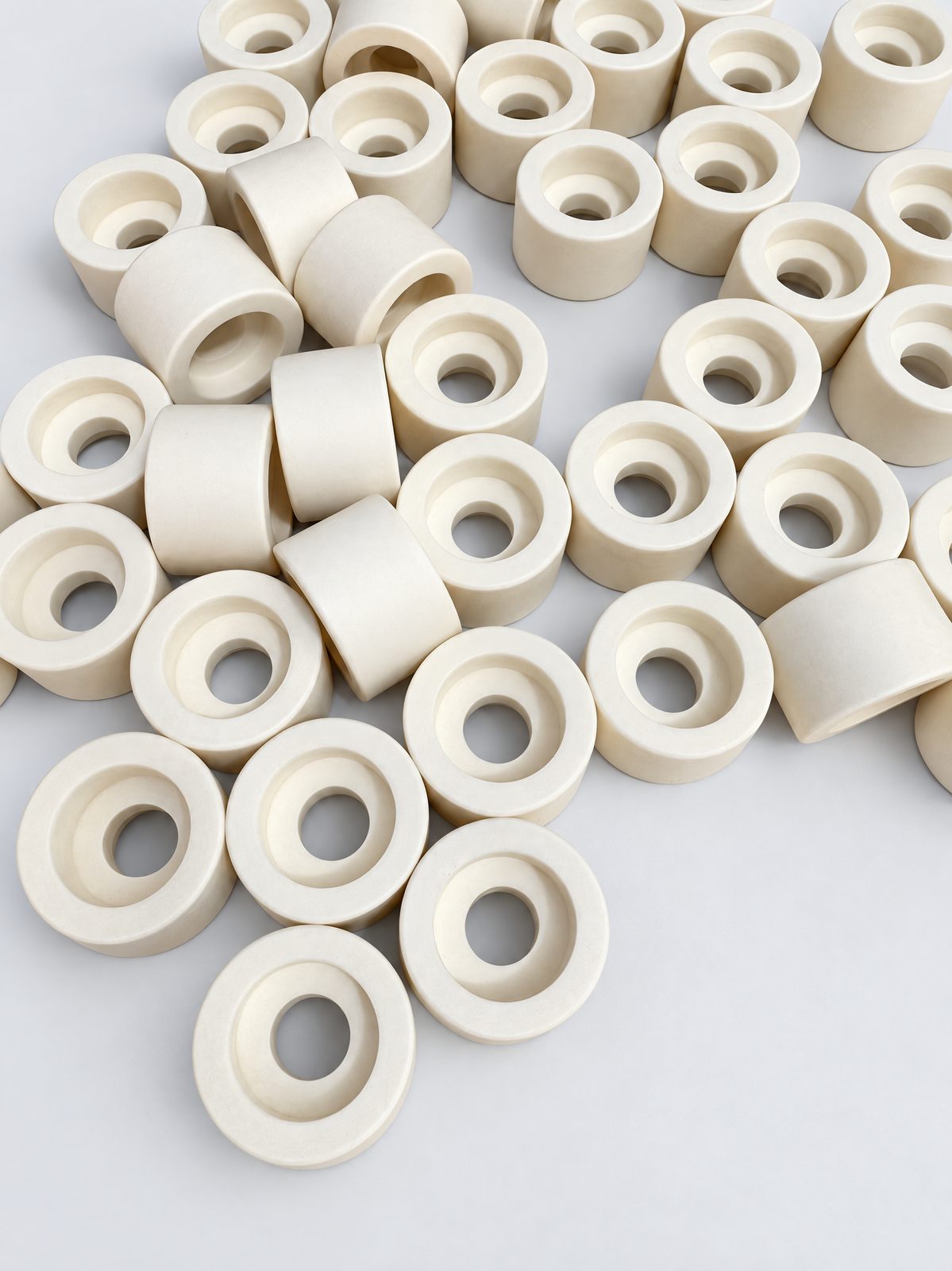
Alumina ceramic injection molding (CIM) mixes fine aluminum oxide powder with thermoplastic binders into pelletized feedstock, molds complex net-shape parts, removes the binder by pyrolysis, and sinters the body with uniform linear shrinkage of up to 20% according to Morgan Technical Ceramics. On miniature components, Kyocera reports mass-production CIM tolerances down to ±0.01 mm without heavy diamond machining. At GY Alumina, we manufacture custom C799 (99.5% Al2O3) and 95% white alumina parts to drawing by slip casting, pressing, extrusion, and hot pressing.
How alumina ceramic injection molding works from feedstock to kiln
Aluminum oxide ceramic injection molding adapts plastic molding principles to form intricate three-dimensional ceramic parts that are too costly to grind from solid blanks. According to Morgan Technical Ceramics, the four-stage CIM workflow starts by compounding fine ceramic powders with thermoplastic binders into a homogeneous, pelletized feedstock. During injection, the melted binder acts as a liquid carrier that forces the suspended alumina powder into single-cavity or multi-cavity steel dies under pressure.
Once ejected from the die, the molded green component goes through two separate thermal cycles. First, pyrolysis (debinding) extracts the organic binder system without cracking the fragile powder compact. Second, firing in a high-temperature kiln sinters the alumina grains into a non-porous, dense technical ceramic.
Because the shape is formed inside a closed cavity before firing, CIM produces geometries that uniaxial die pressing and extrusion cannot release from a tool. Buyers specify ceramic injection molding when a single monolithic part needs several complex features at once.
- Internal and external screw threads, undercuts, and re-entrant angles molded directly at net shape.
- Perpendicular cross-holes, multi-shaped blind cavities, and contoured surface profiles.
- Micro-scale features on small parts, where Kyocera reports minimum wall thicknesses down to 0.02 mm and minimum through-hole diameters down to 0.08 mm.
- Optional post-sintering operations where required, including diamond grinding on mating faces and metallizing or brazing for hermetic ceramic-to-metal feedthroughs and sensor assemblies.
Sintering shrinkage math and dimensional precision
Densification in the kiln drives significant, predictable volume loss as open pores close between alpha-alumina crystals. Both Morgan Technical Ceramics and Precision Ceramics report that an alumina body shrinks uniformly by about 20% in each linear direction during sintering while holding its molded proportions. Die cavities must be oversized by an exact scale factor tied to the feedstock batch and solids loading.
By our calculation from Morgan Technical Ceramics' 20% linear sintering shrinkage figure, a sintered linear dimension equals 0.80 of its green molded size, so the green cavity dimension must be 1.25 times the target finished size. For a custom alumina insulator sleeve with a 16.00 mm finished outside diameter and 8.00 mm bore, the green part must leave the mold at 20.00 mm outside diameter and 10.00 mm bore.
Consistent feedstock compounding keeps this shrinkage uniform enough that most net-shape surfaces need no post-firing wheel work. On small, thin-walled alumina parts such as suction nozzles with 0.08 mm through-holes produced in 1,000-piece lots, Kyocera lists a stable mass-production tolerance capability of ±0.01 mm. On larger geometries or pre-sintered green-machined blanks, Precision Ceramics notes that shrinkage variation prevents ultra-tight as-fired tolerances, so critical bearing journals, sealing faces, and precision bores are finished after sintering with diamond-coated grinding wheels.
Alumina grades and material properties for molded parts
Technical alumina compositions start at 90% Al2O3, and selecting a purity grade shifts mechanical strength, dielectric loss, thermal conductivity, and metallizing behavior. Accuratus notes that 94% alumina is formulated for straightforward thick-film metallization and brazed assemblies, whereas its 99.5% grade handles higher temperatures and harsher chemical exposure, resisting all gases except wet fluorine and all common reagents except hydrofluoric and phosphoric acids.
For dedicated injection molding and extrusion runs, Morgan Technical Ceramics formulates Hilox 998 as a fully dense, vacuum-tight alumina built for high volume resistivity and resistance to thermal and chemical fatigue. In higher-impact or severe thermal-cycling designs, buyers compare molded alumina against zirconia or silicon nitride: on its small-part CIM datasheet, Kyocera lists 480 MPa 3-point flexural strength and 4.3 MPa·m1/2 fracture toughness for AO480S alumina, compared with 1,000 MPa flexural strength and 6 MPa·m1/2 toughness for ZO201N zirconia, and 1,020 MPa strength with 7 MPa·m1/2 toughness for SN240O silicon nitride.
Because grain size, sintering aids, and forming pressure alter fired density, properties always belong to a specific maker and grade rather than to aluminum oxide in the abstract. The table below compares published room-temperature and thermal values across three manufacturers.
| Maker and Grade | Al2O3 Purity | Density (g/cm3) | Flexural Strength (MPa) | Hardness | Thermal Conductivity (W/m·K) | Max No-Load Temp in Air (°C) |
|---|---|---|---|---|---|---|
| Accuratus 94% Alumina | 94% | 3.69 | 330 | 1,175 kg/mm2 | 18 | 1,700 (3,090 °F) |
| Precision Ceramics CeramAlox 96 | 96% | 3.75 | 200 to 300 | 12 GPa | 25 (at 25 °C) | 1,600 |
| Accuratus 99.5% Alumina | 99.5% | 3.89 | 379 | 1,440 kg/mm2 | 35 | 1,750 (3,180 °F) |
| Kyocera DEGUSSIT AL23 (Feb 2025) | Above 99.5% | 3.70 to 3.95 | 300 to 350 (4-point) | 17.1 GPa (HV 1.0) | 34.9 (at 20 °C) | 1,950 |
Alumina ceramic setter plates for MIM and CIM sintering
Read more
Buyers researching injection-molded parts also specify custom ceramic setters and flat setter plates to support metal injection molded (MIM) and CIM green compacts inside high-temperature sintering kilns. During binder burnout and peak densification, molded metal and ceramic parts soften and shrink by roughly one-fifth across the hearth, so the supporting plate must stay flat, smooth, and chemically non-reactive to prevent drag warpage or alloy contamination. Kyocera lists high-purity alumina ceramic setters for sintering quality improvement and cost reduction due to their corrosion resistance and heat stability, while Morgan Technical Ceramics supplies setters and reformers alongside pattern tooling.
Furnace engineers choosing alumina setter plates must account for three thermal limits documented in manufacturer data. First, atmosphere changes the ceiling: Accuratus states that high-purity alumina operates up to 1,925 °C in oxidizing and reducing atmospheres, while in vacuum over 1,700 to 2,000 °C its weight loss runs from 10^-7 to 10^-6 g/(cm2·sec), and alkali metal vapors attack lower-purity grades at high heat. Second, heat transfer drops sharply at sintering soak temperatures: in Kyocera Fineceramics Europe's February 2025 DEGUSSIT AL23 datasheet, thermal conductivity falls from 34.9 W/(m·K) at 20 °C to 6.8 W/(m·K) at 1,000 °C and 5.3 W/(m·K) at 1,500 °C. By our calculation from the DEGUSSIT AL23 datasheet, this grade retains 15.2% of its room-temperature thermal conductivity at 1,500 °C, so thick setter tiles require controlled ramp rates to keep tray temperatures even.
Third, rapid cooling cracks dense oxide plates. Measured by the Hasselmann quench test, Morgan Technical Ceramics places alumina's thermal downshock resistance at a temperature delta of 170 to 300 °C, compared with 400 °C for silicon carbide, 400 to 500 °C for zirconia, and 900 °C for silicon nitride. Fast-cycle pusher or vacuum furnaces with steep quench zones need thin, uniform setter cross-sections or slotted thermal-relief designs.
CIM vs pressing, extrusion, slip casting, and green machining
Hardened multi-cavity injection molds carry high upfront tooling investment and long lead times, so CIM only lowers unit cost when part complexity and annual volume justify amortizing the steel die. Morgan Technical Ceramics breaks development and production quantities into three distinct volume tiers before committing to full production tooling.
When an engineering drawing shows constant cross-sections (tubes, multi-bore insulators, rods, square bars), symmetrical axial profiles (rings, bushings, washers, discs), or open hollow vessels (boats, crucibles, closed-end sheaths), conventional ceramic forming avoids injection die expense altogether. Pressing, extrusion, slip casting, and hot pressing handle orders from 100 pieces upward without six-figure mold programs, and machinable glass-ceramics such as Macor (rated by Precision Ceramics to 800 °C stressed and 1,000 °C unstressed) cover low-temperature prototypes in small batches.
| Forming Route | Typical Volume Range | Best Part Geometries | Key Tooling and Finishing Notes |
|---|---|---|---|
| Green Blank CNC Machining | Tens of pieces (Morgan) | Prototypes and complex low-volume blocks | No molding die required, diamond grinding needed after 20% firing shrink for tight fits |
| Rapid Prototype CIM Tooling | Hundreds to low thousands (Morgan) | Pre-production trials of 3D molded designs | Lower-cost trial mold from 3D CAD before full production die investment |
| Full Production CIM | Tens of thousands to above 1,000,000 (Morgan) | Small 3D parts with threads, undercuts, cross-holes, and thin walls | Multi-cavity hardened tooling, near-net shape down to ±0.01 mm on miniature parts (Kyocera) |
| Extrusion | From 100 pieces custom or stock (GY Alumina) | Round, square, and elliptical tubes, capillaries, multi-bore insulators, solid rods | Continuous profile dies, secondary cut-to-length, slotting, and side-hole drilling |
| Pressing and Hot Pressing | From 100 pieces custom (GY Alumina) | Rings, washers, bushings, discs, beads, boats, and special shapes | Modest die setup suitable for planar and axial industrial hardware |
| Slip Casting | From 100 pieces custom (GY Alumina) | Large furnace tubes, closed-end protection sheaths, crucibles, and custom hollow ware | Plaster or porous molds accommodate large diameters and long closed-end walls |
What GY Alumina makes for custom component and furnace buyers
Read more
GY Alumina manufactures technical alumina and corundum parts at our factory in Tangshan, China, using four forming routes: slip casting, pressing, extrusion, and hot pressing. When an engineer sends us a drawing designed around small-batch industrial equipment, thermocouples, or high-temperature furnaces, we review whether the geometry can be formed cleanly by pressing, hot pressing, extrusion, or slip casting with our factory secondary operations.
Our standard grade is C799 alumina (99.5% Al2O3), sintered as corundum ware at about 1,760 °C (a kiln firing temperature, not a service rating). An independent laboratory tests one of our alumina tubes each year, recording 99.55% Al2O3 in 2024, 99.57% in 2025, and 99.61% in 2026. Where a customer drawing specifies C 610, we supply 95% white alumina or our standard C799 alumina instead (neither is mullite), and our crucibles are made in 99% and 99.5% Al2O3. Our ISO 9001:2015 certificate covers the manufacturing of ceramic protective tubes for thermocouples, and we have served 100+ customers.
Within those four forming lines, we supply custom shapes to drawing or sample alongside standard stock:
- Pressed, hot-pressed, and cast shapes: rings, washers, bushings, discs, balls, square bars, rectangular and cylindrical crucibles, sintering and laboratory boats, and special shapes to drawing.
- Extruded and slip-cast tubes: round, elliptical, and square tubes (open both ends or one end closed), single-, twin-, and multi-bore insulators, capillaries, and threaded or ribbed tubes. Today our largest extruded tube is OD 17 x ID 10 mm, and our largest slip-cast tube is OD 100 x ID 90 x 1,000 mm.
- Secondary factory operations: cutting to length, end slots, side holes, perforated tube walls, and closed ends with drilled holes.
Specification checklist for custom alumina drawings
Clear engineering inputs prevent tooling rework when specifying custom ceramic components. Before sending a drawing out for quotation, verify each item on this specification checklist written by our team.
- 2D tolerance drawing (PDF, DWG, or DXF) and 3D model (STEP or IGES), marking only functional mating surfaces with tight tolerances and leaving non-contact walls at as-sintered tolerances.
- Fit direction on bores and shafts: if a wire, pin, or heater core must slide inside an unground ceramic bore, specify a one-sided clearance limit and confirm the bore against your insert before ordering.
- Target Al2O3 purity grade (such as 95% white alumina or C799 99.5% Al2O3) and whether any surface will be metallized or brazed downstream.
- Operating peak temperature, heating and cooling ramp rates (to check against alumina's 170 to 300 °C thermal shock delta), mechanical load orientation, and furnace atmosphere (air, reducing gas, vacuum, or chemical vapors).
- Order quantity per batch, annual forecast, sample requirements, and destination country for crate packing.
What to send GY Alumina for a quote
At GY Alumina, custom parts made to your drawing or physical sample usually start at a minimum order of 100 pieces per item and take 25 to 30 days to produce. Before running the full batch, we send 5 to 10 free samples for your fit and furnace approval, with courier freight paid by the buyer. Standard catalog tube and rod sizes ship from stock in about 3 days for small orders and about 7 days for bulk quantities.
Send your drawing, the grade and the quantity. We usually reply with a quote within two working days.
Questions buyers ask
- What is alumina ceramic injection molding and when does it make sense?
- According to Morgan Technical Ceramics, ceramic injection molding compounds fine alumina powder with thermoplastic binders, molds net-shape green parts in single or multi-cavity dies, removes the binder by pyrolysis, and sinters the ceramic in a high-temperature kiln. It makes sense when a small part has complex 3D features such as threads, undercuts, perpendicular holes, or thin walls at volumes from thousands to above 1,000,000 pieces, avoiding costly diamond machining.
- How much does alumina shrink during sintering after injection molding?
- Morgan Technical Ceramics and Precision Ceramics both state that alumina shrinks uniformly by about 20% in each linear direction during kiln sintering.
- What wall thicknesses and dimensional tolerances can alumina CIM hold?
- On small precision parts, Kyocera reports mass-production CIM tolerances of ±0.01 mm, minimum wall thicknesses down to 0.02 mm, and micro through-holes down to 0.08 mm in diameter. Where larger geometries or ultra-flat sealing faces exceed as-sintered shrinkage repeatability, Precision Ceramics notes that post-sinter diamond grinding is required.
- Why are high-purity alumina setter plates used for sintering MIM parts?
- Kyocera notes that high-purity alumina setters improve sintering quality and lower processing costs through corrosion resistance and high-temperature stability. Accuratus lists high-purity alumina service up to 1,925 °C in oxidizing or reducing atmospheres and 1,700 to 2,000 °C in vacuum, providing a non-reactive surface as MIM parts debind and densify.
- Which forming methods does GY Alumina use for custom alumina parts?
- GY Alumina forms parts by slip casting, pressing, extrusion, and hot pressing. We make custom rings, bushings, discs, tubes, rods, boats, crucibles, and special shapes to drawing in C799 (99.5% Al2O3) and 95% white alumina, usually starting at 100 pieces with 25 to 30 day production.
Sources
- Morgan Technical Ceramics: Ceramic Injection Moulding Capabilities
- Morgan Technical Ceramics: Ceramic Injection Moulding (CIM) Materials
- Morgan Technical Ceramics: Ceramic Injection Moulded Components
- Morgan Technical Ceramics: Thermal Shock Resistance in Ceramics
- Morgan Technical Ceramics: Wax Pattern Tooling and Setters
- Kyocera Group: Small, Thin Ceramic Injection Molding (CIM)
- Kyocera Group: Alumina (Al2O3) Fine Ceramics Material Overview
- Kyocera Fineceramics Europe: DEGUSSIT AL23 Datasheet (February 2025)
- Precision Ceramics: Alumina Properties and Industrial Applications
- Accuratus: Aluminum Oxide (Al2O3) Ceramic Properties
- GY Alumina: Alumina and Corundum Grades Material Data
- GY Alumina: Custom Alumina Components Made to Drawing
- GY Alumina: Buyer FAQ on MOQ, Lead Time, Samples, and ISO 9001
- GY Alumina: Alumina Ceramics Factory in Tangshan, China
Last checked .