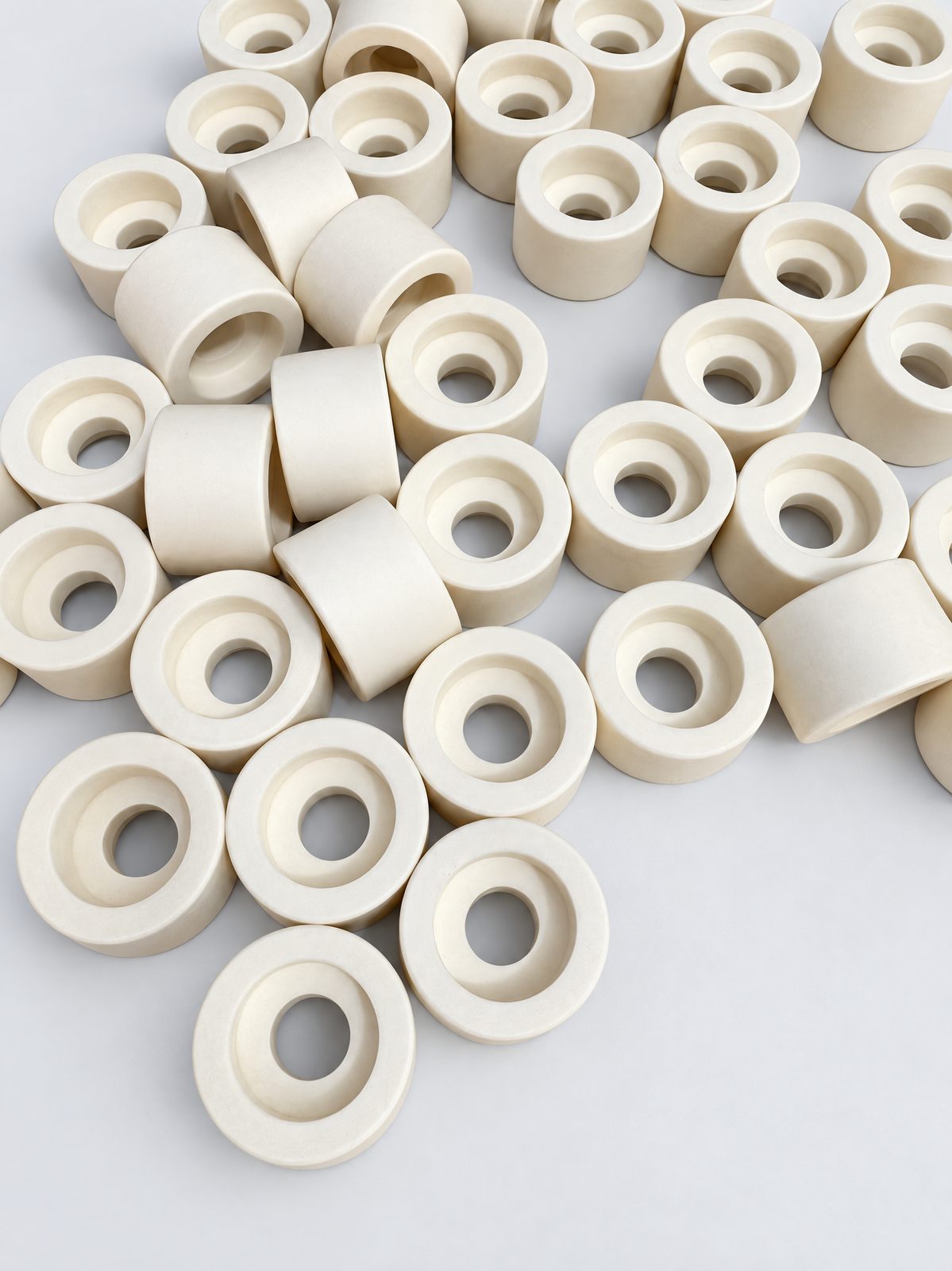
Alumina ceramic green machining is the cutting, milling, turning, or drilling of compacted aluminum oxide powder mixed with an organic binder before high-temperature kiln firing. Shaping the soft, unfired blank avoids slow superabrasive grinding on hardened ceramic, though Precision Ceramics notes that alumina shrinks about 20% in each direction during sintering at 1,500 °C to 1,800 °C. Because firing shrinkage varies across part geometry, green machining forms complex near-net shapes economically while tight final tolerances require post-sintered diamond grinding.
What Is Green Machining of Alumina Ceramics
In ceramic green machining, cutting tools shape a pressed, unfired alumina blank before it enters the sintering kiln. To create a machinable blank, fine alumina powder is blended with an organic binder and compacted under high pressure inside a mold or die to produce a chalk-like raw billet known as a green body. The organic binder holds the pressed ceramic grains together with enough mechanical resistance to withstand multi-axis CNC turning, milling, sawing, and rough drilling.
Technical alumina can be machined at three distinct points along its thermal processing route: the unfired green state, the partially fired biscuit state, and the fully sintered dense state. Roughly halfway through the heating progression, almost all of the organic binder burns out of the compact, leaving an almost pure, porous ceramic body that has not yet densified. In this biscuit machining stage, the part is substantially harder and less crumbly than a raw green compact, making finer operations such as tapping and threading practical before final densification.
Full strength and hardness develop only during final sintering in controlled gas or electric kilns. Precision Ceramics reports typical firing temperatures for alumina from 1,500 °C to 1,800 °C over firing cycles lasting 12 to 24 hours, depending on the kiln type and product. Once cooled from peak firing temperature, dense alumina can only be shaped using diamond grinding, lapping, polishing, or laser machining.
| Process Stage | Material Condition | Material Removal Mechanism | Practical Operations | Remaining Shrinkage and Tolerance Control |
|---|---|---|---|---|
| Green machining | Unfired pressed alumina powder held by organic binder | Low-force cutting governed by organic binder cohesion | 4th- and 5th-axis CNC milling, turning, sawing, rough pockets and bores | About 20% linear shrinkage ahead, near-net tolerances only |
| Biscuit machining | Partially fired halfway through sintering with binder burned off | Controlled cutting of porous, partially fired alumina | Fine drilling, tapping, and threading prior to final kiln cycle | Remaining densification shrinkage ahead, tighter detail than raw green |
| Fired diamond machining | Fully sintered dense ceramic fired at 1,500 °C to 1,800 °C | Brittle fracture under diamond superabrasives | Precision cylindrical and surface grinding, wafering, lapping, polishing | Zero firing shrinkage remaining, required for tight final tolerances |
Alumina Sintering Shrinkage Math and Worked Blank-Sizing Example
Sintering pulls compacted alumina particles together and eliminates the pore volume left behind after binder burnout, causing the body to shrink about 20% in each direction. Because green density varies slightly from pressing friction, gravity sag in the kiln, and wall-thickness transitions, shrinkage is never perfectly uniform across an intricate part. That shrinkage scatter is why tight sub-millimeter tolerances cannot be held by pre-sintering machining alone.
To program a green toolpath, the machinist works backward from the fired target size using the linear enlargement equation: Enlargement Factor = 1 / (1 - s), where s is the decimal linear shrinkage fraction. By our calculation from Precision Ceramics and its published 20% directional shrinkage figure, the linear enlargement factor is 1 / (1 - 0.20) = 1.25, meaning every green linear feature must be cut 25% larger than its target fired size. Shrinking to 80% of green size along all three axes also reduces total part volume to 0.80 x 0.80 x 0.80 = 0.512 of the machined blank, a 48.8% volumetric reduction during firing.
Consider a worked sizing example that an engineer or estimator runs before ordering blanks. Suppose your assembly requires a custom alumina sleeve with a fired 40.0 mm outside diameter, a 20.0 mm inside bore, and an 80.0 mm overall length, with tight concentricity on both diameters. Applying the 1.25 enlargement factor (by our calculation from that 20% linear shrinkage figure) sets the nominal green dimensions at a 50.0 mm outside diameter, a 25.0 mm inside bore, and a 100.0 mm length. Because the outside diameter and bore are precision mating surfaces, the shop adds an extra post-fire diamond grinding stock allowance onto the outside diameter and leaves the bore slightly undersized so a diamond wheel can clean up minor firing ovality after sintering.
When you prepare an engineering drawing for quotation, always specify the final fired dimensions and final fired tolerances rather than pre-scaled green dimensions. Each ceramic producer calibrates directional shrink factors to its specific alumina grade, binder load, forming pressure, and kiln furniture orientation.
Green Machining vs Fired Machining Process: Mechanics, Fixturing, and Coolants
Comparing the green machining vs fired machining process comes down to how the material fails ahead of the cutting edge. In the green state, cutting forces are low because the tool cuts unfired powder held by organic binder, yet exposed oxide particles remain abrasive against cutting edges. Once sintered, 99.5% alumina reaches a hardness of 1,400 to 1,700 HV and a fracture toughness of 3.0 to 4.5 MPa-m1/2 according to a May 2026 technical guide from UKAM Industrial Superhard Tools. Unlike metals, fired alumina does not deform plastically during cutting, so material removal relies on controlled brittle micro-fracture where spindle vibration and localized stress concentration trigger edge chipping.
In the green stage, Precision Ceramics notes that the choice of organic binder governs cutting suitability and mechanical resistance during machining. After sintering, wet cutting with continuous, filtered coolant aimed directly into the cutting interface becomes standard practice to carry away heat, flush abrasive swarf, and prevent thermal cracking, backed by sacrificial support plates made of graphite, phenolic, glass, ceramic, or wax to stop exit breakout.
Cost-conscious component designs split features between pre-sintering and post-sintering operations so diamond grinding wheels remove only minimal stock on critical datums:
- Cut in the green state: outer contours, deep pockets, weight-relief cavities, non-critical clearance holes, generous corner radii, and grinding relief undercuts.
- Cut in the biscuit state: tapped holes, coarse internal or external threads, and delicate cross-holes that benefit from higher handling stiffness after binder burnout.
- Finish in the fired state by diamond grinding or lapping: bearing seats, dynamic sealing faces, tight-tolerance inside bores, precision shaft diameters, and flatness datums.
Diamond Blade and Cutting Benchmarks for Fired Alumina
Read more
Understanding what fired diamond cutting requires shows why shops remove bulk volume in the green state first. When sectioning or slotting dense 99.5% alumina, machine spindle dynamic runout should stay at most 0.0508 mm (0.002 in) for standard precision cuts, with dual side flanges stiffening thin continuous-rim diamond blades against wandering and impact chipping. Excessive feed rates cause entry chipping, blade deflection, and subsurface cracking, whereas overly timid feed rates glaze hard metal bonds and build localized heat.
Controlled laboratory cutting tests published by Buehler in 2025 demonstrate how diamond concentration, abrasive grit scale, and feed method govern fired ceramic cutting speed. Because brittle ceramics cut by micro-fracture rather than ductile ploughing, low-concentration metal-bonded diamond wafering blades apply higher unit stress per diamond crystal to flake ceramic cleanly, whereas cubic boron nitride blades are unsuitable for ceramics.
For production grinding and dicing of fired 99.5% and 96% alumina, engineers match diamond mesh size and bond chemistry (including hybrid bonds spanning 75%, 100%, 125%, and 150% to 200% diamond concentrations) to section thickness and edge quality specifications:
| Diamond Grit Range | Typical Fired Alumina Operation | Preferred Bond Family | Primary Engineering Trade-Off |
|---|---|---|---|
| 80 to 120 mesh | Thick alumina plates and heavy stock removal | Sintered metal bond | Maximum blade life and stiffness, rougher cut edge |
| 120 to 220 mesh | General production cutting and deep slots | Sintered metal bond or 125% hybrid bond | High dimensional retention across long production runs |
| 220 to 325 mesh | Controlled edge quality industrial parts | 100% concentration hybrid bond | Balanced self-sharpening behavior and moderate cycle time |
| 325 to 500 mesh | Precision sectioning of fired alumina components | Resin bond or 75% hybrid bond | Lower vibration transfer and reduced subsurface cracking |
| 500 to 600+ mesh | Thin substrates, fine edges, and optical or metallographic cuts | Resin bond | Finest finish and lowest edge chipping, slower feed rate |
Simultaneous Sintering and Green Bonding for Enclosed Shapes
Read more
Even 5-axis green milling reaches a physical limit when a component requires enclosed cooling labyrinths, curved internal pipes, or deep undercuts that an end mill cannot reach from the outside. Kyocera Group addresses those geometries through simultaneous sintering and green bonding: two or more pre-sintered green alumina bodies are green machined separately to open up internal passages, coated on their mating joint surfaces with a ceramic bonding agent, aligned, and sintered together under load before final exterior grinding.
Because the mating interfaces sinter simultaneously with the bulk powder compact, scanning electron microscopy at 500x magnification shows a unified, dense ceramic boundary free of structural seams. Mechanical flexural strength and thermal conductivity across the joint match bulk monolithic alumina, while additive stacking avoids hogging large volumes of ceramic out of oversized billets. Demonstrated monolithic green-bonded envelopes include a 160 mm diameter by 95 mm thick rotor, a 100 mm diameter by 20 mm thick internal-channel disc, a 200 mm by 200 mm by 30 mm thick bent pipe, and a 60 mm by 40 mm thick stage table.
Alumina Grades, Fired Properties, and Machinable Alternatives
Selecting the right alumina materials and grades shapes both pre-sintering processing and post-fire grinding cost. Morgan Technical Ceramics groups industrial compositions into standard alumina (85% to 95% Al2O3, alongside 90% to 98% grades) for general wear parts and electrical insulators, and high-purity alumina (96% to 99.5% Al2O3) for semiconductor equipment, analytical instruments, medical devices, and vacuum systems operating up to 1,700 °C. Kyocera Fineceramics Europe notes that cutting back glassy sintering aids raises grain-boundary chemical corrosion resistance at high temperatures while a fine fired microstructure supports fine-machined surface finishes. Higher purity also increases fired hardness and abrasiveness, shifting diamond wheel wear during final grinding.
For low-quantity prototypes that never see extreme furnace heat or heavy sliding wear, buyers sometimes evaluate machinable glass-ceramics against green-machined alumina. Macor machinable glass-ceramic can be turned and milled directly to final size with conventional metalworking tools and zero firing shrinkage, reducing small-batch cost, though its maximum use temperature stops at 1,000 °C unstressed and 800 °C stressed with lower thermal shock and wear resistance. By contrast, Precision Ceramics lists sintered alumina across its CeramAlox range for oxidizing and reducing atmospheres up to 1,650 °C (2,900 °F) and vacuum up to 2,000 °C (3,600 °F), with far higher hardness and abrasion life.
| Maker and Grade | Density (g/cm3) | Hardness | Flexural Strength (MPa) | Thermal Conductivity (W/mK) |
|---|---|---|---|---|
| Precision Ceramics CeramAlox 96 (96% Al2O3) | 3.75 | 12 GPa | 200 to 300 (at 25 °C) | 25 (at 25 °C) |
| Kyocera AO479M Alumina | 3.9 | 15.7 GPa (HV9.807N) | 370 (3-point bending) | 32 (at 20 °C) |
| UKAM Reference 99.5% Alumina | About 3.9 | 1,400 to 1,700 HV | 300 to 400 | 25 to 35 |
Buyer Specification Checklist for Custom Alumina Drawings
Clear callouts on your drawing keep diamond grinding off non-critical faces and let your supplier quote the most direct forming route. Checking alumina tube tolerances and mating clearances before releasing a print keeps tooling and finishing costs aligned with how the part actually functions in your furnace or instrument.
Include these seven details on every custom alumina drawing and quote package:
- Final fired dimensions only: state every outside diameter, bore, wall thickness, and length at its finished post-sintered nominal size in millimeters.
- Separated critical and as-fired tolerances: apply tight tolerances only on true mating bores, bearing journals, or seal faces, and leave non-contact surfaces at standard as-fired tolerances.
- Functional bore clearance: confirm any inside diameter against the thermocouple wire, heating element, or core rod that must pass through, using a one-sided plus tolerance where minimum clearance governs.
- Alumina purity grade: state the required Al2O3 percentage (such as 95% alumina or C799 99.5% Al2O3) and note if legacy drawings reference IEC 60672 classes such as C 610.
- Secondary holes, slots, and ends: dimension end slots, side holes, perforation patterns, or closed-end drilled holes clearly from a single datum end.
- Service temperature, orientation, and atmosphere: state peak operating temperature in °C, heating rate, mechanical load, and whether the atmosphere is air, inert gas, reducing gas, vacuum, or exposed to alkali vapor.
- Order quantity and sample needs: specify prototype vs production batch size (such as 100 pieces or recurring series releases) so the supplier selects the right forming route.
How GY Alumina Forms Custom Parts, Stock Rods, and Order Terms
GY Alumina manufactures custom alumina components, thermocouple protection tubes, multi-bore insulators, furnace tubes, solid alumina rods, and crucibles at our factory in Tangshan, China. Rather than multi-axis CNC green milling or diamond lapping, we form parts directly to your drawing or physical sample by slip casting, pressing, extrusion, and hot pressing (knowing how alumina tubes are made helps match wall thickness and length to the right forming line). After firing, our factory performs secondary operations including cutting to length, end slots, side holes, perforated tubes, and closed ends with drilled holes.
Our standard grade is C799 alumina (99.5% Al2O3), and an independent lab analyzes one of our alumina tubes every year: 99.55% Al2O3 (2024), 99.57% (2025), and 99.61% (2026). Where a buyer's drawing names C 610, we supply 95% white alumina or our standard C799 instead, as neither is mullite. Across these grades we produce round, elliptical, and square tubes (open or one end closed), single-, twin-, and multi-bore tubes and capillaries, threaded, ribbed, perforated, and slotted tubes, solid rods, square bars, balls, rings, washers, bushings, discs, crucibles, boats, and custom shapes, with extruded tubes up to OD 17 x ID 10 mm and slip-cast tubes up to OD 100 x ID 90 x 1,000 mm.
With 100+ customers served, our ISO 9001:2015 certificate covers the manufacturing of ceramic protective tubes for thermocouples (that scope only). Custom parts made to your drawing or sample usually start at 100 pieces per item and take 25 to 30 days to produce, with 5 to 10 free samples sent for your approval first (you pay the courier), while standard sizes ship from stock in about 3 days for small orders to about 7 days for bulk orders. Send your drawing, the grade and the quantity. We usually reply with a quote within two working days.
Questions buyers ask
- What is green machining of alumina ceramic?
- Green machining is the cutting, turning, milling, or drilling of compacted alumina powder held together by an organic binder before high-temperature kiln sintering. Shaping the unfired compact removes bulk material quickly with far less tool wear and cost than grinding hardened ceramic after firing.
- How much does green-machined alumina shrink during sintering?
- Precision Ceramics reports that alumina shrinks about 20% in each direction during sintering at 1,500 °C to 1,800 °C over 12 to 24 hours. Scaling a fired target dimension by a 1.25 linear enlargement factor compensates for a 20% directional shrink before adding any post-fire grinding stock.
- What is the difference between green machining and biscuit machining?
- Green machining shapes the raw pressed powder compact while its organic binder is still intact, whereas biscuit machining takes place roughly halfway through firing after the binder has burned off. Because the porous biscuit body is noticeably harder than a raw green blank, operations such as tapping and threading become practical before final densification.
- Should custom alumina drawings show green sizes or final fired dimensions?
- Always put the final fired dimensions and tolerances on your drawing rather than oversized green dimensions. Every ceramic manufacturer calculates shrinkage compensation around its own powder batch, binder system, forming pressure, and kiln cycle.
- What custom alumina parts and forming methods does GY Alumina offer?
- GY Alumina makes custom tubes, multi-bore insulators, rods, rings, bushings, discs, crucibles, and boats to your drawing or sample by slip casting, pressing, extrusion, and hot pressing, with cutting to length, end slots, side holes, and drilled holes. Custom orders usually start at 100 pieces per item with 5 to 10 free samples (the buyer pays courier freight) and take 25 to 30 days to produce.
Sources
- Green Machining of Technical Ceramics, Precision Ceramics
- Alumina Properties and Industrial Applications, Precision Ceramics
- Alumina Tubes and Rods, Precision Ceramics
- How to Select a Diamond Blade for 99.5% Alumina Ceramic Without Edge Chipping, UKAM Industrial Superhard Tools
- Precision Cutting: The Science of the Cut (TechNotes Vol. 3, Issue 6), Buehler
- Simultaneous Sintering and Bonding Technology: Green Bonding, Kyocera Group
- Alumina Technical Ceramics, Kyocera Fineceramics Europe
- Alumina Ceramic Components, Morgan Technical Ceramics
- Custom Alumina Components, GY Alumina
- Alumina and Corundum Grades, GY Alumina
- Buyer FAQ: MOQ, Lead Time, Samples, ISO 9001, GY Alumina
- Alumina Ceramics Factory in Tangshan, GY Alumina
Last checked .