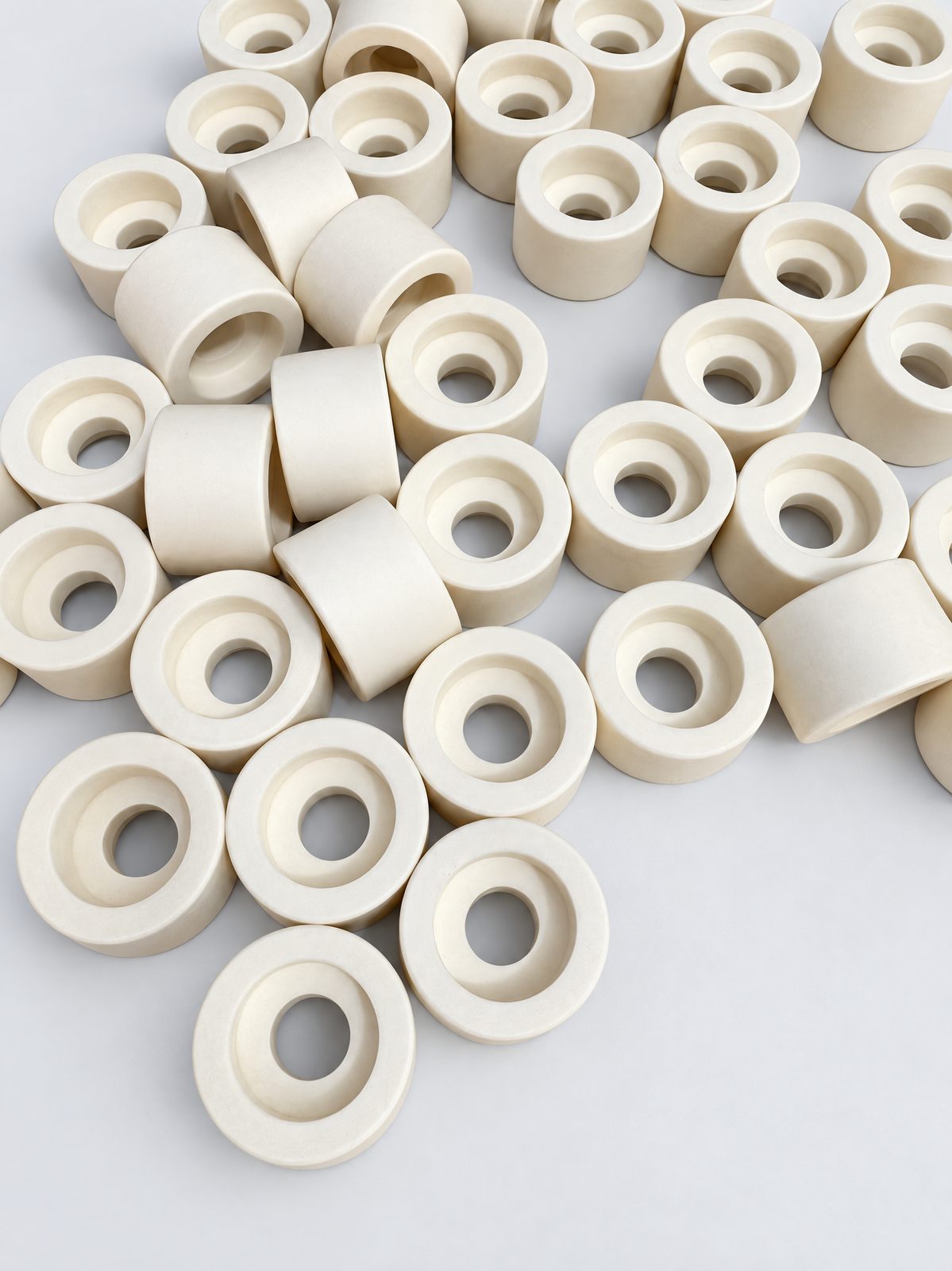
Alumina ceramic bushings are cylindrical aluminum oxide (Al2O3) sleeves, rings and collars used as high-voltage electrical insulators, sliding bearing bushes, and wear-resistant or thermal liners in pumps, valves, furnaces and instrumentation. Depending on the maker and purity grade, dense alumina bushings withstand compressive loads from 2,000 MPa on Precision Ceramics CeramAlox 96 to 2,600 MPa on Accuratus 99.5% alumina and no-load temperatures up to 1,750 °C (3,180 °F) on Accuratus 99.5% alumina or 1,950 °C in air on Kyocera DEGUSSIT AL23. At GY Alumina, we make custom bushings, rings, washers and tubes to your drawing or sample in C799 alumina, 99.5% Al2O3, and 95% white alumina, with a usual minimum order of 100 pieces and a 25 to 30 day production lead time.
What Are Alumina Bushings and How Are They Used
Alumina ceramic bushings are cylindrical sleeves, collars and rings manufactured from aluminum oxide. In mechanical, electrical and thermal equipment, a ceramic bushing sits between a moving shaft or wire and a stationary housing, or isolates a live conductor passing through a metal bulkhead. Because Accuratus notes that alpha-phase alumina is the strongest and stiffest of the oxide ceramics, engineers use alumina bushings where metal sleeves gall, corrode or conduct electricity, and where polymer bushings melt or wear out.
At GY Alumina, we manufacture custom rings, washers, bushings, discs, solid rods and single- or multi-bore tubes to your drawing or physical sample. We form custom alumina components by slip casting, pressing, extrusion and hot pressing at our factory in Tangshan, China, and supply them to 100+ customers across furnace, thermocouple, laboratory and industrial equipment industries.
Across industrial plant engineering, power equipment and thermal processing, alumina bushings serve four primary engineering functions:
- Sliding bearing bushes and pump sleeves: Used in rotary and reciprocating pumps, metering valves, and mechanical seals handling abrasive slurries or chemically aggressive fluids, as documented by Morgan Technical Ceramics and Kyocera.
- High-voltage and high-temperature electrical insulators: Used as insulating sleeves, standoffs and vacuum-tight electrical feedthroughs from DC to GHz frequencies, as listed by Accuratus and Morgan Technical Ceramics.
- Thermal protection and furnace liners: Used as thermocouple protection sleeves, cartridge heater insulators, and furnace tube liners operating in oxidizing or reducing atmospheres, as described by Precision Ceramics and Morgan Technical Ceramics.
- Thread, wire and abrasion guides: Used as hard-wearing eyelets, wire guides, shot blast nozzles, and hydrocyclone or elbow liners that resist friction from high-speed filaments and abrasive flow, as noted by Accuratus and Precision Ceramics.
Advantages of Alumina Ceramic Bushings
When you replace a metal or plastic sleeve with an alumina ceramic bushing, you gain mechanical hardness, electrical isolation, heat resistance and chemical stability in one component. The specific performance values depend on the Al2O3 purity and the manufacturer's firing process.
Key engineering advantages recorded across commercial alumina datasheets include:
- Extreme hardness and wear resistance: Kyocera lists a Vickers hardness (HV 1.0) of 17.1 GPa for its DEGUSSIT AL23 above 99.5% purity and 15.2 GPa (HV 9.807 N) for its AO479O at least 99% purity. This hardness prevents abrasive scoring in sliding bearings and wire guides.
- High compressive strength: Dense alumina supports heavy radial and axial loads without creep. Accuratus reports a compressive strength of 2,100 MPa (304.5 x 10^3 lb/in2) for 94% and 96% alumina, and 2,600 MPa (377 x 10^3 lb/in2) for 99.5% alumina.
- High-temperature electrical insulation: At room temperature (20 to 25 °C), volume resistivity exceeds 10^14 ohm-cm across 94% to 99.5% grades from Accuratus, Morgan AL995 and Kyocera AO479O. At elevated temperatures, Morgan AL995 maintains a volume resistivity of 2.0 x 10^11 ohm-cm at 300 °C and 2.2 x 10^9 ohm-cm at 500 °C, with a DC dielectric strength of 31.5 kV/mm (800 V/mil).
- Refractoriness and thermal stability: Accuratus states that high-purity alumina is usable in both oxidizing and reducing atmospheres up to 1,925 °C, with a no-load maximum use temperature of 1,700 °C (3,090 °F) for 94% and 96% grades and 1,750 °C (3,180 °F) for 99.5% alumina. Accuratus also reports vacuum weight loss from 10^-7 to 10^-6 g/cm2.sec over 1,700 to 2,000 °C.
- Chemical and corrosion inertness: Precision Ceramics and Accuratus state that alumina resists strong acid and alkali attack even at elevated temperatures. According to Accuratus, alumina resists attack by all gases except wet fluorine and resists all common reagents except hydrofluoric acid and phosphoric acid. Alkali metal vapors can attack alumina at elevated temperatures, particularly in lower purity grades.
- Zero open porosity and vacuum tightness: Sintered technical alumina grades from Accuratus (94%, 96%, 99.5%), Morgan (AL995) and Kyocera (DEGUSSIT AL23, AO479O) have 0% open porosity and 0% water absorption, making them non-porous and vacuum tight.
Alumina Grades and Property Comparison by Maker
Commercial alumina bushings are produced by makers such as Morgan Technical Ceramics and Precision Ceramics in purity grades ranging from 85% to 99.5%. Standard-purity grades such as 94% alumina offer an easily metallizable composition, and Accuratus notes that additions can be made to improve the ease and consistency of metal films fired to the ceramic for subsequent brazed and soldered assembly. Kyocera and Precision Ceramics note that high-purity grades of 99% and above largely dispense with sintering aids to maximize grain-boundary corrosion resistance, electrical resistivity, thermal conductivity and high-temperature stability.
The table below compares published room-temperature and thermal specifications across seven reference grades from Accuratus, Morgan Technical Ceramics, Kyocera and Precision Ceramics.
| Property | Accuratus 94% Al2O3 | Accuratus 96% Al2O3 | Kyocera AO479O (at least 99% Al2O3) | Accuratus 99.5% Al2O3 | Morgan AL995 (99.5% Al2O3) | Kyocera DEGUSSIT AL23 (above 99.5% Al2O3) |
|---|---|---|---|---|---|---|
| Density (g/cm3) | 3.69 | 3.72 | 3.8 | 3.89 | 3.86 | 3.70 to 3.95 |
| Open porosity / water absorption (%) | 0 | 0 | 0 | 0 | 0 | 0 |
| Hardness (Vickers / datasheet unit) | 1,175 kg/mm2 | 1,100 kg/mm2 | 15.2 GPa (HV 9.807 N) | 1,440 kg/mm2 | 81 (Rockwell R30N) | 17.1 GPa (HV 1.0) |
| Flexural strength (MPa) | 330 | 345 | 310 | 379 | 310 | 300 to 350 |
| Compressive strength (MPa) | 2,100 | 2,100 | 2,160 | 2,600 | 2,070 | 2,500 |
| Elastic / Young's modulus (GPa) | 300 | 300 | 360 | 375 | Not stated | 380 |
| Fracture toughness KIC (MPa.m1/2) | 3.5 | 3.5 | 3 to 4 | 4 | Not stated | Not stated |
| Thermal conductivity at 20 to 25 °C (W/m.K) | 18 | 25 | 29 | 35 | 29.3 | 34.9 |
| Coefficient of thermal expansion (10^-6 /K) | 8.1 | 8.2 | 7.2 (40 to 400 °C), 8.0 (40 to 800 °C) | 8.4 | 6.9 (25 to 200 °C) to 9.4 (800 to 1,000 °C) | 8.2 (20 to 1,000 °C) |
| Max no-load use temperature (°C) | 1,700 | 1,700 | Not stated | 1,750 | 1,725 | 1,950 (in air) |
| Dielectric strength (kV/mm) | 16.7 AC | 14.6 AC | 15 | 16.9 AC | 31.5 DC | 20 to 30 |
| Volume resistivity at 20 to 25 °C (ohm-cm) | Above 10^14 | Above 10^14 | Above 10^14 | Above 10^14 | Above 10^14 | Not stated |
GY Alumina Grades for Custom Bushings and Sleeves
At GY Alumina, our standard grade for custom components is C799 alumina. An independent laboratory analyses one of our alumina tubes every year, recording 99.55% Al2O3 in 2024, 99.57% in 2025, and 99.61% in 2026.
Where an engineering drawing calls for C 610, we supply 95% white alumina or our standard C799 alumina instead. Neither of those grades is mullite. If your bushing or liner requires another ceramic family, we confirm the grade and maximum operating temperature for each part in your quotation.
When you specify a short tube or sleeve from GY Alumina, you can also order solid alumina rods for mating pins or cores.
Thermal Shock, Expansion Mismatch and Material Trade-Offs
Alumina ceramic bushings are strong in compression, but like all technical ceramics they are brittle under tensile stress and rapid temperature drops. Morgan Technical Ceramics explains that when a hot ceramic bushing is quenched or cooled rapidly, the outer surface cools and contracts faster than the warmer core, placing the surface in tension and initiating cracks.
Morgan Technical Ceramics publishes a comparative table of ceramic thermal downshock resistance measured by the Hasselmann quench method, alongside Kyocera's JIS R 1648 value for AO479O:
- Alumina thermal shock limit: Morgan Technical Ceramics lists a thermal downshock resistance of 170 to 300 °C for alumina. Kyocera lists a thermal shock temperature difference of 200 °C (JIS R 1648) for its AO479O at least 99% purity.
- Comparison with other technical ceramics: In the same Morgan Technical Ceramics table, Silicon Carbide is rated at a 400 °C drop, Zirconia at 400 to 500 °C, and Silicon Nitride at 900 °C. By our calculation from Morgan Technical Ceramics' thermal downshock table, Silicon Nitride's 900 °C rating is 3 to 5.29 times the 170 to 300 °C thermal downshock rating of alumina.
- Zirconia and ZTA trade-offs: Precision Ceramics notes that Zirconia has the highest fracture toughness of all monolithic oxide ceramics, whereas alumina is one of the most cost-effective ceramics with high hardness, thermal stability and electrical insulation. Precision Ceramics and Morgan Technical Ceramics note that Zirconia Toughened Alumina (ZTA) combines both materials to retain alumina's high hardness while increasing fracture toughness, bending strength and thermal shock resistance.
- Macor and Shapal trade-offs for small batches: Precision Ceramics notes that Macor machinable glass ceramic can reduce production costs for small quantities because it does not require diamond grinding, but Macor is limited to a maximum use temperature of 1,000 °C unstressed and 800 °C stressed, has lower wear resistance than alumina, and is vulnerable to thermal shock.
- Thermal conductivity drop at high heat: When designing high-temperature bushings to dissipate heat, account for the drop in thermal conductivity as temperature rises. For Kyocera DEGUSSIT AL23, thermal conductivity is 34.9 W/m.K at 20 °C, drops to 6.8 W/m.K at 1,000 °C, and reaches 5.3 W/m.K at 1,500 °C (DIN EN ISO 18755). By our calculation from Kyocera's DEGUSSIT AL23 datasheet, thermal conductivity at 1,000 °C is 19.5% of its 20 °C value.
- Worked thermal expansion calculation: Suppose you mount a 50 mm outside diameter high-purity alumina bushing with a mean linear thermal expansion coefficient of 8.2 x 10^-6 /K over 20 to 1,000 °C (the DIN EN ISO 17562 value on Kyocera's DEGUSSIT AL23 datasheet) that heats from 20 °C to 1,000 °C, a 980 K temperature rise. Leave radial clearance around heated alumina bushings so surrounding metal housings do not pinch the ceramic during warm-up or cool-down.
| Ceramic Material | Thermal Downshock Resistance (delta °C) | Key Trade-Off Note from Official Sources |
|---|---|---|
| Alumina (Al2O3) | 170 to 300 °C | Precision Ceramics and Accuratus note high hardness, electrical insulation and chemical resistance at a cost-effective price |
| Silicon Carbide (SiC) | 400 °C | Morgan Technical Ceramics lists higher thermal shock tolerance than alumina |
| Zirconia (ZrO2) | 400 to 500 °C | Precision Ceramics notes the highest fracture toughness among monolithic oxide ceramics |
| Silicon Nitride (Si3N4) | 900 °C | Morgan Technical Ceramics notes that a very low coefficient of thermal expansion yields high thermal shock resistance |
How Alumina Bushings Are Formed, Sintered and Finished
Read more
Across the technical ceramics industry, manufacturers such as Precision Ceramics and Morgan Technical Ceramics form alumina powder into bushing blanks using dry pressing, isostatic pressing, extrusion, slip casting or ceramic injection molding. Before firing, the compacted clay-like body is in its green or biscuit state and can be machined into complex geometries using conventional tooling.
Precision Ceramics notes that during high-temperature sintering, the alumina body densifies and shrinks by approximately 20%. Because of this 20% firing shrinkage, very tight dimensional tolerances cannot be held by green machining alone. Where an application requires ultra-tight tolerances or mirror-smooth sealing surfaces, specialized machinists such as Precision Ceramics and Morgan Technical Ceramics use diamond grinding, CNC grinding, lapping, polishing and laser machining on the fully sintered part.
When an alumina bushing must be hermetically sealed into a vacuum chamber or high-voltage feedthrough assembly, the ceramic surface can be metallized (such as moly-manganese metallizing on Morgan AL995 or fired metal films on Accuratus 94% alumina) for subsequent high-temperature brazing or soldering to metal fittings.
At GY Alumina, we form custom bushings, rings, washers, rods and tubes by slip casting, pressing, extrusion and hot pressing. After forming and firing, the secondary operations we perform in our factory are cutting to length, end slots, side holes and perforated tubes, and closed ends with drilled holes. Buyers can submit a drawing for our team to review against these forming and secondary operations.
Dimensional Tolerances and Bore Clearance Guidelines
When specifying a ceramic bushing, only put tight tolerances on the surfaces that actually mate with a shaft, wire or housing. Keeping non-critical dimensions to standard as-sintered tolerances avoids unnecessary processing costs and delays.
At GY Alumina, we manufacture custom cylindrical sleeves, rings and tubes to your drawing or physical sample. Key size envelopes and bore clearance practices include:
- Forming size envelopes at GY Alumina: Our largest extruded tube today is OD 17 x ID 10 mm, and our largest slip-cast tube is OD 100 x ID 90 x 1,000 mm.
- Firing shrinkage allowance: Because dense alumina shrinks by approximately 20% during sintering according to Precision Ceramics, leave non-mating outer walls and flange faces at standard fired tolerances wherever possible.
- Bore clearance for shaft and wire fit: If a shaft, pin, core or wire must pass cleanly through the bushing ID, confirm the bore against your mating wire or shaft before ordering so the ID is never undersized.
Buyer Specification Checklist
For electrical and electronic parts, ASTM International publishes ASTM D2442-75(2025), Standard Specification for Alumina Ceramics for Electrical and Electronic Applications, which covers electrical, mechanical, thermal and general property limits for fabricated alumina parts and ceramic-to-metal seals regardless of part geometry.
Use the engineering checklist below to prepare your request:
- Engineering drawing or physical sample: Prepare a clear drawing showing part geometry, or courier a physical sample for measurement.
- Key dimensions and critical tolerances: State the outside diameter (OD), inside diameter (ID), overall length, flange diameter and thickness, and any end slots or side holes. Mark which tolerances are critical and confirm bore clearance against any shaft or wire that passes through.
- Alumina grade: Specify C799 alumina or 95% white alumina (which we supply when a drawing names C 610).
- Operating conditions: Note the maximum working temperature, heating or cooling ramp rate, mechanical load, and surrounding atmosphere (air, vacuum, reducing gas, or corrosive liquids/vapors).
- Order quantity and delivery destination: State whether you need initial approval samples (5 to 10 pieces) and the production batch quantity (usually from 100 pieces per item).
How to Order from GY Alumina
At GY Alumina, custom parts made to your drawing or sample usually start at a minimum order quantity of 100 pieces per item and take 25 to 30 days to produce. Before running the full production batch, we send 5 to 10 free samples for your approval (you pay the courier freight). Standard sizes in stock ship in about 3 days for small orders and about 7 days for bulk orders. Our ISO 9001:2015 certificate covers the manufacturing of ceramic protective tubes for thermocouples (that scope only). Send your drawing, the grade and the quantity. We usually reply with a quote within two working days.
Questions buyers ask
- What are alumina ceramic bushings and how are they used?
- Alumina ceramic bushings are cylindrical aluminum oxide sleeves, rings and collars made to isolate electrical conductors, guide moving wires, or support rotating shafts. Morgan Technical Ceramics, Kyocera and Precision Ceramics list them as high-voltage insulators, vacuum-tight feedthroughs, pump and valve sliding bearings, and high-temperature thermocouple or heater sleeves.
- What are the main advantages of alumina ceramic bushings over metal or plastic?
- Unlike plastics or metals, high-purity alumina operates at no-load temperatures up to 1,750 °C on Accuratus 99.5% alumina or 1,950 °C in air on Kyocera DEGUSSIT AL23 and resists strong acids and alkalis.
- Why does sintered alumina require diamond grinding for tight bushing tolerances?
- According to Precision Ceramics, the high-temperature sintering process required to fully densify alumina causes the ceramic body to shrink by approximately 20%. Because of this 20% shrinkage, pre-sintering green machining cannot hold very tight tolerances, so ultra-precise dimensions require post-sintering diamond grinding.
- How much thermal shock can an alumina ceramic bushing withstand?
- Morgan Technical Ceramics lists a thermal downshock resistance of 170 to 300 °C for alumina, and Kyocera specifies a 200 °C thermal shock temperature difference (JIS R 1648) for its AO479O grade of at least 99% purity. Rapid quenching beyond this temperature drop creates surface tensile stress that can crack the bushing.
- What is GY Alumina's minimum order quantity and lead time for custom bushings?
- At GY Alumina, custom parts made to your drawing or sample usually start at 100 pieces per item and take 25 to 30 days to produce. We send 5 to 10 free samples for your approval before production runs, with the buyer paying the courier freight.
Sources
- GY Alumina: Custom Alumina Ceramic Components
- GY Alumina: Alumina and Corundum Grades Material Data
- GY Alumina: Buyer FAQ on MOQ, Lead Time, Samples and ISO 9001
- GY Alumina: Alumina Ceramics Factory in Tangshan
- Precision Ceramics: Alumina Properties and Industrial Applications
- Accuratus: Aluminum Oxide (Al2O3) Material Properties
- Kyocera Fineceramics Europe: DEGUSSIT AL23 Datasheet (February 2025)
- Kyocera Fineceramics Europe: AO479O Alumina Datasheet
- Kyocera Fineceramics Europe: Alumina Materials and Products
- Morgan Technical Ceramics: High-Performance Alumina Ceramic Components
- Morgan Technical Ceramics: AL995 99.5% Alumina Datasheet
- Morgan Technical Ceramics: Thermal Shock Resistance in Ceramics
- ASTM International: Standard Specification for Alumina Ceramics for Electrical and Electronic Applications
Last checked .