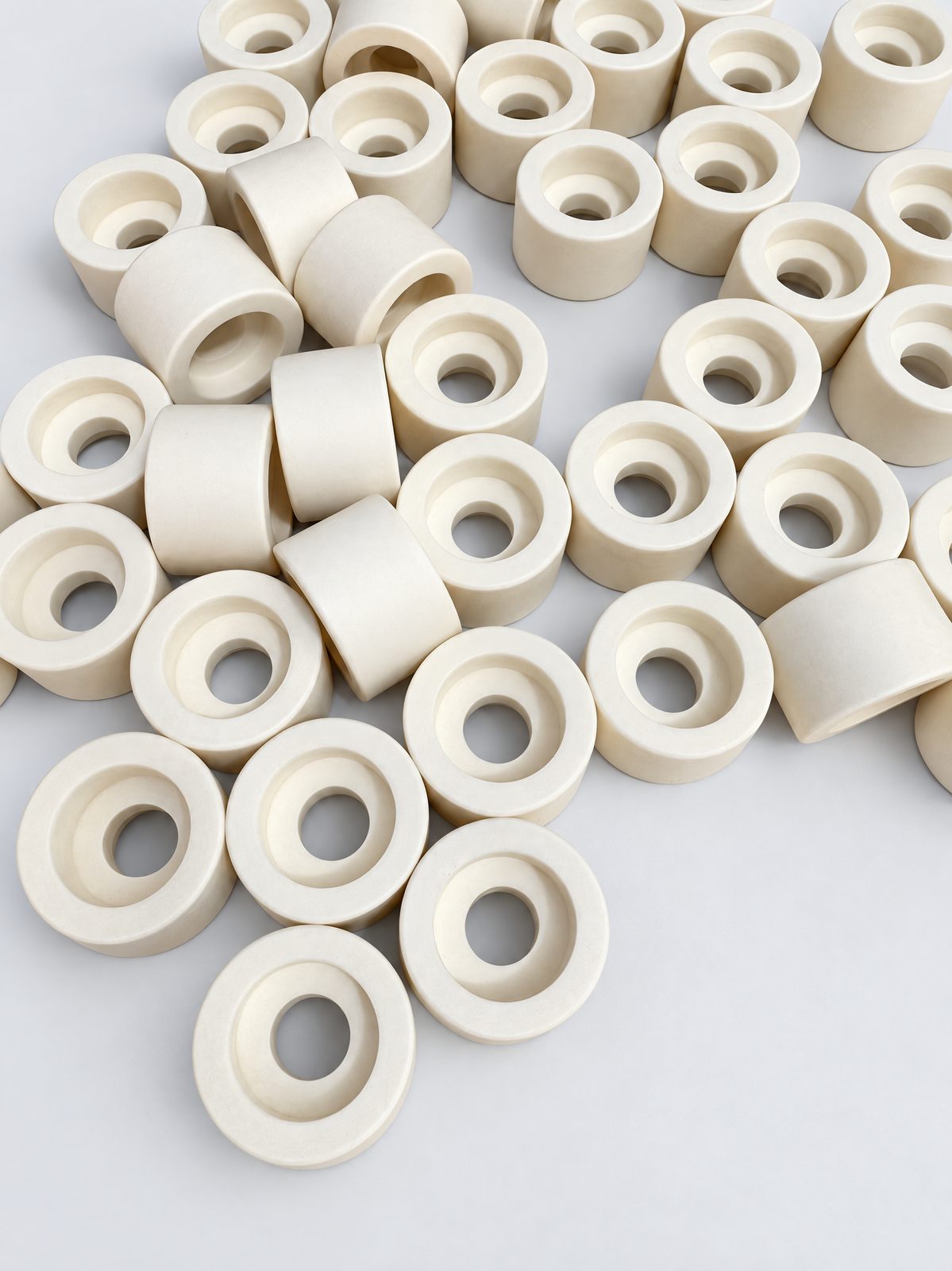
An alumina bolt is an electrically insulating, corrosion-resistant aluminum oxide (Al2O3) fastener used in furnaces, vacuum chambers, chemical reactors, and high-voltage assemblies where metal bolts oxidize, soften, or short out. Commercial recrystallized alumina bolt and nut sets run up to around 1,700 °C in air according to Almath Crucibles, while Accuratus lists 1,750 °C under no load for 99.5% alumina and Kyocera's February 2025 DEGUSSIT AL23 datasheet gives 1,950 °C in air. Because tensile strength in Precision Ceramics' CeramAlox 96 is only 140 MPa against 2,000 MPa in compression, reliable joint design depends on light assembly preload, thermal shock control, and expansion clearance.
Standard alumina bolt and nut sizes (M3, M4, M5 and M6)
Off-the-shelf ceramic bolt and nut sets are typically stocked in metric sizes from M3 through M6 for laboratory furnaces, wafer fixtures, and high-voltage standoffs. In Almath Crucibles' standard fastener catalog, each alumina fastener SKU is supplied as a matched set containing one bolt and one nut made from recrystallized alumina, rated to a maximum operating temperature of around 1,700 °C.
Buyers can specify three standard head configurations across these metric sets at the same price: Hex, Flat Socket, and Cap Socket. Documented product sheets for M3 x 10 mm, M4 x 10 mm, M4 x 20 mm, and M6 x 20 mm list a part weight of 0.01 kg per set and a minimum order quantity of 5 sets per item. Because ceramic fasteners in small stock series are often hand-finished or fired without post-sinter thread grinding on every surface, Almath Crucibles notes general production tolerances of about +/-10% of stated nominal dimensions unless tighter custom machining is arranged.
| Catalog SKU and Designation | Thread Size | External Diameter (mm) | External Length (mm) | Head Style Options | Set Contents and Max Temp |
|---|---|---|---|---|---|
| M3BOLTA5 Alumina Bolt & Nut M3 x 5mm | M3 | 3 mm | 5 mm | Hex, Flat Socket, Cap Socket | 1 bolt and 1 nut, around 1,700 °C |
| M3BOLTA10 Alumina Bolt & Nut M3 x 10mm | M3 | 3 mm | 10 mm | Hex, Flat Socket, Cap Socket | 1 bolt and 1 nut, around 1,700 °C |
| M3BOLTA20 Alumina Bolt & Nut M3 x 20mm | M3 | 3 mm | 20 mm | Hex, Flat Socket, Cap Socket | 1 bolt and 1 nut, around 1,700 °C |
| M3BOLTA25 Alumina Bolt & Nut M3 x 25mm | M3 | 3 mm | 25 mm | Hex, Flat Socket, Cap Socket | 1 bolt and 1 nut, around 1,700 °C |
| M4BOLTA5 Alumina Bolt & Nut M4 x 5mm | M4 | 4 mm | 5 mm | Hex, Flat Socket, Cap Socket | 1 bolt and 1 nut, around 1,700 °C |
| M4BOLTA10 Alumina Bolt & Nut M4 x 10mm | M4 | 4 mm | 10 mm | Hex, Flat Socket, Cap Socket | 1 bolt and 1 nut, around 1,700 °C |
| M4BOLTA20 Alumina Bolt & Nut M4 x 20mm | M4 | 4 mm | 20 mm | Hex, Flat Socket, Cap Socket | 1 bolt and 1 nut, around 1,700 °C |
| M4BOLTA25 Alumina Bolt & Nut M4 x 25mm | M4 | 4 mm | 25 mm | Hex, Flat Socket, Cap Socket | 1 bolt and 1 nut, around 1,700 °C |
| M5BOLTA5 to M5BOLTA25 series | M5 | 5 mm | 5, 10, 20, 25 mm | Hex, Flat Socket, Cap Socket | 1 bolt and 1 nut, around 1,700 °C |
| M6BOLTA5 to M6BOLTA25 series (including M6BOLTA20) | M6 | 6 mm | 5, 10, 20, 25 mm | Hex, Flat Socket, Cap Socket | 1 bolt and 1 nut, around 1,700 °C |
Mechanical, thermal and electrical properties by alumina grade (94% and higher)
Technical alumina fasteners and threaded insulators are produced across purity levels from 94% Al2O3 upward. Lower-alkali, lower-silica compositions at 99.5% Al2O3 hold their stiffness, electrical resistivity, and chemical inertness to higher temperatures, whereas 94% and 96% grades use a controlled silicate glass phase that lowers sintering cost and supports metallizing for brazed ceramic-to-metal assemblies.
When comparing alumina materials and grades across datasheets, check whether strength and temperature figures were measured on polished test bars under zero mechanical load. Accuratus lists no-load maximum use temperatures of 1,700 °C (3,090 °F) for 94% and 96% alumina and 1,750 °C (3,180 °F) for 99.5% alumina. Precision Ceramics lists a no-load limit in air and inert gas of 1,600 °C for CeramAlox 96%. Kyocera Fineceramics Europe records a maximum air operating temperature of 1,950 °C for DEGUSSIT AL23 (above 99.5% Al2O3, 0 vol-% open porosity, 10 micrometers mean grain size, 17.1 GPa Vickers HV 1.0 hardness).
Room-temperature volume resistivity stays above 10^14 ohm-cm across Accuratus's 94%, 96%, and 99.5% alumina grades and Precision Ceramics' CeramAlox 96. That combination of high dielectric strength and zero magnetic permeability makes alumina bolts standard hardware around RF induction coils, ion thrusters, plasma chambers, and high-voltage feedthroughs.
| Manufacturer and Grade | Al2O3 Purity | Density (g/cm3) | Flexural Strength (MPa) | Compressive Strength (MPa) | Tensile Strength (MPa) | Thermal Conductivity (W/mK) | Dielectric Strength (kV/mm) | Max Temp No Load (°C) |
|---|---|---|---|---|---|---|---|---|
| Accuratus 94% Al2O3 | 94% | 3.69 g/cm3 | 330 MPa | 2,100 MPa | Not stated | 18 W/mK | 16.7 ac-kV/mm | 1,700 °C (3,090 °F) |
| Accuratus 96% Al2O3 | 96% | 3.72 g/cm3 | 345 MPa | 2,100 MPa | Not stated | 25 W/mK | 14.6 ac-kV/mm | 1,700 °C (3,090 °F) |
| Precision Ceramics CeramAlox 96 | 96% | 3.75 g/cm3 | 200-300 MPa | 2,000 MPa | 140 MPa | 25 W/mK | 9 kV/mm DC | 1,600 °C |
| Accuratus 99.5% Al2O3 | 99.5% | 3.89 g/cm3 | 379 MPa | 2,600 MPa | Not stated | 35 W/mK | 16.9 ac-kV/mm | 1,750 °C (3,180 °F) |
| Kyocera DEGUSSIT AL23 | Above 99.5% | 3.70-3.95 g/cm3 | 300-350 MPa | 2,500 MPa | Not stated | 34.9 W/mK at 20 °C | 20-30 kV/mm | 1,950 °C in air |
Tensile limits, tightening preload and why ceramic threads fracture
Most supplier catalogs highlight compressive strength above 2,000 MPa while omitting the number that actually governs bolt survival: direct tensile strength. Tightening a nut puts the bolt shank into axial tension and concentrates bending and shear stress at the sharp root of the first engaged thread.
By our calculation from Precision Ceramics' CeramAlox property table, tensile strength is exactly 7% of compressive strength in 96% alumina (140 MPa tensile vs 2,000 MPa compressive), so compressive strength is about 14.3 times tensile strength. At the same time, fracture toughness KIC sits between 3.5 MPa m1/2 (Accuratus 94% and 96% grades) and 4.5 MPa m1/2 (Precision Ceramics CeramAlox 96), with an elastic modulus from 300 GPa (Accuratus 94% and 96% and CeramAlox 96) to 380 GPa (Kyocera DEGUSSIT AL23) and a Poisson's ratio of 0.21 to 0.23 across those Accuratus, Kyocera DEGUSSIT AL23, and Precision Ceramics CeramAlox grades.
In a steel M3 or M4 screw, local yielding at the first thread root redistributes load across neighboring threads before the shank snaps. Sintered alumina cannot yield plastically. Any angular misalignment under the bolt head, grit trapped in the threads, or wrench over-tightening drives local root stress straight past CeramAlox 96's 140 MPa tensile ceiling and pops the head off cleanly.
Treat an alumina bolt as a high-temperature locating pin and electrical isolator rather than a high-clamp structural tie rod. Seat the bolt finger-tight plus a fraction of a turn only to remove play, place a flat alumina washer under the head and nut so clamping forces stay in compression on smooth faces, and keep metal tools from prying sideways against hex flats or socket recesses.
Thermal expansion, thermal shock and furnace joint design
Fastening a metal bracket to a ceramic plate with an alumina bolt creates a differential expansion problem during heat-up. In Kyocera's DEGUSSIT AL23 datasheet, mean linear coefficient of thermal expansion from 20 to 1,000 °C is 8.2 x 10^-6 /K (with specific heat capacity of 900 J/(kg K) at 20 °C and elastic modulus of 380 GPa), while Precision Ceramics lists expansion for 96% alumina of 6.3 x 10^-6 /K from 25 to 300 °C and 7.0 x 10^-6 /K from 25 to 700 °C.
Worked expansion example: take a 20 mm clamped length on an M4 x 20 mm or M6 x 20 mm alumina bolt heated from 20 °C to 1,000 °C, a temperature rise of 980 K. By our calculation from Kyocera's DEGUSSIT AL23 expansion value of 8.2 x 10^-6 /K, the alumina shank grows freely by 0.16072 mm (20 mm x 980 K x 8.2 x 10^-6 /K = 0.16072 mm). If that bolt clamps a thicker metal flange with a higher thermal expansion coefficient and zero axial compliance, the expanding metal stretches the rigid 380 GPa ceramic shank and snaps it in tension well before furnace setpoint.
- Size through-holes with generous radial clearance so expanding metal plates can slide laterally without shearing the bolt shank.
- Avoid cold-gas blasts or rapid door openings at high temperature that expose bolt heads to a sudden surface drop near or above the 170 to 300 °C alumina thermal downshock delta listed by Morgan Technical Ceramics.
- Use matching alumina washers, bushings, or spacer sleeves between dissimilar materials to lengthen the effective grip length and spread bearing stress.
- Where moderate-temperature spring compliance is practical outside the hottest zone, let a spring element absorb differential axial growth instead of locking the ceramic nut solid.
Vacuum outgassing, atmospheres and chemical attack
Read more
Unlike polymer screws that outgas or stainless steel fasteners that gall and weld in vacuum furnaces, dense alpha alumina stays clean in high vacuum and aggressive atmospheres. Accuratus reports that high-purity alumina operates in both oxidizing and reducing atmospheres up to 1,925 °C, with vacuum weight loss between 1,700 and 2,000 °C limited to 10^-7 to 10^-6 g/cm2.sec. Precision Ceramics similarly notes general alumina service up to 1,650 °C (2,900 °F) in oxidizing and reducing atmospheres and up to 2,000 °C (3,600 °F) in vacuum.
Chemically, Accuratus states that dense alumina resists attack by all gases except wet fluorine and resists all common chemical reagents except hydrofluoric acid and phosphoric acid. The main furnace contaminant to watch is alkali metal vapor (such as sodium or potassium species), which attacks alumina at elevated temperatures, especially in 94% and 96% grades that carry a higher intergranular silicate content.
When an assembly sees heavy mechanical shock, frequent wrenching, or steep thermal quenches rather than extreme peak temperature, three other ceramics appear alongside alumina in fastener catalogs. Precision Ceramics notes that Macor machinable glass ceramic cuts easily with conventional tooling for small batches, with a maximum use temperature of 1,000 °C unstressed and 800 °C stressed, though it has lower wear resistance and thermal shock tolerance than alumina. For tougher oxide fasteners, Almath Crucibles stocks identical M3 to M6 bolt sizes in zirconia and zirconia-toughened alumina (ZTA), taking advantage of the 400 to 500 °C zirconia thermal downshock rating listed by Morgan Technical Ceramics and ZTA's higher bending strength and fracture toughness.
How ceramic threads are formed and diamond ground
Read more
Producing accurate external and internal metric threads in aluminum oxide is harder than machining metal rod stock because fired alumina approaches diamond in hardness. As Precision Ceramics documents, raw alumina bodies can be formed by die pressing, isostatic pressing, extrusion, slip casting, or injection molding, then turned and threaded in the unfired green or pre-fired biscuit state using conventional cutting tools.
Precision Ceramics notes that during sintering to full density, the alumina body shrinks linearly by about 20%, just like in how alumina tubes are made. Contraction varies across thin thread crests and thick heads, so green-machined threads need post-fire finishing for tight fits, much like standard alumina tube tolerances.
Once sintered to zero open porosity, alumina can only be machined with diamond-coated grinding wheels, turning tools, drills, and taps. Diamond thread grinding delivers crisp pitch accuracy and smooth thread flanks that reduce local stress risers, and it adds spindle time that makes batch quantity and tolerance selection major cost drivers on custom threaded ceramics.
Specification checklist before you order or request a quote
Whether you are buying standard M3 or M4 sets from a fastener stockist or drafting a custom threaded insulator, pinned standoff, or collar for quotation, locking down eight details up front prevents assembly breakage and unnecessary diamond-machining cost.
- Thread designation and pitch: state nominal thread size (such as M3, M4, M5, or M6), pitch, and whether standard coarse clearance or a looser high-temperature anti-jam fit is required.
- Lengths and thread coverage: specify total under-head length, threaded length versus unthreaded shoulder length, and matching nut height.
- Head and drive geometry: choose Hex, Cap Socket, Flat Socket, or a custom slotted or collared head that leaves thick ceramic walls around the drive feature.
- Mating bore and washer stack: confirm the through-hole diameter in the clamped parts and include flat ceramic washers or stepped bushings where bearing faces are uneven.
- Alumina purity grade: pick 94% to 96% Al2O3 for general electrical insulation and metallized assemblies up to 1,600-1,700 °C, or 99.5% Al2O3 for alkali resistance and peak temperatures.
- Operating temperature, ramp profile, and atmosphere: list continuous temperature, heating and cooling transitions relative to the 170 to 300 °C alumina thermal downshock window listed by Morgan Technical Ceramics, and air, reducing gas, or vacuum pressure.
- Mechanical load direction: verify that primary service loads act in compression or light positioning shear rather than high axial tension.
- Critical versus non-critical tolerances: put tight tolerances only on functional mating surfaces and leave non-contact head exteriors at standard fired tolerances.
Custom alumina parts and ordering from GY Alumina
GY Alumina is the export brand of our factory in Tangshan, China. We manufacture thermocouple protection tubes, thermocouple insulators and multi-bore tubes, furnace tubes, crucibles and boats, solid alumina rods, and custom alumina components to a buyer's drawing or physical sample. Using slip casting, pressing, extrusion, and hot pressing, we make threaded, ribbed, perforated, and slotted tubes, rings, washers, bushings, discs, square bars, balls, and special shapes to drawing, alongside secondary cutting to length, end slots, side holes, and closed ends with drilled holes.
Our standard grade is C799 alumina (99.5% Al2O3). An independent lab analyses one of our alumina tubes each year, recording 99.55% Al2O3 in 2024, 99.57% in 2025, and 99.61% in 2026. Where a customer drawing names C 610, we supply 95% white alumina or our standard C799 instead, and neither is mullite. Our ISO 9001:2015 certificate covers the manufacturing of ceramic protective tubes for thermocouples (that scope only), with 100+ customers served.
If your assembly uses ceramic washers, bushings, spacer sleeves, threaded tubes, rod blanks, or a custom ceramic shape to drawing, you can send your drawing for review. Parts made to drawing usually start at 100 pieces per item and take 25 to 30 days to produce, with 5 to 10 free samples sent for approval first while the buyer pays the courier, and standard stock sizes ship in about 3 days for small orders to about 7 days for bulk orders. Send your drawing, the grade and the quantity. We usually reply with a quote within two working days.
Questions buyers ask
- What standard sizes do M3 and M4 alumina bolt and nut sets come in?
- Almath Crucibles lists recrystallized alumina bolt and nut sets in M3 lengths of 5 mm (M3BOLTA5), 10 mm (M3BOLTA10), 20 mm (M3BOLTA20), and 25 mm (M3BOLTA25), and in M4 lengths of 5 mm (M4BOLTA5), 10 mm (M4BOLTA10), 20 mm (M4BOLTA20), and 25 mm (M4BOLTA25), plus M5 and M6 variants. Each set includes one bolt and one matching nut with a choice of Hex, Flat Socket, or Cap Socket heads.
- What is the maximum operating temperature of an alumina bolt?
- Maximum temperature depends on purity, atmosphere, and mechanical load. Almath Crucibles rates its recrystallized alumina bolts to around 1,700 °C, Precision Ceramics lists a no-load limit of 1,600 °C for 96% alumina, Accuratus lists 1,750 °C for 99.5% alumina, and Kyocera Fineceramics Europe specifies 1,950 °C in air for DEGUSSIT AL23 (above 99.5% Al2O3).
- Why do ceramic bolts snap when tightened like steel fasteners?
- Dense alumina has a compressive strength of 2,000 to 2,600 MPa across Precision Ceramics' CeramAlox 96 and Accuratus 94% to 99.5% grades, while tensile strength in CeramAlox 96 is only 140 MPa with low fracture toughness (3.5 MPa m1/2 in Accuratus 94% and 96% to 4.5 MPa m1/2 in CeramAlox 96). Because sintered ceramic does not yield plastically, wrench torque concentrates tensile stress at the first engaged thread root and snaps the shank, so alumina bolts should only be snugged lightly.
- Can alumina bolts be used in ultra-high vacuum and strong acids?
- Yes, Accuratus reports that dense alpha alumina resists all common chemical reagents except hydrofluoric acid and phosphoric acid, and resists all gases except wet fluorine. In vacuum between 1,700 and 2,000 °C, Accuratus lists weight loss at 10^-7 to 10^-6 g/cm2.sec, while Precision Ceramics notes vacuum use up to 2,000 °C (3,600 °F).
- When should I choose zirconia or ZTA fasteners instead of alumina?
- Choose zirconia or zirconia-toughened alumina (ZTA) when mechanical impact, bending stress, or rapid thermal cycling matters more than peak furnace temperature. Morgan Technical Ceramics lists thermal downshock resistance at 400 to 500 °C for zirconia versus 170 to 300 °C for alumina, and Precision Ceramics notes that ZTA pairs alumina's hardness with increased fracture toughness and bending strength.
Sources
- Almath Crucibles: Ceramic Fasteners Catalog
- Almath Crucibles: M3BOLTA10 Alumina Bolt and Nut M3 x 10mm
- Almath Crucibles: M4BOLTA10 Alumina Bolt and Nut M4 x 10mm
- Almath Crucibles: M4BOLTA20 Alumina Bolt and Nut M4 x 20mm
- Almath Crucibles: M6BOLTA20 Alumina Bolt and Nut M6 x 20mm
- Precision Ceramics USA: Alumina Properties and Industrial Applications
- Kyocera Fineceramics Europe: DEGUSSIT AL23 Material Datasheet (February 2025)
- Accuratus: Aluminum Oxide Al2O3 Material Properties
- Morgan Technical Ceramics: Thermal Shock Resistance in Ceramics
- GY Alumina: Custom Alumina Parts Made to Drawing or Sample
- GY Alumina: Alumina and Corundum Grades Material Data
- GY Alumina: Alumina Ceramics Factory in Tangshan
- GY Alumina: Buyer FAQ on MOQ, Lead Time, Samples and ISO 9001
Last checked .