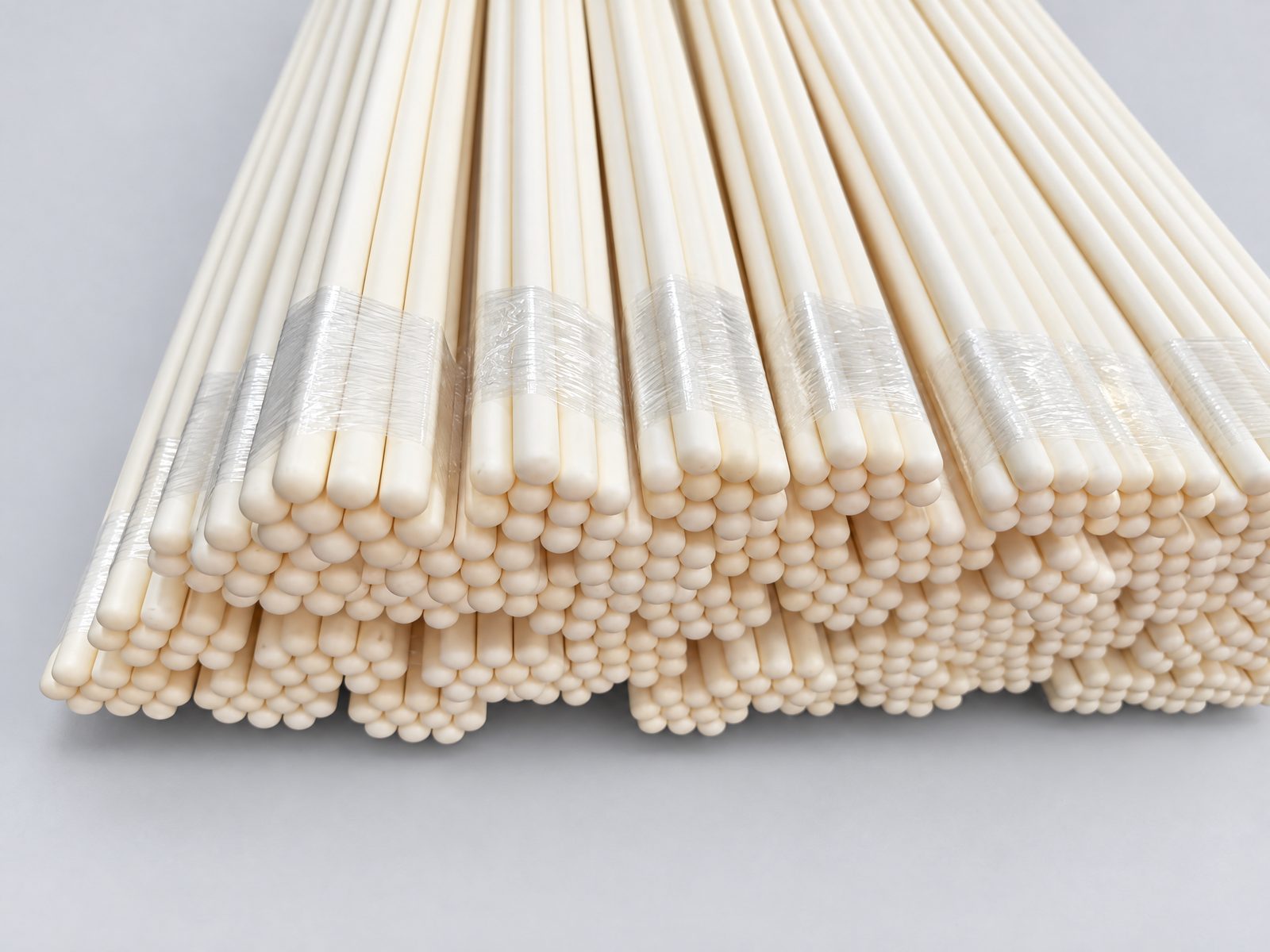
Zirconium (Zr, CAS 7440-67-7) is a metallic chemical element with a molecular weight of 91.224 g/mol, while zirconia (zirconium dioxide, ZrO2, CAS 1314-23-4) is its white crystalline oxide ceramic with a molecular weight of 123.223 g/mol, according to the NIST Chemistry WebBook (SRD 69). Bonding zirconium with oxygen converts the pure metal into a nonmetallic, biocompatible ceramic that shifts across monoclinic, tetragonal, and cubic crystal structures upon heating. Metallic zirconium alloys serve in nuclear energy systems where surface zirconia controls passivation, while stabilized zirconia grades such as Y-TZP and Mg-PSZ serve in dental restorations, surgical implants, and reactor core components.
Zirconium vs. Zirconia: Chemical Identity and Naming
Engineers, dentists, and industrial buyers frequently encounter zirconium and zirconia on technical drawings, yet the two names describe different classes of matter. Zirconium (chemical symbol Zr, CAS Registry Number 7440-67-7, IUPAC Standard InChI InChI=1S/Zr) is a pure metallic element with a molecular weight of 91.224 g/mol (listed as 91.224 in the NIST Chemistry WebBook, SRD 69, using atomic weight data compiled by the NIST Physics Laboratory). In metallic alloy form, zirconium behaves as a structural metal that oxidizes at elevated temperatures.
Zirconia is the common ceramic trade and scientific name for zirconium dioxide (chemical formula ZrO2, indexed as O2Zr under CAS Registry Number 1314-23-4 with a molecular weight of 123.223 g/mol in SRD 69). First discovered in the 18th century, zirconia is a naturally occurring white crystalline oxide of zirconium. Because each zirconium atom is chemically oxidized by two oxygen atoms inside an ionic-covalent crystal lattice, sintered zirconia contains no free metallic bonds and functions strictly as an inorganic, nonmetallic technical ceramic.
Material specifications also reference related zirconium-bearing compounds that should not be confused with pure zirconium metal or monolithic zirconia ceramic. Unstabilized zirconium oxide powder is particulate raw ZrO2 used to press or sinter ceramic shapes. Partially stabilized zirconia (PSZ) and yttria tetragonal zirconia polycrystal (Y-TZP) are dense ceramic bodies alloyed with secondary metal oxides such as yttria, calcia, magnesia, or ceria to lock in high-temperature crystal structures at room temperature. By contrast, zircon-based silicate materials (ZrO2-SiO2) combine zirconia with silica, such as nanocrystalline zircon glass-ceramics containing monocrystalline zirconia nanoparticles inside an amorphous silica matrix.
| Property or Identifier | Zirconium (Zr Metal Element) | Zirconia (ZrO2 Oxide Ceramic) |
|---|---|---|
| Material classification | Metallic chemical element | White crystalline oxide ceramic |
| Chemical formula | Zr | ZrO2 (indexed as O2Zr in NIST SRD 69) |
| CAS Registry Number | 7440-67-7 | 1314-23-4 |
| Molecular weight | 91.224 g/mol | 123.223 g/mol |
| Elemental mass composition | 100% Zr | 74.03% Zr and 25.97% O (our calculation) |
| Primary engineering uses | Nuclear alloys and refractory composites | Dental crowns, surgical implants, reactor core shapes |
Worked Calculation: Oxidation Mass Gain and Powder Stoichiometry
When metallic zirconium oxidizes in high-temperature air or steam, or when ceramic formulators batch zirconium oxide powder from elemental precursors, the gravimetric ratio between Zr and ZrO2 governs both scale growth and mass balance. Using the evaluated molecular weights in the NIST Chemistry WebBook (SRD 69) allows an exact stoichiometric calculation without relying on rounded handbook estimates.
In one mole of zirconium dioxide (123.223 g/mol), elemental zirconium accounts for 91.224 g/mol. Subtracting the zirconium mass leaves 31.999 g/mol contributed by the two bonded oxygen atoms. Dividing each component by the compound molecular weight establishes the exact mass share of pure, unstabilized ZrO2, and dividing the compound weight by the metal weight defines the gravimetric oxidation factor.
- Practical thermogravimetric example: If a 100 g metallic zirconium test coupon oxidizes completely into ZrO2 during high-temperature exposure, it absorbs 35.08 g of oxygen to yield 135.08 g of zirconium dioxide ceramic.
Crystal Phases of Zirconia and Oxide Stabilization (PSZ and Y-TZP)"
Pure zirconium dioxide is polymorphic, meaning it rearranges its atomic crystal lattice across distinct temperature zones while keeping the same ZrO2 chemical formula. According to a September 8, 2020 technical report from The American Ceramic Society, unalloyed zirconia forms a monoclinic crystalline structure at room temperature. Upon heating, monoclinic zirconia transforms into a tetragonal phase between 1,170 °C and 2,370 °C, and then shifts into a cubic phase above 2,370 °C.
Cooling pure sintered zirconia back down through the 2,370 °C and 1,170 °C transition boundaries reverses those phase shifts and disrupts structural components. In 1972, researchers at McMaster University demonstrated that alloying zirconia with dopant oxides such as calcia, yttria (Y2O3), and magnesia (MgO) stabilizes the high-temperature tetragonal and cubic phases down to ambient temperature. That metallurgical discovery produced partially stabilized zirconia (PSZ) and opened structural biomedical and engineering markets to zirconia ceramics. Ceria-doped zirconia formulations were also introduced and studied in dental ceramic fracture research reported in 2008.
Among fine-grained structural grades, 3Y-TZP designates 3 mol% yttria-stabilized tetragonal zirconia polycrystal, which maintains a fine sintered grain size of a few hundred nanometers. Engineers verifying binary and ternary oxide phase boundaries or lattice parameters across doped ZrO2 compositions can consult the NIST-ACerS Phase Equilibria Diagram Database 6.0 (PED) and the NIST Inorganic Crystal Structure Database (ICSD, SRD 3), which compiles more than 210,000 inorganic crystal structure entries from scientific literature dating back to 1913.
| Phase or Grade | Thermal Regime or Dopant Oxide | Microstructure and Engineering Role |
|---|---|---|
| Monoclinic ZrO2 | Ambient to 1,170 °C (unalloyed) | Natural room-temperature crystal phase of unstabilized zirconia |
| Tetragonal ZrO2 | 1,170 °C to 2,370 °C (unalloyed) | High-strength crystal phase retained at room temperature in Y-TZP |
| Cubic ZrO2 | Above 2,370 °C (unalloyed) | High-temperature phase stabilized at ambient conditions with oxide dopants |
| 3Y-TZP | 3 mol% yttria (Y2O3) | Polycrystal with grain size of a few hundred nanometers for crowns and bridges |
| Mg-PSZ | Magnesium oxide (MgO) | Dense magnesia partially stabilized zirconia standardized for surgical implants |
| Ceria-doped zirconia | Cerium oxide dopant | Stabilized dental and structural ceramic studied via focused ion beam testing |
Mechanical Strength and Fracture Toughness Testing Pitfalls
Stabilized tetragonal zirconia stands out among oxide and silicate ceramics for both bending strength and resistance to crack propagation. According to a January 22, 2019 report by The American Ceramic Society, yttrium partially stabilized tetragonal zirconia achieves a flexural strength of about 900 MPa to 1,200 MPa, making it the strongest zirconia-based ceramic used in dental applications. By comparison, conventional lithium disilicate dental glass-ceramics measure 200 MPa to 500 MPa in flexural strength and require resin bonding cements for clinical longevity, while an experimental nanocrystalline zircon (ZrO2-SiO2) glass-ceramic developed at Uppsala University in Sweden averaged 1 GPa without resin bonding cements.
When comparing zirconia supplier datasheets, buyers should pay close attention to how fracture toughness (resistance to crack extension, measured in MPa√m) was tested. Advanced ceramics are commonly evaluated using three test methods: single-edge pre-cracked beam (SEPB), surface crack in flexure (SCF), and single-edge V-notched beam (SEVNB). For yttria-stabilized zirconia such as 3Y-TZP, conventional SEVNB testing is not recommended because 3Y-TZP's grain size of a few hundred nanometers prevents a standard saw blade from cutting a notch-tip radius sharp enough to act like a natural crack.
Researchers from the American Dental Association Science and Research Institute and Argonne National Laboratory tested 11 sintered yttria-stabilized zirconia bars with pre-sintering saw-blade V-notches, adding nanometer-scale notches to 6 of the 11 bars after sintering via focused ion beam (FIB) milling. Specimens with saw-blade notches alone recorded an apparent fracture toughness of 8.90 ± 0.23 MPa√m, whereas FIB-notched specimens measured 5.64 ± 1.14 MPa√m. Earlier 1994 round-robin testing on the same type of yttria-stabilized zirconia using the SCF method produced 4.36 ± 0.44 MPa√m. Raman analysis confirmed that FIB milling introduced no detectable monoclinic phase, though ion bombardment can form a 20 nm to 30 nm thick amorphous surface layer.
By our calculation from The American Ceramic Society's 2020 report, testing 3Y-TZP with a saw-blade V-notch (8.90 MPa√m) inflates apparent fracture toughness by 3.26 MPa√m, or 57.80%, above the FIB-notched measurement (5.64 MPa√m), and by 4.54 MPa√m, or 104.13%, above the 1994 SCF round-robin value (4.36 MPa√m). Engineers auditing supplier test reports should confirm whether reported MPa√m figures come from SCF or SEPB testing rather than saw-notched SEVNB bars.
Biomedical, Orthopedic, and Dental Applications
Read more
Although zirconia was identified in the 18th century, more than 150 years passed before stabilized oxide grades entered clinical medicine. Following the 1972 stabilization breakthrough, partially stabilized zirconia entered orthopedic surgery in the 1980s as a ceramic alternative to cobalt-chrome alloy in hip and knee replacements. In the 1990s, partially stabilized zirconia moved into restorative dentistry as endodontic posts designed to reinforce damaged tooth roots. Over the past 20 years, yttria-stabilized zirconia has become a primary restorative material for metal-free crowns and bridges, alongside ongoing research into zirconia dental implants as an alternative to titanium implants.
Clinical demand for durable restorative materials is substantial: more than 90% (90 percent) of United States adults experience some degree of tooth decay, and about 15 million people have crown and bridge replacements for missing teeth. Back molar replacements frequently rely on cast metal alloys to survive heavy chewing loads, whereas front restorations prioritize natural tooth aesthetics. Because zirconia crowns and porcelain-based crowns are oxide or silicate ceramics rather than metallic alloys, they do not risk an allergic reaction in patients who have a metal allergy. Standard high-strength zirconia is bright opaque white, so clinicians weigh its 900 MPa to 1,200 MPa flexural strength against the superior natural translucency of lower-strength glass-ceramics.
For implantable orthopedic and surgical hardware, ASTM International maintains active material specifications in SI units. Active standard ASTM F2393-12(2025) (designation F2393-12R25, published in Book of Standards Volume 13.01 by Subcommittee F04.13) establishes material requirements for high-purity, dense zirconium oxide partially stabilized by magnesium oxide (magnesia partially stabilized zirconia, Mg-PSZ) for surgical implant applications.
Nuclear Reactor Cores and Ultra-High-Temperature Engineering
Read more
Both metallic zirconium and ceramic zirconia perform distinct jobs inside nuclear reactors and aerospace propulsion systems. According to an April 17, 2012 report by The American Ceramic Society, service temperatures above 1,500 °C exceed the limits of refractory metal alloys and require technical ceramics. In nuclear power systems, metallic zirconium alloys operate in reactor coolant environments where surface oxidation generates a zirconia scale. Controlling how zirconia forms on those metal surfaces governs how zirconium alloys passivate during loss-of-coolant nuclear accidents.
Inside the reactor core itself, engineered ceramic shapes require tightly controlled starting powders. Active standard ASTM C1065-08(2022) (designation C1065-08R22, last updated July 26, 2022 in Book of Standards Volume 12.01 by Subcommittee C26.03) defines the SI physical and chemical requirements for particulate nuclear-grade zirconium oxide powder intended for fabrication into shapes made entirely or partially of zirconia for use in a nuclear reactor core.
At even higher aerospace temperatures, candidate leading-edge composites for hypersonic vehicles include refractory (Zr, Hf) boride-silicon carbide systems that experience temperatures above 2,000 °C, where surface oxidation forms zirconium and hafnium oxides during flight. Yttria (Y2O3), widely used to stabilize zirconia thermal barrier coatings and structural ceramics, exhibits a premelting phase transition at about 2,400 °C. Because reliable thermodynamic data above 1,500 °C are scarce and difficult to model from first principles alone, high-temperature laboratories combine thermocouples or optical pyrometry with drop, combustion, solution, and flash calorimetry, vapor pressure measurements, and high-temperature dilatometry, supported by NIST X-ray Photoelectron Spectroscopy Database (version 5.0) and Auger-electron spectroscopy reference data.
Buyer Specification Checklist: Zirconium, Zirconia, or Alumina
Ambiguous callouts such as writing plain zirconium when an engineer wants sintered Y-TZP ceramic cause rejected RFQ packages and unusable parts. Before releasing a print or purchase order for high-temperature, nuclear, or biomedical components, run through this six-point verification checklist written by our team.
- Confirm metal vs. oxide formula and CAS number: Write Zr (CAS 7440-67-7) only when ordering metallic zirconium or metal alloys, and write ZrO2 (CAS 1314-23-4) when ordering zirconium dioxide ceramic or oxide powder.
- Name the exact stabilizer oxide and crystal phase: Specify 3Y-TZP (3 mol% yttria), Mg-PSZ (magnesia), calcia-stabilized zirconia, ceria-doped zirconia, or unstabilized monoclinic ZrO2 rather than leaving the stabilizer open.
- Cite the active ASTM specification where required: Reference ASTM C1065-08(2022) for particulate nuclear-grade zirconium oxide powder in reactor core shapes, or ASTM F2393-12(2025) for surgical-implant Mg-PSZ.
- Require test-method disclosure on fracture toughness: When comparing 3Y-TZP vendors, ask whether MPa√m figures were measured via SCF or SEPB rather than saw-notched SEVNB, which overstates toughness on sub-micron zirconia.
- Check cycle temperatures against phase transitions: Account for the 1,170 °C monoclinic-to-tetragonal and 2,370 °C tetragonal-to-cubic transitions in unalloyed ZrO2, and verify ceramic selection whenever service temperatures exceed 1,500 °C.
- Match ceramic chemistry to furnace hardware needs: Where a tube, rod, boat, or crucible needs electrical insulation and refractory stability in kilns or thermocouple assemblies without zirconia-specific requirements, evaluate high-purity alumina (Al2O3) alongside zirconia.
High-Purity Alumina Ceramic Parts from GY Alumina
GY Alumina manufactures C799 alumina and corundum ceramic parts rather than metallic zirconium or zirconia ceramics. When your furnace, thermocouple, pyrometry, or laboratory design calls for high-purity alumina instead of zirconia, we produce thermocouple protection tubes, thermocouple insulators and multi-bore capillaries, furnace tubes, crucibles and boats, solid alumina rods, and custom alumina shapes to your drawing or sample.
Our factory forms alumina components by slip casting, pressing, extrusion, and hot pressing, and performs secondary operations including cutting to length, end slots, side holes, perforated tube walls, and closed ends with drilled holes. Where an older drawing specifies IEC 60672 mullite class C 610, we supply white alumina or our standard C799 alumina instead. Send your drawing, the grade and the quantity. We usually reply with a quote within two working days.
Questions buyers ask
- Is zirconia the same as zirconium?
- No. Zirconium (Zr, CAS 7440-67-7) is a metallic chemical element with a molecular weight of 91.224 g/mol, whereas zirconia (zirconium dioxide, ZrO2, CAS 1314-23-4) is its white crystalline oxide ceramic with a molecular weight of 123.223 g/mol in the NIST Chemistry WebBook (SRD 69). Once zirconium bonds with oxygen, the compound behaves as an inorganic nonmetallic ceramic rather than a metal.
- Can patients with a metal allergy get zirconia crowns?
- Yes. According to The American Ceramic Society, zirconia dental crowns are oxide ceramics rather than metallic alloys and do not risk an allergic reaction in patients who have an allergy to metal.
- Why is zirconia alloyed with yttria, magnesia, or calcia?
- Unalloyed zirconia has a monoclinic crystal structure at room temperature and shifts to tetragonal (1,170 °C to 2,370 °C) and cubic (above 2,370 °C) phases when heated. Alloying zirconia with calcia, yttria, or magnesia stabilizes those high-temperature phases at room temperature, creating partially stabilized zirconia (PSZ) and Y-TZP with high strength and crack resistance.
- How strong is yttria-stabilized zirconia compared to dental glass-ceramics?
- The American Ceramic Society reports that yttrium partially stabilized tetragonal zirconia has a flexural strength of about 900 MPa to 1,200 MPa, making it the strongest zirconia-based dental ceramic. Standard lithium disilicate dental glass-ceramics measure 200 MPa to 500 MPa, while experimental nanocrystalline zircon (ZrO2-SiO2) glass-ceramics have averaged 1 GPa.
- What ASTM standards cover nuclear-grade zirconia powder and surgical implants?
- Active standard ASTM C1065-08(2022) defines SI physical and chemical requirements for particulate nuclear-grade zirconium oxide powder intended for shapes in a nuclear reactor core. For medical implants, active standard ASTM F2393-12(2025) covers high-purity, dense magnesia partially stabilized zirconia (Mg-PSZ) for surgical implant applications.
Sources
- NIST Chemistry WebBook, SRD 69: Zirconium
- NIST Chemistry WebBook, SRD 69: Zirconium Dioxide
- NIST Chemistry WebBook: Frequently Asked Questions
- The American Ceramic Society: Focused Ion Beam Milling and Zirconia Fracture Toughness
- The American Ceramic Society: Dental Zirconia and Nanocrystalline Zircon Glass-Ceramics
- The American Ceramic Society: Measuring Thermophysical Properties at Very High Temperatures
- ASTM C1065-08(2022): Standard Specification for Nuclear-Grade Zirconium Oxide Powder
- ASTM F2393: Standard Specification for High-Purity Dense Magnesia Partially Stabilized Zirconia (Mg-PSZ) for Surgical Implant Applications
- NIST Standard Reference Data Program
Last checked .