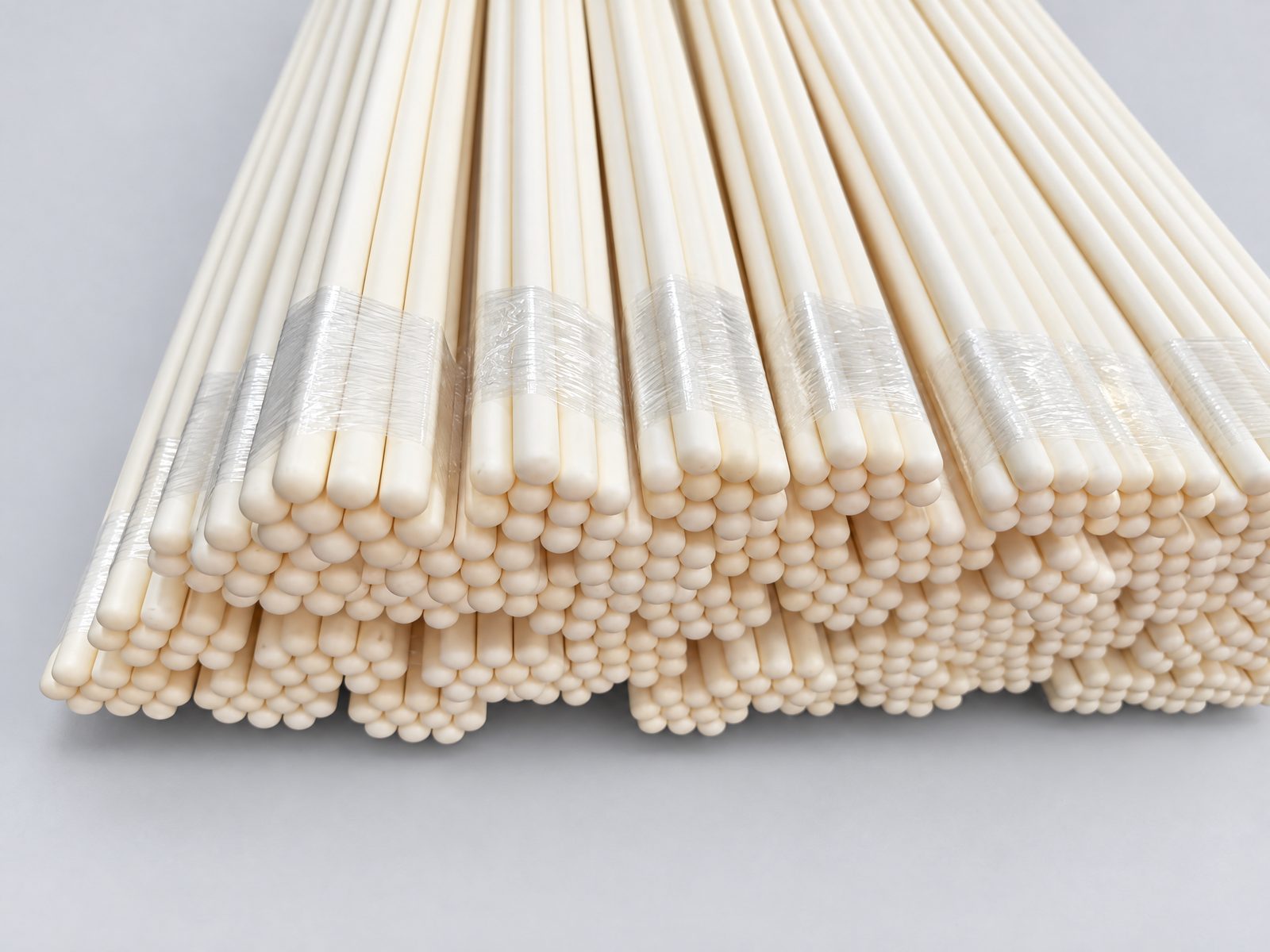
Yttria-stabilized zirconia (YSZ), also written yttria stabilized zirconia or zirconia yttria stabilized, is zirconium dioxide alloyed with yttrium oxide so its high-temperature tetragonal and cubic crystal phases stay stable at room temperature without cracking. Engineers specify 3 mol % YSZ for tough structural and dental parts, 7 % to 8 % yttria by mass for turbine thermal barrier coatings, or 8 mol % YSZ as an oxygen-ion electrolyte in solid oxide fuel cells. In National Institute of Standards and Technology (NIST) guarded-hot-plate testing at 950 °C, predominantly tetragonal YSZ averaged 2.8 W m-1 K-1 and predominantly cubic YSZ averaged 2.3 W m-1 K-1.
How Yttria Stabilizes Zirconia Crystal Phases
Yttria-stabilized zirconia (YSZ), also written yttria stabilized zirconia, is zirconium dioxide (ZrO2, CAS 1314-23-4) alloyed with yttrium oxide, commonly called yttria (Y2O3, CAS 1314-36-9).
Unalloyed zirconium dioxide shatters when cooled from sintering temperatures. As documented by The American Ceramic Society, pure zirconia forms a monoclinic crystal structure at room temperature, transforms into a tetragonal phase between 1,170 °C and 2,370 °C, and shifts into a cubic phase above 2,370 °C. Cooling pure zirconia back through the tetragonal-to-monoclinic transition causes an abrupt lattice shift that cracks dense parts.
In 1972, researchers at McMaster University showed that alloying zirconia with calcia, yttria, or magnesia retains the tetragonal and cubic phases down to room temperature. As reported in the September 2022 American Ceramic Society Bulletin, doping with yttria also increases intrinsic crystal defects that create oxygen-ion vacancies inside the fluorite lattice, enabling both phase stability and high-temperature ion conduction.
YSZ thermal-spray powder also contains hafnium oxide, or hafnium dioxide (CAS 12055-23-1). In the September 19, 2016 Certificate of Analysis for NIST Standard Reference Material (SRM) 1982, thermal-spray YSZ powder analyzed at 91.00 % zirconium oxide by balance, 7.33 % yttrium oxide, and 1.39 % hafnium oxide, with the seven remaining trace oxides (0.13 % silicon oxide, 0.08 % titanium oxide, 0.02 % aluminum oxide, 0.02 % ferric oxide, 0.01 % calcium oxide, 0.01 % magnesium oxide, and 0.01 % uranium plus thorium oxide) totaling 0.28 % by our calculation from Table 5.
YSZ Grades Compared: 3 mol %, 7 wt % to 8 wt %, and 8 mol %
Confusing mole percent (mol %) with weight or mass percent (wt %) is a common ordering mistake. A coating containing 7 % yttria by mass is partially stabilized, whereas an 8 mol % YSZ ceramic is fully stabilized in a cubic fluorite structure. State both the numerical value and the basis (mol % or mass %) on every drawing and quote request.
Lower yttria additions produce partially stabilized, predominantly tetragonal grades such as 3 mol % yttria-stabilized tetragonal zirconia polycrystal (3Y-TZP), whose grain size of a few hundred nanometers resists crack growth in dental and mechanical wear components. Intermediate compositions of 7 % to 8 % yttria by mass are standard in gas turbine thermal barrier coatings (TBCs). Higher doping at 8 mol % YSZ locks in a cubic fluorite crystal structure for oxygen-ion transport in solid oxide fuel cells (SOFCs) operating from 550 °C to 1,000 °C.
| Grade Designation | Yttria Concentration | Primary Crystal Phase | Measured Reference Property | Primary Engineering Applications |
|---|---|---|---|---|
| 3Y-TZP (Partially Stabilized) | 3 mol % Y2O3 | Predominantly tetragonal (grains of a few hundred nm) | 4.36 ± 0.44 MPa√m (SCF) and 5.64 ± 1.14 MPa√m (FIB notch) | Dental crowns, bridges, implants, and structural wear parts |
| Thermal Barrier Coating YSZ | 7 % to 8 % Y2O3 by mass (7.33 % in SRM 1982) | Partially stabilized | 5.86 ± 0.01 g/cm3 powder specific gravity, about 10 % sprayed film porosity | Gas turbine combustors, superalloy blades, and protective top coats |
| 8 mol % YSZ (Fully Stabilized) | 8 mol % Y2O3 | Cubic fluorite structure | 0.34 eV bulk activation energy from 300 °C to 500 °C (3D-printed LCM) | Solid oxide fuel cell (SOFC) electrolytes from 550 °C to 1,000 °C |
Thermal Conductivity, Fracture Toughness, and Flash-Sintered Plasticity
YSZ keeps a low, nearly temperature-independent thermal conductivity across wide operating ranges. In a June 1, 1999 NIST steady-state guarded-hot-plate study from 130 °C to 950 °C, predominantly tetragonal YSZ averaged 2.8 W m-1 K-1 at 950 °C and predominantly cubic YSZ averaged 2.3 W m-1 K-1 at 950 °C.
When comparing fracture toughness numbers on 3Y-TZP datasheets, check which ASTM C1421-18 test method was used: single-edge pre-cracked beam (SEPB), surface crack in flexure (SCF), or single-edge V-notched beam (SEVNB). Because 3Y-TZP grains measure only a few hundred nanometers across, a mechanical saw blade cannot cut a notch root sharp enough for valid SEVNB testing.
Sintering under an electric field (flash sintering) also changes how YSZ accommodates compressive load. Typical ceramics fracture below 2 % to 3 % compressive strain (compared with 10 % or 20 % in metals), and conventionally sintered YSZ requires 800 °C to deform plastically. A 2018 Purdue University study showed that flash-sintered YSZ formed finer grains and mobile dislocations, deforming plastically at temperatures up to 600 °C, keeping high compressive strength below 400 °C, and compressing to 7 % to 10 % strain without catastrophic fracture.
YSZ Thermal Barrier Coatings: Pore Architecture and High-Temperature Limits
Aerospace engineers have applied YSZ thermal barrier coatings to nickel-based superalloy turbine hardware since the 1960s, starting on stationary combustors before moving to rotating blades. Modern propulsion programs also pair barrier coatings with ceramic matrix composites (CMCs), where silicon-bearing layers cap current operating temperatures at 1,414 °C (the melting point of silicon) while laboratory rigs evaluate thermal and environmental barrier coatings around 1,700 °C.
Pore architecture governs both thermal insulation and spallation resistance. A 2000 NIST small-angle neutron scattering study quantified three pore families in plasma-sprayed YSZ deposits: intra-splat cracks (which anneal preferentially at high temperature), inter-splat lamellar pores (which drive elastic anisotropy), and globular pores, with total void surface area tracking average elastic modulus. Free-standing plasma-sprayed ZrO2 with 8 wt % Y2O3 films contain about 10 % porosity. Coating processes tailor these pores and high-temperature limits in four ways:
- Electron-beam directed-vapor deposition (EB-DVD): A 2010 NIST ultra-small-angle X-ray scattering study of YSZ with 7 % yttria by mass deposited at 7.5 Pa to 23 Pa measured pores from 2 μm to 50 nm in diameter with openings down to 10 nm. Intermediate deposition pressure maximized feather-like oblate pores tilted at about 60° to the coating plane and perpendicular columnar pores, minimizing through-thickness thermal conductivity.
- Molten silicate glass resistance above 1,150 °C: Above 1,150 °C, ingested airborne dust melts into glass that penetrates coating pores and cracks the ceramic during cooling. Research reported by The American Ceramic Society in 2023 showed that lowering porosity, using ceria-stabilized YSZ (CYSZ) to reduce thermal expansion mismatch, and co-doping with both alumina and titania trigger rapid glass crystallization to stop infiltration.
- Double-layer zirconate coatings above 1,300 °C: Thermal cycling above about 1,300 °C causes single-layer YSZ to densify and shift crystal structure, leading to spallation. Placing a lanthanum zirconate layer over YSZ outperformed single-layer YSZ above 1,300 °C and can raise operating temperatures by 100 °C.
Solid Oxide Fuel Cell Electrolytes and 3D Printing of 8 mol % YSZ
A solid oxide fuel cell places a dense ceramic electrolyte between a porous cathode and a porous anode to shuttle oxygen ions at 550 °C to 1,000 °C. Fully stabilized 8 mol % YSZ is a proven SOFC electrolyte because its cubic fluorite lattice and yttria-induced vacancies sustain ion conduction while resisting electrode stresses.
Thin electrolytes are often inkjet-printed, while complex fuel cell geometries can be built by lithography-based ceramic manufacturing (LCM) using photosensitive resin loaded with 40 vol % to 50 vol % ceramic powder. In the 2022 Bulletin study on 8 mol % YSZ, starting powders measuring 0.5 μm to 1 μm with a 5 m2/g to 7 m2/g surface area mixed cleanly, with optimal solid loadings at 45.5 vol % and 46.5 vol % (across 42.5 %, 45.5 %, 46.5 %, and 48.5 % tested). Fresh 45.5 vol % slurry completed a 120-layer build, whereas reused vat slurry partially cured and failed at layer 63. Post-print firing results depended on four parameters:
- Drying and binder burnout: Printed parts were dried at 120 °C for 3 days and debound at 420 °C using extended low-temperature dwells so escaping gases did not tunnel or delaminate layers.
- Wall thickness and part shape: Thin walls let decomposition gases escape cleanly. An 18 mm diameter by 10.5 mm tall printed YSZ turbine sintered with no surface damage, whereas a 17.5 mm wide by 3 mm tall flat block cracked and flaked between layers.
- Powder grade and sintered density: Tosoh TZ-8YS slurries sintered up to 98.3 % relative density (97 % average) with a 2.7 μm average grain size, while TZ-8Y slurries reached 93.4 % peak density (93 % average) with a 5.3 μm grain size.
- Electrical conduction: On 25 μm printed layers, LCM 8 mol % YSZ averaged 1.33 x 10⁻³ ohm-cm at 300 °C and a 0.34 eV bulk activation energy from 300 °C to 500 °C (versus 1.16 eV reported for thick-film YSZ), with layer orientation showing no substantial impact.
Biomedical Applications, Standards, and Alternative Stabilizers
Read more
Partially stabilized zirconia entered hip and knee replacements in the 1980s as an alternative to cobalt-chrome alloys, expanded into dental endodontic root posts in the 1990s, and has served over the past 20 years in dental crowns, bridges, and implants.
Where service conditions favor another stabilizer or oxide ceramic, ASTM Subcommittee F04.13 maintains 10 active ceramic surgical implant standards, including ASTM F2393-12(2025) for magnesia partially stabilized zirconia (Mg-PSZ) and ASTM F603-12(2025) for high-purity dense aluminum oxide. Ceria-modified zirconia adds cerium(IV) oxide to adjust thermal expansion or toughness.
Finished orthopedic devices are verified under active standards in the ASTM Medical Device portfolio, including ASTM F2033-20 for hip bearing surfaces, ASTM F2345-21 for cyclic fatigue of ceramic modular femoral heads, ASTM F3495-23 for static failure load of ceramic knee femoral components, and ASTM F981-23 for long-term muscle and bone tissue response, alongside quality system standard UNE-EN ISO 13485 and risk management standard UNE-EN ISO 14971.
Powder Particle Sizing and Workplace Dust Safety
Read more
Thermal-spray YSZ powder particle size distributions (PSD) shift depending on the test method. Sonic sieving showed only about 2 % by mass exceeding 90 μm versus 20 % by light scattering because sonic vibration breaks up particle clusters, and NIST LLS testing requires dispersing powder in a 4 % by mass sodium pyrophosphate solution (0.5 cm3 per gram of powder) in distilled water adjusted to pH 9.5 ± 0.1 with 0.1 M sodium hydroxide.
Sintered YSZ is odorless, water-insoluble, non-regulated by US DOT and IATA, and not listed as a carcinogen by OSHA, IARC, or NTP. Airborne powder dust, however, can irritate eyes, skin, and mucous membranes, and prolonged rare-earth oxide inhalation can cause chemical pneumonitis or bronchitis. Use local exhaust ventilation, goggles, and chemical-resistant gloves under OSHA 29 CFR 1910.132, certified respirators under OSHA 29 CFR 1910.134 and NIOSH 42 CFR 84 when warranted, high-efficiency particulate filter vacuums for spills, and a 15-minute water flush after eye or skin exposure.
| Constituent Oxide | CAS Number | SRM 1982 Mass % | NIOSH REL (TWA) | NIOSH IDLH |
|---|---|---|---|---|
| Zirconium oxide (as Zr) | 1314-23-4 | 91.00 % (above 90 % nominal) | 5 mg/m3 (STEL 10 mg/m3) | 25 mg/m3 |
| Yttrium oxide (as Y) | 1314-36-9 | 7.33 % | 1 mg/m3 (ACGIH TLV 1 mg/m3) | 500 mg/m3 |
| Hafnium oxide (as Hf) | 12055-23-1 | 1.39 % | 0.5 mg/m3 (ACGIH TLV 0.5 mg/m3) | 50 mg/m3 |
Buyer Specification Checklist for YSZ Orders
Before releasing a drawing or purchase order for a zirconia component or spray powder, verify five specification details prepared by our team:
- Write both the yttria number and the basis: Specify 3 mol % Y2O3 (structural), 7 wt % to 8 wt % Y2O3 (thermal barrier coating), or 8 mol % Y2O3 (cubic SOFC electrolyte) so mole percent and mass percent are never mixed up.
- Check high-temperature coating thresholds: Account for molten silicate dust above 1,150 °C and cyclic densification above 1,300 °C, where low-porosity alumina-titania co-doping or lanthanum zirconate top coats outperform plain YSZ.
- Name the fracture toughness test method: Require SCF or SEPB under ASTM C1421-18 rather than conventional saw-blade SEVNB on submicron 3Y-TZP.
- Avoid thick flat sections on complex sintered shapes: Keep wall thicknesses thin and even so 420 °C binder burnout does not cause interlayer flaking.
- Define the particle sizing protocol on powders: State whether d10, d50, and d90 limits apply to SEM, sonic sieving, or LLS dispersed with sodium pyrophosphate at pH 9.5 ± 0.1.
Alumina Refractory Alternatives from GY Alumina
GY Alumina manufactures dense alumina and corundum ceramic parts for high-temperature furnaces, sensors, and lab equipment that do not require zirconia oxygen-ion conduction or transformation-toughened bearings. When you need rigid refractory hardware rather than a low-conductivity thermal barrier, high-purity alumina avoids zirconia crystal phase shifts and conducts heat evenly.
We produce thermocouple protection tubes, thermocouple insulators, multi-bore tubes and capillaries, furnace tubes, crucibles, boats, solid alumina rods, and custom parts made to your drawing or sample using slip casting, pressing, extrusion, and hot pressing, with cutting to length, end slots, side holes, perforated tubes, and closed ends with drilled holes. Send your drawing, the grade and the quantity, and we usually reply with a quote within two working days.
Questions buyers ask
- Why is yttria added to zirconium dioxide?
- Pure zirconium dioxide shifts between monoclinic (room temperature), tetragonal (1,170 °C to 2,370 °C), and cubic (above 2,370 °C) crystal phases during heating and cooling, which shatters unalloyed sintered parts. Adding yttrium oxide stabilizes the tetragonal or cubic structure at room temperature and introduces oxygen vacancies that enable high-temperature ion conduction.
- What is the thermal conductivity of yttria-stabilized zirconia at high temperature?
- In steady-state guarded-hot-plate measurements by NIST from 130 °C to 950 °C, predominantly tetragonal YSZ averaged 2.8 W m-1 K-1 at 950 °C and predominantly cubic YSZ averaged 2.3 W m-1 K-1 at 950 °C. Both compositions maintained thermal conductivity values nearly independent of temperature across that range.
- What is the difference between 3 mol % YSZ and 8 mol % YSZ?
- A 3 mol % YSZ grade (3Y-TZP) is partially stabilized in a submicron tetragonal phase built for crack resistance in dental crowns, bridges, and mechanical wear parts. An 8 mol % YSZ grade is fully stabilized in a cubic fluorite crystal structure used for oxygen-ion transport in solid oxide fuel cells operating from 550 °C to 1,000 °C.
- Why do YSZ thermal barrier coatings degrade above 1,150 °C in jet engines?
- Above 1,150 °C, ingested silicate dust melts into glass that infiltrates coating pores and cracks the ceramic on cooling, while cycling above about 1,300 °C triggers densification and phase changes that cause spallation. Engineers counter these failures with lower porosity, alumina and titania co-doping, or a lanthanum zirconate top layer.
- What workplace exposure limits apply to YSZ powder?
- According to the NIST Safety Data Sheet for SRM 1982, NIOSH recommended time-weighted average (TWA) exposure limits are 5 mg/m3 for zirconium compounds (as Zr), 1 mg/m3 for yttrium compounds (as Y), and 0.5 mg/m3 for hafnium compounds (as Hf). Shops handling loose powder should use local exhaust ventilation, goggles, gloves, and high-efficiency particulate filter vacuums.
Sources
- NIST: Thermal Conductivity of Two Compositions of Yttria-Stabilized Zirconia
- NIST: Multi-Scale Pore Morphology in Vapor-Deposited Yttria-Stabilized Zirconia Coatings
- NIST: Microstructural Characterization of Yttria-Stabilized Zirconia Plasma-Sprayed Deposits
- NIST Material Measurement Laboratory: Standard Reference Materials
- NIST SRM 1982 Certificate of Analysis: Thermal Spray Powder Yttria-Stabilized Zirconia
- NIST SRM 1982 Safety Data Sheet: Yttria-Stabilized Zirconia Powder
- The American Ceramic Society: Focused Ion Beam Milling and Zirconia Fracture Toughness
- The American Ceramic Society: Flash-Sintered Yttria-Stabilized Zirconia Plasticity
- The American Ceramic Society: Alumina and Titania Improve TBC Resistance to Molten Glass
- The American Ceramic Society: Thermal and Environmental Barrier Coatings Overview
- The American Ceramic Society: Suspension Plasma Spray YSZ Thermal Barrier Coating
- American Ceramic Society Bulletin: Engineered Ceramics in Aerospace
- American Ceramic Society Bulletin: Additive Manufacturing of YSZ for Energy Applications
- ASTM International: Subcommittee F04.13 on Ceramic Materials
- ASTM International: Medical Device Standards and Test Methods
Last checked .