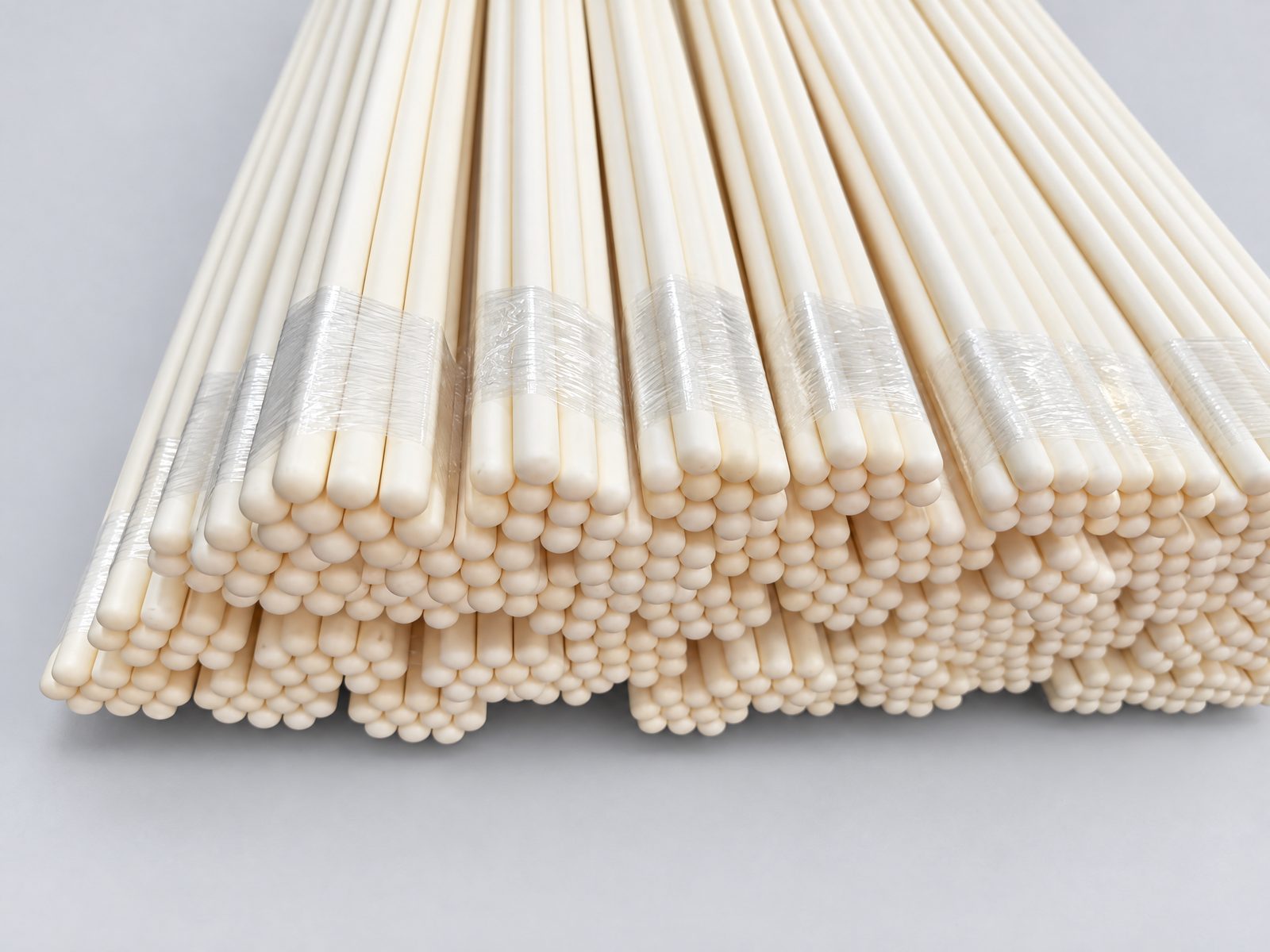
Silicon nitride (often searched as Si3N4 silicon nitride) is an advanced technical ceramic used as a fine raw powder and in precision structural components such as bearing balls and cylindrical bearing rollers. International standards govern its quality from raw material to finished part, with ASTM F2094/F2094M-18a and ASTM F2730/F2730M-18a establishing 3 capability classes (Classes I, II, and III) for bearing elements based on application severity. Chemical testing of fine silicon nitride powders evaluates 9 specific elements: total silicon, total nitrogen, aluminum, iron, calcium, oxygen, carbon, fluorine, and chlorine.
Silicon Nitride (Si3N4): Powders and Monolithic Bearing Parts
Silicon nitride (Si3N4) is a fine technical ceramic material standardized across mechanical, thermal, optical, and electronic disciplines. In international standards, silicon nitride appears both as fine silicon nitride powders used as the raw material for fine ceramics and as dense monolithic parts engineered for extreme mechanical contact.
According to ASTM Committee C28 on Advanced Ceramics, which was formed in 1986 and maintains 55 standards in Volume 15.01 of the Annual Book of ASTM Standards, advanced ceramics play a preeminent role in thermal systems including heat engines and heat exchangers, armor, fuel cells, sensors and actuators, electronics, coatings, and catalyst substrates. Within these systems, standards evaluate mechanical properties and performance such as fracture toughness, flexural strength, tensile strength, compressive strength, and thermal shock, alongside physical properties like elastic constants, thermal properties, and powder characteristics.
For rolling contact duties, silicon nitride is processed into spherical balls and cylindrical rollers that carry mechanical loads with very little tribological resistance. According to ASTM International, hybrid roller bearings using silicon nitride elements serve in high-speed machine tool spindles and the high-pressure turbopumps that move liquid hydrogen in the space shuttle.
- Raw feedstock: Produced from either silicon nitride powder or silicon metal powder meeting strict compositional limits.
- Monolithic rolling elements: Classified into Classes I, II, and III to match material capability to the severity of the intended application.
- Reliability verification: Evaluated under advanced ceramic frameworks covering Weibull statistics, fractography, and dynamic elastic moduli.
Silicon Nitride Powder Chemical Analysis and Purity Control
The mechanical reliability of a sintered silicon nitride component starts with the chemical purity of its starting powder. Under the ISO/TC 206 technical committee for fine ceramics (advanced ceramics, advanced technical ceramics), chemical analysis methods are standardized to verify raw powder lots before forming and firing. The current edition in this series is ISO 17947-1:2026.
Standardized chemical analysis of fine silicon nitride powders used as the raw material for fine ceramics stipulates determination methods for 9 elements: total silicon, total nitrogen, aluminum, iron, calcium, oxygen, carbon, fluorine, and chlorine.
For bearing manufacturing, ASTM F2094/F2094M-18a specifies that silicon nitride bearing balls should be produced from either silicon nitride powder having the required compositional limits or from silicon metal powder.
| Element Determined | Standardized Analytical Scope |
|---|---|
| Total silicon | Determination method stipulated for fine silicon nitride powders |
| Total nitrogen | Determination method stipulated for fine silicon nitride powders |
| Aluminum | Determination method stipulated for fine silicon nitride powders |
| Iron | Determination method stipulated for fine silicon nitride powders |
| Calcium | Determination method stipulated for fine silicon nitride powders |
| Oxygen | Determination method stipulated for fine silicon nitride powders |
| Carbon | Determination method stipulated for fine silicon nitride powders |
| Fluorine | Determination method stipulated for fine silicon nitride powders |
| Chlorine | Determination method stipulated for fine silicon nitride powders |
Silicon Nitride Bearing Balls and Cylindrical Bearing Rollers
Rolling element bearings permit constrained relative motion, either linear or rotational, between mechanical parts. To let manufacturers, industrial plants, and end users verify bearing elements for safe installation and use, ASTM Subcommittee F34.01 on Advanced Bearing Materials (under Committee F34 on Rolling Element Bearings) maintains 2 active silicon nitride specifications published in Book of Standards Volume 01.09, alongside 2 active specifications for bearing cage raw materials.
ASTM F2094/F2094M-18a (last updated July 12, 2018, 9 pages, ICS Code 21.100.01) covers the establishment of the basic quality, physical and mechanical property, and test requirements for silicon nitride balls across Classes I, II, and III to be used for ball bearings and specialty ball applications. Complementing the ball specification, ASTM F2730/F2730M-18a (last updated July 16, 2018, 7 pages, ICS Code 21.100.20) covers the basic quality, physical and mechanical property, and test requirements for silicon nitride rollers across Classes I, II, and III for cylindrical roller bearings.
Both standards divide silicon nitride material into 3 levels of capability (Classes I, II, and III) so the engineer can specify the material for the severity of the intended application. In addition to material property thresholds, ASTM F2730/F2730M-18a provides dimensional specifications for the form and surface condition of the finished roller. Both standards require SI units and inch-pound units to be used independently of each other, because values in the 2 systems are not exact equivalents and combining them may result in nonconformance.
| Standard Designation | Component Scope | Material Classes | Book of Standards Volume | Page Count |
|---|---|---|---|---|
| ASTM F2094/F2094M-18a | Silicon nitride bearing balls and specialty balls | Classes I, II, and III | Volume 01.09 | 9 pages |
| ASTM F2730/F2730M-18a | Silicon nitride cylindrical bearing rollers | Classes I, II, and III | Volume 01.09 | 7 pages |
| ASTM F2953-12(2021)_ | Phenolic raw materials for bearing cages | Not stated | Not stated | Not stated |
| ASTM F3131-14(2023)_ | Epoxy / cotton raw materials for bearing cages | Not stated | Not stated | Not stated |
Mechanical, Coating and Environmental Testing of Advanced Ceramics
Read more
Qualifying monolithic silicon nitride and ceramic coatings requires standardized mechanical and physical testing. Under ISO/TC 206 (ICS 81.060.30), sonic resonance testing determines the dynamic elastic moduli of monolithic fine ceramics at room temperature, provided the ceramics are elastic, homogeneous, and isotropic. The current edition of this sonic resonance test method is ISO 17561:2016.
When silicon nitride or other technical ceramics are applied as thin surface layers rather than bulk monoliths, adhesion testing is required. Under ISO/TC 206, the Rockwell indentation test qualitatively evaluates the adhesion of ceramic coatings up to 20 micrometers (20 µm) thick by indentation with a Rockwell diamond indenter using a Rockwell hardness test instrument. The formation of cracks after indentation may also reveal cohesive failure, though the test is not suitable for elastic coatings on hard substrates. The current edition of this coating adhesion standard is ISO 26443:2023.
In addition to traditional powder pressing and sintering, advanced ceramics and structural materials are increasingly shaped by 3D geometries. Additive manufacturing terminology is standardized by ISO/TC 261 and ASTM F42, which classify terms for technologies that build physical 3D geometries by the successive addition of material. The current edition is ISO/ASTM 52900:2021.
Photonic, Electronic and Electrical Insulation Standards
Read more
Beyond mechanical bearings and structural wear blocks, ceramic and dielectric materials play a foundational role in microelectronics, photonics, and electrical insulation. In optics and photonics, IEC TR 63072-1:2017 (published May 11, 2017 by Technical Committee TC 86/SC 86C, 46 pages, stability date 2028) provides an introduction to photonic integrated circuits (PICs) and describes a roadmap for the standardization of PIC technology. Related optical radiation spectral bands for optics and photonics are divided under ISO 20473:2007.
When ceramic films and passivation layers are deployed inside non-hermetic packaged solid-state semiconductor devices, component reliability in humid environments is evaluated using steady-state temperature and humidity bias life testing. IEC Technical Committee TC 47 standardizes this method, with the current edition published as IEC 60749-5:2023. For broader component testing, IEC 60068-2-67:1995+AMD1:2019 CSV specifies Test Cy for damp heat, steady state, accelerated testing primarily intended for components, while general dependability terminology across electrotechnical applications is defined in IEC 60050-192:2015.
For bulk electrical insulation, IEC 60672-1:1995 (published June 27, 1995 by Technical Committee TC 15, Edition 2.0, 29 pages, stability date 2029) gives definitions and classification for ceramic, glass, and glass-ceramic materials used for electrical insulation purposes. Its companion parts, IEC 60672-2:1999 (published December 22, 1999, Edition 2.0) and IEC 60672-3:1997 (published October 17, 1997, Edition 2.0), complete the classification and specification framework for solid electrical insulating ceramics.
Procurement Checklist: Specifying Silicon Nitride Across the Supply Chain
ASTM International notes that bearing standards are designed to work across 3 distinct tiers of the supply chain: roller and ball blank manufacturers, bearing manufacturers, and industrial end users. If you are preparing a purchase order or engineering drawing for silicon nitride bearing components or raw powders, use the step-by-step verification checklist below to prevent unit mixing and capability mismatches.
- Step 1 (Raw Powder Verification): Specify whether the component may be produced from fine silicon nitride powder or silicon metal powder under ASTM F2094/F2094M-18a, and require chemical analysis documentation covering total silicon, total nitrogen, aluminum, iron, calcium, oxygen, carbon, fluorine, and chlorine.
- Step 2 (Blank Procurement by Roller Manufacturers): When purchasing unfinished roller blanks, invoke ASTM F2730/F2730M-18a and designate Class I, Class II, or Class III so the blank lot meets the required physical and mechanical property capability before finish grinding.
- Step 3 (Component Procurement by Bearing Companies): When procuring finished silicon nitride balls or cylindrical rollers, specify ASTM F2094/F2094M-18a (for balls) or ASTM F2730/F2730M-18a (for rollers) alongside the required dimensional specifications for form and surface condition.
- Step 4 (Unit System Separation): State all drawing dimensions and tolerances exclusively in SI units (mm, MPa, GPa) or exclusively in inch-pound units. Both ASTM F2094/F2094M-18a and ASTM F2730/F2730M-18a warn that values in the 2 systems are not exact equivalents and combining them can cause nonconformance.
- Step 5 (Assembly Procurement by End Users): Require the bearing supplier to certify the ASTM capability class (Class I, II, or III) of the internal silicon nitride rolling elements on the finished hybrid bearing assembly certificate.
Worked Example: Specifying a Hybrid Bearing Assembly vs. High-Temperature Furnace Ware
Read more
Worked example written by our team. The engineering scenario is invented to show how buyers apply ASTM and IEC ceramic standards to real bill-of-materials decisions.
Scenario: A mechanical engineering team is designing 2 separate subsystems for a specialized manufacturing plant. Subsystem A is a high-speed machine tool spindle requiring hybrid cylindrical roller bearings. Subsystem B is a stationary thermocouple assembly and electrical insulator operating inside an atmospheric laboratory furnace.
Decision for Subsystem A (Spindle Bearing): High-speed rotational contact requires low tribological resistance and high rolling fatigue capability. The engineer selects silicon nitride cylindrical rollers and writes the procurement specification to ASTM F2730/F2730M-18a, choosing the capability class (Class I, II, or III) that matches the spindle load severity, and keeping all form and surface tolerances strictly in SI metric units.
Decision for Subsystem B (Furnace Thermocouple and Insulator): Stationary furnace protection tubes, multi-bore insulators, and crucibles do not experience rolling contact fatigue, so bearing-grade silicon nitride is unnecessary. Instead, the engineer turns to electrical and thermal insulating ceramics classified under IEC 60672-1:1995, sourcing alumina protection tubes, multi-bore insulators, and crucibles directly from an alumina ceramic factory.
What GY Alumina Manufactures for High-Temperature and Wear Applications
GY Alumina does not manufacture silicon nitride powders, silicon nitride bearing balls, or silicon nitride rollers. We are an export brand of a Chinese factory in Tangshan that makes alumina and corundum ceramic parts for furnace, thermocouple, laboratory, and industrial buyers: thermocouple protection tubes, thermocouple insulators and multi-bore tubes, furnace tubes, crucibles and boats, solid alumina rods, and custom parts to your drawing or sample.
We form ceramic parts using slip casting, pressing, extrusion, and hot pressing, and we perform secondary operations including cutting to length, end slots, side holes, perforated tubes, and closed ends with drilled holes. If your project uses alumina ceramic balls, rods, square bars, rings, washers, bushings, discs, or furnace tubes instead of silicon nitride, or if you are sourcing alumina parts alongside your bearing assemblies, you can send us a drawing or sample for review.
Send your drawing, the grade and the quantity. We usually reply with a quote within two working days.
Questions buyers ask
- What raw materials are permitted for silicon nitride bearing balls under ASTM F2094/F2094M-18a?
- According to ASTM F2094/F2094M-18a, silicon nitride balls should be produced from either silicon nitride powder meeting specified compositional limits or from silicon metal powder. Both feedstocks must satisfy the physical, mechanical, and quality test requirements defined by the standard.
- Which elements are measured during the chemical analysis of fine silicon nitride powders?
- Under the ISO/TC 206 standard framework for fine silicon nitride powders (current edition ISO 17947-1:2026), chemical analysis determines 9 elements. These are total silicon, total nitrogen, aluminum, iron, calcium, oxygen, carbon, fluorine, and chlorine.
- Why are silicon nitride bearing balls and cylindrical rollers divided into Classes I, II, and III?
- ASTM F2094/F2094M-18a and ASTM F2730/F2730M-18a include 3 capability classes (Classes I, II, and III) so engineers can specify the material to match the operational severity of the intended application. This allows roller blank makers, bearing manufacturers, and end users to align material properties with service demands such as high-speed machine tool spindles or liquid hydrogen turbopumps.
- Can SI metric units and inch-pound units be combined when ordering to ASTM F2094 or ASTM F2730?
- No. Both ASTM F2094/F2094M-18a and ASTM F2730/F2730M-18a state that values in SI units and inch-pound units are to be regarded separately as standard, and combining values from the 2 systems may result in nonconformance.
Sources
- ASTM F2094/F2094M-18a Standard Specification for Silicon Nitride Bearing Balls
- ASTM F2730/F2730M-18a Standard Specification for Silicon Nitride Cylindrical Bearing Rollers
- New Standard for Silicon Nitride Cylindrical Bearing Rollers Issued by ASTM International
- ASTM Subcommittee F34.01 on Advanced Bearing Materials
- ASTM Rolling Element Bearing Standards
- ASTM Committee C28 on Advanced Ceramics
- ISO/TC 206 Methods for Chemical Analysis of Fine Silicon Nitride Powders (ISO 17947-1:2026)
- ISO Rockwell Indentation Test for Evaluation of Adhesion of Ceramic Coatings (ISO 26443:2023)
- ISO Test Method for Elastic Moduli of Monolithic Ceramics at Room Temperature by Sonic Resonance (ISO 17561:2016)
- ISO 20473:2007 Optics and Photonics: Spectral Bands
- ISO/ASTM Additive Manufacturing General Principles and Terminology (ISO/ASTM 52900:2021)
- IEC TR 63072-1:2017 Photonic Integrated Circuits: Introduction and Roadmap for Standardization
- IEC Semiconductor Devices: Steady-State Temperature Humidity Bias Life Test (IEC 60749-5:2023)
- IEC 60068-2-67:1995/AMD1:2019 Environmental Testing: Damp Heat Steady State Accelerated Test
- IEC 60050-192:2015 International Electrotechnical Vocabulary Part 192: Dependability
- IEC 60672-1:1995 Ceramic and Glass Insulating Materials Part 1: Definitions and Classification
- IEC International Standards List (IEC 60672 Series)
Last checked .